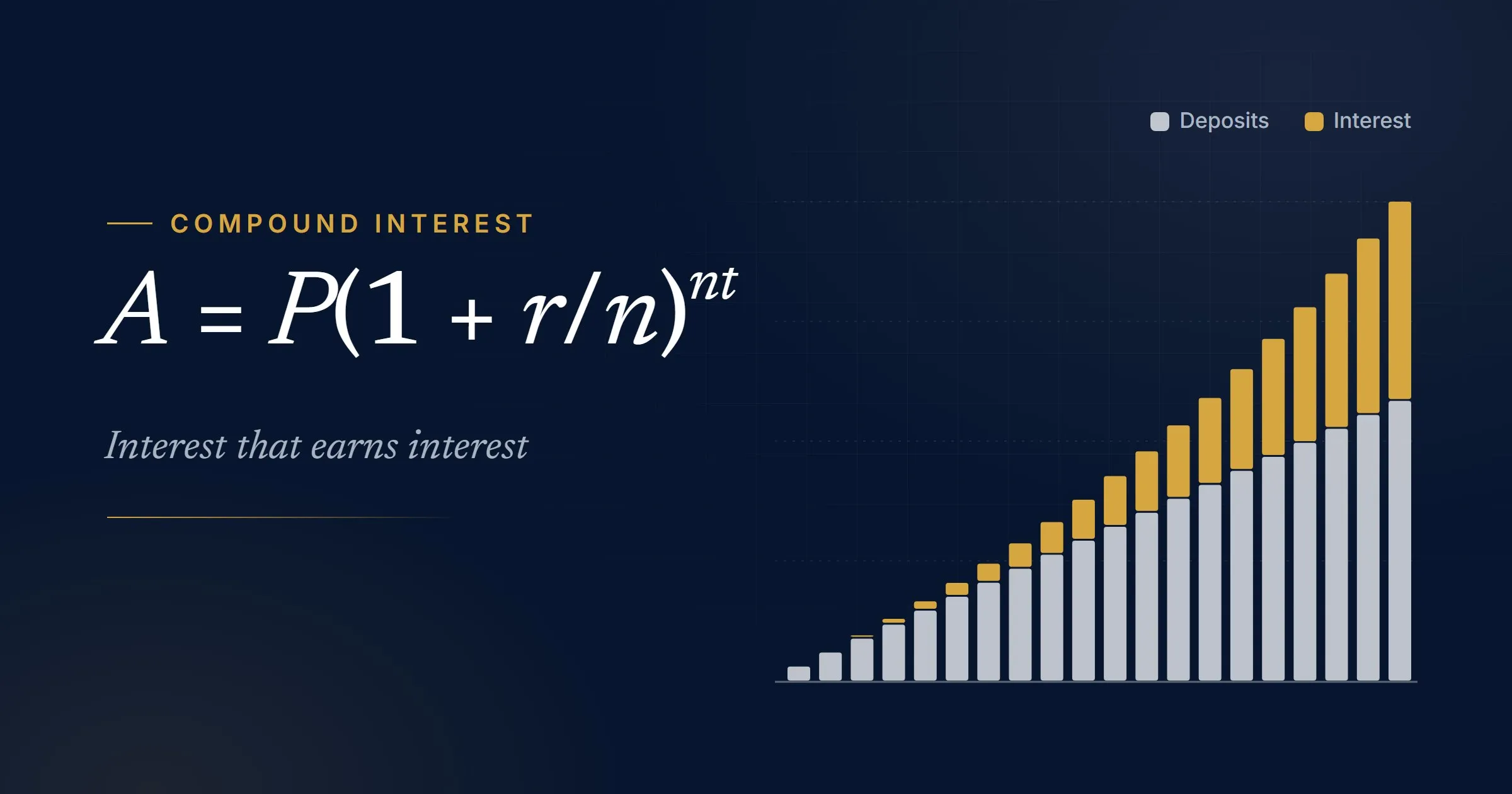
Compound Interest Explained: How It Works, With Examples
How compound interest works, step by step: the formula, worked examples, monthly deposits, the Rule of 72, and what it means for your savings and debt.
9 min read

Topic
The core ideas behind every money decision, explained with worked examples. Start here to understand interest, inflation and the vocabulary used in financial products.
A handful of concepts explain most of personal finance. Once you understand how interest compounds and how inflation changes what money can buy, product terms and offers become much easier to judge.
Each explainer in this section shows the formula, walks through an example step by step and connects the idea to a real decision.
Guides
Researched from primary sources, with the math shown. Newest first.
How compound interest works, step by step: the formula, worked examples, monthly deposits, the Rule of 72, and what it means for your savings and debt.
9 min read
Key ideas
Three ideas that frame everything else in this section.
With compounding, interest is added to your balance and then earns interest of its own. The longer the time and the higher the rate, the bigger the effect, whether you're saving or borrowing.
If prices rise 3% over a year, $100 buys about what $97 bought a year earlier. Comparing your savings rate with inflation shows whether your money is keeping pace.
Source: BLS Consumer Price Index
The Rule of 72 estimates how long money takes to double: divide 72 by the annual growth rate. At 6% a year, that is about 12 years.
Calculators
Run your own numbers. Each tool shows its formula and assumptions.
See how money can grow over time, year by year.
Project savings growth using an account's APY.
Official resources
Government and nonprofit resources we rely on when researching this section.
SEC (Investor.gov)
The SEC's free calculator for exploring how savings could grow with compounding.
CFPB
A short official explanation of compounding.
U.S. Bureau of Labor Statistics
The official U.S. measure of consumer inflation, published monthly.
MyMoney.gov
Federal financial-education resources for every stage of life.