
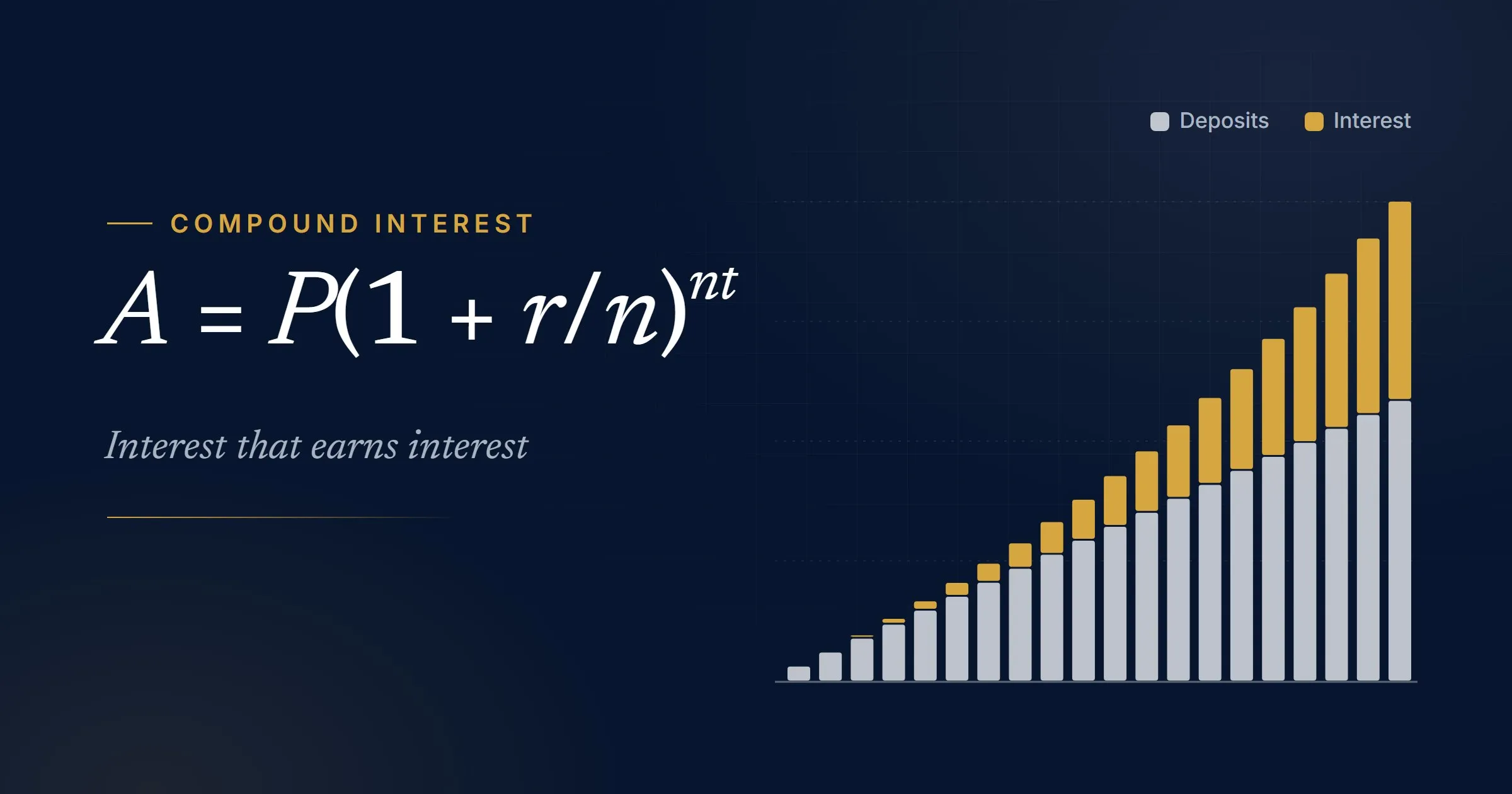
Compound interest is interest earned on both your original money and the interest it has already earned.Source 1 Each time interest is added to your balance, the next round of interest is figured on a slightly bigger number, so your money grows faster the longer you leave it alone.Source 2
That works in your favor in a savings account and against you on a credit card balance. This guide covers the formula, worked examples, regular deposits, how often interest compounds, the Rule of 72, and what slows growth down. Every example is calculated from the formulas shown, so you can check the math yourself.
How compound interest works
Here’s the example the Consumer Financial Protection Bureau (CFPB) uses to explain it.Source 2
Interest on interest
You start with $1,000 that earns 5% interest, compounded once a year.
- In year one, you earn $50 in interest, so your balance grows to $1,050.
- In year two, you earn 5% on $1,050, not just on your original $1,000. That’s $52.50, for a balance of $1,102.50.
The extra $2.50 in year two is interest earned on interest. It looks small, but it grows every year, because each year’s interest is figured on a bigger balance.
Over a few years, the effect is modest. Over decades, interest on interest can become most of your balance, as the next sections show.
Compound interest vs. simple interest
Simple interest is paid only on the original amount. Compound interest is paid on the original amount plus any interest already added. Here’s how $10,000 earning 5% a year grows under each method.
| After | Simple interest | Compound interest | Difference |
|---|---|---|---|
| 1 year | $10,500 | $10,500 | $0 |
| 5 years | $12,500 | $12,763 | $263 |
| 10 years | $15,000 | $16,289 | $1,289 |
| 20 years | $20,000 | $26,533 | $6,533 |
| 30 years | $25,000 | $43,219 | $18,219 |
Compound interest is added once a year. Figures are rounded to the nearest dollar.
After 30 years, compounding has earned $33,219 in interest, more than twice the $15,000 from simple interest. Notice that the gap is tiny at first and widens every year. That’s why time matters so much.
$10,000 at 5%: compound vs. simple interest
The compound interest formula
To work out compound interest for any amount, rate and length of time, use this formula:
A equals P times the quantity 1 plus r over n, raised to the power n times t.
- A is the amount you’ll have at the end
- P is the principal, the money you start with
- r is the annual interest rate as a decimal (5% is 0.05)
- n is how many times a year interest compounds (12 for monthly)
- t is the number of years
The interest you earn is the final amount minus what you started with, or A − P.
$10,000 at 5%, compounded monthly, for 10 years
- Divide the rate by the number of compounding periods a year: 0.05 ÷ 12 = 0.0041666…
- Count the periods: 12 × 10 = 120 months.
- Add 1 and raise it to that power: (1 + 0.05 ÷ 12)120 = 1.647009, rounded to six decimal places.
- Multiply by the principal: $10,000 × 1.647009 = $16,470.09.
That’s $6,470.09 in interest. Keep every digit your calculator shows until the last step. Rounding the monthly rate to 0.0042, for example, would overstate the result by about $66.
Compound interest with monthly contributions
Most people don’t deposit a lump sum and walk away. They add money regularly. For the same deposit made at the end of every period, use the future value of an annuity formula:
FV equals PMT times the quantity 1 plus r over n, raised to the power n times t, minus 1, all divided by r over n.
- FV is what your deposits grow to
- PMT is the amount you deposit each period
The letters r, n and t mean the same as in the first formula. The formula assumes one deposit per compounding period, such as monthly deposits with monthly compounding.
Here’s what $200 a month grows to at 5%, compounded monthly:
| After | You deposit | Interest earned | Balance | Share from interest |
|---|---|---|---|---|
| 10 years | $24,000 | $7,056 | $31,056 | 22.7% |
| 20 years | $48,000 | $34,207 | $82,207 | 41.6% |
| 30 years | $72,000 | $94,452 | $166,452 | 56.7% |
| 40 years | $96,000 | $209,204 | $305,204 | 68.5% |
Deposits are made at the end of each month. Figures are rounded to the nearest dollar.
The last column tells the story. The longer the money stays invested, the more of the balance comes from interest rather than from your deposits.
Why starting early matters
Saving for 40 years instead of 30 means depositing $24,000 more, but it leaves you with $138,752 more at the end. Compare that with chasing a better rate: earning 6% instead of 5% over the same 30 years adds $34,451. In this example, the extra time is worth about four times as much as the higher rate.
Adding a starting balance or yearly deposits
If you already have savings, run the first formula for that amount and add the two results. For example, $10,000 plus $200 a month at 5%, compounded monthly for 20 years, grows to about $27,126 + $82,207 = $109,333.
If you deposit once a year instead, use yearly values in the same formula, so n is 1. Putting $2,400 in at the end of each year for 20 years at 5%, compounded yearly, gives $79,358. That’s $2,849 less than depositing $200 a month, partly because each monthly deposit starts earning sooner and partly because the interest compounds more often.
How often interest compounds
Interest can compound yearly, quarterly, monthly, daily or even continuously. The more often it compounds, the faster your balance grows, but the differences are smaller than you might expect.
| Compounding | Balance after 10 years | Effective yearly rate (APY) |
|---|---|---|
| Yearly | $16,288.95 | 5.00% |
| Quarterly | $16,436.19 | 5.09% |
| Monthly | $16,470.09 | 5.12% |
| Daily | $16,486.65 | 5.13% |
| Continuous | $16,487.21 | 5.13% |
Daily compounding uses a 365-day year. Figures are rounded to the nearest cent.
Switching from yearly to monthly compounding adds $181.14 over 10 years. Going from monthly to daily adds only $16.56. A better rate matters far more: 6% instead of 5%, compounded monthly, adds $1,723.88.
Continuous compounding is the mathematical limit, where interest compounds every instant. Its formula is A = P × ert, where e is a constant of about 2.71828. In the table, it beats daily compounding by just 56 cents.
APY: the number to compare
The last column shows what banks call the annual percentage yield, or APY. Federal rules define APY as a percentage rate reflecting the total interest paid on an account, based on the interest rate and how often interest compounds over a 365-day period.Source 3 For an account that compounds n times a year, that works out to (1 + r/n)n − 1. At 5% compounded daily, the APY is 5.13%.
Banks must disclose an account’s APY, its interest rate, and how often interest is compounded and credited, generally before you open the account.Source 4 Credit unions have the same duty under the National Credit Union Administration’s rules, though they often call the interest dividends.Source 5 Because APY already includes compounding, it’s the fairer number for comparing savings accounts. Our Banking section covers savings accounts and APY.
The Rule of 72
To estimate how long it takes money to double, divide 72 by the annual interest rate. At 6%, that’s 72 ÷ 6 = 12 years. The exact answer, with interest compounded yearly, is 11.9 years.
| Annual rate | Rule of 72 estimate | Exact, compounded yearly |
|---|---|---|
| 2% | 36.0 years | 35.0 years |
| 4% | 18.0 years | 17.7 years |
| 5% | 14.4 years | 14.2 years |
| 6% | 12.0 years | 11.9 years |
| 8% | 9.0 years | 9.0 years |
| 10% | 7.2 years | 7.3 years |
| 12% | 6.0 years | 6.1 years |
Exact figures use ln 2 ÷ ln(1 + r), rounded to one decimal place.
For rates from 4% to 12%, the shortcut lands within about four months of the exact answer. It’s less accurate at low rates. At 2%, it’s off by about 12 months.
Compound interest on debt
Compounding works the same way when you owe money, only now it’s working against you. Many credit card companies calculate interest daily, based on your average daily balance.Source 6 The daily rate is generally your annual percentage rate (APR) divided by 360 or 365, and each day’s interest is added to your balance, so the interest compounds daily.Source 7
Card rates are high. In the third quarter of 2026, the average rate on bank credit card accounts that were charged interest was 22.36%, according to preliminary Federal Reserve data.Source 8
A $1,000 credit card balance at 22.36% APR
Divide 22.36% by 365 and the daily rate is about 0.0613%. Compounded daily for a full year, with no payments or new charges, a $1,000 balance would build up $250.49 in interest. That’s $26.89 more than the $223.60 the APR alone suggests, because the rate with daily compounding is 25.05% a year.
This is a simplified illustration. Your actual charges depend on your card’s terms, your payments, new purchases and fees.
If your card has a grace period, you can avoid interest on purchases by paying your full balance by the due date each month. Without one, the sooner you pay off all or part of your balance, the less interest you’ll pay.Source 6 Compounding is one more reason to pay off high-interest debt as early as you can. Our Debt section compares ways to choose which debt to pay off first.
What slows compounding down
The formulas assume a fixed rate and nothing taken out. In real life, several things reduce how much your money actually grows.
- Inflation. Rising prices reduce what your money can buy. If your savings earn 5% while prices rise 3% a year, your real growth is about 1.94% a year, not 2%. After 30 years at those rates, $10,000 grows to $43,219, but that would buy only about what $17,806 buys today.
- Taxes. Most interest credited to an account you can withdraw from without penalty is taxable in the year it becomes available to you, even if you leave it in the account.Source 9 You should receive a Form 1099-INT if you received $10 or more in interest, and you must report taxable interest even if you don’t get one.Source 9
- Fees. A fee that takes 1% of your balance each year works much like a rate one point lower. $10,000 growing at 4% instead of 5% for 30 years ends at $32,434 instead of $43,219, about 25% less.
- Changing rates and returns. Savings rates can change. Investments such as stock funds don’t earn a fixed rate at all: their returns vary from year to year and can be negative. Treat any long-term projection as an estimate, not a promise.
Compound interest in Excel and Google Sheets
Spreadsheets have a built-in future value function, FV, that does this math for you. Excel and Google Sheets take the same inputs in the same order.Source 10Source 11
- rate is the interest rate per period, such as
5%/12for 5% compounded monthly - nper is the total number of periods, such as
120for 10 years of monthly compounding - pmt is the amount you deposit each period, or
0if you don’t add money - pv is the amount you start with (optional)
- type is
1if you deposit at the start of each period, or0or blank for the end (optional)
Enter money you put in as a negative number, because spreadsheets treat deposits as cash you pay out.Source 10 The result then comes out positive.
| What you want to know | Formula | Result |
|---|---|---|
| $10,000 after 10 years at 5%, compounded monthly | =FV(5%/12,120,0,-10000) |
$16,470.09 |
| $200 a month for 20 years at 5% | =FV(5%/12,240,-200) |
$82,206.73 |
| $10,000 plus $200 a month for 20 years | =FV(5%/12,240,-200,-10000) |
$109,333.14 |
| $200 at the start of each month for 20 years | =FV(5%/12,240,-200,0,1) |
$82,549.26 |
Common questions
Is compound interest good or bad?
It depends on which side you’re on. When you save or invest, compounding helps your money grow. When you borrow, especially on a credit card, it makes an unpaid balance grow faster.
What’s the difference between APR and APY?
A credit card’s interest rate is usually stated as an annual percentage rate, or APR. The daily rate is generally the APR divided by 360 or 365, and interest then compounds daily, so the APR itself leaves out the effect of compounding.Source 7 APY, which you’ll see on savings accounts, includes the effect of compounding over a year.Source 3 That’s why a 22.36% APR compounded daily works out to 25.05% a year.
How often do savings accounts compound interest?
It varies by account. Your bank or credit union must tell you how often interest is compounded and how often it’s credited to your account.Source 4Source 5 Those can differ: interest might compound daily but show up in your account monthly. Either way, the APY reflects the compounding.
Does compound interest work with stocks?
Strictly speaking, stocks don’t pay interest. But investment returns can compound in a similar way when you reinvest dividends and gains, so your returns start earning returns of their own. Unlike savings account interest, though, stock returns can be negative.
Run your own numbers
See how money can grow over time, year by year.
Open the calculator
Sources
Numbers in the text link to these sources. We check them whenever we update this page.
- 1
Compound Interest(external site)
Investor.gov, U.S. Securities and Exchange Commission · Accessed November 16, 2026 · Back to text for source 1
- 2
How does compound interest work?(external site)
Consumer Financial Protection Bureau · Last reviewed October 19, 2023 · Accessed November 16, 2026 · Back to text for source 2
- 3
12 CFR 1030.2, Definitions (Regulation DD, Truth in Savings)(external site)
Electronic Code of Federal Regulations · Accessed November 16, 2026 · Back to text for source 3
- 4
12 CFR 1030.4, Account disclosures (Regulation DD, Truth in Savings)(external site)
Electronic Code of Federal Regulations · Accessed November 16, 2026 · Back to text for source 4
- 5
12 CFR 707.4, Account disclosures (NCUA Truth in Savings)(external site)
Electronic Code of Federal Regulations · Accessed November 16, 2026 · Back to text for source 5
- 6
How does my credit card company calculate the amount of interest I owe?(external site)
Consumer Financial Protection Bureau · Last reviewed January 22, 2024 · Accessed November 16, 2026 · Back to text for source 6
- 7
What is a “daily periodic rate” on a credit card?(external site)
Consumer Financial Protection Bureau · Last reviewed September 23, 2024 · Accessed November 16, 2026 · Back to text for source 7
- 8
Consumer Credit, G.19 statistical release(external site)
Board of Governors of the Federal Reserve System · Published November 6, 2026 · Accessed November 16, 2026 · Back to text for source 8
- 9
Topic no. 403, Interest received(external site)
Internal Revenue Service · Last reviewed October 7, 2026 · Accessed November 16, 2026 · Back to text for source 9
- 10
Microsoft Support · Accessed November 16, 2026 · Back to text for source 10
- 11
Google Docs Editors Help · Accessed November 16, 2026 · Back to text for source 11
About the author
Wealthistry Editorial Team
Research, writing and editing
The team that researches, writes, fact-checks and updates Wealthistry's guides and calculators, following our published editorial standards.
Author profileEditorial policyHow we researchReport an error