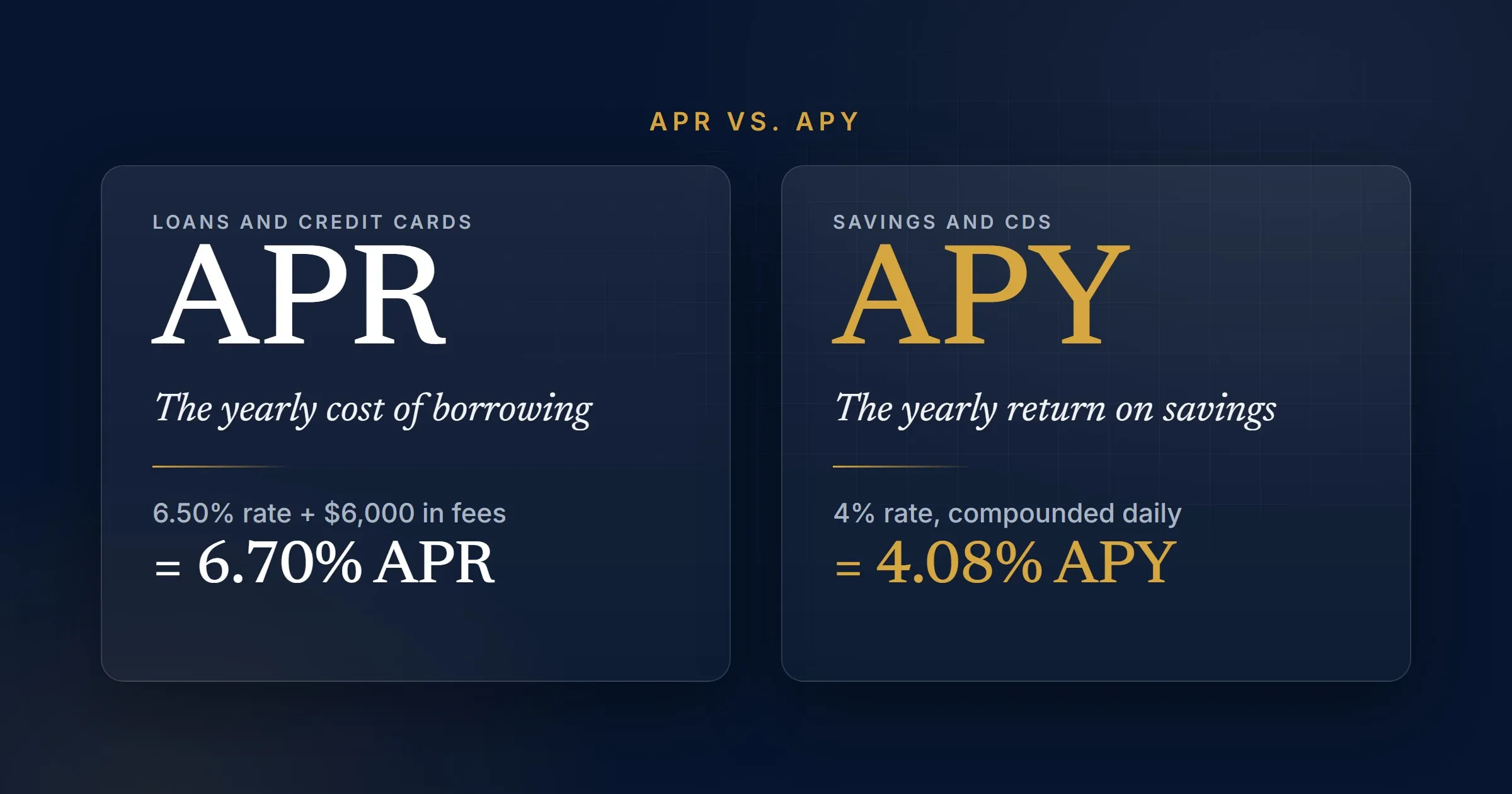
APR and APY both describe interest as a yearly percentage, but they answer different questions. The annual percentage rate, or APR, is a measure of the cost of credit, expressed as a yearly rate.Source 1 The annual percentage yield, or APY, reflects the total interest paid on a deposit account, based on the interest rate and how often interest compounds over a year.Source 2
In short: APR is what you pay to borrow, and APY is what you earn on savings. This guide explains how each one is calculated, why they can differ from the plain interest rate, and which one to compare when you’re choosing an account or a loan. Every example is worked out from the formulas shown.
APR vs. APY at a glance
| Feature | APR | APY |
|---|---|---|
| Used for | Loans and credit cards | Savings accounts, CDs and other deposit accounts |
| Measures | The yearly cost of borrowing | The yearly return on a deposit |
| Compounding | Not included | Included |
| Fees | A loan's APR includes certain fees | Only interest counts; bonuses are left out |
| Required by | Truth in Lending (Regulation Z) | Truth in Savings (Regulation DD) |
| Better when | Lower | Higher |
What APR means
APR is the rate lenders must disclose so you can compare the cost of credit. How it’s worked out depends on the kind of credit.
On a credit card
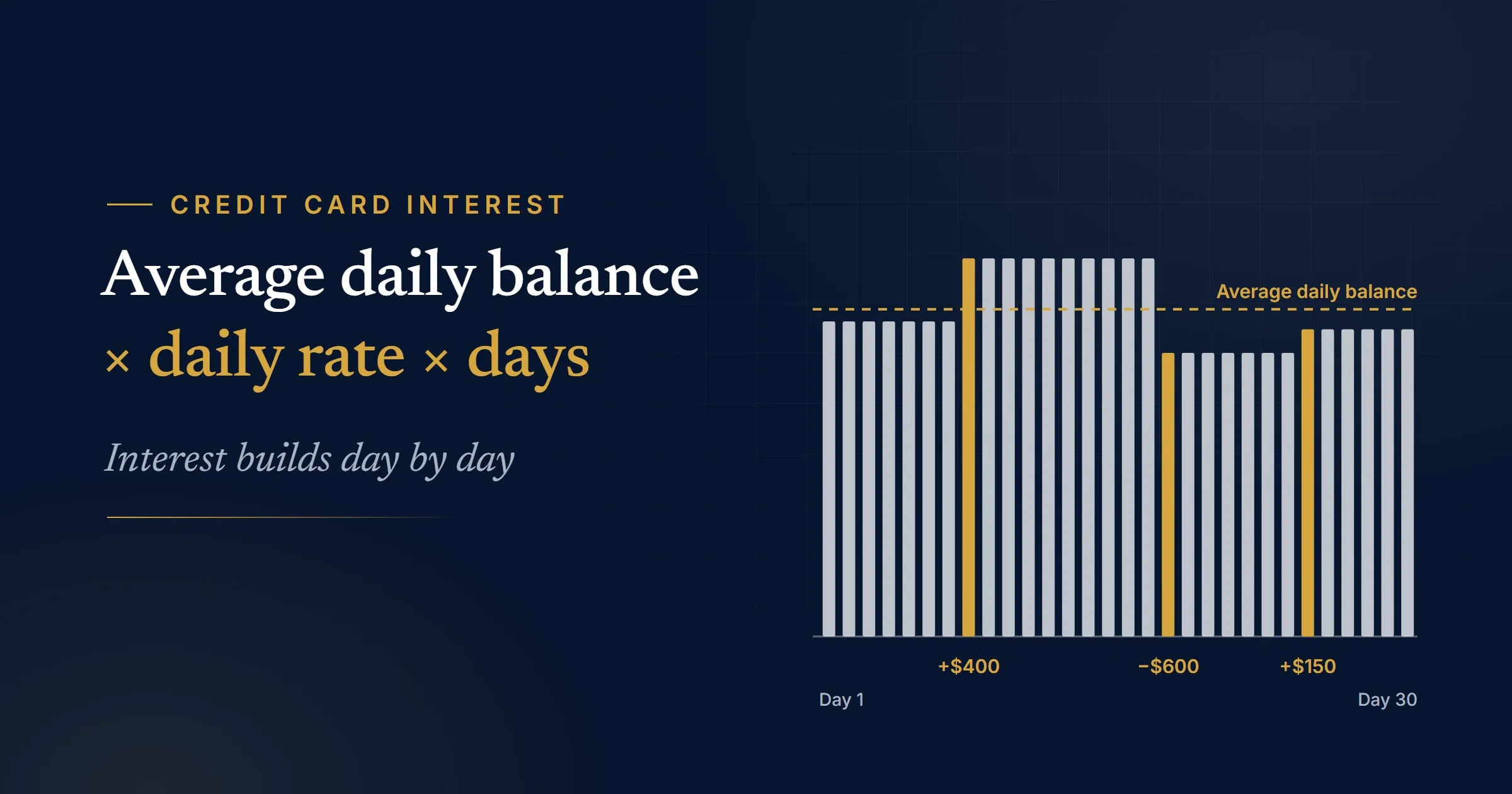
A card’s APR is its periodic rate multiplied by the number of periods in a year.Source 1 Many cards use a daily periodic rate, generally the APR divided by 360 or 365, and add each day’s interest to the balance, so the interest compounds daily.Source 3 The APR leaves that compounding out.
At 22.36%, the Federal Reserve’s average APR on card accounts charged interest in the third quarter of 2026,Source 4 the daily rate is 0.06126%. Compounded daily, that works out to 25.05% a year, the rate a card would show if it were quoted like an APY. Our guide to how credit card interest works shows the daily calculation step by step.
On a loan
For a loan, the APR is the interest rate plus additional fees charged by the lender, including origination charges and other fees charged when the loan is made.Source 5 On a mortgage, it reflects the interest rate, any points, mortgage broker fees and other charges you pay to get the loan, so it’s usually higher than the interest rate.Source 6 Technically, it relates the amount and timing of the money you receive to the amount and timing of the payments you make.Source 7
| Loan | Interest rate | Fees | APR |
|---|---|---|---|
| $300,000 mortgage, 30 years | 6.50% | $6,000 | 6.70% |
| $10,000 personal loan, 3 years | 12.00% | $500 | 15.60% |
Monthly payments are based on the full loan amount; the fees are paid at the start.
Why the APR is higher than the interest rate
- The mortgage. At 6.50% for 30 years, the payment on $300,000 is $1,896.20 a month. But $6,000 of points and fees means you effectively receive $294,000. The rate at which those same payments repay $294,000 is the APR: about 6.70%.
- The personal loan. At 12% for 3 years, the payment on $10,000 is $332.14. A $500 fee leaves you $9,500, which makes the APR about 15.60%. The fee is a smaller dollar amount, but it’s spread over only three years, so it raises the APR far more.
On a mortgage Loan Estimate, the interest rate is on page 1 under “Loan Terms,” and the APR is on page 3 under “Comparisons.”Source 6 Because all lenders must disclose the APR, you can use it to compare loans, as long as you compare APRs with APRs and not with interest rates.Source 5
What APY means
APY measures the total interest paid on an account based on the interest rate and the frequency of compounding, as a yearly rate based on a 365-day year. It reflects only interest, so a bonus for opening the account isn’t included.Source 8 Federal rules spell out the formula:
APY equals 100 times the quantity: 1 plus I divided by P, raised to the power of 365 divided by d, minus 1.
- I is the total interest earned on the principal over the term
- P is the principal, the amount deposited at the start
- d is the number of days in the term; for a savings account with no maturity date, it’s 365
The formula assumes all the principal and interest stay on deposit for the whole term, with no other deposits or withdrawals.Source 8
The APY on $10,000 at 4%, compounded daily
Over 365 days, $10,000 earning a 4% interest rate compounded daily earns $408.08. So the APY is 100 × [(1 + $408.08 ÷ $10,000)365 ÷ 365 − 1] = 4.08%.
The more often interest compounds, the higher the APY for the same interest rate:
| Compounded | APY | Interest in a year |
|---|---|---|
| Daily | 4.08% | $408.08 |
| Monthly | 4.07% | $407.42 |
| Quarterly | 4.06% | $406.04 |
| Once a year | 4.00% | $400.00 |
Interest earned over one year, with the interest left in the account.
Banks must disclose an account’s APY and its interest rate, using those terms.Source 9 Credit unions do the same under the National Credit Union Administration’s rules, where the interest rate is called the dividend rate.Source 10
Converting between APR and APY
When interest compounds a set number of times a year, you can convert a rate to an APY and back:
APY equals 1 plus r divided by n, raised to the power n, minus 1.
- r is the yearly interest rate (or a credit card’s APR), as a decimal
- n is the number of times interest compounds a year: 365 for daily, 12 for monthly
r equals n times the quantity: 1 plus APY, raised to the power 1 divided by n, minus 1.
- APY is the annual percentage yield, as a decimal
- n is the number of times interest compounds a year
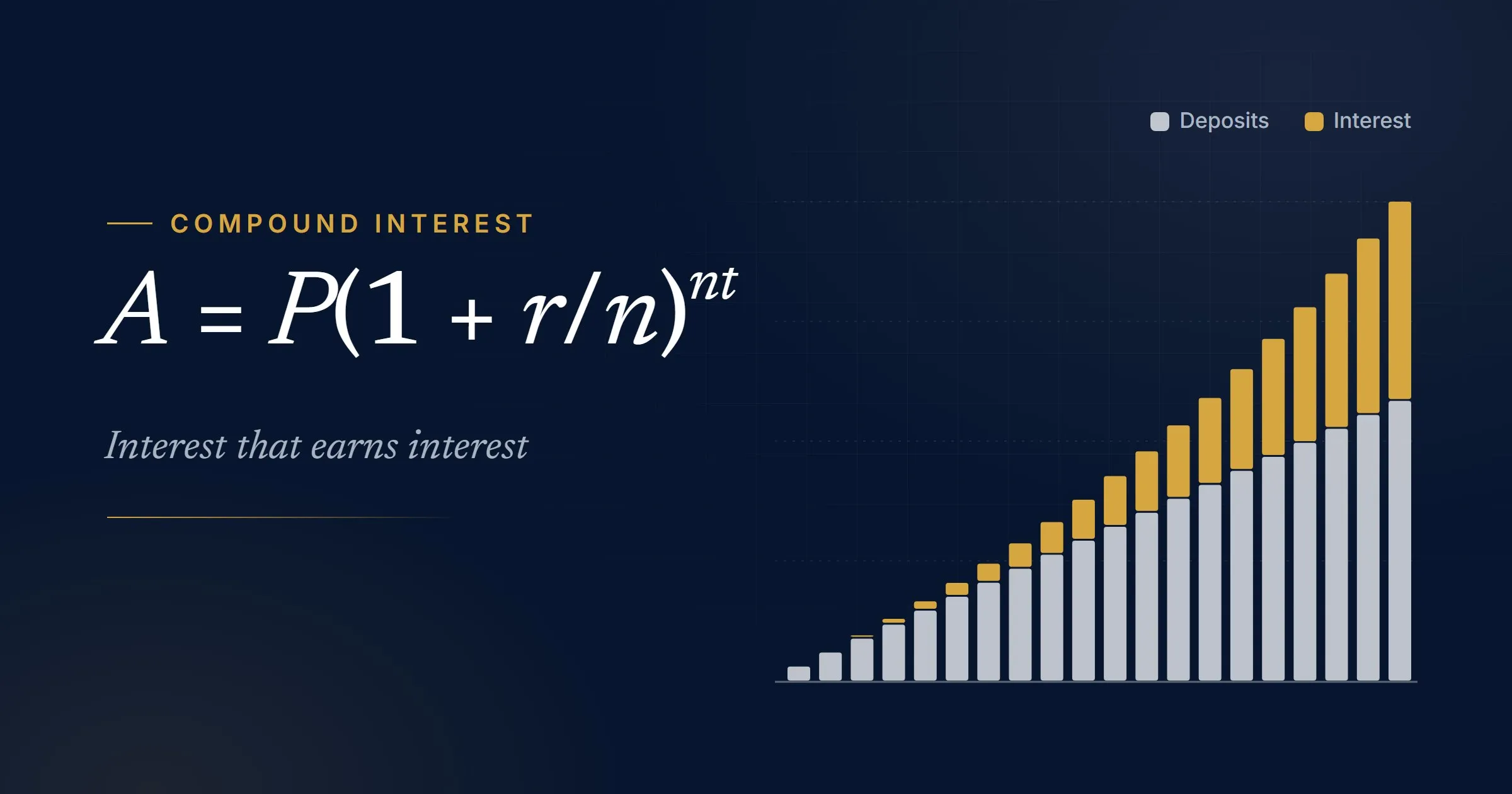
For example, a 4.50% APY with monthly compounding comes from an interest rate of 4.41%, or 0.3675% a month. And a 4% rate compounded daily is a 4.08% APY. Our compound interest guide covers compounding in more depth.
Which one should you compare?
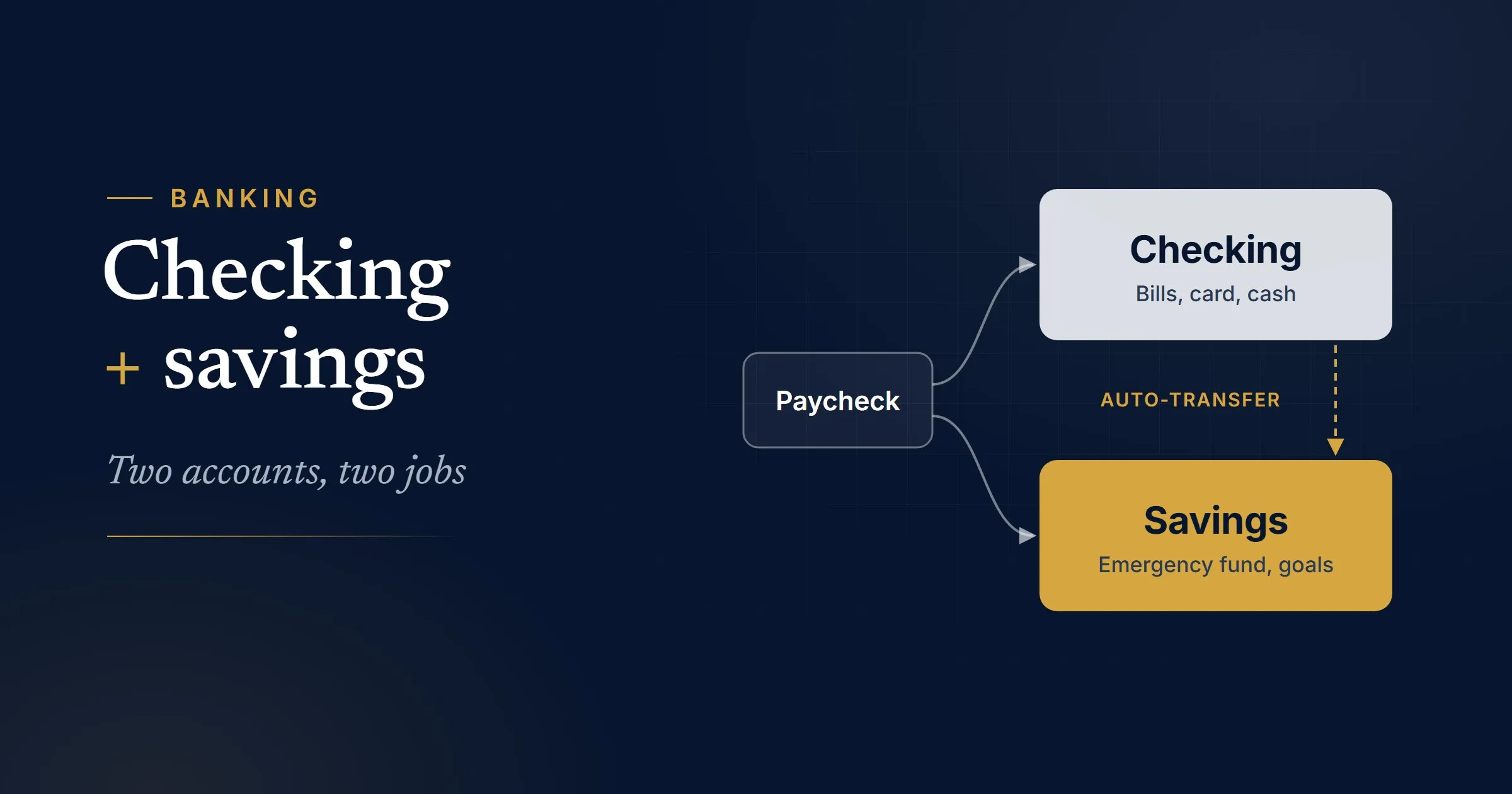
- Savings accounts and CDs: compare APY. Higher is better. Because APY already includes compounding, it’s the fairer way to compare accounts that compound at different frequencies. Our checking vs. savings guide covers what else to look for.
- Loans: compare APR. Lower is better, and it captures fees that the interest rate leaves out. Compare APRs with APRs, not with interest rates.Source 5
- Credit cards: look at the APR, and avoid paying it. If you pay your full statement balance by the due date each month, a card with a grace period won’t charge interest on purchases at all, as our credit card interest guide explains.
A note on CDs
A CD’s APY assumes the interest stays in the CD for the whole term.Source 8 If you have the interest paid out to another account instead, it can’t compound, so you’ll earn less than the APY suggests.
Common questions
Is APR or APY better?
Neither: they measure different things. When you borrow, you want a lower APR. When you save, you want a higher APY.
Why is APY higher than the interest rate?
Because of compounding. Interest earned during the year starts earning interest itself, and APY includes that.Source 2 If interest compounds only once a year, the APY and the interest rate are the same.
Why is a loan’s APR higher than its interest rate?
Because the APR also counts certain fees, such as points and origination charges, that you pay to get the loan.Source 6
Is APY the same as the interest rate?
Only when interest compounds once a year. In the table above, a 4% rate compounded daily is a 4.08% APY, while compounding once a year gives exactly 4%.
What’s the difference between APY and EAR?
EAR, the effective annual rate, is the yearly rate once compounding is included, which is the same idea as APY. You’ll usually see “APY” on savings accounts and “EAR” in finance textbooks.
Can I convert APY to APR?
Yes, if you know how often interest compounds. Use the second formula above: for monthly compounding, a 4.50% APY corresponds to a 4.41% yearly rate.
Run your own numbers
Project savings growth using an account's APY.
Open the calculator
Sources
Numbers in the text link to these sources. We check them whenever we update this page.
- 1
Electronic Code of Federal Regulations · Accessed November 18, 2026 · Back to text for source 1
- 2
12 CFR 1030.2, Definitions (Regulation DD, Truth in Savings)(external site)
Electronic Code of Federal Regulations · Accessed November 18, 2026 · Back to text for source 2
- 3
What is a “daily periodic rate” on a credit card?(external site)
Consumer Financial Protection Bureau · Last reviewed September 23, 2024 · Accessed November 18, 2026 · Back to text for source 3
- 4
Consumer Credit - G.19(external site)
Board of Governors of the Federal Reserve System · Published November 6, 2026 · Accessed November 18, 2026 · Back to text for source 4
- 5
What is the difference between a loan interest rate and the APR?(external site)
Consumer Financial Protection Bureau · Last reviewed August 28, 2026 · Accessed November 18, 2026 · Back to text for source 5
- 6
What is the difference between a mortgage interest rate and an APR?(external site)
Consumer Financial Protection Bureau · Last reviewed August 28, 2026 · Accessed November 18, 2026 · Back to text for source 6
- 7
Electronic Code of Federal Regulations · Accessed November 18, 2026 · Back to text for source 7
- 8
Appendix A to Part 1030, Annual Percentage Yield Calculation (Regulation DD)(external site)
Consumer Financial Protection Bureau · Accessed November 18, 2026 · Back to text for source 8
- 9
12 CFR 1030.4, Account disclosures (Regulation DD, Truth in Savings)(external site)
Electronic Code of Federal Regulations · Accessed November 18, 2026 · Back to text for source 9
- 10
12 CFR 707.4, Account disclosures (NCUA Truth in Savings)(external site)
Electronic Code of Federal Regulations · Accessed November 18, 2026 · Back to text for source 10
About the author
Wealthistry Editorial Team
Research, writing and editing
The team that researches, writes, fact-checks and updates Wealthistry's guides and calculators, following our published editorial standards.
Author profileEditorial policyHow we researchReport an error