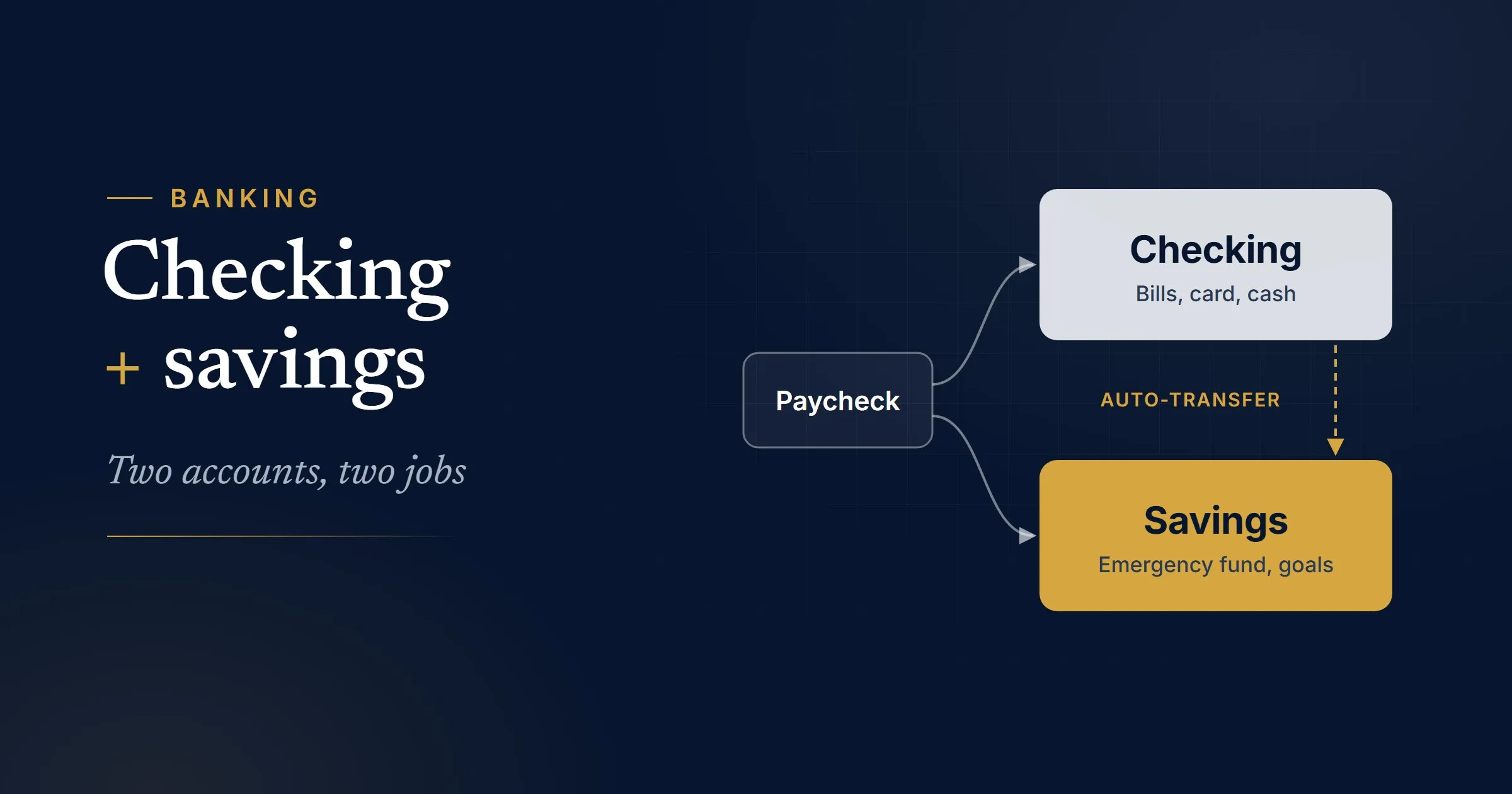
Checking and savings accounts do different jobs. A checking account is for the money you spend: you can pay with a debit card or check, get cash from an ATM and pay bills online.Source 1 A savings account is for money you’re setting aside for emergencies or goals, kept separate from the money you spend every month.Source 1
Most people are best off with both. This guide compares them side by side, explains a federal rule that changed in 2020, and shows how to set the two up so they work together.
Checking vs. savings at a glance
| Checking | Savings | |
|---|---|---|
| Main job | Bills and everyday spending | Money you’re setting aside |
| How you use it | Debit card, checks, ATMs, online bill pay | Mostly transfers to and from checking |
| Interest | Often none; a little on interest checking | Usually some, and rates vary widely by bank |
| Average rate | 0.07% for interest checking | 0.39% |
| Withdrawals | No limit | No federal limit since 2020, but your bank may set one |
| Common fees | Monthly service, overdraft, other banks’ ATMs | Monthly service, extra withdrawals |
| Insurance | Up to $250,000 at an insured bank or credit union | The same, counted together with checking in the same name |
Average rates are the FDIC’s national averages for November 2026.Source 2 The sections below explain each difference.
What a checking account is for
Use checking for money that moves often. A checking account lets you pay with a debit card or check instead of cash, get cash from an ATM, pay bills online, and pay people through a payment app.Source 1 It’s also where your paycheck usually lands by direct deposit.
Fees are the main thing to watch. Some banks and credit unions offer free checking as long as you stay above a minimum balance, and using your own bank’s or credit union’s ATMs avoids fees from other ATMs.Source 1
How to avoid overdraft fees
An overdraft happens when you don’t have enough money in your account to cover a transaction and your bank or credit union pays it anyway. You then have to repay the shortfall plus overdraft fees.Source 3 Fees vary, but many banks and credit unions charge $30 or more per transaction, and they can charge for each overdraft, so you could pay several in one day.Source 3 At $30 each, three small card purchases on an overdrawn account would cost $90 in fees.
You have options that cost less:Source 3
- Opt out of debit card and ATM overdraft coverage. Without it, a purchase or ATM withdrawal you can’t cover is generally declined, but you won’t pay an overdraft fee. Banks and credit unions can’t charge you for overdrafts on ATM transactions unless you’ve opted in.
- Link your savings account. If you overdraw checking, money moves from your linked savings to cover the difference. You may pay a transfer fee, but it’s less than an overdraft fee.
- Ask about a line of credit. You’d pay interest and possibly a fee when you use it, but it can still be a cheaper way to cover a short gap.
Low-balance alerts by email or text help too, and so does knowing when scheduled payments such as rent will come out and when your deposits will be available to use.Source 3
What a savings account is for
Use savings for money you don’t plan to spend this month: your emergency fund, money set aside for bills that don’t come every month, and goals such as a car or a trip. A savings account keeps that money separate from the money you spend every month.Source 1
Interest and APY
Savings accounts usually pay more interest than checking, but national averages are low. In November 2026, the FDIC’s national average rate was 0.39% for savings, 0.07% for interest checking and 0.64% for money market accounts.Source 2 Here’s what that means for $5,000 left in each for a year:
| Account | APY | A year's interest |
|---|---|---|
| Interest checking | 0.07% | $3.50 |
| Savings | 0.39% | $19.50 |
| Money market | 0.64% | $32.00 |
| 4% APY example | 4.00% | $200.00 |
National average rates from the FDIC for November 2026. The 4% APY is an example, not a rate any particular bank offers.
At the national average, $5,000 in savings earns $19.50 in a year, compared with $3.50 in interest checking. An account paying a 4% APY would earn $200.00. Rates vary widely from bank to bank, so compare the APY, which already includes compounding. Banks must disclose an account’s APY, interest rate and fees, generally before you open it.Source 4 Our Savings Calculator shows how a balance would grow at any APY, and our APR vs. APY guide explains how APY differs from an interest rate.
The six-withdrawal limit: what changed in 2020
For years, a federal rule, Regulation D, limited certain convenient transfers and withdrawals from savings accounts to six a month. In April 2020, the Federal Reserve removed that limit from the rule, so banks and credit unions can now let customers make unlimited convenient transfers and withdrawals from savings.Source 5
The change allows banks to drop the limit but doesn’t require them to, and the rule neither requires nor prohibits fees for going over it.Source 6 So your bank may still cap withdrawals from savings or charge for extra ones. Check your account agreement before you rely on savings for frequent payments.
How to use checking and savings together
- Have your pay deposited into checking. If your employer allows it, split your direct deposit so part of each paycheck goes straight to savings.Source 7
- Keep a cushion in checking. Hold enough for the month’s bills plus a buffer. Deposits, withdrawals and other transactions don’t always update your balance right away, or in the order you expect.Source 3
- Move savings automatically. A recurring transfer from checking to savings on payday is one of the easiest ways to save consistently.Source 7
- Link savings for overdraft protection. A small transfer fee costs less than an overdraft fee.Source 3
- Use more than one savings account if it helps. One account for your emergency fund and another for irregular bills keeps each goal clear. Our budgeting guide shows how to turn irregular bills into a monthly amount, and our emergency fund guide covers how much to keep.
Is your money safe in checking and savings?
Yes, at an insured bank or credit union. FDIC deposit insurance covers checking accounts, savings accounts, money market deposit accounts and certificates of deposit (CDs) at FDIC-insured banks. It doesn’t cover non-deposit investment products such as stocks, bonds, mutual funds or crypto assets, even when an FDIC-insured bank offers them.Source 8 Since the FDIC was founded in 1933, no depositor has lost a penny of FDIC-insured funds.Source 8
The FDIC insures deposits up to at least $250,000 per depositor, per ownership category, at each insured bank, and accounts in the same category count together: a checking account and a savings account in your name alone at one bank share one limit.Source 8
Checking and savings at the same bank
You have $30,000 in checking and $230,000 in savings at one FDIC-insured bank, both in your name alone. Together that’s $260,000, which is $10,000 over the $250,000 limit for that ownership category.
At a federally insured credit union, the NCUA insures individual accounts up to $250,000.Source 9 To check that a bank is FDIC-insured, use the FDIC’s BankFind Suite search tool.Source 8 Our FDIC insurance guide explains the limits for joint, retirement and trust accounts, with examples.
Money market accounts and CDs
Two other kinds of deposit accounts sit alongside checking and savings, and both are covered by deposit insurance:Source 8
- Money market deposit accounts had a national average rate of 0.64% in November 2026.Source 2 Don’t confuse them with money market mutual funds, which are investments: deposit insurance doesn’t cover mutual funds.Source 8
- Certificates of deposit hold your money until a maturity date. The national average for a 12-month CD was 1.81% in November 2026.Source 2 Before you open one, check the early withdrawal terms: the account disclosures must say whether a penalty will or may be charged if you take money out early, how it’s calculated and when it applies.Source 4
Common questions
Do I need both a checking and a savings account?
Most people do. Checking handles your bills and spending; savings keeps money you’re setting aside out of the way. If you keep everything in checking, your emergency fund is easy to spend by accident.
How much should I keep in checking?
Enough to cover the month’s bills and spending, plus a cushion so a late deposit or an early payment doesn’t overdraw your account. Keep the rest in savings, where it can earn more interest.
Can I have more than one savings account?
Yes. Many people keep separate savings for separate goals, such as an emergency fund and a car fund, so each balance shows exactly how much is set aside.
Is a savings account better than a checking account?
Neither is better; they do different jobs. Savings usually earns more interest, but checking is built for paying bills and spending. The best setup uses both.
Do savings accounts still limit withdrawals?
Not under federal rules since 2020, but your bank or credit union may still set its own limit or charge a fee for extra withdrawals.Source 6 Check your account agreement.
Run your own numbers
Project savings growth using an account's APY.
Open the calculator
Sources
Numbers in the text link to these sources. We check them whenever we update this page.
- 1
Opening a Bank Account(external site)
Federal Trade Commission, consumer.gov · Accessed November 18, 2026 · Back to text for source 1
- 2
National Rates and Rate Caps – November 2026(external site)
Federal Deposit Insurance Corporation · Updated November 16, 2026 · Accessed November 18, 2026 · Back to text for source 2
- 3
Know your overdraft options(external site)
Consumer Financial Protection Bureau · Updated June 4, 2025 · Accessed November 18, 2026 · Back to text for source 3
- 4
12 CFR 1030.4, Account disclosures (Regulation DD, Truth in Savings)(external site)
Electronic Code of Federal Regulations · Accessed November 18, 2026 · Back to text for source 4
- 5
Board of Governors of the Federal Reserve System · Published April 24, 2020 · Accessed November 18, 2026 · Back to text for source 5
- 6
Regulation D: Reserve Requirements of Depository Institutions (interim final rule)(external site)
Board of Governors of the Federal Reserve System · Published April 24, 2020 · Accessed November 18, 2026 · Back to text for source 6
- 7
An essential guide to building an emergency fund(external site)
Consumer Financial Protection Bureau · Updated October 29, 2025 · Accessed November 18, 2026 · Back to text for source 7
- 8
Understanding Deposit Insurance(external site)
Federal Deposit Insurance Corporation · Updated April 1, 2024 · Accessed November 18, 2026 · Back to text for source 8
- 9
Share Insurance Coverage(external site)
National Credit Union Administration · Updated November 18, 2026 · Accessed November 18, 2026 · Back to text for source 9
About the author
Wealthistry Editorial Team
Research, writing and editing
The team that researches, writes, fact-checks and updates Wealthistry's guides and calculators, following our published editorial standards.
Author profileEditorial policyHow we researchReport an error