A budget is a plan you write down to decide how you’ll spend your money each month.Source 1 It shows how much you make and where it goes, so you can make sure you’ll have enough every month and still save for goals and emergencies.Source 1
This guide walks through six steps, following one example household from start to finish, with every number worked out. You can follow along in our Monthly Budget Calculator, which does the adding up for you.
Step 1: Gather your pay stubs, bills and statements
Start by gathering your bills and pay stubs.Source 1 Add your last two or three months of bank and credit card statements. They show what you actually spend, including the small purchases that are easy to forget.
If going through months of statements feels like too much, start small: look at one week of spending at a time, using your receipts or your checking account.Source 2 Small daily purchases, like buying breakfast or lunch instead of bringing it, add up over time.Source 2
Step 2: Work out your monthly income
Count every source of money you rely on: your job, a second job or self-employment, child support and government benefits.Source 2 Use take-home pay, not your salary. Your employer deducts taxes before you’re paid, and often money for benefits such as health insurance or a retirement account.Source 3
If you’re paid weekly or every two weeks, turn your pay into a monthly figure:
Monthly pay equals pay per paycheck times paychecks a year, divided by 12.
- 52 paychecks a year if you’re paid every week
- 26 if you’re paid every two weeks
- 24 if you’re paid twice a month
Our example household's income
You take home $1,920 every two weeks and earn about $300 a month from weekend work.
- Your paychecks come to $1,920 × 26 ÷ 12 = $4,160 a month.
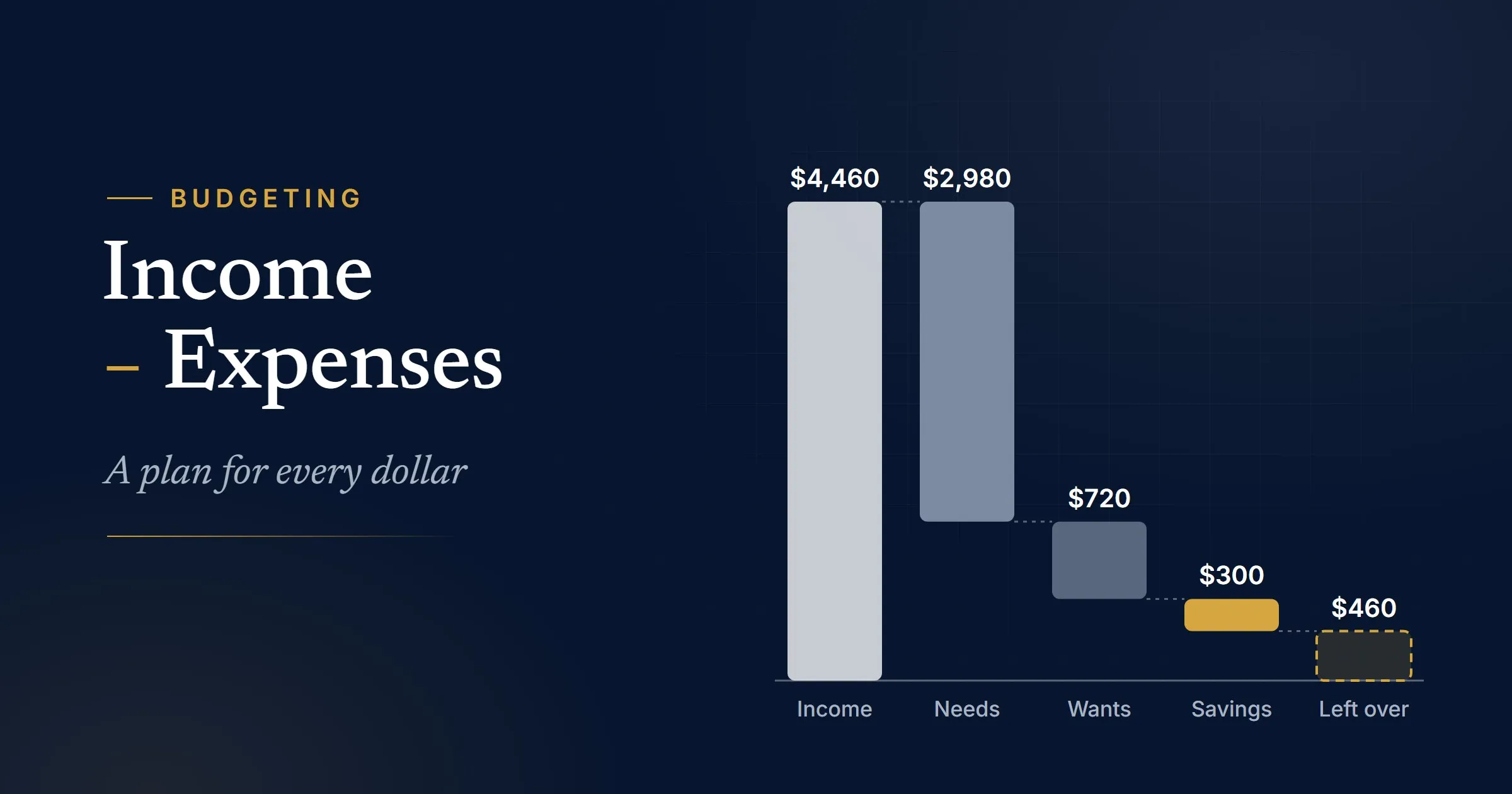
- Add the weekend work: $4,160 + $300 = $4,460 a month.
If your income changes from month to month, add up what you earned last year and divide by 12 for an estimate.Source 1 If you’d rather be cautious, plan around one of your slower months instead; our guide to budgeting on an irregular income shows how. Our guide to the 50/30/20 rule explains what to do when retirement savings or health insurance comes out of your paycheck, and our guide to budgeting by paycheck shows how to plan around paydays that don’t line up with your bills.
Step 3: List every expense
Write down everything you spend money on, using your statements from step 1. It helps to think in three kinds of costs:
- Fixed costs are the same every month, such as rent, a car payment, insurance and the minimum payments on your debts.
- Variable costs change from month to month, such as groceries, gas, utilities, dining out and shopping.
- Irregular costs don’t come every month, such as car registration, insurance you pay every six months, yearly subscriptions and holiday gifts.
Our list of budget categories shows what usually goes in each one.
Irregular costs are the ones that break budgets. A month that looks fine on paper falls apart when the car registration arrives. The fix is to turn each one into a monthly amount and set it aside.
Turning an irregular bill into a monthly amount
Car insurance costs $720 every six months, which is $720 × 2 = $1,440 a year. Divide by 12: $1,440 ÷ 12 = $120 a month.
Here’s the same math for all of the example household’s irregular bills:
| Bill | Per year | Per month |
|---|---|---|
| Car insurance | $1,440 | $120 |
| Car registration | $180 | $15 |
| Car maintenance | $480 | $40 |
| Subscriptions | $96 | $8 |
| Gifts and holidays | $600 | $50 |
| Total | $2,796 | $233 |
Each bill's yearly cost divided by 12. Car registration is due once a year; maintenance, subscriptions and gifts are yearly totals.
Together, these bills cost $2,796 a year, or $233 a month. Moving that much into a separate savings account each month means the money is already there when each bill arrives. Money set aside this way is often called a sinking fund; our sinking funds guide shows how to set them up.
Then add each set-aside to the category it belongs in. Here’s the example household’s full list, with the irregular bills folded in: car insurance under insurance, registration and maintenance under transportation, subscriptions under entertainment, and gifts under travel and gifts.
| Category | Group | Monthly |
|---|---|---|
| Housing | Needs | $1,450 |
| Utilities and phone | Needs | $210 |
| Groceries | Needs | $480 |
| Transportation | Needs | $495 |
| Insurance | Needs | $135 |
| Health care | Needs | $60 |
| Minimum debt payments | Needs | $150 |
| Dining out | Wants | $250 |
| Entertainment | Wants | $90 |
| Shopping and personal | Wants | $220 |
| Travel and gifts | Wants | $100 |
| Other wants | Wants | $60 |
| Savings and investing | Savings and extra debt payments | $300 |
Transportation includes a $260 car payment and $180 for gas. Insurance includes $15 for renters insurance.
Step 4: Subtract your expenses from your income
Subtract your monthly bills and expenses from your monthly income. The result should be more than zero; if it’s less, you’re spending more than you make.Source 1
Income minus expenses
$4,460 − $4,000 = $460 left over each month.
A positive number is good news, but money without a plan tends to disappear. That’s the next step.
If your number is negative, don’t panic. Many people find that on their first try. See If your budget doesn’t balance below.
Step 5: Give every dollar a job
Decide what happens to the money that’s left, and choose a method that makes the plan easy to follow. Four common ones:
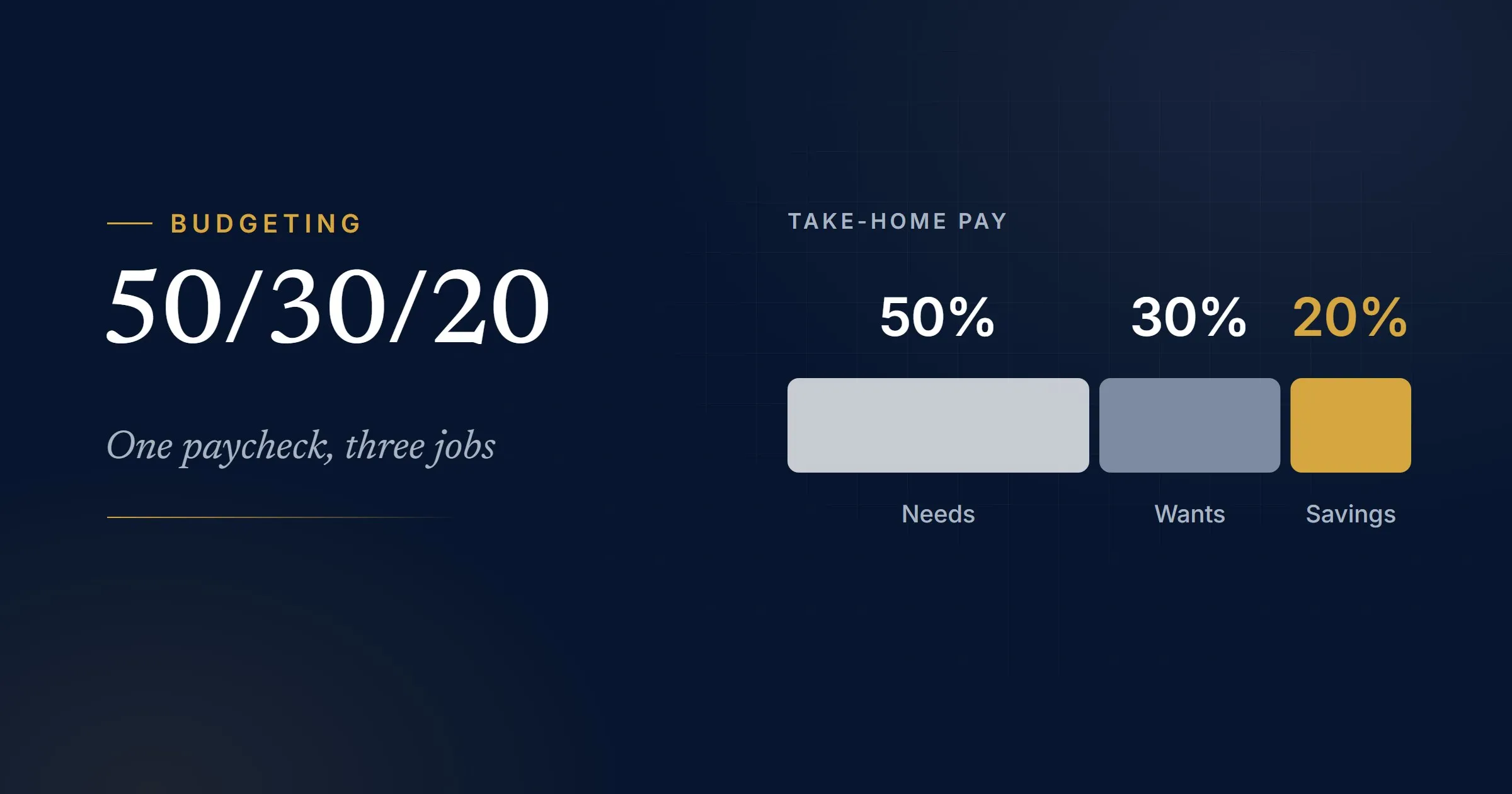
- 50/30/20. About half of your take-home pay for needs, 30% for wants and 20% for savings and extra debt payments. Good if you want a quick check without tracking every category. Our 50/30/20 guide covers it in detail.
- Zero-based budget. Assign every dollar of income to a category until nothing is left unassigned. Good if you want full control. Our zero-based budgeting guide walks through a full month.
- Envelope method. Set a fixed amount, in cash or a separate account, for categories where you tend to overspend, and stop when it runs out.
- Pay yourself first. Move your savings out on payday, before you spend anything. Good if saving is the part you struggle with.
You don’t have to pick just one. Here’s the example household using a zero-based approach for its leftover money, then checking the result against 50/30/20.
Giving the leftover money a job
- $260 more goes to savings, building an emergency fund, for $560 a month in all.
- $200 goes to an extra payment on the credit card, on top of the minimum.
- That leaves $0 unassigned: every dollar has a job.
Against the 50/30/20 rule of thumb, the budget now splits 67/16/17. Savings and debt are at 17%, close to the 20% target. Needs are high at 67%, mostly because of rent and the car, so those are the bills to revisit when the lease is up or the car is paid off.
Make the savings automatic. A recurring transfer from checking to savings is one of the easiest ways to save consistently, though it’s worth keeping an eye on your balance so the transfer doesn’t overdraw your account.Source 4
Step 6: Track your spending and adjust every month
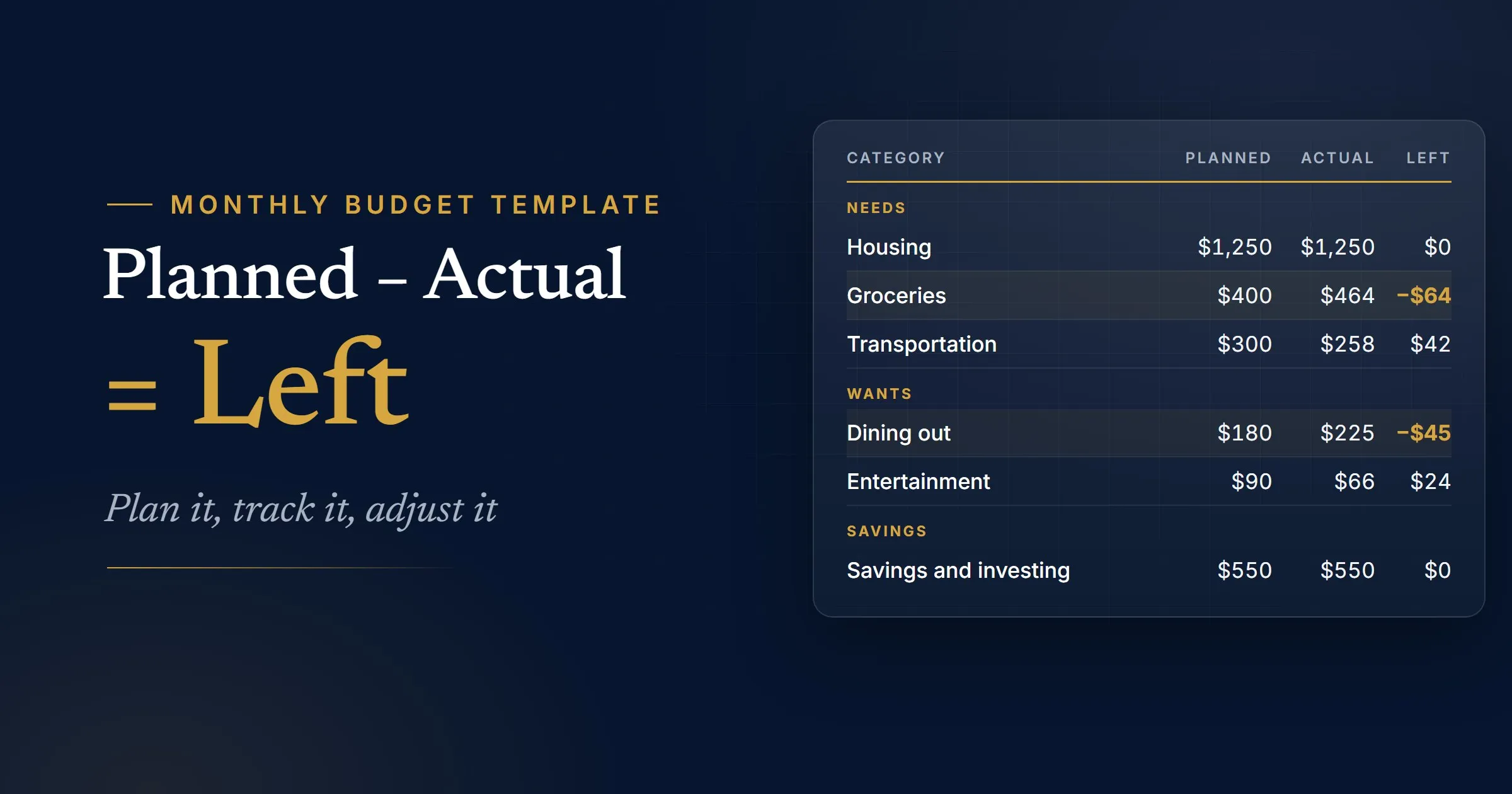
A budget is something you use every month. At the start of the month, plan your spending; during the month, write down what you spend; at the end, see whether you spent what you planned, and use that to plan the next month.Source 1
- Pick a tracking method you’ll actually use. Choose a way to track spending that’s easy for you, such as a daily journal or a folder of receipts you review at the end of each week.Source 2 Apps and spreadsheets work too. Our free budget template includes a spending tracker page, and the CFPB’s free Your Money, Your Goals toolkit includes fillable worksheets, such as a spending tracker, a bill calendar and a cash flow budget.Source 5
- Watch the timing, not just the totals. If you come up short at the end of the month, your bills and paychecks may not line up.Source 2 You may be able to ask your landlord, utility or card company to move a due date closer to payday.Source 4
- Update it when life changes. A new job or a change in your spending habits is a reason to redo the numbers.Source 2
- Set a goal. A specific target, like a first $1,000 in savings, makes the effort easier to keep up.Source 2
If your budget doesn’t balance
If your expenses are more than your income, look for things in your budget you can change.Source 1 Work through it in this order:
- Trim wants first. Dining out, shopping and subscriptions are the easiest costs to pause, often within the same month.
- Look at your biggest bills. Rent, the car and insurance are where the money usually is. Shopping around for insurance or refinancing a loan can save more than many small cuts.
- Raise your income if you can. Extra hours, side work or benefits you may qualify for all count. The CFPB toolkit has a worksheet for finding ways to increase income and benefits.Source 5
- Avoid covering the gap with a credit card. A balance you carry from month to month keeps adding interest, which makes next month’s budget even tighter. Our compound interest guide shows how fast card interest builds.
If you can’t cover everything this month, decide which bills come first, such as housing, utilities and food, and contact the companies you can’t pay in full before the due date to ask about your options. The CFPB toolkit includes a worksheet for prioritizing bills.Source 5
Common budgeting mistakes
- Budgeting with your salary. Taxes and deductions come out first, so plan with what actually reaches your account.
- Forgetting irregular bills. Annual and twice-a-year costs belong in every month’s budget, as set-asides.
- Guessing instead of checking. Small, frequent purchases are easy to forget. Your statements are more reliable than memory.
- Cutting too hard. A budget with no room for anything you enjoy rarely lasts. Leave some money for wants.
- Having no cushion. Without an emergency fund, one surprise bill can undo a month of planning. Our emergency fund guide shows how to build one in milestones.
Common questions
What’s the easiest way to start a budget?
Write down your monthly take-home pay, list your bills and other expenses, and subtract the expenses from your income.Source 1 Then decide where any money left over should go. The Monthly Budget Calculator does the math as you type.
How much should I budget for groceries?
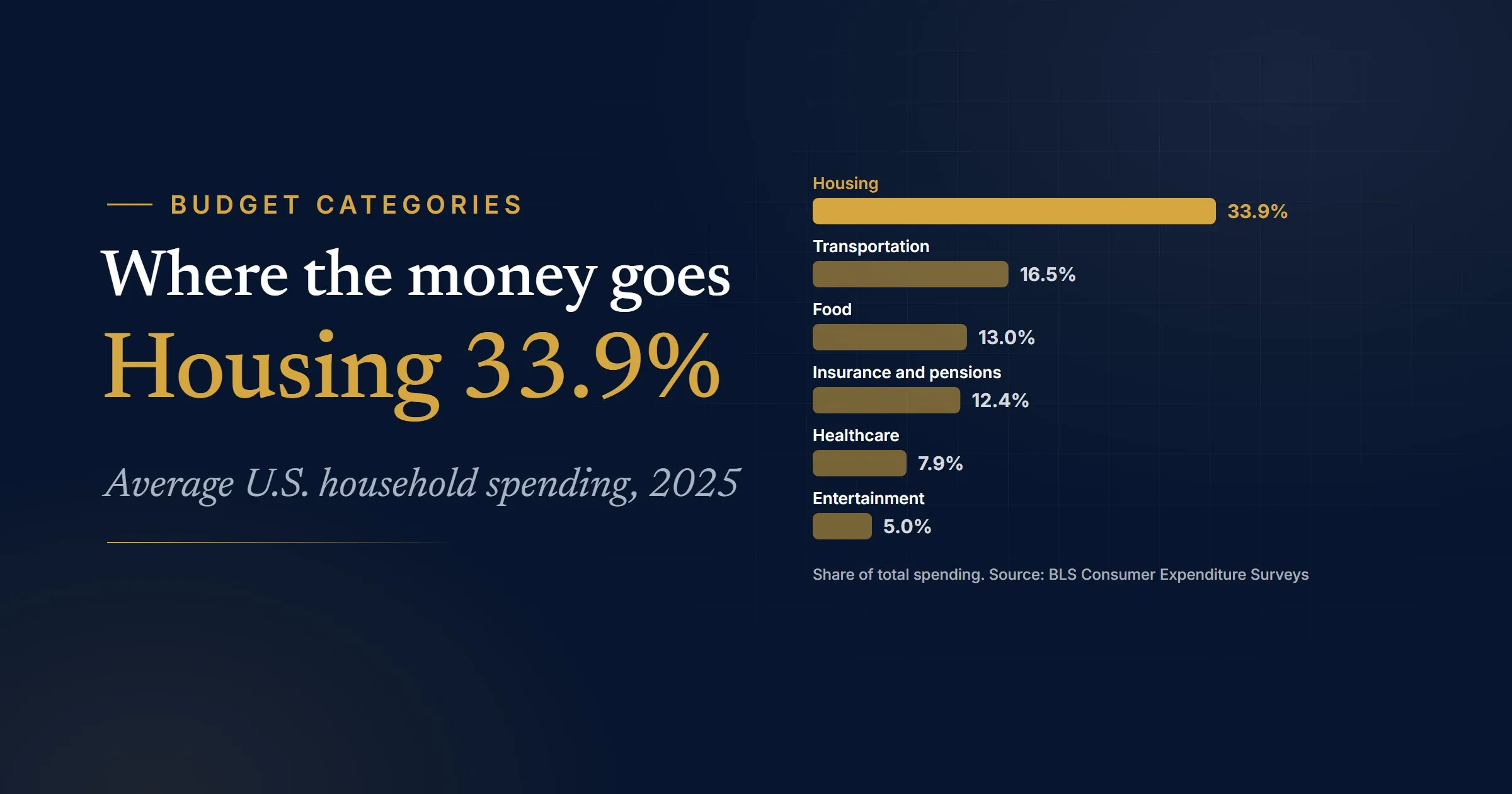
Start with what your statements show you actually spend. For comparison, the average U.S. household spent $6,491 on food at home in 2025, about $541 a month, and $4,142 on food away from home, about $345 a month.Source 6 Those are averages across households of every size, so yours could be higher or lower.
How often should I update my budget?
Plan each month before it starts and review it at the end.Source 1 Redo it whenever your income or a major expense changes.
Should I use an app or a spreadsheet?
Use whichever you’ll keep using. The method matters less than checking your spending regularly. If you’d like a starting point, our free budget template has printable pages and steps for building the same layout in a spreadsheet, the Monthly Budget Calculator lets you download your plan as a spreadsheet file (CSV), and the CFPB’s toolkit has printable worksheets.Source 5
Run your own numbers
See where your take-home pay goes each month.
Open the calculator
Sources
Numbers in the text link to these sources. We check them whenever we update this page.
- 1
Making a Budget(external site)
Federal Trade Commission, consumer.gov · Accessed November 18, 2026 · Back to text for source 1
- 2
Budgeting: How to create a budget and stick with it(external site)
Consumer Financial Protection Bureau (archived blog post) · Published June 5, 2019 · Accessed November 18, 2026 · Back to text for source 2
- 3
Your Paycheck Explained(external site)
Federal Trade Commission, consumer.gov · Accessed November 18, 2026 · Back to text for source 3
- 4
An essential guide to building an emergency fund(external site)
Consumer Financial Protection Bureau · Updated October 29, 2025 · Accessed November 18, 2026 · Back to text for source 4
- 5
Your Money, Your Goals toolkit(external site)
Consumer Financial Protection Bureau · Updated April 24, 2026 · Accessed November 18, 2026 · Back to text for source 5
- 6
Consumer Expenditures--2025(external site)
U.S. Bureau of Labor Statistics · Published October 29, 2026 · Accessed November 18, 2026 · Back to text for source 6
About the author
Wealthistry Editorial Team
Research, writing and editing
The team that researches, writes, fact-checks and updates Wealthistry's guides and calculators, following our published editorial standards.
Author profileEditorial policyHow we researchReport an error