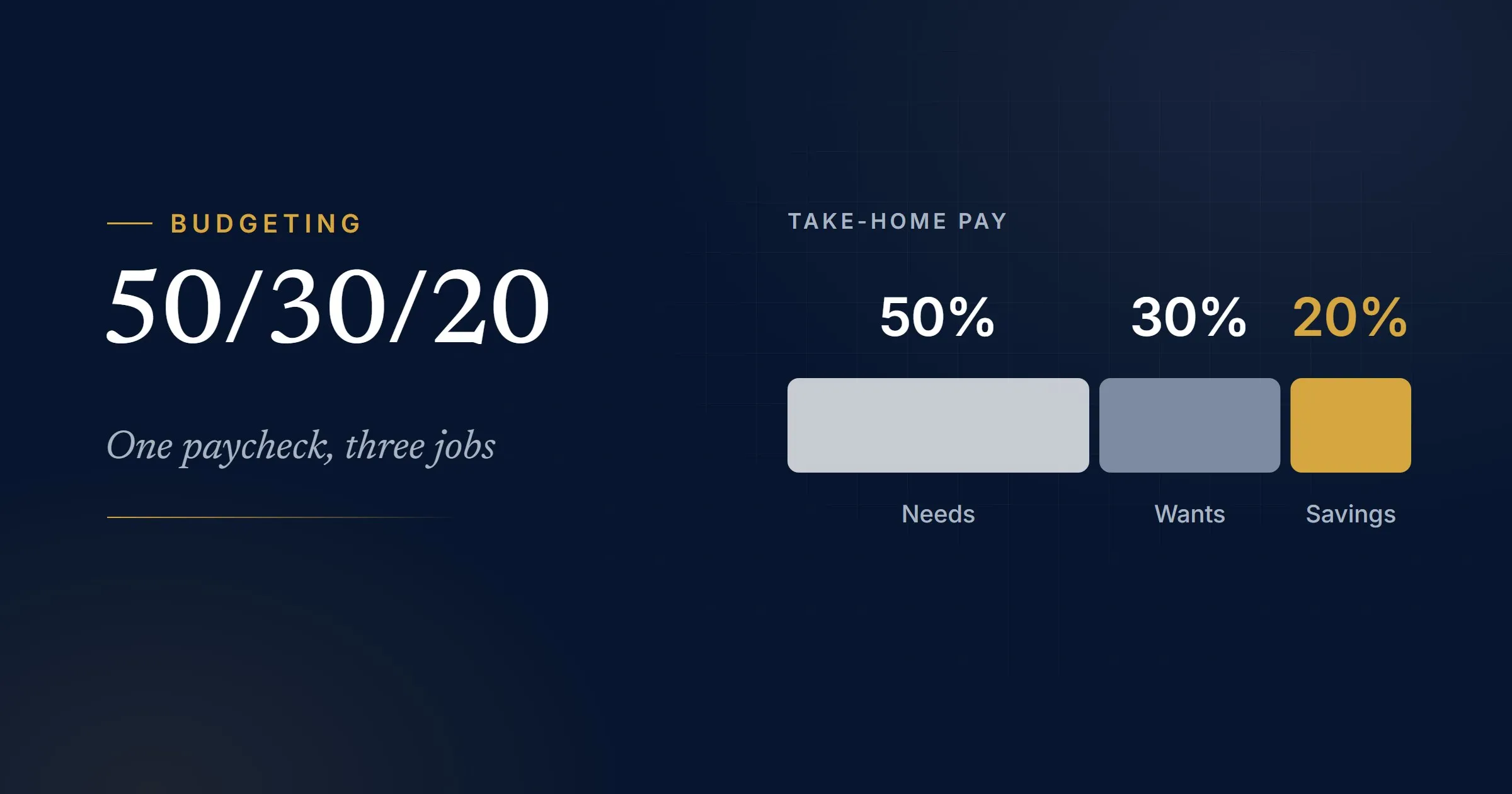
The 50/30/20 rule is a simple way to split your take-home pay: about 50% for needs, 30% for wants and 20% for savings and paying down debt. Elizabeth Warren and Amelia Warren Tyagi popularized it in their 2005 book All Your Worth, which divides income after taxes into must-haves, wants and savings.Source 1
If you take home $4,000 a month, the rule suggests $2,000 for needs, $1,200 for wants and $800 for savings and extra debt payments. You don’t have to track every coffee. You only need to know which of three groups each expense belongs to.
This guide covers what goes in each group, which income figure to start from, what to do when rent makes 50% impossible, and how the rule compares with what U.S. households actually spend. Every example uses the same math as our Monthly Budget Calculator, so you can check it yourself.
How the 50/30/20 rule works
The rule sorts everything you spend into three groups:
- Needs (50%): bills you’d have to keep paying even if your income dropped, such as rent or a mortgage, utilities, groceries, insurance, getting to work, child care and the minimum payments on your debts.
- Wants (30%): spending you could cut back on or pause, such as dining out, entertainment, shopping, travel and upgrades beyond the basic version of a need.
- Savings and debt (20%): money that builds your future or pays down what you already owe, such as an emergency fund, retirement savings, other goals and any debt payments above the minimum.
Here’s how the split works out at different take-home pays:
| Take-home pay a month | Needs (50%) | Wants (30%) | Savings and debt (20%) |
|---|---|---|---|
| $2,500 | $1,250 | $750 | $500 |
| $3,500 | $1,750 | $1,050 | $700 |
| $4,500 | $2,250 | $1,350 | $900 |
| $6,000 | $3,000 | $1,800 | $1,200 |
| $8,000 | $4,000 | $2,400 | $1,600 |
Take-home pay is what reaches your account after taxes and other deductions.
The percentages are targets, not limits you fail by missing. The point is balance: no one group should crowd out the others, and some money should always go toward the future.
Start with your take-home pay
The rule works with take-home pay, not your salary. Your employer must withhold federal and state employment taxes and Social Security and Medicare contributions before you’re paid, and may also take out money for benefits such as health insurance and a retirement savings account.Source 2 Because all of that comes out first, a budget built on your salary would set every target too high.
To turn your paycheck into a monthly figure, use this formula:
Monthly pay equals pay per paycheck times paychecks a year, divided by 12.
- 52 paychecks a year if you’re paid every week
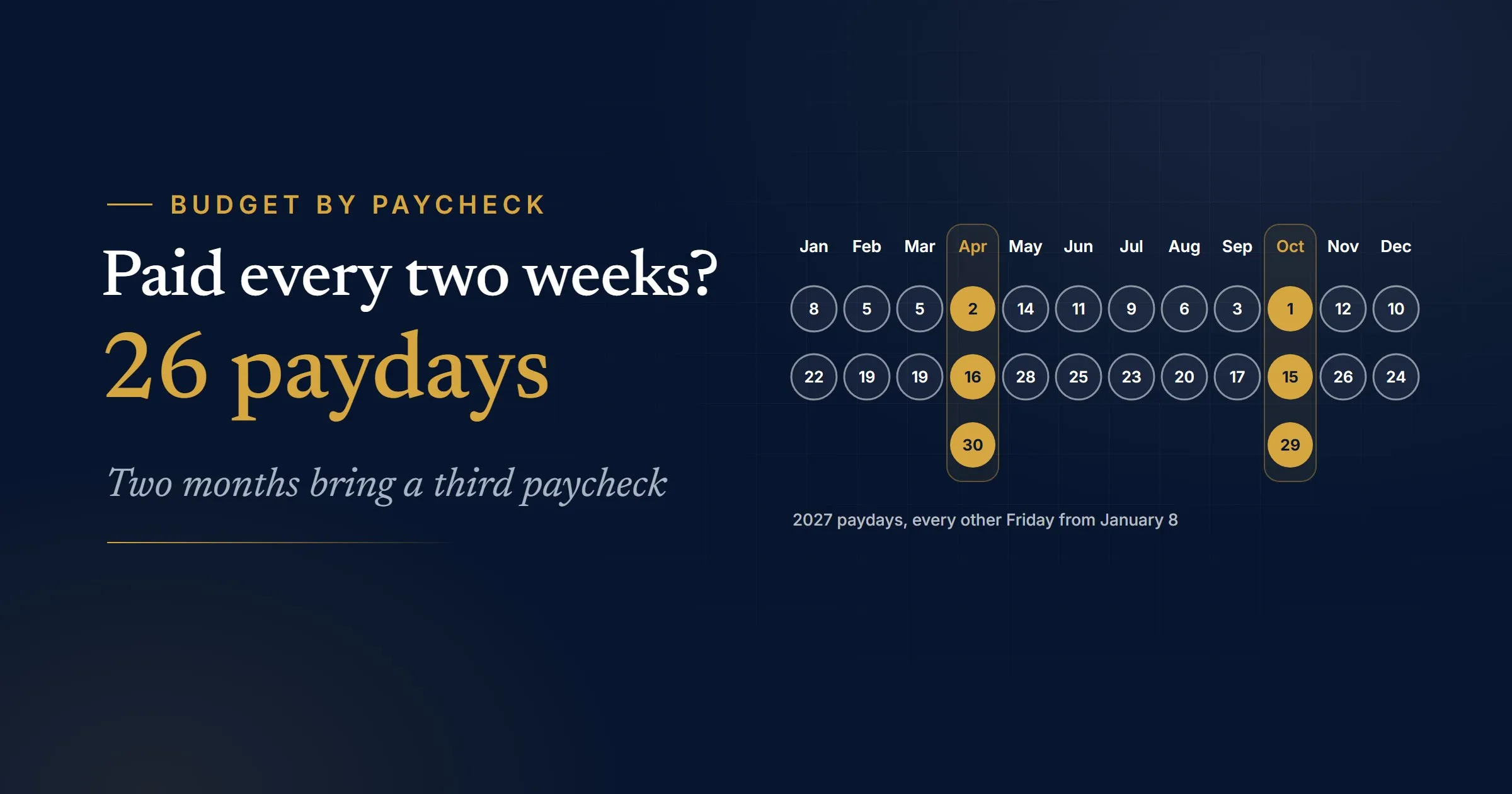
- 26 if you’re paid every two weeks
- 24 if you’re paid twice a month
- 12 if you’re paid once a month
Paid every two weeks
Your paycheck is $1,850 every two weeks: $1,850 × 26 ÷ 12 = $4,008.33 a month.
Don’t just double one paycheck. Most years, two months have three paychecks instead of two, and doubling would leave them out.
If savings or benefits come out of your paycheck
When money for a 401(k) or health insurance is deducted before you’re paid, your take-home pay is already lower, and a budget based on it would miss the saving you’re doing. We suggest adding those deductions back, then counting each one in its group: retirement contributions in savings and health insurance premiums in needs.
Adding back paycheck deductions
Your paycheck is $1,850 every two weeks, after $150 goes to your 401(k) and $90 to health insurance.
- Add them back: $1,850 + $150 + $90 = $2,090 a paycheck, or $4,528.33 a month.
- Your 20% target for savings and debt is $905.67.
- Your 401(k) contributions, $325.00 a month, already count toward it, so another $580.67 a month would reach 20%.
- The $195.00 a month for health insurance counts as a need.
If your employer adds matching contributions, leave them out. They aren’t part of your pay, so they don’t count toward your 20%.
If your income changes from month to month
If you don’t earn the same amount every month, add up your income from last year and divide by 12 to estimate a monthly figure.Source 3 A more cautious option is to plan around a low month, then move anything extra into savings when a better month comes in. Our guide to budgeting on an irregular income walks through both.
What counts as needs, wants and savings
A quick test for a need: would you still have to pay it if you lost your job tomorrow? If so, it’s a need. If you could pause it or switch to a cheaper version, it’s a want, or at least the upgrade part is. Our budget categories guide lists common categories and the group each belongs to.
| Expense | Group | Watch for |
|---|---|---|
| Rent or mortgage payment | Needs | A bigger home than you need is partly a want |
| Utilities and a basic phone plan | Needs | Premium plans and extra lines are wants |
| Groceries | Needs | Restaurants and takeout are wants |
| Car payment, gas, transit and parking for work | Needs | A pricier car than the job requires is a want |
| Health, car and renters or homeowners insurance | Needs | |
| Child care | Needs | |
| Minimum payments on loans and credit cards | Needs | Payments above the minimum belong in savings |
| Streaming, gym memberships and hobbies | Wants | |
| Travel, gifts and clothes beyond the basics | Wants | |
| Emergency fund and other savings deposits | Savings | |
| Retirement contributions, including payroll ones | Savings | |
| Debt payments above the minimum | Savings |
Minimum payments are needs because you have to make them to stay current. Anything above the minimum goes in the 20%, because it pays the debt down faster and cuts the interest you’ll pay. Credit card statements must carry a warning that if you make only the minimum payment, you’ll pay more in interest and take longer to pay off your balance.Source 4
When an expense is partly need and partly want, count the basic version as the need and the upgrade as a want. The Monthly Budget Calculator sorts its categories into the same three groups.
A worked example: $4,500 a month
Here’s a budget for someone who takes home $4,500 a month, with each expense in the group the calculator puts it in:
| Expense | Group | Monthly |
|---|---|---|
| Housing | Needs | $1,350 |
| Utilities and phone | Needs | $200 |
| Groceries | Needs | $420 |
| Transportation | Needs | $250 |
| Insurance | Needs | $130 |
| Health care | Needs | $70 |
| Minimum debt payments | Needs | $100 |
| Dining out | Wants | $300 |
| Entertainment | Wants | $120 |
| Shopping and personal | Wants | $380 |
| Travel and gifts | Wants | $180 |
| Other wants | Wants | $100 |
| Savings and investing | Savings and extra debt payments | $600 |
And here’s how the three groups compare with the 50/30/20 targets:
| Group | Monthly | Share | Target |
|---|---|---|---|
| Needs (50%) | $2,520 | 56% | $2,250 |
| Wants (30%) | $1,080 | 24% | $1,350 |
| Savings (20%) | $600 | 13% | $900 |
| Not yet assigned | $300 | 7% | – |
Shares are of take-home pay, rounded to whole percentages that add up to 100%.
Needs come to 56% of take-home pay, $270 over the 50% target, mostly because of rent. Wants are $270 under their target, and savings are $300 short of 20%.
The fix here doesn’t need any cuts. $300 a month isn’t assigned to anything, and money without a job tends to get spent. Setting up a recurring transfer from checking to savings is one of the easiest ways to save consistently.Source 5 Moving that $300 to savings on payday raises savings to $900 a month and makes the split 56/24/20.
Needs are still above 50%, and that can work as long as wants stay low enough to make room. Of the three targets, the 20% for savings and debt is the one worth protecting.
When your needs are more than 50%
In many areas, housing alone makes a 50% needs budget hard to reach. For decades, housing policy has used 30% of income as the line for affordable housing, and households that spend more than that on housing are considered cost burdened.Source 6
$1,600 rent on $3,600 a month
Half of $3,600 is $1,800. Rent alone takes 44% of take-home pay, which leaves $200 of the needs budget for groceries, utilities, transportation and insurance.
If those cost $900, needs come to $2,500, or 69% of take-home pay. With $560 for wants and $540 for savings, the split is 69/16/15.
When needs run high, adjust the split rather than giving up on it:
- Protect savings first. Even 10% or 15% builds a cushion and keeps you moving. If saving at all feels hard, start small: even a small amount can provide some financial security.Source 5 The 52-week savings challenge starts at $1 a week and builds from there.
- Let wants absorb the difference. Wants are the group you can change fastest, often within a month.
- Work on the biggest need. Housing is usually where the money is. A roommate, a cheaper place when your lease ends or a refinance can move your split more than many small cuts.
- Save part of every raise. Decide how much of a raise goes to savings before it gets absorbed into everyday spending.
Where the 20% should go
The rule doesn’t say how to divide the 20%. One reasonable order, which you can adjust to your situation (our guide to paying off debt or saving first shows the math behind it):
- A starter emergency fund. An emergency fund is cash set aside for unplanned expenses such as car repairs, home repairs, medical bills or a loss of income.Source 5 Without one, a surprise bill can end up on a credit card. Our emergency fund guide lays out a milestone plan, and the Emergency Fund Calculator sets a target from your essential expenses.
- Your employer’s full retirement match. The Department of Labor suggests finding out how much you’d need to contribute to your plan to get the full employer contribution.Source 7
- High-interest debt above the minimums. Every extra dollar on a credit card balance saves interest at the card’s rate. Our snowball vs. avalanche guide compares paying the highest rate first with paying the smallest balance first, and the Debt Payoff Calculator runs both on your own debts.
- A fuller emergency fund and longer-term goals. Build toward several months of essential expenses, then save for goals such as a home or invest for retirement.
As the 20% builds up, it starts earning interest of its own. Our compound interest guide shows how regular deposits grow, and checking your net worth once or twice a year shows the progress.
Is the 50/30/20 rule realistic?
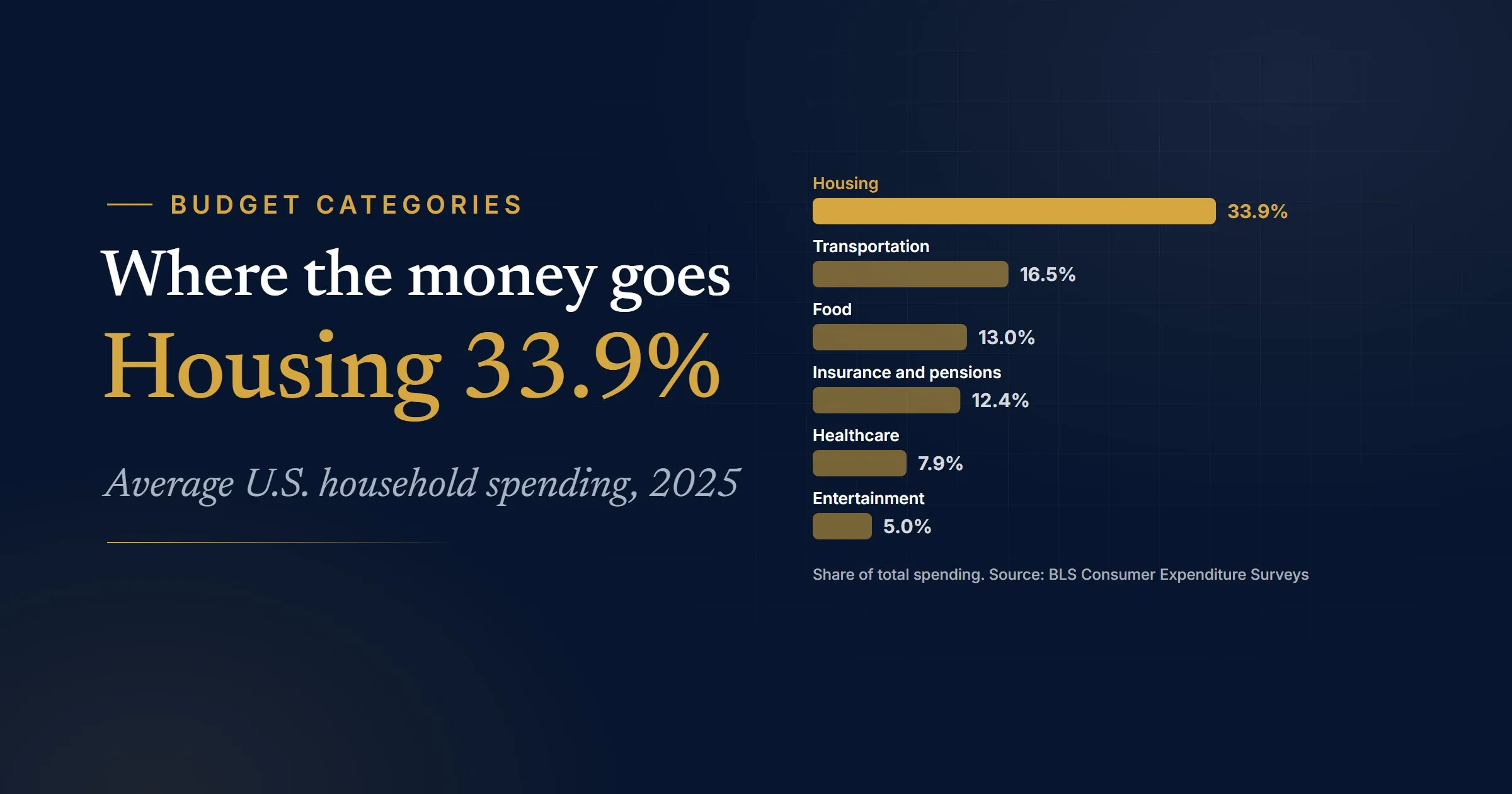
Federal spending data shows why needs so often run past 50%. In 2025, the average U.S. household spent $81,905, about $6,825 a month. Housing was the biggest share at 33.9%, about $2,316 a month, followed by transportation at 16.5% and food at 13.0%.Source 8 Together, those three made up 63.4% of spending.
Those are shares of spending, not of take-home pay, and they’re averages across very different households. Food also includes restaurant meals, which count as wants. Still, the numbers show how much of a typical budget goes to the basics, and why a rigid 50% cap doesn’t fit everyone. Treat 50/30/20 as a starting point: set targets, compare them with a real month, and adjust.
50/30/20 vs. other budgeting methods
The 50/30/20 rule is one of several popular methods. Here’s how it compares:
| Method | How it works | Good fit if you |
|---|---|---|
| 50/30/20 | Three broad groups, each with a target share of take-home pay | Want a simple check without tracking every category |
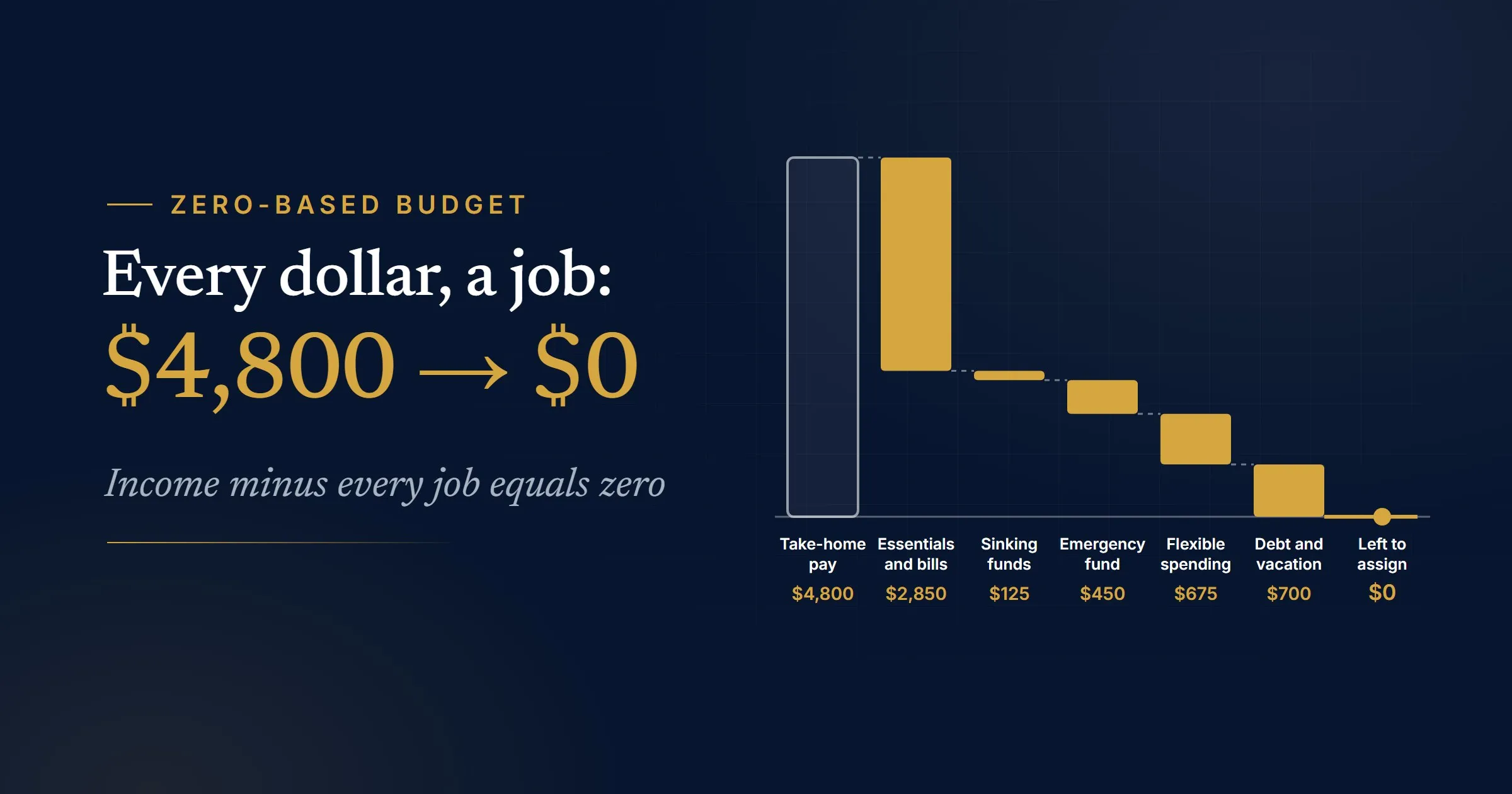
| Zero-based budget | Every dollar of income gets a job until nothing is unassigned | Want full control and don’t mind detailed planning |
| Envelope method | Cash or a separate account for each category; when it’s empty, you stop | Overspend in a few categories, such as dining out |
| Pay yourself first | Savings move out on payday, and you spend what’s left | Want saving on autopilot |
You can combine them. Many people use 50/30/20 to set their targets and plan each month in more detail with categories, which is what the Monthly Budget Calculator does, and our free budget template has a 50/30/20 check built in. If you’re starting from scratch, our step-by-step guide to making a budget follows one household from pay stubs to a finished plan.
Common questions
Is the 50/30/20 rule based on gross or net income?
It’s based on net income, or take-home pay. The book that popularized the rule works with income after taxes.Source 1 Using your gross salary would make every target too high. If retirement savings or health insurance comes out of your paycheck, add it back and count it in its group.
Do 401(k) contributions count toward the 20%?
Yes. Add the contributions you make back to your take-home pay and count them as savings. Your employer’s matching contributions aren’t part of your pay, so leave them out.
Where do debt payments go?
Minimum payments go in needs. Anything you pay above the minimum counts toward the 20% for savings and debt.
What if I can’t save 20%?
Start with what you can, even 5%, and raise it when your pay goes up or a bill goes away. A small emergency fund still helps, and saving consistently matters more than the exact percentage.
Is rent a need or a want?
Rent is a need. But if your home costs much more than a basic place that would work for you, the difference behaves like a want: it’s money you’ve chosen to spend on space or location. That doesn’t make it wrong, but it’s worth knowing when the split looks out of balance.
Run your own numbers
See where your take-home pay goes each month.
Open the calculator
Sources
Numbers in the text link to these sources. We check them whenever we update this page.
- 1
All Your Worth: The Ultimate Lifetime Money Plan(external site)
Elizabeth Warren and Amelia Warren Tyagi, Free Press (2005) · Accessed November 18, 2026 · Back to text for source 1
- 2
Your Paycheck Explained(external site)
Federal Trade Commission, consumer.gov · Accessed November 18, 2026 · Back to text for source 2
- 3
Making a Budget(external site)
Federal Trade Commission, consumer.gov · Accessed November 18, 2026 · Back to text for source 3
- 4
12 CFR 1026.7, Periodic statement (Regulation Z, Truth in Lending)(external site)
Electronic Code of Federal Regulations · Accessed November 18, 2026 · Back to text for source 4
- 5
An essential guide to building an emergency fund(external site)
Consumer Financial Protection Bureau · Updated October 29, 2025 · Accessed November 18, 2026 · Back to text for source 5
- 6
Defining Housing Affordability(external site)
HUD User, U.S. Department of Housing and Urban Development · Published August 14, 2017 · Accessed November 18, 2026 · Back to text for source 6
- 7
Top 10 Ways to Prepare for Retirement(external site)
Employee Benefits Security Administration, U.S. Department of Labor · Accessed November 18, 2026 · Back to text for source 7
- 8
Consumer Expenditures--2025(external site)
U.S. Bureau of Labor Statistics · Published October 29, 2026 · Accessed November 18, 2026 · Back to text for source 8
About the author
Wealthistry Editorial Team
Research, writing and editing
The team that researches, writes, fact-checks and updates Wealthistry's guides and calculators, following our published editorial standards.
Author profileEditorial policyHow we researchReport an error