If you have credit card debt and little in savings, every spare dollar raises the same question: should it go to the debt or into savings? It’s a common dilemma. In 2025, 45% of credit card owners said they carried a balance at least once during the prior 12 months.Source 1
The short answer: paying off high-interest debt usually wins, but not before you have a small cushion of savings. This guide lays out an order that works for most people, with the math behind each step worked out month by month.
Why paying off high-interest debt usually wins
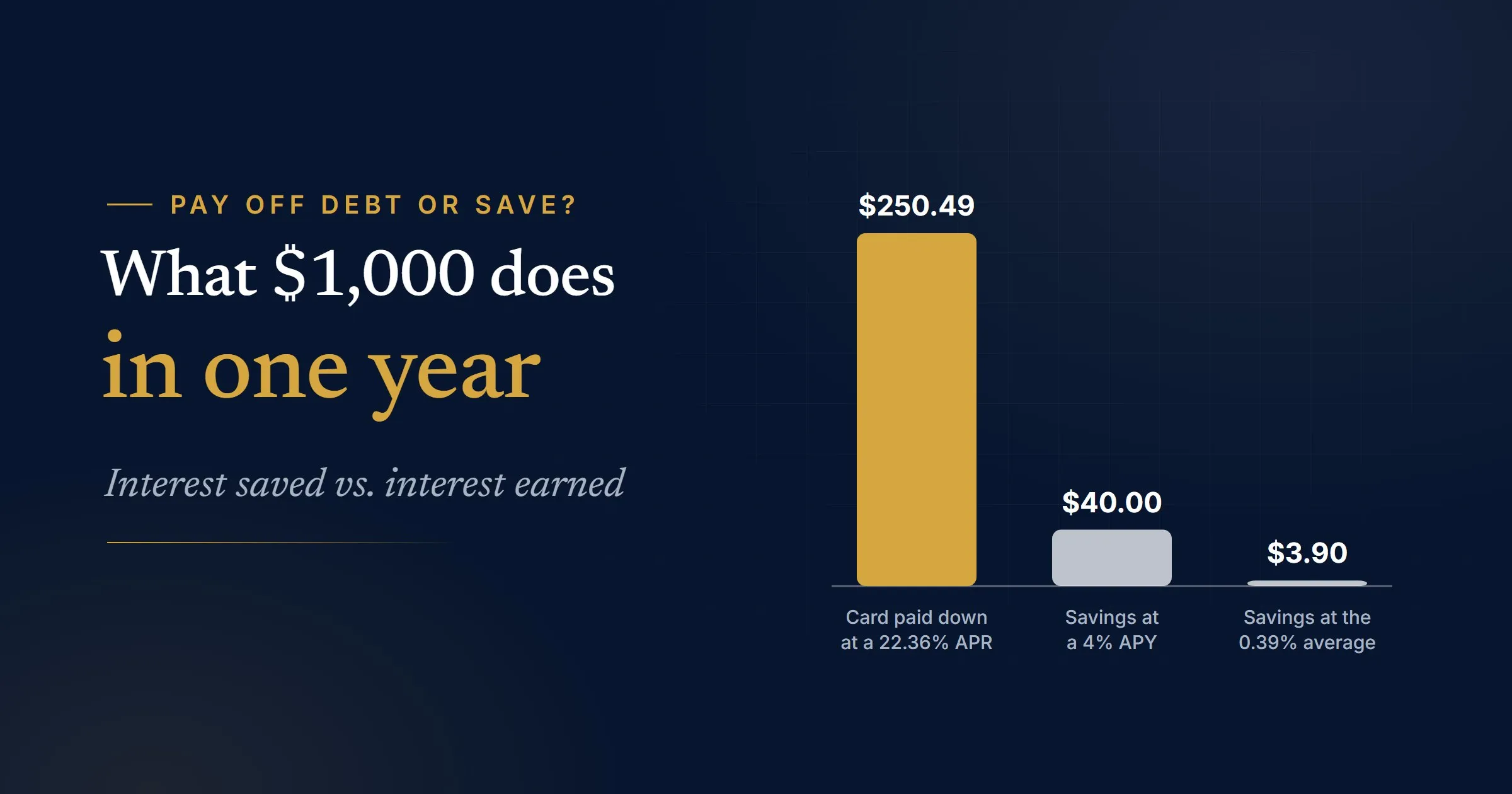
The interest you avoid by paying down a debt is a guaranteed return at the debt’s rate. As the SEC’s investor education site puts it, no investment strategy pays off as well as, or with less risk than, eliminating high-interest debt.Source 2 And the gap between card rates and savings rates is wide: the average APR on card accounts charged interest was 22.36% in the third quarter of 2026,Source 3 while the national average rate on savings accounts was 0.39% in November 2026.Source 4
| Where the $1,000 goes | Interest saved or earned in a year |
|---|---|
| Paying down a credit card at a 22.36% APR | $250.49 |
| A savings account at a 4.00% APY | $40.00 |
| A savings account at the 0.39% national average | $3.90 |
The card balance is assumed to stay for the whole year otherwise, with interest compounded daily. The 4.00% APY is an example rate.
Why you still need a small emergency fund first
If every dollar goes to the card and you have no savings, the next car repair or medical bill goes right back on the card. Without savings, even a minor financial shock can set you back, and if you use a credit card or a loan to pay for it, the one-time expense can grow much larger than the original bill because of interest and fees.Source 5 Many households don’t have that cushion: in the Federal Reserve’s 2025 survey, 63% of adults said they would cover a $400 emergency expense entirely with cash or its equivalent, so more than a third would not.Source 6
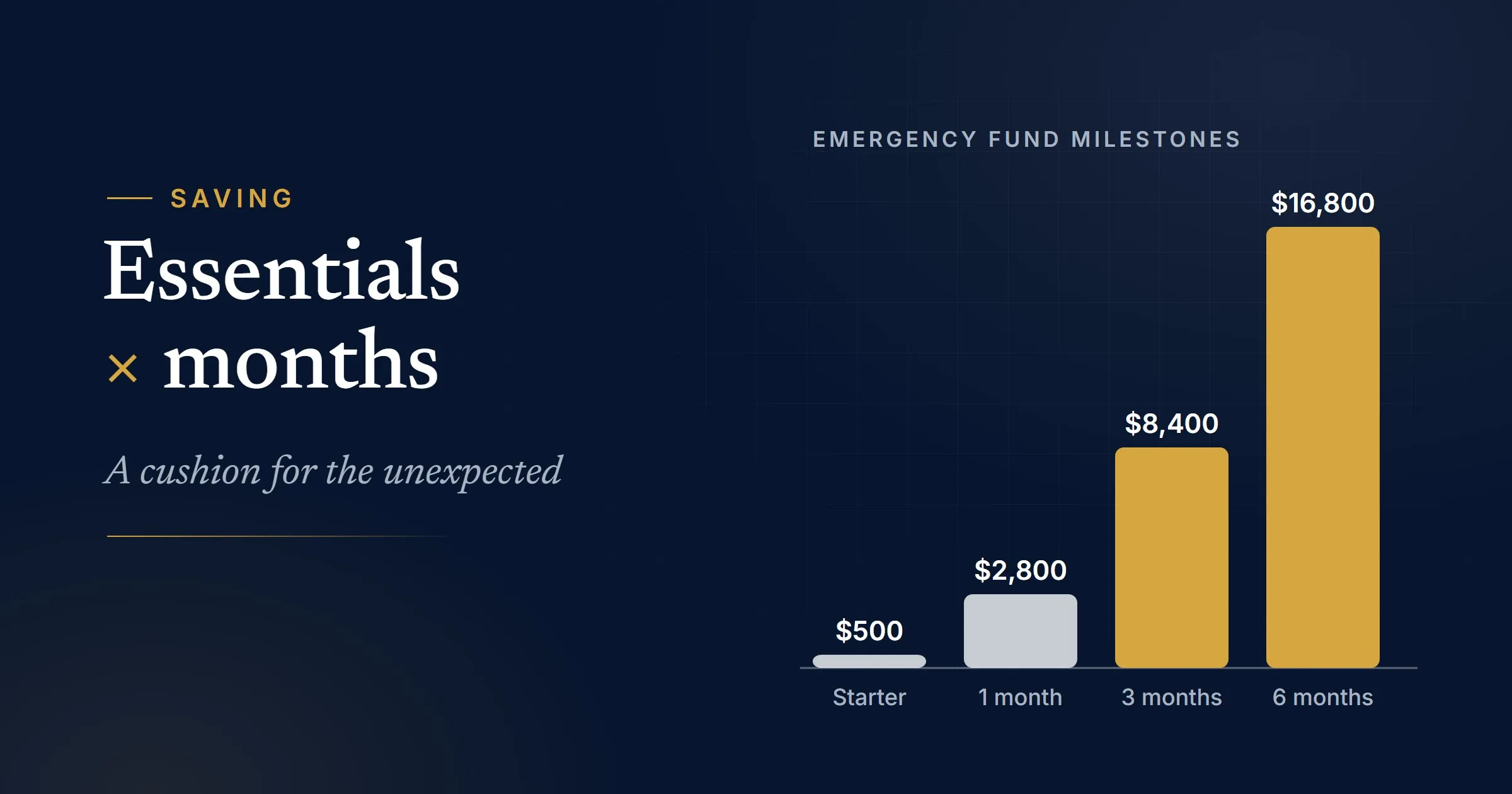
That’s why a small starter fund comes before extra debt payments. Our emergency fund guide suggests $500 as a first milestone. To see what that cushion costs, say you have $300 a month to split between a $3,000 card balance at a 22.36% APR and a savings account earning a 4% APY. The card’s minimum payment is 1% of the balance plus that month’s interest. Here’s where three plans stand after two years:
| How the $300 is split | Saved | Still owed | Card interest |
|---|---|---|---|
| Card first, then save | $3,924 | $0 | $351 |
| $500 starter fund, then card, then save | $3,827 | $0 | $463 |
| Minimums on the card, save the rest | $5,554 | $2,346 | $1,196 |
Every plan pays at least the minimum on the card each month. The card's interest is the balance × APR ÷ 12 each month; savings interest compounds monthly.
- Card first pays the card off in month 12, then saves, finishing with the most: $3,924 in savings minus debt.
- The starter fund first has $500 saved by month 3, pays the card off in month 14, and ends just $97 behind. That’s a small price for having cash ready from the start.
- Saving while paying minimums builds the biggest savings balance, but the card is still there after two years and costs $1,196 in interest, far more than the $203 the savings earn. It ends $716 behind.
Don’t skip the employer match
If your employer offers a retirement plan such as a 401(k), the Labor Department suggests signing up and contributing all you can. Your employer may add money too, so find out how much you’d need to contribute to get the full employer contribution, and how long you’d need to stay in the plan to keep it.Source 7
A 50% match on up to 6% of pay
On a $50,000 salary, contributing 6% means putting in $3,000 a year. With a 50% match, your employer adds $1,500, an immediate 50% return before any investment growth. That’s more than even a high credit card APR.
The order to follow
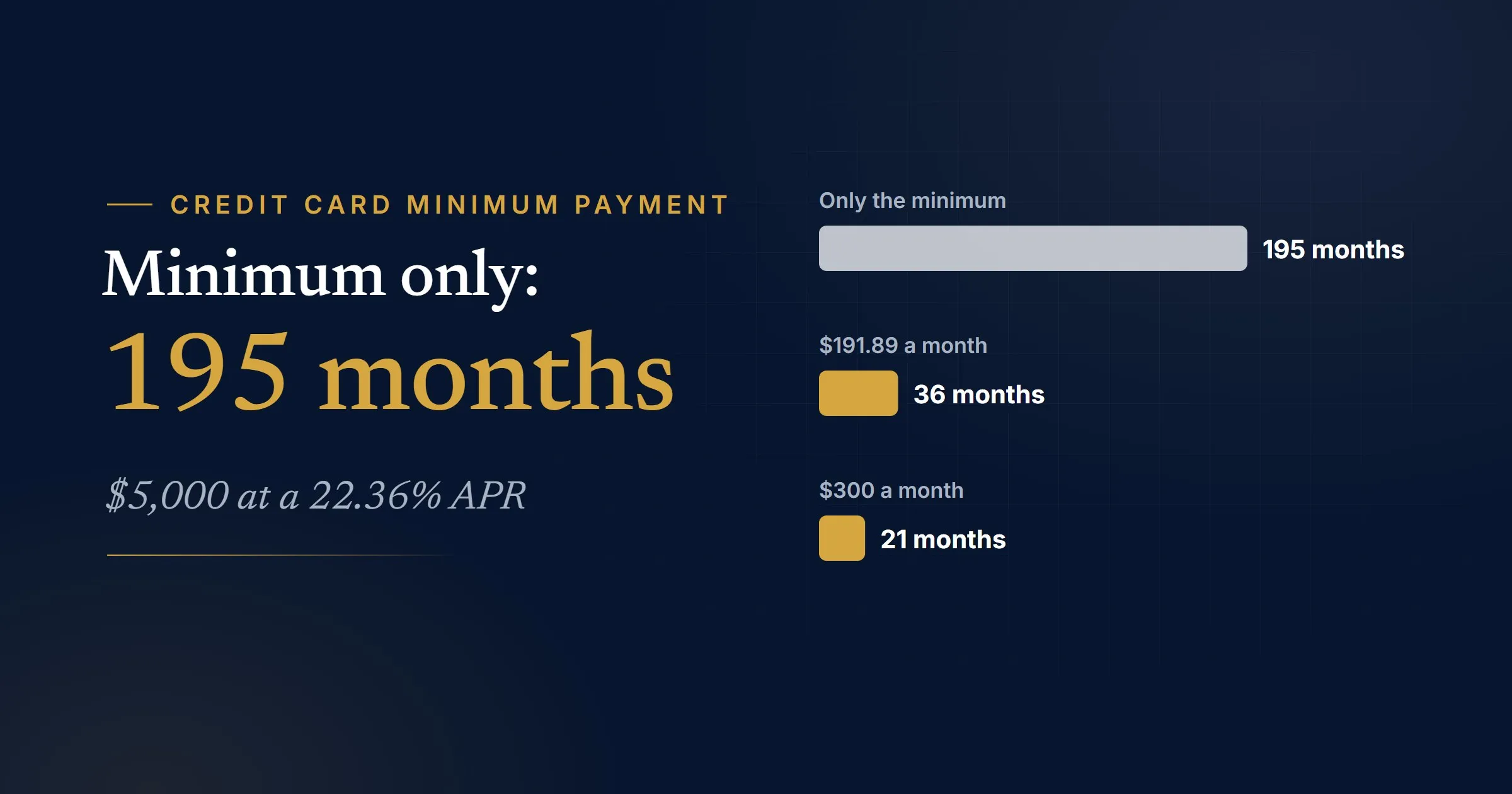
- Pay the minimum on every debt, on time. Missed payments bring late fees, can trigger a penalty APR and hurt your credit history. Our minimum payment guide explains the rules.
- Build a starter emergency fund, such as $500, in a separate savings account.
- Contribute enough to get your full employer match, if you have one.Source 7
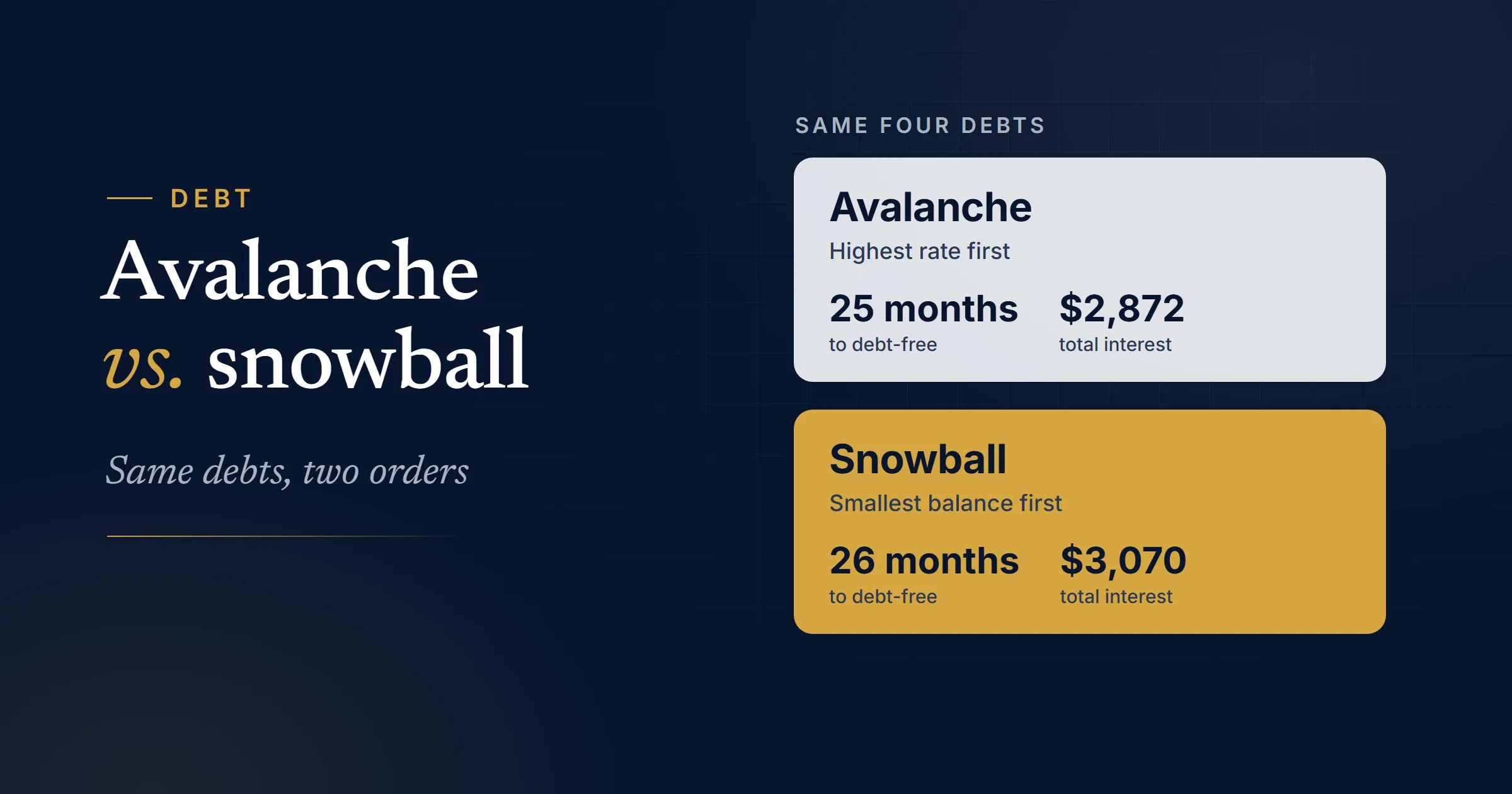
- Pay off high-interest debt, highest rate first. Put as much as you can toward the card with the highest rate while paying the minimum on the others. The same goes for other high-interest debt, about 8% or above, that doesn’t offer tax advantages.Source 2 Our step-by-step guide to paying off debt builds the plan, and our snowball vs. avalanche guide compares this with paying the smallest balance first.
- Finish your emergency fund. A common goal is 3 to 6 months of living expenses.Source 8
- Then weigh lower-interest debt against your other goals, such as saving more for retirement or a home.
When saving should come first
The order above fits most people, but some situations call for more savings sooner:
- You have no savings at all. Step 2 comes first, even if your debt has a high rate.
- Your income is irregular or your job is at risk. A bigger cushion protects you from having to borrow if your income drops. The emergency fund guide explains how to size it.
- The debt has a low rate. Below about 8%, the case for paying extra is weaker,Source 2 and building savings or getting a full employer match can come first.
- A big expense is coming. If you know you’ll need to replace a car or pay a large bill soon, setting money aside for it keeps that cost off the card.
Should you use savings to pay off debt?
If your savings are larger than the emergency fund you need, using the extra to pay off a high-interest card can save a lot of interest. But don’t drain your savings to zero: keep at least your starter fund, so the next surprise doesn’t go back on the card.
Common questions
Should I pay off debt or build an emergency fund first?
Build a small starter fund first, such as $500, then pay off high-interest debt, then finish the full emergency fund. That order protects you from new debt while you clear the expensive debt you already have.
Is it better to pay off credit card debt or save?
For credit card debt, paying it off usually wins. Virtually no investment will give you returns to match a high credit card rate, which is why the SEC’s investor education site says you’re better off eliminating credit card debt before investing.Source 2 Keep a small emergency fund and get any employer match first.
Should I pay off debt or invest?
Pay off high-interest debt before investing, with one exception: contribute enough to get any employer match.Source 7 For low-interest debt, it’s reasonable to invest while paying it down on schedule.
Should I pay off debt or save for a house?
High-interest debt usually comes first, because the interest you avoid is likely more than your savings would earn. Paying down debt also lowers your debt-to-income ratio, your monthly debt payments divided by your gross monthly income, which is one way lenders measure your ability to manage the payments on a new loan.Source 9
What counts as high-interest debt?
Credit cards almost always do. The SEC’s investor education site uses about 8% or above as the line for other high-interest debt that doesn’t offer tax advantages.Source 2
Should I stop my 401(k) contributions to pay off debt?
Usually not below the point where you get the full employer match, because the match is money you’d otherwise give up.Source 7 Above the match, putting extra toward high-interest debt for a while can make sense.
Run your own numbers
Compare snowball and avalanche plans side by side.
Open the calculator
Sources
Numbers in the text link to these sources. We check them whenever we update this page.
- 1
Credit, Report on the Economic Well-Being of U.S. Households in 2025 - May 2026(external site)
Board of Governors of the Federal Reserve System · Accessed November 18, 2026 · Back to text for source 1
- 2
Pay Off Credit Cards or Other High Interest Debt(external site)
Investor.gov, U.S. Securities and Exchange Commission · Accessed November 18, 2026 · Back to text for source 2
- 3
Consumer Credit - G.19(external site)
Board of Governors of the Federal Reserve System · Published November 6, 2026 · Accessed November 18, 2026 · Back to text for source 3
- 4
National Rates and Rate Caps – November 2026(external site)
Federal Deposit Insurance Corporation · Updated November 16, 2026 · Accessed November 18, 2026 · Back to text for source 4
- 5
An essential guide to building an emergency fund(external site)
Consumer Financial Protection Bureau · Updated October 29, 2025 · Accessed November 18, 2026 · Back to text for source 5
- 6
Board of Governors of the Federal Reserve System · Accessed November 18, 2026 · Back to text for source 6
- 7
Top 10 Ways to Prepare for Retirement(external site)
Employee Benefits Security Administration, U.S. Department of Labor · Accessed November 18, 2026 · Back to text for source 7
- 8
Investor Resilience – World Investor Week 2022: Investor Bulletin(external site)
Investor.gov, U.S. Securities and Exchange Commission · Published October 3, 2022 · Accessed November 18, 2026 · Back to text for source 8
- 9
What is a debt-to-income ratio?(external site)
Consumer Financial Protection Bureau · Last reviewed November 9, 2026 · Accessed November 18, 2026 · Back to text for source 9
About the author
Wealthistry Editorial Team
Research, writing and editing
The team that researches, writes, fact-checks and updates Wealthistry's guides and calculators, following our published editorial standards.
Author profileEditorial policyHow we researchReport an error