Getting out of debt is possible when you know what you owe and what you can do to repay it.Source 1 In practice, that comes down to a plan: a list of every debt, a set amount you pay each month, and an order for paying them off.
This guide walks through that plan step by step, following one example household from a list of debts to a debt-free date. Every number is worked out with the same math as our Debt Payoff Calculator, so you can run the same plan on your own debts.
Step 1: List every debt
Write down each debt’s balance, interest rate (APR), minimum payment and due date. Your statements show all four. The Consumer Financial Protection Bureau’s free toolkit includes a debt log and a debt action plan worksheet you can use.Source 2
| Debt | Balance | APR | Minimum |
|---|---|---|---|
| Credit card | $4,200 | 24.99% | $126 |
| Second card | $1,800 | 21.24% | $54 |
| Car loan | $9,600 | 7.9% | $310 |
Together, they owe $15,600, with $490 a month in minimum payments.
Step 2: Make sure you can pay every minimum
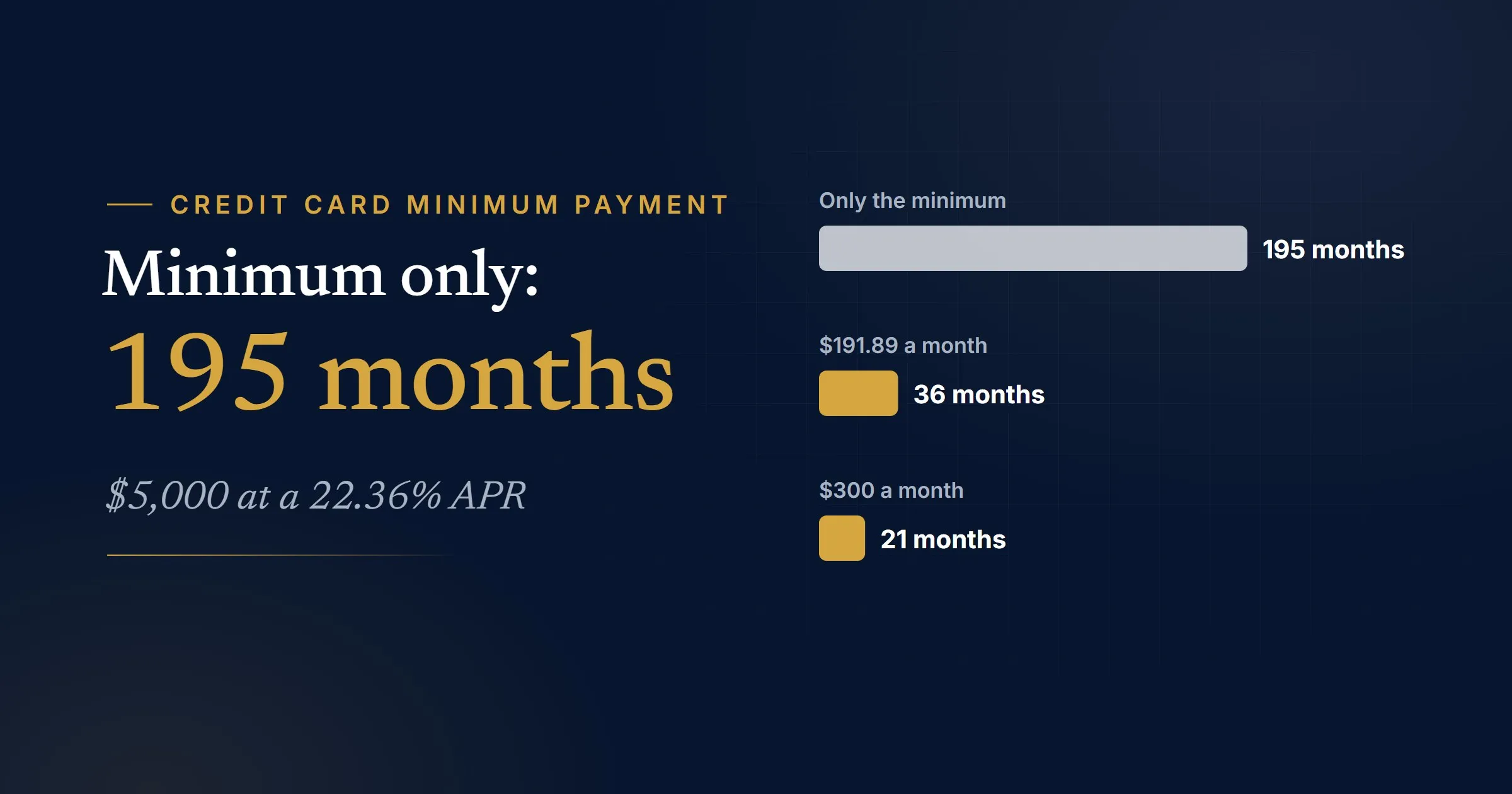
Missed payments bring late fees, can trigger a penalty APR and stay on your credit report, so covering every minimum on time comes first. Our minimum payment guide explains what’s at stake. A written budget shows where the money will come from; our budgeting guide walks through one.
If you can’t cover all the minimums, contact your creditors before you fall behind. Some creditors might be willing to accept lower minimum payments, waive certain fees, reduce your interest rate or change your due date to match when you get paid.Source 3
Step 3: Keep a small emergency fund
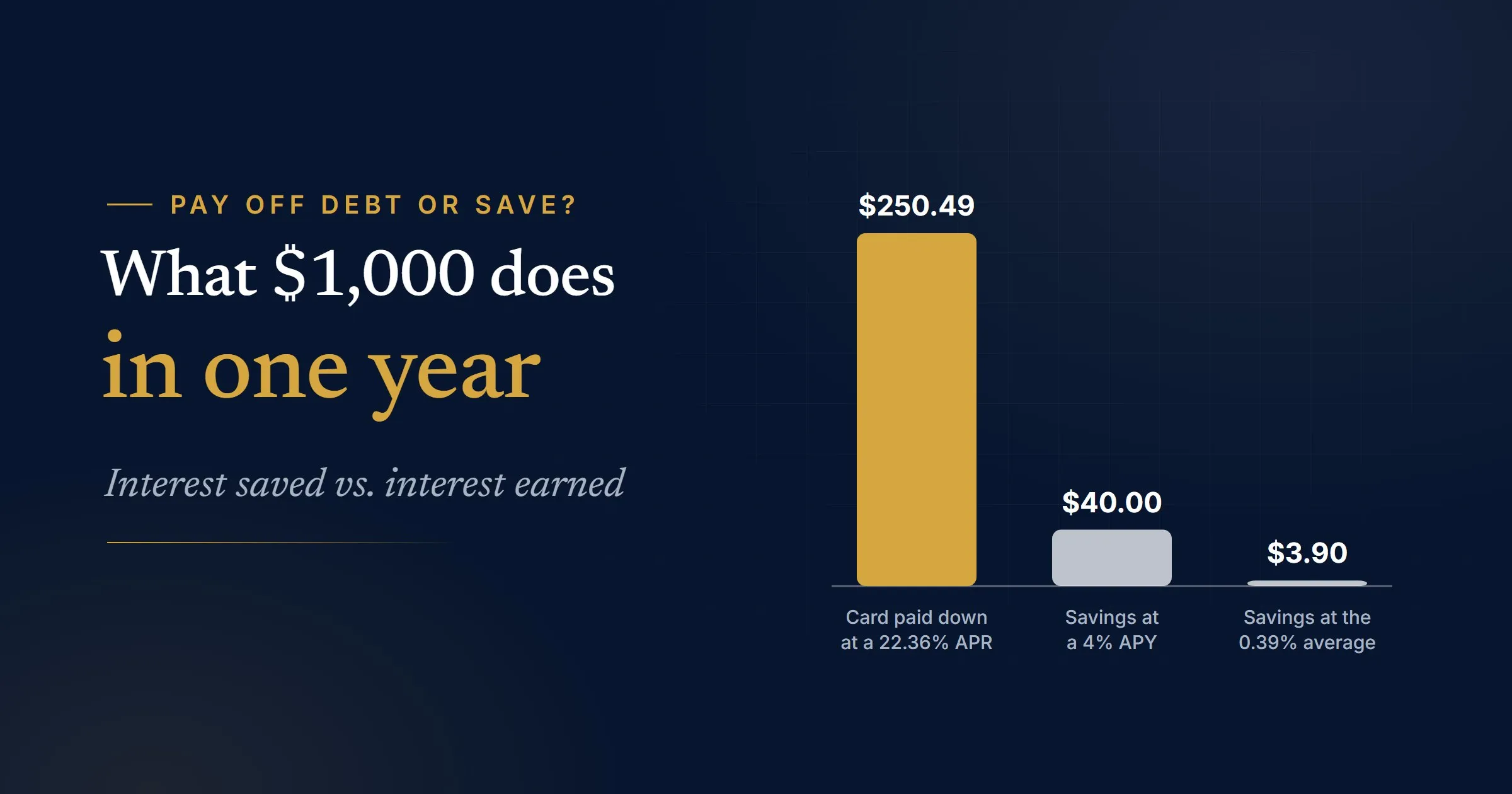
If you have no savings, the next car repair or medical bill goes right back on a card and undoes your progress. A small starter fund, such as $500, keeps that from happening. Our guide to paying off debt or saving first shows how little that cushion costs.
Step 4: Find extra money for your debts
Every dollar above the minimums shortens the plan. Look for it in a few places:
- Your budget. Trim wants for a while, and give money that isn’t assigned to anything a job. In the 50/30/20 rule, extra debt payments come out of the 20% for savings.
- One-time money. For many Americans, a tax refund can be one of the largest checks they get all year.Source 4 Putting some of it toward your debt can jump-start your progress.
- More income. Extra hours or side work, even for a few months, speeds things up. The CFPB’s toolkit has a worksheet for finding ways to increase income and benefits.Source 2
Small amounts count. In the example, adding just $50 a month to the minimums gets the household out of debt 22 months sooner and saves $1,485 in interest compared with paying only the minimums.
Step 5: Choose a payoff order
Pay the minimum on every debt, and put all your extra money toward one target debt at a time. There are two popular ways to choose the target:
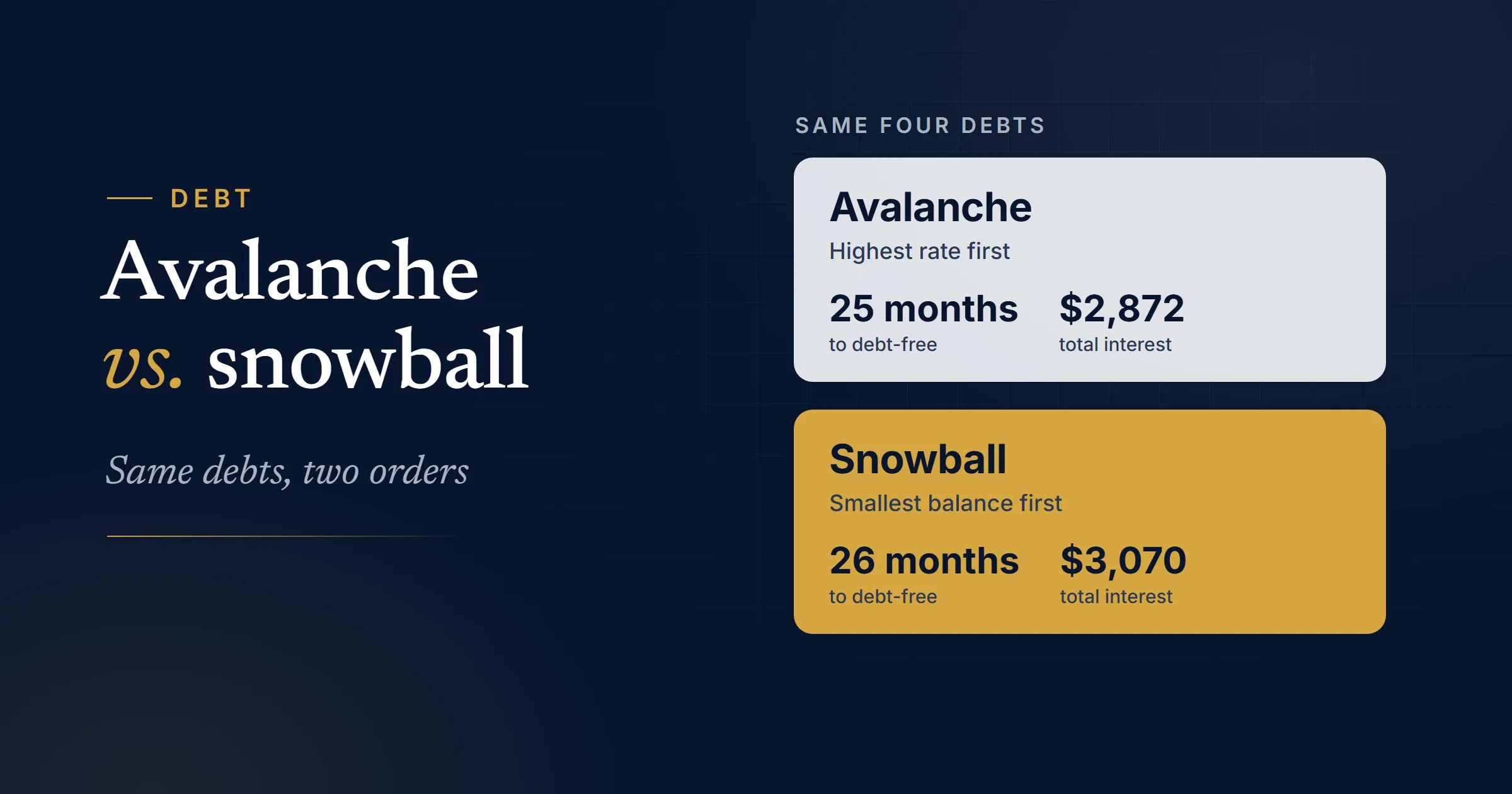
- Highest interest rate first (the avalanche method) pays off your costliest debt first, which can save you money in the long run.Source 1 The SEC’s investor education site suggests paying down the card with the highest rate first, while still paying the minimum on the others.Source 5
- Smallest balance first (the snowball method) gets rid of a debt quickly, so you see progress sooner, though you may pay more in the long run.Source 1
Our snowball vs. avalanche guide compares the two in detail. The example uses the highest rate first.
Step 6: Roll each payment into the next debt
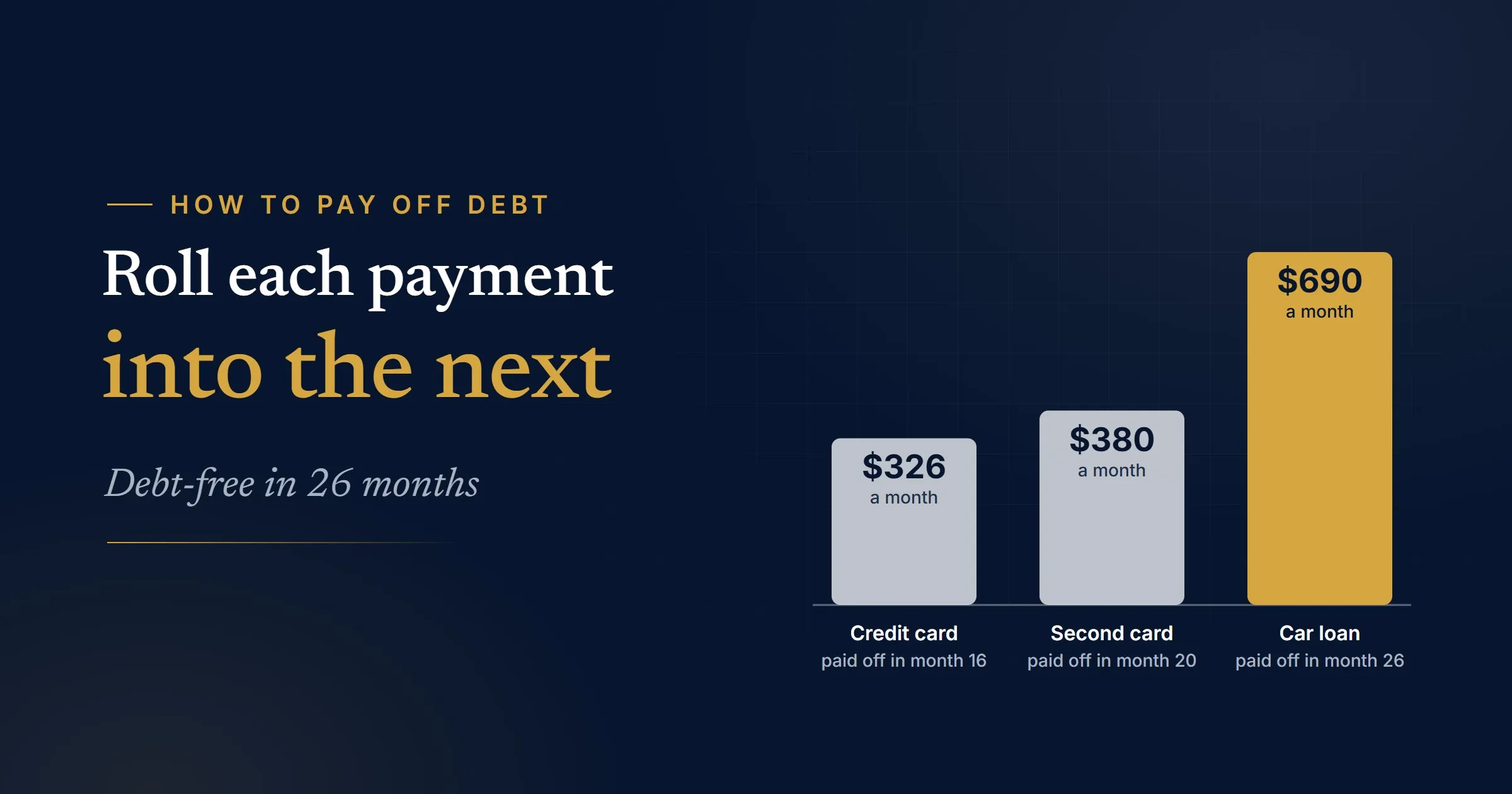
When a debt is paid off, don’t let its payment disappear into your budget. Add it to the payment on the next target debt, so your total stays the same. Here’s the example household’s plan, paying $690 a month in total, $200 more than the minimums:
| Step | Focus on | Paid each month | Paid off in |
|---|---|---|---|
| 1 | Credit card | $326 | Month 16 |
| 2 | Second card | $380 | Month 20 |
| 3 | Car loan | $690 | Month 26 |
Each focus debt gets its own minimum plus everything freed up from debts already paid off. The other debts keep getting their minimums.
They’re debt-free in 26 months, with $2,274 in interest along the way. Here’s how that compares with other ways to pay the same debts:
| How you pay | Each month | Debt-free in | Interest |
|---|---|---|---|
| Minimums only, each debt on its own | $490 | 58 months | $5,158 |
| Minimums, rolled over as debts are paid off | $490 | 42 months | $4,670 |
| Rolled over, plus $50 a month | $540 | 36 months | $3,673 |
| Rolled over, plus $200 a month | $690 | 26 months | $2,274 |
Highest interest rate first. Interest is each balance × APR ÷ 12 each month.
Rolling payments forward makes a difference by itself. Paying the same $490 a month, but rolling each paid-off minimum into the next debt, cuts the plan from 58 months to 42 and saves $488. With $200 extra, the savings come to $2,884.
Step 7: Lower your interest rates where you safely can
A lower rate means more of each payment goes to the balance. The CFPB describes a few ways to consolidate or lower the cost of credit card debt, each with catches:Source 3
- Ask your card issuer. Some creditors may agree to reduce your interest rate.
- Balance transfers. Many cards offer 0% or low-interest balance transfers, but the promotional rate lasts for a limited time, the rate may rise afterward, and you’ll probably pay a balance transfer fee, usually a percentage of the amount or a fixed amount, whichever is more. Our guide to paying off credit card debt works through a transfer with numbers.
- Debt consolidation loans. These turn several debts into one payment, possibly at a lower rate. But some low rates are teaser rates, and a lower monthly payment may come from a longer term, which can mean paying more overall.
- Home equity loans. These may offer lower rates, but using one for credit card debt is risky: if you don’t repay it, you could lose your home to foreclosure, and closing costs can run hundreds or thousands of dollars.
If problems with debt have hurt your credit score, you probably won’t qualify for the lowest rates.Source 3 When you compare offers, compare them by APR, which includes many fees; our APR vs. APY guide explains why.
Step 8: Stop adding new debt and track your progress
New charges on a card you’re paying down move the finish line, and while you carry a balance, new purchases usually start costing interest right away. Our guide to how credit card interest works explains why. Update your debt list once a month, and mark each debt you pay off.
Paying on time also helps your credit: a positive payment history helps you build and keep a strong credit score.Source 6
If you’re overwhelmed
You don’t have to do this alone, but choose your help carefully.
- Nonprofit credit counseling. Credit counseling organizations are usually nonprofits whose counselors are certified in consumer credit, money and debt management, and budgeting. They can help you build a budget and may set up a debt management plan, which typically lowers your monthly payments, interest charges and fees. You make one payment to the organization each month, and it pays your creditors.Source 7
- Finding a counselor. The CFPB suggests starting with the Financial Counseling Association of America, the National Foundation for Credit Counseling or the U.S. Department of Justice’s list of approved credit counselors, and checking a counselor with your state attorney general.Source 7
- Be wary of debt settlement. Debt settlement companies often charge expensive fees and typically encourage you to stop paying your credit card bills, which brings late fees, penalty interest, collection efforts and possibly a lawsuit, and can hurt your credit scores. Debt settlement may leave you deeper in debt than when you started.Source 8
Paying off debt on a low income
When money is tight, the plan is the same, just slower:
- Cover essentials and every minimum first, and call creditors about hardship options before you miss a payment.Source 3
- Use free or low-cost help from a nonprofit credit counselor.Source 7
- Put every spare dollar, even $25 or $50, toward one debt at a time, and roll each payment forward as debts disappear.
- Look for ways to raise your income or reduce bills, so the extra amount can grow over time.
Common questions
What’s the fastest way to pay off debt?
Pay as much as you can toward one debt at a time, starting with the highest interest rate, while paying the minimum on the rest, and roll each payment into the next debt when one is paid off. How much extra you pay each month matters most: in the example, $200 a month on top of the minimums gets the household out of debt in 26 months instead of 58.
Is it better to pay off debt all at once or make payments?
If you have the cash beyond your emergency fund, paying off high-interest debt in one go saves the most interest. Just don’t empty your savings to do it, or the next surprise ends up back on a card.
Should I consolidate my debt?
It can help if the new APR is lower, the fees are small and you don’t run up new balances on the cards you paid off. Watch for promotional rates that end and longer terms that raise the total cost.Source 3
What is a debt payoff plan?
A written plan with every debt you owe, how much you’ll pay each month, the order you’ll pay them in and the month you expect to be debt-free. Our Debt Payoff Calculator builds one from your own debts.
Should I use a debt settlement company?
Consider your other options first, including a nonprofit credit counselor or negotiating directly with your creditors. Debt settlement can be risky and expensive, and it may leave you deeper in debt.Source 8
Run your own numbers
Compare snowball and avalanche plans side by side.
Open the calculator
Sources
Numbers in the text link to these sources. We check them whenever we update this page.
- 1
How to reduce your debt(external site)
Consumer Financial Protection Bureau (archived blog post) · Published July 16, 2019 · Accessed November 18, 2026 · Back to text for source 1
- 2
Your Money, Your Goals toolkit(external site)
Consumer Financial Protection Bureau · Updated April 24, 2026 · Accessed November 18, 2026 · Back to text for source 2
- 3
What do I need to know about consolidating my credit card debt?(external site)
Consumer Financial Protection Bureau · Last reviewed September 2, 2026 · Accessed November 18, 2026 · Back to text for source 3
- 4
An essential guide to building an emergency fund(external site)
Consumer Financial Protection Bureau · Updated October 29, 2025 · Accessed November 18, 2026 · Back to text for source 4
- 5
Pay Off Credit Cards or Other High Interest Debt(external site)
Investor.gov, U.S. Securities and Exchange Commission · Accessed November 18, 2026 · Back to text for source 5
- 6
How long does information stay on my credit report?(external site)
Consumer Financial Protection Bureau · Last reviewed September 2, 2026 · Accessed November 18, 2026 · Back to text for source 6
- 7
What is credit counseling?(external site)
Consumer Financial Protection Bureau · Last reviewed October 28, 2026 · Accessed November 18, 2026 · Back to text for source 7
- 8
What is a debt relief program and how do I know if I should use one?(external site)
Consumer Financial Protection Bureau · Last reviewed August 28, 2023 · Accessed November 18, 2026 · Back to text for source 8
About the author
Wealthistry Editorial Team
Research, writing and editing
The team that researches, writes, fact-checks and updates Wealthistry's guides and calculators, following our published editorial standards.
Author profileEditorial policyHow we researchReport an error