Credit card debt is expensive to carry. In the third quarter of 2026, the average APR on card accounts that were charged interest was 22.36%,Source 1 and in 2025, 45% of cardholders carried a balance at least once during the year.Source 2 The good news is that a clear plan works: a fixed payment, a set order and no new charges.
This guide walks through six steps, with tables showing what it takes to pay off common balances and how long it takes at different payments. Every example uses a 22.36% APR, with interest each month of the balance × APR ÷ 12. Your card’s terms and how it calculates interest will change the exact numbers.
Step 1: Stop adding to the balance
Paying down a card you’re still using is like bailing out a boat with a leak. When you carry a balance, you usually lose your grace period, so new purchases start costing interest from the day you make them.Source 3 Put the card away and pay with cash or debit while you pay it off.
$9,000 paid down at $400 a month
- With no new charges, the balance is gone in 2 years and 6 months, with $2,775 of interest.
- Keep charging $100 a month, and it takes 3 years and 9 months, with $4,304 of interest.
Step 2: List what you owe
For each card, write down the balance, APR, minimum payment and due date. Understanding what you owe, and when, helps you manage it; the CFPB suggests a bill calendar to keep it all in one place.Source 4 Set up automatic payments for at least the minimum on every card so you never miss one.
Step 3: Choose a monthly payment and a deadline
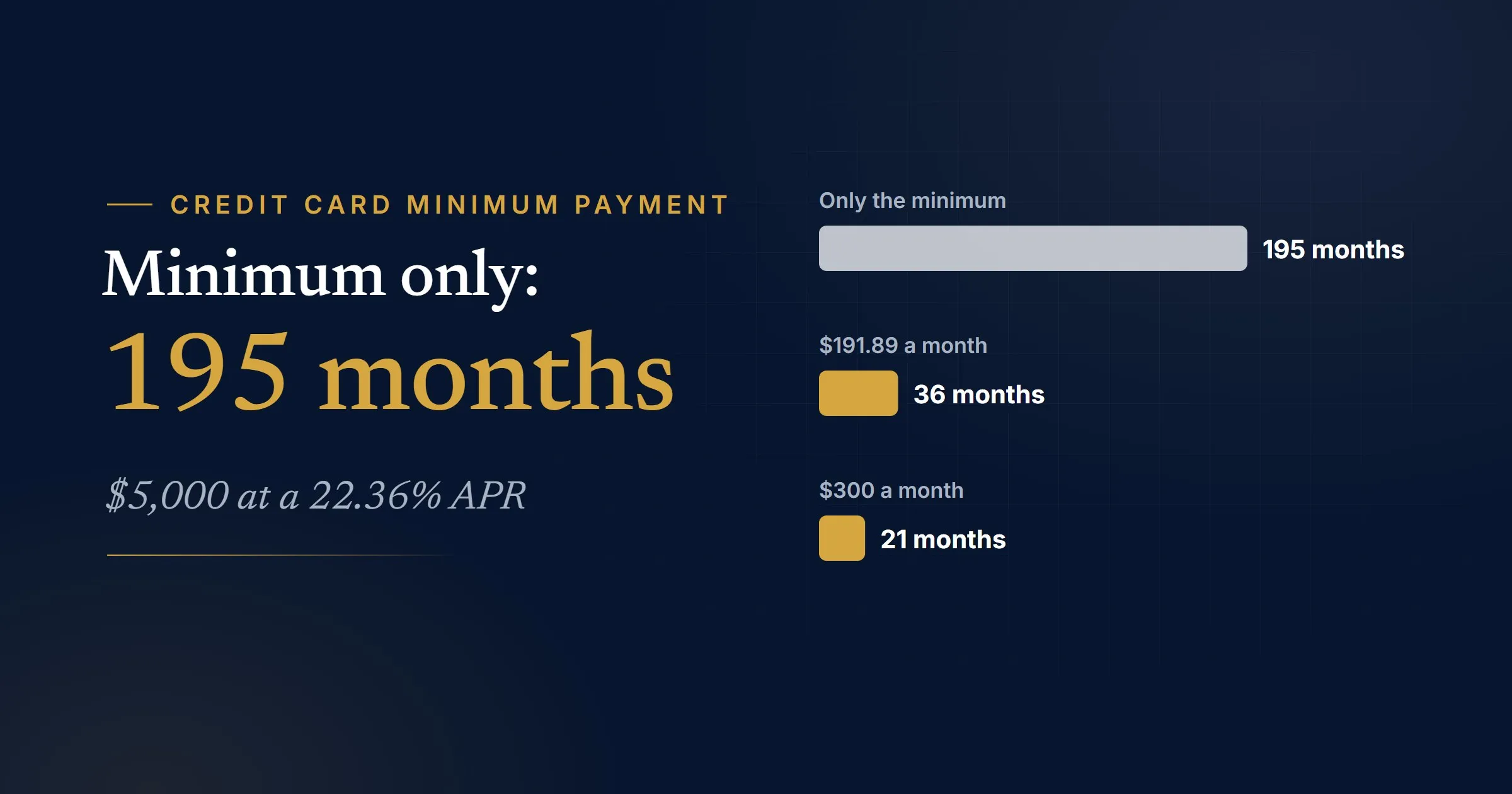
The minimum payment keeps your account current, but paying only the minimum can take years. Pick a fixed payment instead. Here’s what it takes to be debt-free by a deadline:
| Balance | In 1 year | In 2 years | In 3 years |
|---|---|---|---|
| $3,000 | $281 | $156 | $115 |
| $6,000 | $563 | $312 | $230 |
| $9,000 | $844 | $469 | $345 |
| $12,000 | $1,125 | $625 | $461 |
Equal monthly payments, no new charges. Interest is the balance × APR ÷ 12 each month.
To pay off $9,000 in six months, you’d need about $1,599 a month. And here’s how long $9,000 takes at different payments:
| Monthly payment | Time to pay off | Interest |
|---|---|---|
| $250 | 5 years and 1 month | $6,046 |
| $400 | 2 years and 6 months | $2,775 |
| $600 | 1 year and 6 months | $1,655 |
| Minimum only | 21 years | $14,999 |
No new charges. The minimum is 1% of the balance plus that month's interest, at least $35. Interest is the balance × APR ÷ 12 each month.
Paying only the minimum, which starts at $259.38 here, takes decades because the payment shrinks along with the balance. Our minimum payment guide explains why. Our Credit Card Payoff Calculator works out a plan for your own balance and rate.
Step 4: Decide which card to pay first
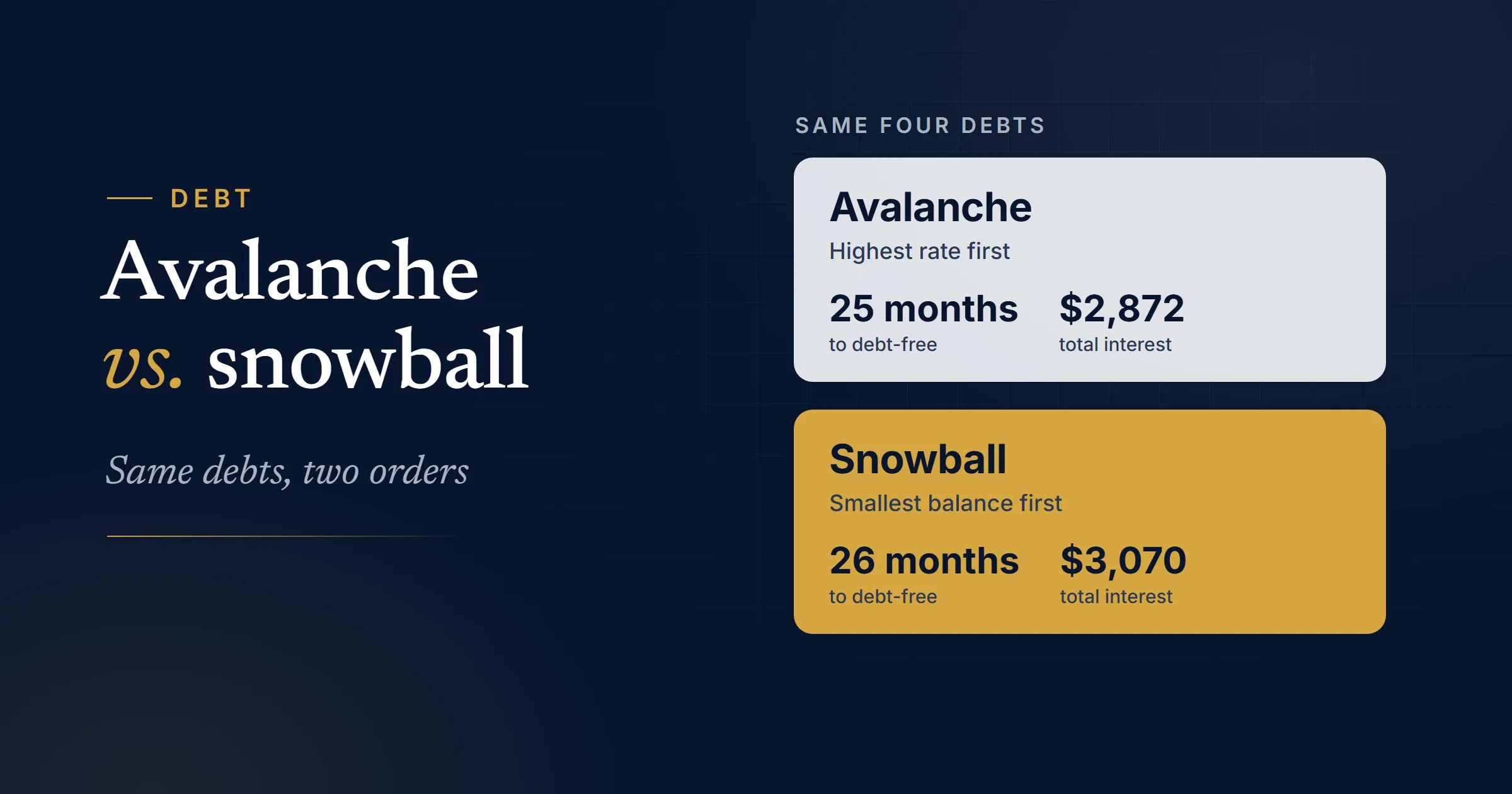
If you have more than one card, pay the minimum on all of them and put every extra dollar toward one card at a time. There are two common ways to choose:Source 4
- Highest rate first (the avalanche). It saves the most money, because it clears the costliest debt first. Investor.gov recommends paying down the card with the highest rate first while paying the minimum on the others.Source 5
- Smallest balance first (the snowball). You pay off a card quickly and see progress sooner, though you may pay more in the long run.
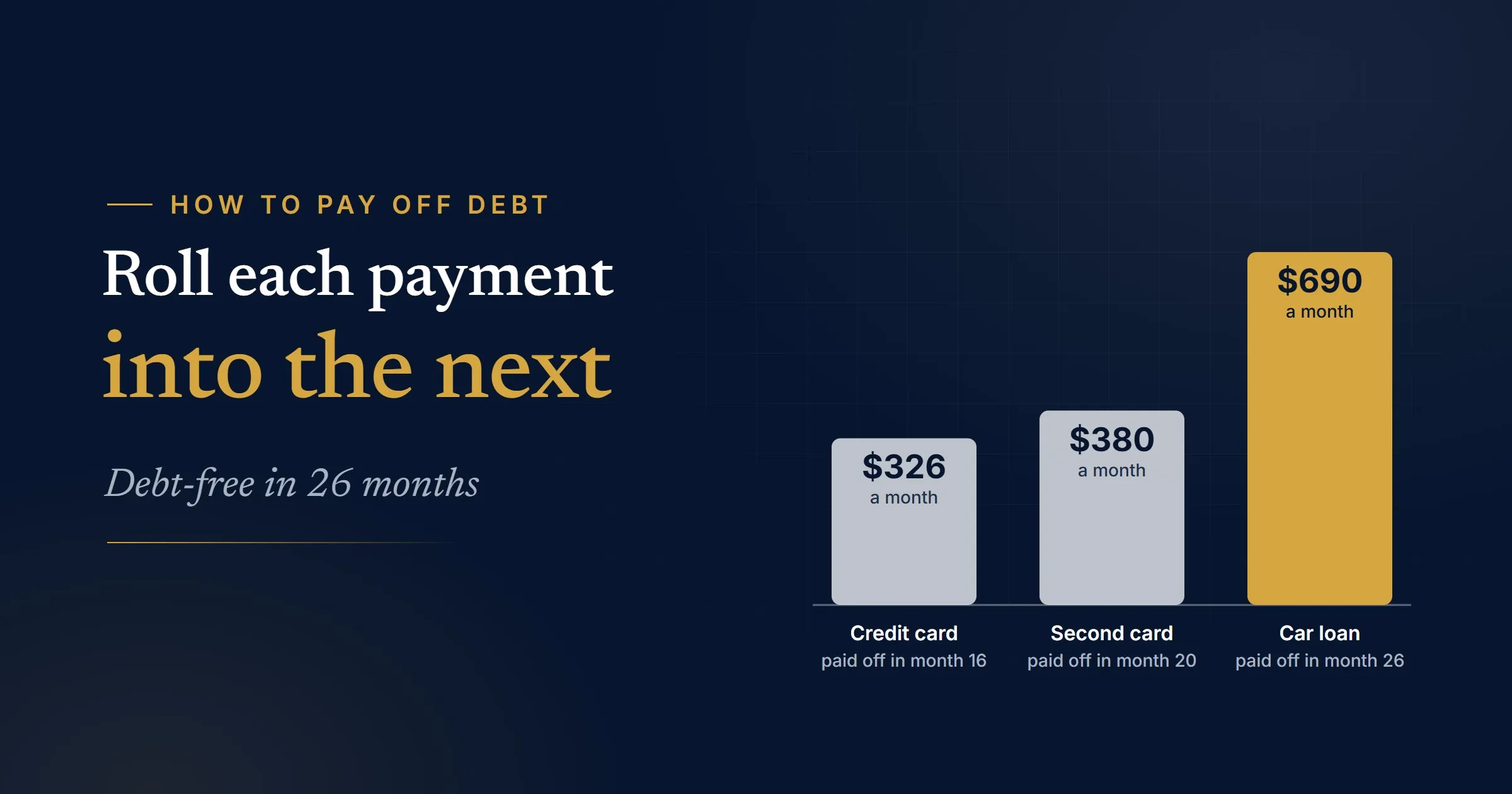
When a card is paid off, roll its payment into the next one. Our snowball vs. avalanche guide compares the two with numbers, and the Debt Payoff Calculator runs both on your own cards.
Step 5: Lower your interest rate, if you can
Balance transfers
Many card companies offer 0% or low-interest balance transfers. Before you move a balance, know the catches:Source 6
- The promotional rate lasts for a limited time, and the rate may rise afterward.
- You’ll probably pay a balance transfer fee, usually a percentage of the amount or a fixed amount, whichever is more.
- New purchases on the same card don’t get a grace period, so they cost interest until the whole balance, including the transfer, is paid off.
- If you’re more than 60 days late, the card company can raise the rate on all your balances, including the transferred one.
A card company can raise a promotional rate when it ends only if the promotion lasted at least six months and the company told you in writing, before it started, how long it would last and what rate would apply afterward.Source 7
Moving $6,000 to a 0% card for 15 months
- A 3% transfer fee adds $180, so you owe $6,180.
- To clear it before the 0% rate ends, you’d pay about $412 a month for 15 months.
- Paying off the same $6,000 in 15 months at 22.36% would take about $462 a month and cost $933 in interest.
- The transfer saves about $753, as long as it’s paid off in time and nothing new goes on the card.
Debt consolidation loans
Banks, credit unions and installment lenders may offer a loan that combines several debts into one payment, possibly at a lower rate than you’re paying now.Source 6 Compare the rate, fees and total cost, and check that the loan’s term doesn’t stretch payments out so long that you pay more overall. Our guide to paying off debt covers consolidation in more detail.
Step 6: Find extra money for your payment
Every extra dollar shortens the plan. Look for it in your budget, in a few spending cuts, and in one-time money like a tax refund. Our guide to saving money has a dozen ways to free some up, and budgeting by paycheck can help you fit the payment around your paydays.
Keep a small emergency fund, too, so a surprise bill doesn’t go right back on the card. Our guide to paying off debt or saving first shows how to balance the two.
If you can’t keep up with your payments
Credit counseling organizations, usually nonprofits, can help you build a budget and set up a debt management plan. Under a plan, you make one payment to the counseling organization each month, and it pays your creditors. A plan typically lowers your monthly payments, interest charges and fees.Source 8 Learn the difference between a nonprofit credit counselor and a for-profit debt relief company before you sign up; our guide to paying off debt explains the risks of debt settlement.
Common questions
What’s the fastest way to pay off credit card debt?
Stop using the card, pay as much as you can each month, and put extra money toward the highest-rate card first. A 0% balance transfer can help if you can pay it off before the promotion ends.
How long does it take to pay off $9,000 in credit card debt?
At 22.36% APR with no new charges, about 2 years and 6 months at $400 a month, or 1 year and 6 months at $600. On the minimum payment alone, it would take 21 years.
Should I pay off my credit card in full every month?
Yes, if you can. If your card has a grace period, paying your full balance by the due date each month means you won’t pay interest on purchases.Source 9
Is it better to pay off credit cards or save?
Usually both: keep a small emergency fund and put the rest toward high-interest debt. As Investor.gov puts it, no investment strategy pays off as well as, or with less risk than, eliminating high-interest debt.Source 5
What if I can only afford the minimum?
Keep paying at least the minimum on time on every card, and look for small amounts to add. If you’re struggling to make even the minimums, a nonprofit credit counselor may be able to set up a debt management plan, which typically lowers your monthly payments, interest charges and fees.Source 8
Run your own numbers
Estimate your payoff date and the total interest you'd pay.
Open the calculator
Sources
Numbers in the text link to these sources. We check them whenever we update this page.
- 1
Consumer Credit, G.19 statistical release(external site)
Board of Governors of the Federal Reserve System · Published November 6, 2026 · Accessed November 16, 2026 · Back to text for source 1
- 2
Credit, Report on the Economic Well-Being of U.S. Households in 2025 - May 2026(external site)
Board of Governors of the Federal Reserve System · Accessed November 18, 2026 · Back to text for source 2
- 3
What is a grace period for a credit card?(external site)
Consumer Financial Protection Bureau · Last reviewed September 23, 2024 · Accessed November 18, 2026 · Back to text for source 3
- 4
How to reduce your debt(external site)
Consumer Financial Protection Bureau (archived blog post) · Published July 16, 2019 · Accessed November 18, 2026 · Back to text for source 4
- 5
Pay Off Credit Cards or Other High Interest Debt(external site)
Investor.gov, U.S. Securities and Exchange Commission · Accessed November 18, 2026 · Back to text for source 5
- 6
What do I need to know about consolidating my credit card debt?(external site)
Consumer Financial Protection Bureau · Last reviewed September 2, 2026 · Accessed November 18, 2026 · Back to text for source 6
- 7
Electronic Code of Federal Regulations · Accessed November 18, 2026 · Back to text for source 7
- 8
What is credit counseling?(external site)
Consumer Financial Protection Bureau · Last reviewed October 28, 2026 · Accessed November 18, 2026 · Back to text for source 8
- 9
How does my credit card company calculate the amount of interest I owe?(external site)
Consumer Financial Protection Bureau · Last reviewed January 22, 2024 · Accessed November 18, 2026 · Back to text for source 9
About the author
Wealthistry Editorial Team
Research, writing and editing
The team that researches, writes, fact-checks and updates Wealthistry's guides and calculators, following our published editorial standards.
Author profileEditorial policyHow we researchReport an error