A monthly budget is easier to follow when it matches how you’re actually paid. If your paycheck arrives every two weeks, every week or twice a month, budgeting by paycheck means deciding, for each paycheck, which bills it pays, what it saves and what’s left to spend until the next one.
Every two weeks is the most common pay schedule in the U.S. In February 2023, 43.0% of private establishments paid their employees biweekly, and 27.0% paid weekly.Source 1 This guide shows how to turn each paycheck into a plan, with a worked biweekly example on the 2027 calendar, how to handle three-paycheck months, and what changes with weekly or twice-a-month pay.
How much is your paycheck per month?
Start with your take-home pay, the amount that actually reaches your account. Your pay stub shows how much you earned and how much your employer took out for taxes and benefits, such as health insurance or a retirement savings account.Source 2 To compare a paycheck with monthly bills, convert it to a monthly average:
Monthly average equals paycheck times paychecks a year, divided by 12.
- paycheck is your take-home pay from one paycheck
- paychecks a year is 52 if you’re paid every week, 26 every two weeks, 24 twice a month and 12 once a month
Here’s the same $52,000 a year of take-home pay on each schedule:
| Pay schedule | Paychecks a year | Each paycheck | In a month |
|---|---|---|---|
| Every week | 52 | $1,000 | 4 or 5 |
| Every two weeks | 26 | $2,000 | 2 or 3 |
| Twice a month | 24 | $2,166.67 | 2 |
| Every month | 12 | $4,333.33 | 1 |
Over a year, every schedule pays the same, and each averages $4,333.33 a month. What changes is the size of each paycheck and when it arrives, and that’s what a paycheck budget plans for. Our Monthly Budget Calculator converts any pay schedule to a monthly amount.
How to budget by paycheck
- List your paydays. Write down the date and take-home amount of each paycheck for the next month or two.
- List your bills and their due dates. Include rent, utilities, phone, insurance and debt payments. The CFPB’s free bill calendar is built for this.Source 3
- Match each bill to the paycheck that arrives before its due date. Deposits don’t always show up in your balance right away, so don’t count on a paycheck that lands the same day a bill is due.Source 4
- Even out heavy paychecks. If one paycheck carries a big bill like rent, set aside part of it from the paycheck before. You may also be able to work with your landlord, utility or credit card company to move a due date.Source 5
- Give the rest a job. Set aside money for groceries, gas and savings from every paycheck; what’s left is spending money until the next payday. If you’re paid by direct deposit, your employer may be able to split your pay between checking and savings.Source 5
- Plan the months with an extra paycheck, as shown below.
A biweekly budget example
Here’s someone who takes home $2,000 every other Friday. Their first payday of 2027 is January 8, so in March they’re paid on March 5 and March 19. Their monthly bills are rent of $1,400 due on the 1st, phone and internet ($130) on the 8th, a car payment ($320) on the 15th, utilities ($180) on the 20th, car insurance ($150) on the 25th and a credit card minimum ($50) on the 28th. Every paycheck also sets aside $500: $260 for groceries and household, $90 for gas and $150 for savings.
By due date alone, the March 19 paycheck would have to cover $1,780 of bills, including all of April’s rent. That leaves $220, $280 short of the $500 it needs, while the March 5 paycheck has $1,550 left after its bills.
Splitting the rent fixes it. Each paycheck puts $700 toward it:
| Item | March 5 paycheck | March 19 paycheck |
|---|---|---|
| Take-home pay | $2,000 | $2,000 |
| Phone and internet, due March 8 | $130 | – |
| Car payment, due March 15 | $320 | – |
| Utilities, due March 20 | – | $180 |
| Car insurance, due March 25 | – | $150 |
| Credit card minimum, due March 28 | – | $50 |
| Rent, due April 1 | $700 | $700 |
| Groceries and household | $260 | $260 |
| Gas | $90 | $90 |
| Savings | $150 | $150 |
| Spending money | $350 | $420 |
The rent share from March 5 waits in checking or savings until the rent is due.
Both paychecks cover their bills and set-asides, and each has money left to spend for two weeks.
Why the plan changes from month to month
Biweekly paydays fall on different dates each month, so the bills each paycheck covers change too. Here’s what’s left to spend from each paycheck from March to May, with the same bills and set-asides:
| Payday | By due date | Equal share |
|---|---|---|
| March 5 | $350 | $470 |
| March 19 | $420 | $470 |
| April 2 | $1,050 | $470 |
| April 16 | $420 | $470 |
| April 30 | $670 | $470 |
| May 14 | $100 | $470 |
| May 28 | $670 | $470 |
By due date: each bill comes from the paycheck before it, with rent split across two paychecks. Equal share: $1,030 from every paycheck goes to a separate bills account.
By due date, spending money swings from $100 on May 14 to $1,050 on April 2. There are two ways to smooth that out:
- Plan a few paychecks ahead. Map the next two or three months, and when a paycheck has extra, keep some of it for the lean one coming.
- Use an equal share. Add up your monthly bills ($2,230), multiply by 12 and divide by 26: that’s $1,029.23, or $1,030 rounded up. Move that much from every paycheck to a separate account you use only for bills, and pay them from there. Every paycheck then leaves the same $470. Because bills don’t fall evenly between paydays, the account needs a cushion to start: in this example, up to $1,220, depending on the payday you begin on.
Three-paycheck months
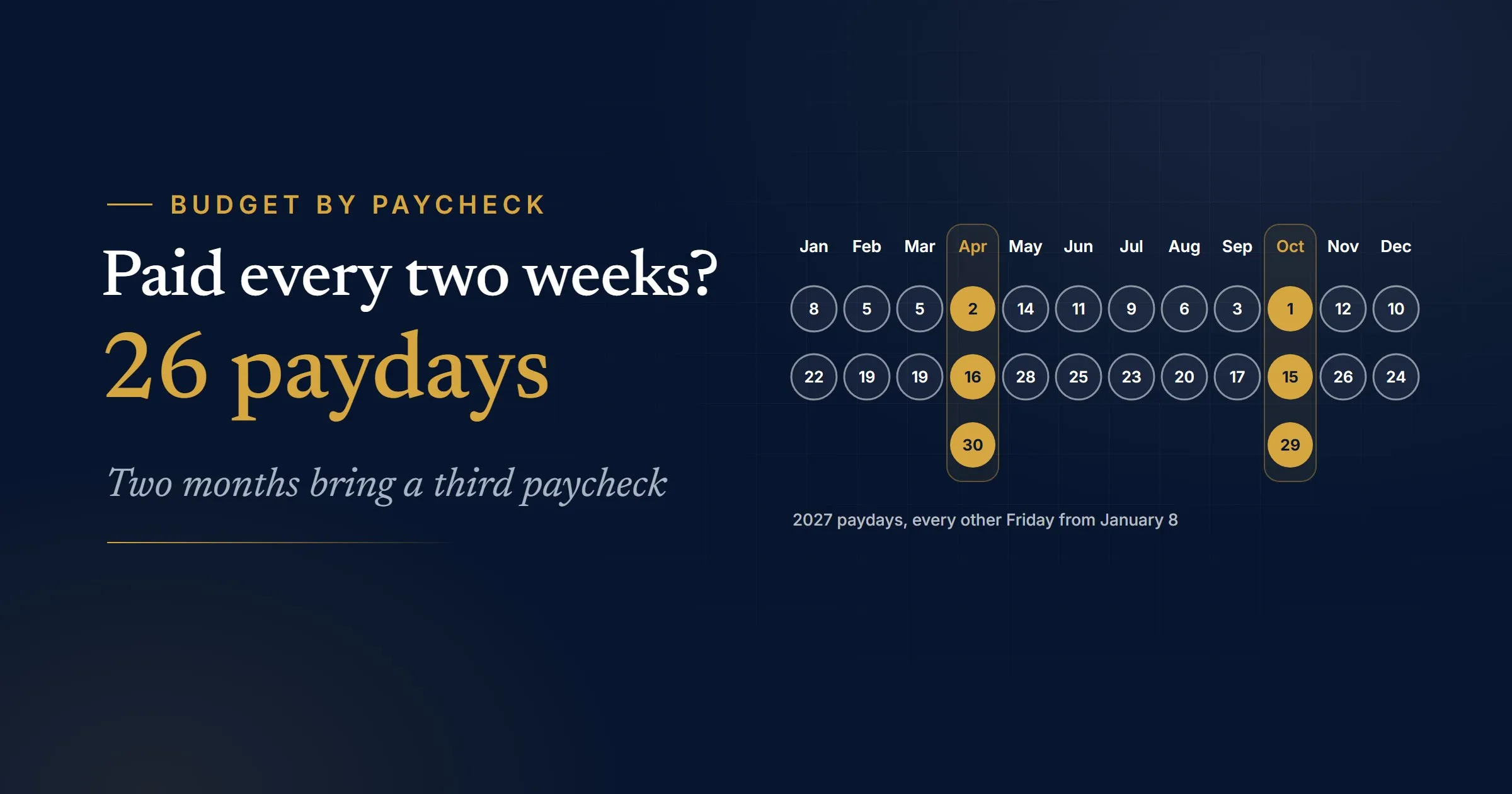
With biweekly pay, two months a year have three paydays, or three months in a year with 27 paydays. Which months depends on your schedule:
| First payday of 2027 | Three-paycheck months | Paydays |
|---|---|---|
| Friday, January 1 | January, July and December | 27 |
| Friday, January 8 | April and October | 26 |
Over a year, 26 paychecks is two more than a plan built on two a month expects. In the example, two paychecks make $4,000 a month, while the true monthly average is $4,333.33. That’s $4,000 a year a two-paycheck plan doesn’t count.
Don’t assume the third paycheck itself is the free one. In the example, April’s paydays are April 2, April 16 and April 30. The April 30 paycheck still owes half of May’s rent. The slack shows up on April 2, which has no rent to cover because April’s rent came from the March paychecks, and leaves $1,050 to spend. Decide before payday where that money goes: a cushion for lean paychecks like May 14, an emergency fund, extra debt payments or a sinking fund.
Weekly, twice-a-month and monthly pay
- Every week. Plan on four paychecks a month. A $1,000 weekly paycheck averages $4,333.33 a month, while four paychecks make $4,000. The difference comes in five-paycheck months: with Friday paydays in 2027, those are January, April, July, October and December, for 53 paydays in the year. Each paycheck is smaller, so matching bills to paydays matters even more.
- Twice a month. Semimonthly pay comes on set dates, such as the 15th and the last day of the month, so your plan can stay the same every month. Bills due in the first half of the month come from the paycheck at the end of the month before, and the rest from the mid-month one.
- Once a month. One paycheck covers everything, so set aside the money for bills due later in the month first. Without a budget, you might run out of money before your next paycheck.Source 6
Budget by paycheck or by month?
Both. A monthly budget sets the amounts: how much goes to rent, groceries, savings and everything else. A paycheck plan handles the timing. If you’re coming up short at the end of the month, the timing of your bills and income may not match,Source 7 and that’s what a paycheck plan fixes.
Start with our step-by-step budgeting guide or a zero-based budget, then map it onto your paydays. Our free budget template works for either.
If you’re living paycheck to paycheck
- Start small. When you’re living paycheck to paycheck, putting money aside can feel difficult, but even a small amount can provide some financial security.Source 5
- Line up due dates with paydays. Asking to move a due date can keep one paycheck from carrying too much.Source 5
- Watch automatic payments. Know when they’ll come out and how much they’ll be, so a payment doesn’t hit before your paycheck does.Source 4
- Work toward a paycheck ahead. Each extra paycheck you keep in reserve makes the next lean one easier, and over time lets you pay bills with money you already have.
Common questions
How do you budget biweekly pay?
Work out your monthly average (paycheck × 26 ÷ 12), match each bill to the paycheck before its due date, split big bills like rent across two paychecks, and give the rest of each paycheck a job.
How much is $2,000 every two weeks per month?
About $4,333.33 on average: $2,000 × 26 ÷ 12. Most months bring two paychecks, or $4,000.
Which months have three paychecks in 2027?
It depends on your paydays. If you’re paid every other Friday starting January 8, 2027, they’re April and October. If your first payday is Friday, January 1, they’re January, July and December.
Is it better to be paid weekly or biweekly?
Over a year, you’re paid the same. Weekly pay means smaller, more frequent paychecks, which can make bills easier to time. Biweekly pay means bigger paychecks and two months a year with a third one.
What’s the difference between biweekly and semimonthly pay?
Biweekly pay comes every two weeks, 26 times a year, on a date that moves through the month. Semimonthly pay comes twice a month on set dates, 24 times a year. On the same yearly pay, each semimonthly paycheck is bigger, but a month never brings a third.
Run your own numbers
See where your take-home pay goes each month.
Open the calculator
Sources
Numbers in the text link to these sources. We check them whenever we update this page.
- 1
Length of pay periods in the Current Employment Statistics survey(external site)
U.S. Bureau of Labor Statistics · Updated August 4, 2023 · Accessed November 19, 2026 · Back to text for source 1
- 2
Your Paycheck Explained(external site)
Federal Trade Commission, consumer.gov · Accessed November 18, 2026 · Back to text for source 2
- 3
Your Money, Your Goals toolkit(external site)
Consumer Financial Protection Bureau · Updated April 24, 2026 · Accessed November 18, 2026 · Back to text for source 3
- 4
Know your overdraft options(external site)
Consumer Financial Protection Bureau · Updated June 4, 2025 · Accessed November 18, 2026 · Back to text for source 4
- 5
An essential guide to building an emergency fund(external site)
Consumer Financial Protection Bureau · Updated October 29, 2025 · Accessed November 18, 2026 · Back to text for source 5
- 6
Making a Budget(external site)
Federal Trade Commission, consumer.gov · Accessed November 18, 2026 · Back to text for source 6
- 7
Budgeting: How to create a budget and stick with it(external site)
Consumer Financial Protection Bureau (archived blog post) · Published June 5, 2019 · Accessed November 18, 2026 · Back to text for source 7
About the author
Wealthistry Editorial Team
Research, writing and editing
The team that researches, writes, fact-checks and updates Wealthistry's guides and calculators, following our published editorial standards.
Author profileEditorial policyHow we researchReport an error