When you owe on several debts, the two best-known ways to pay them down are the debt avalanche and the debt snowball. The Consumer Financial Protection Bureau calls them the highest interest rate method and the snowball method.Source 1
Both work. The avalanche usually costs less; the snowball pays off whole debts sooner. This guide runs both on the same debts with exact totals, shows when the difference is big and when it barely matters, and looks at what research says about sticking with a plan. Every example uses the same math as our Debt Payoff Calculator.
How the two methods work
The methods share the same steps. They differ only in which debt gets your extra money first.
- List every debt with its balance, interest rate (APR) and minimum payment.
- Pay at least the minimum on every debt every month.
- Put all your extra money toward one target debt.
- When the target is paid off, move its payment to the next debt in line. The payment you freed up adds to the next one, creating a “snowball” of payments as you eliminate each debt.Source 1
The order is what sets them apart:
- Avalanche: highest APR first. You go after the debt that’s costing you the most, which can save you money in the long run, even if it doesn’t feel like you’re making progress at first.Source 1
- Snowball: smallest balance first. You see progress quickly as small debts disappear, but you may end up paying more in the long run, because you aren’t focusing on the larger or more costly debts.Source 1
The same debts, paid off both ways
Here’s a household with four debts and $250 a month to put toward them on top of the minimums:
| Debt | Balance | APR | Minimum |
|---|---|---|---|
| Store card | $900 | 29.99% | $35 |
| Credit card | $6,200 | 24.49% | $186 |
| Medical bill | $1,400 | 0% | $70 |
| Personal loan | $8,500 | 11.5% | $260 |
The minimums add up to $551, so the household pays $801 a month in total. Interest is charged monthly at each debt’s APR, a simplification: card issuers usually figure it daily, as our guide to how credit card interest works explains.
Both methods start with the store card, because it has the smallest balance and the highest APR. It’s paid off in month 4 either way. Then they split: the avalanche moves on to the 24.49% credit card, while the snowball clears the $1,400 medical bill, which charges no interest.
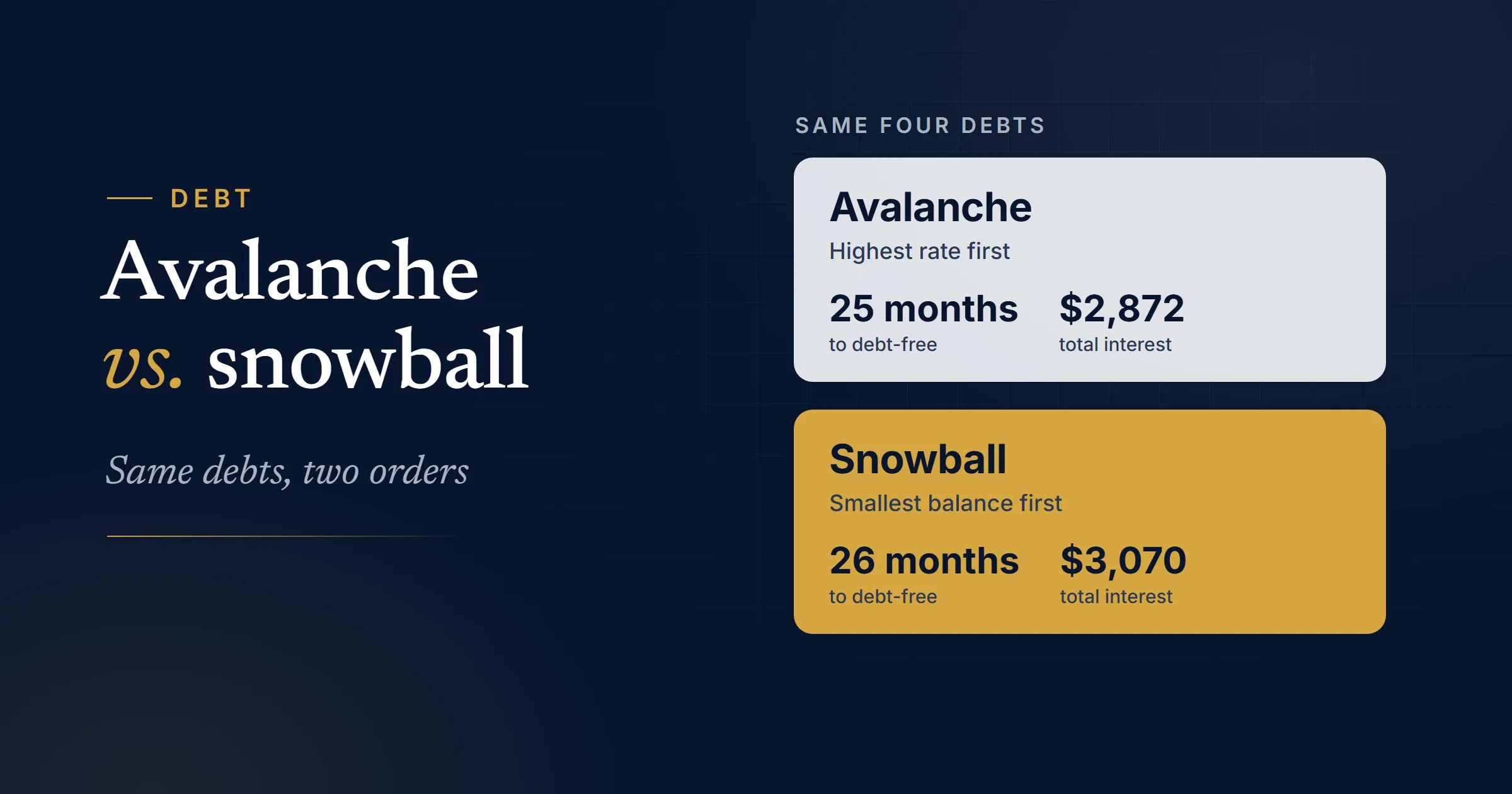
| Method | Debt-free in | Total interest |
|---|---|---|
| Avalanche | 25 months | $2,872 |
| Snowball | 26 months | $3,070 |
| Minimums only | 57 months | $6,604 |
Interest is rounded to the nearest dollar.
| Debt | Avalanche | Snowball |
|---|---|---|
| Store card | Month 4 | Month 4 |
| Credit card | Month 19 | Month 19 |
| Medical bill | Month 20 | Month 7 |
| Personal loan | Month 25 | Month 26 |
The avalanche finishes 1 month sooner and saves $198 in interest. The snowball pays off the medical bill in month 7 instead of month 20, so by month 7, two of the four debts are gone, compared with one under the avalanche. That’s the trade: a modest amount of money for faster visible progress.
Either way, the plan is a big improvement on paying only the minimums. That would take 4 years and 9 months and cost $6,604 in interest, so the avalanche saves $3,732 and finishes 2 years and 8 months sooner.
When the snowball costs much more
The gap depends on where the interest rates sit. It’s widest when your smallest debts have the lowest rates and your largest debt has the highest:
| Debt | Balance | APR | Minimum |
|---|---|---|---|
| Large card | $9,000 | 27.99% | $270 |
| Small loan | $1,500 | 6% | $60 |
| Medium card | $3,000 | 19.99% | $90 |
| Method | Debt-free in | Total interest |
|---|---|---|
| Avalanche | 26 months | $3,777 |
| Snowball | 27 months | $4,505 |
Interest is rounded to the nearest dollar.
The snowball pays off the 6% loan first, in month 5, while the 27.99% card keeps building interest. The avalanche attacks that card first and clears it in month 23. Here the avalanche saves $728.
The opposite is also true: when your smallest debt also has the highest rate, the two methods pay it first, just as both did with the store card above.
How much extra you pay matters more than the method
Here’s the first household again with different amounts of extra money each month, showing the total interest under each method:
| Extra each month | Avalanche | Snowball | Difference |
|---|---|---|---|
| $100 | $4,061 | $4,166 | $105 |
| $250 | $2,872 | $3,070 | $198 |
| $500 | $1,963 | $2,174 | $211 |
The first household's four debts. Interest is rounded to the nearest dollar.
Raising the extra payment from $100 to $500 a month cuts the avalanche’s interest from $4,061 to $1,963, a saving of $2,098. That’s far bigger than the difference between the methods at any of these amounts. If you can find more money for your debts, it will do more than choosing the perfect order.
What research says about sticking with it
The avalanche wins on paper, but a plan only works if you keep following it. Several studies have looked at how people actually pay down multiple debts:
- People tend to pay small debts first, even when it costs more. In four experiments with a debt repayment game, participants consistently paid off small debts first, even when larger debts had higher interest rates. Drawing their attention to the interest each debt had built up helped them reduce their overall debt more quickly.Source 2
- Closing accounts seems to keep people going. In data from a debt settlement company, paying off whole accounts predicted whether people eliminated their debt, regardless of the dollar balances of the accounts they closed.Source 3
- Starting small can help motivation. In one study, people were more motivated to keep paying down debt when they started with the smallest balance.Source 4
The takeaway: the math favors the avalanche, while quick wins can favor the snowball. The CFPB’s advice is to choose based on what motivates you. If it’s saving the most money, the highest interest rate method may be right for you; if it’s seeing progress quickly, consider the snowball.Source 1
How to choose
The avalanche may suit you if:
- Your interest rates are far apart, especially if your largest balance has the highest rate.
- Seeing the interest you’re saving keeps you motivated.
- You can stay patient while the first big debt shrinks.
The snowball may suit you if:
- You have several small debts you could clear within a few months.
- Your rates are close together, so the order costs little.
- You’ve tried to pay down debt before and lost momentum.
You can also switch partway through. Some people clear one or two very small debts for a quick win, then switch to the avalanche for the rest. Enter your own debts in the Debt Payoff Calculator to see the difference in dollars before you decide, and see our step-by-step guide to paying off debt for the rest of the plan.
Make either method work better
- Pay more than the minimum. Credit card statements must warn that if you make only the minimum payment, you’ll pay more in interest and take longer to pay off your balance.Source 5 Our minimum payment guide shows how much longer.
- Find the extra in your budget. A written budget shows where extra money for your target debt can come from each month. Our step-by-step budgeting guide walks through one.
- Stop adding new charges to the debts you’re paying off, or the target keeps moving.
- Keep a small emergency fund. Without savings, a surprise bill can end up on a credit card or a loan, which can make it much more expensive because of interest and fees.Source 6 Our emergency fund guide suggests starting with $500, and our guide to paying off debt or saving first shows how little that cushion costs.
- Put windfalls toward the target. A tax refund or bonus paid toward your target debt shortens the whole plan. The calculator has a field for a one-time payment.
- Write the plan down. The CFPB offers a debt reduction worksheet; you’ll need copies of your bills and your interest payment information to fill it in.Source 1
Common questions
Which is faster, the snowball or the avalanche?
Usually the avalanche, because less of your money goes to interest. In our first example, it finished 1 month sooner. The snowball pays off individual debts sooner, which can make it feel faster.
Is the debt snowball a bad idea?
No. It usually costs more interest than the avalanche, but if it keeps you paying, it can still get you out of debt far sooner than paying only the minimums. In our first example, the snowball cost $198 more than the avalanche, but both saved thousands compared with minimums only.
What if two debts have the same rate or the same balance?
Then the order between those two barely matters. Our calculator breaks a tie in APR by paying the smaller balance first, and a tie in balance by paying the higher rate first.
Should I include my mortgage or car loan?
You can, but low-rate debts usually come last under the avalanche anyway. Many people focus extra payments on high-interest debt such as credit cards and keep paying the minimum on a mortgage.
Can I combine the two methods?
Yes. You might pay off a very small debt first for a quick win, then switch to highest APR first. Any order that keeps every minimum paid and puts extra money on one debt at a time will work; the order only changes how much interest you pay and how soon each debt disappears.
Run your own numbers
Compare snowball and avalanche plans side by side.
Open the calculator
Sources
Numbers in the text link to these sources. We check them whenever we update this page.
- 1
How to reduce your debt(external site)
Consumer Financial Protection Bureau (archived blog post) · Published July 16, 2019 · Accessed November 18, 2026 · Back to text for source 1
- 2
Winning the Battle but Losing the War: The Psychology of Debt Management(external site)
Moty Amar, Dan Ariely, Shahar Ayal, Cynthia E. Cryder and Scott I. Rick, Journal of Marketing Research (2011) · Accessed November 18, 2026 · Back to text for source 2
- 3
Can Small Victories Help Win the War? Evidence from Consumer Debt Management(external site)
David Gal and Blakeley B. McShane, Journal of Marketing Research (2012) · Accessed November 18, 2026 · Back to text for source 3
- 4
Research: The Best Strategy for Paying Off Credit Card Debt(external site)
Harvard Business Review · Published December 27, 2016 · Accessed November 17, 2026 · Back to text for source 4
- 5
12 CFR 1026.7, Periodic statement (Regulation Z, Truth in Lending)(external site)
Electronic Code of Federal Regulations · Accessed November 18, 2026 · Back to text for source 5
- 6
An essential guide to building an emergency fund(external site)
Consumer Financial Protection Bureau · Updated October 29, 2025 · Accessed November 18, 2026 · Back to text for source 6
About the author
Wealthistry Editorial Team
Research, writing and editing
The team that researches, writes, fact-checks and updates Wealthistry's guides and calculators, following our published editorial standards.
Author profileEditorial policyHow we researchReport an error