Your credit card’s minimum payment is the smallest amount you can pay by the due date and still be on time. Paying it keeps your account in good standing, but it pays the balance down slowly. That’s why every statement must carry this warning: “If you make only the minimum payment each period, you will pay more in interest and it will take you longer to pay off your balance.”Source 1
This guide explains how minimum payments are calculated, what paying only the minimum really costs, and how to pay off a balance much faster. The examples use a $5,000 balance at a 22.36% APR, the Federal Reserve’s average for card accounts charged interest in the third quarter of 2026.Source 2 Every figure is worked out with the same math as our Credit Card Payoff Calculator.
How the minimum payment is calculated
Each card issuer sets its own formula, and your cardholder agreement explains how your card’s minimum is worked out. Formulas are built from a percentage of your balance, sometimes plus that month’s interest, with a dollar amount as the lowest minimum. Here are two examples:
- A percentage plus interest. For example, 1% of the balance plus that month’s interest, at least $35. This is the example rule in our calculator.
- A flat percentage. For example, 2% of the outstanding balance or $20, whichever is greater. That’s the formula federal rules use in their sample calculation of the payoff figures on a statement.Source 3
The first minimum on $5,000 at a 22.36% APR
A month’s interest is $5,000 × 22.36% ÷ 12 = $93.17, so the new balance is $5,093.17.
- 1% plus interest, at least $35: 1% of the new balance is $50.93. Add the $93.17 of interest and the minimum is $144.10. Of that, $93.17 (65%) covers interest and $50.93 pays down the balance.
- 2% or $20: the minimum is $101.86, but $93.17 of it is interest, so only $8.69 comes off the balance.
At a high APR, a flat 2% barely gets ahead of the interest. Paying only that minimum, the example balance would still be $4,057 after ten years, and it wouldn't be paid off within 50 years. Federal bank regulators expect card lenders to require minimum payments that pay off the balance over a reasonable period of time, and have warned about minimums that don’t cover each month’s finance charges and fees.Source 4
What paying only the minimum costs
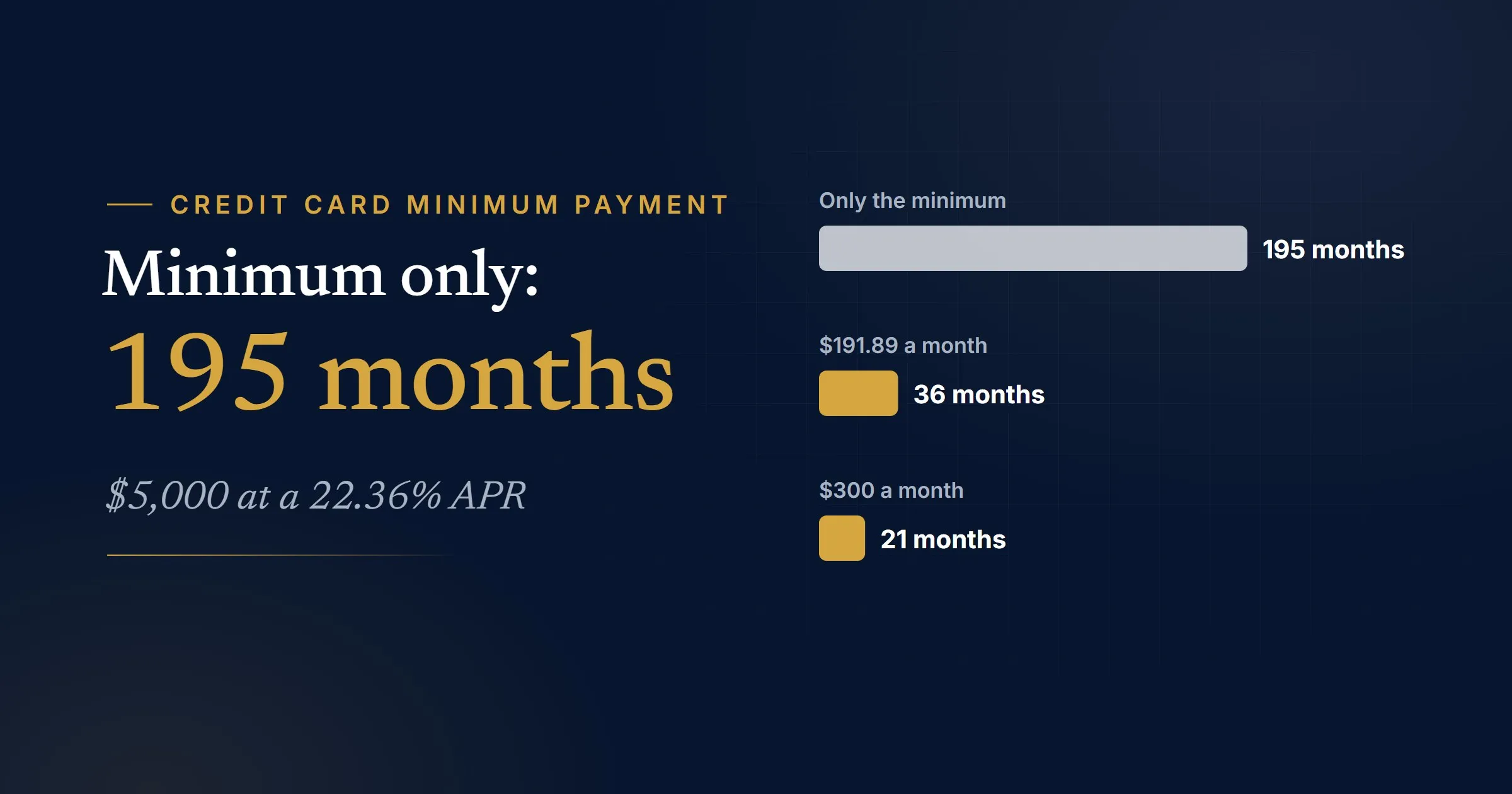
A minimum based on your balance shrinks as the balance does. In the example, the 1%-plus-interest minimum starts at $144.10 and falls each month, until it reaches the $35 floor in the final years. Paying only the minimum, the $5,000 takes 16 years and 3 months to pay off and costs $7,682 in interest, for $12,682 in total.
Paying a fixed amount instead changes everything:
| How you pay | First payment | Time | Interest |
|---|---|---|---|
| Only the minimum | $144.10 | 195 months | $7,682 |
| First minimum, every month | $144.10 | 57 months | $3,118 |
| Paid off in 3 years | $191.89 | 36 months | $1,908 |
| $300 a month | $300 | 21 months | $1,043 |
The minimum is 1% of the balance plus that month's interest, at least $35. No new charges. Interest is the balance × APR ÷ 12 each month.
Notice the second row. Simply paying your first minimum, $144.10, every month instead of letting the payment shrink clears the card in 4 years and 9 months and saves $4,564 in interest.
The minimum payment warning on your statement
Below the warning, your statement must show how long it would take to pay off the balance making only minimum payments, and the total you’d pay. If that’s two years or more, the time is rounded to the nearest year. Unless minimum payments would pay off the balance within about three years, it must also show the monthly payment that would pay it off in 36 months, what that would cost in total and how much you’d save. And it must give a toll-free number for information about credit counseling.Source 1 Here’s roughly what that box would say for the example balance:
| If you pay each month | You'll pay off the balance in about | And pay an estimated total of |
|---|---|---|
| Only the minimum payment | 16 years | $12,682 |
| $191.89 | 3 years | $6,908 |
Worked out with our calculator's monthly interest math; your card issuer's figures may differ slightly. Totals include the $5,000 you borrowed.
Paying $191.89 a month for three years would save an estimated $5,774. The estimates are based on your balance on the statement date and don’t take future purchases into account. You don’t have to pay more than the minimum, but the more you pay each month, the less interest you’ll pay over time.Source 5
Minimum payment vs. statement balance vs. current balance
Your statement and your online account show several amounts. Here’s what each one means:
- Minimum payment due is the least you can pay by the due date and still be on time. Next to it, your statement must show the due date, the late fee and any higher APR that could apply if you pay late.Source 1
- Statement balance, or new balance, is what you owed on the closing date of the billing cycle.Source 1 If your card has a grace period, paying this amount in full by the due date means you’re not charged interest on purchases.Source 6
- Current balance is what you owe right now, including any purchases and payments since the statement closed. Charges made after the closing date appear on your next statement.
Paying the statement balance is the target if you can. Paying the minimum protects you from late fees but leaves the rest of the balance costing interest. Our guide to how credit card interest works shows how that interest is calculated.
What happens if you pay less than the minimum
Paying less than the minimum, or paying late, can cost you in several ways:
- A late fee. Your statement shows the amount of any late payment fee.Source 1
- A penalty APR. If your minimum payment is more than 60 days late, your card issuer can raise the APR on your existing balance. It must give you written notice at least 45 days before the increase,Source 7 and if you then make six minimum payments in a row on time, it must lower the rate on that balance back to what it was.Source 8
- Damage to your credit history. Credit reporting companies can generally report negative information about your payment history for up to seven years.Source 9
You also have protections. Your due date must be the same day every month,Source 1 and card issuers must have procedures to make sure your statement is mailed or delivered at least 21 days before the payment is due. A minimum payment that arrives within 21 days after your statement was mailed or delivered can’t be treated as late.Source 10
If you can’t make the minimum this month, contact your card issuer before the due date to ask about your options, and consider calling the credit counseling number on your statement.
Why your minimum payment changed
Because the minimum follows a formula, it moves when the inputs do:
- Your balance went up. New purchases raise a percentage-based minimum, and paying the balance down lowers it.
- Your interest went up. If your formula includes that month’s interest, a higher APR or a higher balance raises the minimum. A variable APR can rise when the index it follows goes up.Source 8
- A promotional rate ended. Once the regular APR applies, a formula that includes interest asks for more each month.
Your cardholder agreement explains exactly how your card’s minimum is calculated.
How to pay off a card faster
- Pay the statement balance in full if you can, so new purchases stay interest-free.Source 6
- Pick a fixed payment and stick to it. Your first minimum payment is an easy place to start, and the three-year payment on your statement is a good target.
- Never miss the minimum. Paying at least the minimum on time keeps late fees and penalty rates away. Then pay extra whenever you can.
- Stop adding new charges to the card you’re paying off. While you carry a balance, new purchases are charged interest from the day you make them.Source 6
- Choose an order for several cards. Our debt snowball vs. avalanche guide compares paying the smallest balance first with paying the highest APR first.
To see your own numbers, enter your balance, APR and your card’s minimum payment rule in the Credit Card Payoff Calculator. If you have several debts, our step-by-step guide to paying off debt builds a full plan.
Common questions
What is the minimum payment on a credit card?
It’s the smallest amount you must pay by the due date each month to stay current on the account. Your statement shows it alongside the due date and any late fee.Source 1
How is the credit card minimum payment calculated?
With a formula set by your card issuer, explained in your cardholder agreement. Formulas use a percentage of the balance, sometimes plus that month’s interest, with a dollar floor, such as 2% of the balance or $20, whichever is greater.Source 3
What happens if I only pay the minimum?
You stay current and avoid late fees, but you pay much more interest and take much longer to pay off the balance.Source 1 In our example, paying only the minimum on $5,000 at a 22.36% APR takes 16 years and 3 months and costs $7,682 in interest.
What’s the minimum payment on $1,000, $5,000 or $10,000?
It depends on your card’s formula and APR. With 1% of the balance plus interest, at least $35, at a 22.36% APR:
| Balance | First minimum | Time at the minimum | Interest |
|---|---|---|---|
| $1,000 | $35 | 42 months | $441 |
| $2,000 | $57.64 | 106 months | $2,194 |
| $3,000 | $86.46 | 145 months | $4,023 |
| $5,000 | $144.10 | 195 months | $7,682 |
| $10,000 | $288.19 | 263 months | $16,828 |
At a 22.36% APR, paying only the minimum, with no new charges.
Is it better to pay the minimum or the statement balance?
The statement balance, if you can. If your card has a grace period, paying the statement balance in full by the due date means no interest on purchases.Source 6 The minimum only keeps you from being late.
Does paying only the minimum hurt my credit score?
Paying at least the minimum on time keeps your payment history positive, and a positive payment history helps you build and keep a strong credit score.Source 9 The cost of paying only the minimum is the interest, which keeps adding up while you carry the balance.
Run your own numbers
Estimate your payoff date and the total interest you'd pay.
Open the calculator
Sources
Numbers in the text link to these sources. We check them whenever we update this page.
- 1
12 CFR 1026.7, Periodic statement (Regulation Z, Truth in Lending)(external site)
Electronic Code of Federal Regulations · Accessed November 18, 2026 · Back to text for source 1
- 2
Consumer Credit - G.19(external site)
Board of Governors of the Federal Reserve System · Published November 6, 2026 · Accessed November 18, 2026 · Back to text for source 2
- 3
Appendix M2 to Part 1026, Sample Calculations of Repayment Disclosures (Regulation Z)(external site)
Consumer Financial Protection Bureau · Accessed November 18, 2026 · Back to text for source 3
- 4
Account Management and Loss Allowance Guidance for Credit Card Lending(external site)
Federal Deposit Insurance Corporation and other federal bank regulators · Published January 8, 2003 · Accessed November 18, 2026 · Back to text for source 4
- 5
Consumer Financial Protection Bureau · Last reviewed January 22, 2024 · Accessed November 18, 2026 · Back to text for source 5
- 6
What is a grace period for a credit card?(external site)
Consumer Financial Protection Bureau · Last reviewed September 23, 2024 · Accessed November 18, 2026 · Back to text for source 6
- 7
12 CFR 1026.9, Subsequent disclosure requirements (Regulation Z, Truth in Lending)(external site)
Electronic Code of Federal Regulations · Accessed November 18, 2026 · Back to text for source 7
- 8
Electronic Code of Federal Regulations · Accessed November 18, 2026 · Back to text for source 8
- 9
How long does information stay on my credit report?(external site)
Consumer Financial Protection Bureau · Last reviewed September 2, 2026 · Accessed November 18, 2026 · Back to text for source 9
- 10
12 CFR 1026.5, General disclosure requirements (Regulation Z, Truth in Lending)(external site)
Electronic Code of Federal Regulations · Accessed November 18, 2026 · Back to text for source 10
About the author
Wealthistry Editorial Team
Research, writing and editing
The team that researches, writes, fact-checks and updates Wealthistry's guides and calculators, following our published editorial standards.
Author profileEditorial policyHow we researchReport an error