Saving money comes down to two things: spending less than you earn, and making sure the difference actually lands in savings instead of getting spent. The habit pays off. In the Federal Reserve’s 2025 survey, 86% of adults who always had money left over at the end of the month had savings to cover three months of expenses, compared with 13% of those who never had money left over.Source 1
This guide covers 12 practical ways to save, a worked example of how small changes add up, and how to start if money is tight.
Start with three steps
- Pick a goal. A specific goal, such as an emergency fund or a vacation, helps you stay motivated.Source 2
- Find the money. Track what you spend for a month to see where it goes; our guide to making a budget walks through it.
- Make it automatic. Set a specific amount to move to savings on a schedule, so you save before you can spend it.Source 2
12 ways to save money
Build the habit
- Set a specific goal. Knowing what you’re saving for, and how much, makes it easier to stick with. When you reach a goal, celebrate it and set the next one.Source 2
- Track your spending. Logging what you spend, even one week at a time, shows where your money really goes and where you could cut back.Source 3 The CFPB’s free toolkit includes a spending tracker and a tool for cutting expenses.Source 4
- Pay yourself first with automatic transfers. A recurring transfer from checking to savings is one of the easiest ways to save consistently. Keep an eye on your balance so a transfer doesn’t overdraw your account.Source 2
- Split your paycheck. If you’re paid by direct deposit, ask your employer whether part of each paycheck can go straight to savings.Source 2
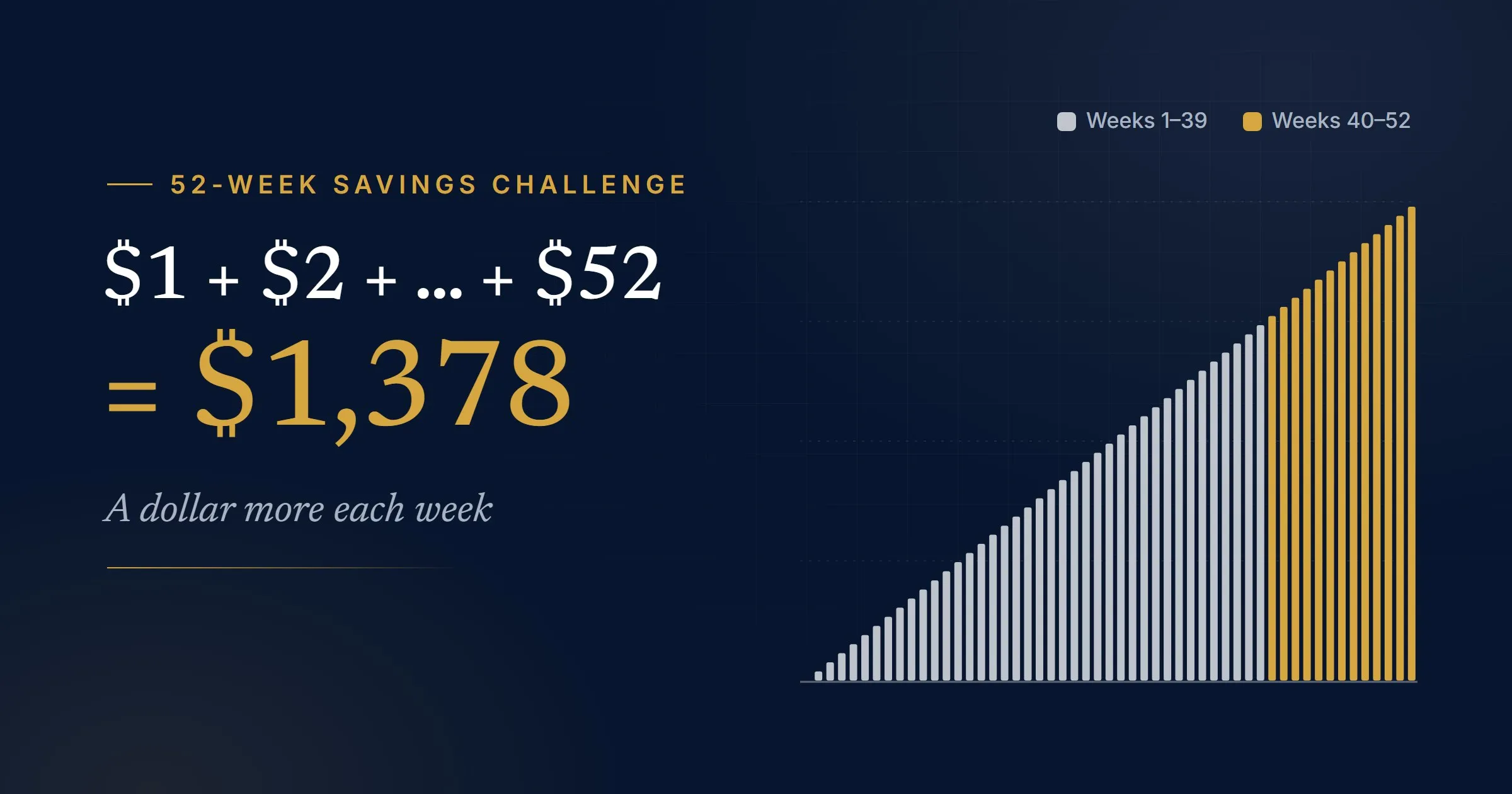
- Start small. If putting money aside feels hard, even a small amount can provide some financial security.Source 2 The 52-week savings challenge starts at $1 a week.
- Save windfalls. A tax refund is one of the largest checks many people get all year. Saving all or part of it, or of a cash gift, can build savings quickly.Source 2
Spend less
- Cut recurring costs. Subscriptions, memberships, phone plans and insurance renew automatically. Review them once a year and cancel or shop around for the ones you don’t need at that price.
- Eat out less often. In 2025, the average U.S. household spent $4,142 on food away from home and $6,491 on food at home.Source 5 Cooking a few more meals a week is one of the simplest ways to free up money, as the example below shows.
- Make a plan for impulse buys. If you know you’re prone to impulse spending, decide in advance how you’ll limit it, such as a waiting period before nonessential purchases.Source 3
- Avoid fees. Overdraft fees can add up, and banks can charge one for each overdraft. Track your balance, sign up for low-balance alerts and consider linking checking to savings to cover shortfalls.Source 6
Make your savings work harder
- Pay off high-interest debt. As the SEC’s Investor.gov puts it, no investment strategy pays off as well as, or with less risk than, eliminating high-interest debt.Source 7 Our guide to paying off debt shows how.
- Get your full retirement match. If your employer offers a retirement plan such as a 401(k), the Department of Labor suggests finding out how much you’d need to contribute to get the full employer contribution.Source 8
How small changes add up
Here’s what three everyday changes are worth for someone who eats out and buys lunch often:
| Change | Each month | Each year |
|---|---|---|
| Cook dinner at home two more nights a week, saving $15 each time | $130 | $1,560 |
| Bring lunch three workdays a week, saving $9 each time | $117 | $1,404 |
| Cancel two subscriptions you don't use, at $12 each | $24 | $288 |
| Total | $271 | $3,252 |
Weekly habits are counted over 52 weeks a year.
Together, they free up $271 a month, or $3,252 a year. Moved to savings automatically at the end of each month, at an example rate of 4% APY, that grows to $3,311 after a year, including $59 of interest. After five years, it reaches $17,935, with $1,675 of interest. At the national average savings rate of 0.39% in November 2026,Source 9 the same deposits would reach $16,417, with just $157 of interest. Our Savings Calculator runs the numbers for any amount and rate.
How to save money on a low income
When money is tight, saving can feel out of reach. If your ability to save is limited, managing your cash flow and putting away part of your tax refund are the easiest ways to start.Source 2
- Manage your cash flow. Match bills to paydays, and in weeks when you have a little more, move some of it to savings. You may be able to ask your landlord, utility or card company to move a due date.Source 2 Our budget by paycheck guide shows how.
- Save a set amount each payday, even $5 or $10, and raise it when you can.
- Save part of every windfall, such as a tax refund or a cash gift.Source 2
How much should you save?
A common rule of thumb is the 50/30/20 rule, which puts 20% of take-home pay toward savings and extra debt payments; our 50/30/20 guide explains what to do when that isn’t realistic yet. A good first goal is an emergency fund, which our emergency fund guide breaks into milestones, and sinking funds cover costs you can see coming.
Where to keep your savings
Keep savings somewhere safe, easy to get to and separate from your spending money, so you’re not tempted to spend it on other things.Source 2 A savings account at an insured bank or credit union does all three. Rates differ from bank to bank, so compare what you’d earn; our high-yield savings guide, checking vs. savings guide and FDIC insurance guide cover the details.
Common questions
What is the best way to save money?
Make it automatic. A recurring transfer to savings on payday means you save before you can spend the money.Source 2
How can I save money fast?
Cut a few recurring costs, put any windfall straight into savings, and set up an automatic transfer for whatever you free up.
How much of my paycheck should I save?
The 50/30/20 rule suggests 20% of take-home pay for savings and extra debt payments. If that’s too much for now, start with a smaller amount and raise it over time.
How do I save money if I live paycheck to paycheck?
Start small, match your bills to your paydays, and save part of any windfall. Even a small amount can provide some financial security.Source 2
How do I stop spending money I want to save?
Move it out of your checking account on payday, into a separate savings account, so it isn’t there to spend.
Run your own numbers
Project savings growth using an account's APY.
Open the calculator
Sources
Numbers in the text link to these sources. We check them whenever we update this page.
- 1
Board of Governors of the Federal Reserve System · Accessed November 18, 2026 · Back to text for source 1
- 2
An essential guide to building an emergency fund(external site)
Consumer Financial Protection Bureau · Updated October 29, 2025 · Accessed November 18, 2026 · Back to text for source 2
- 3
Budgeting: How to create a budget and stick with it(external site)
Consumer Financial Protection Bureau (archived blog post) · Published June 5, 2019 · Accessed November 18, 2026 · Back to text for source 3
- 4
Your Money, Your Goals toolkit(external site)
Consumer Financial Protection Bureau · Updated April 24, 2026 · Accessed November 18, 2026 · Back to text for source 4
- 5
Consumer Expenditures--2025(external site)
U.S. Bureau of Labor Statistics · Published October 29, 2026 · Accessed November 18, 2026 · Back to text for source 5
- 6
Know your overdraft options(external site)
Consumer Financial Protection Bureau · Updated June 4, 2025 · Accessed November 18, 2026 · Back to text for source 6
- 7
Pay Off Credit Cards or Other High Interest Debt(external site)
Investor.gov, U.S. Securities and Exchange Commission · Accessed November 18, 2026 · Back to text for source 7
- 8
Top 10 Ways to Prepare for Retirement(external site)
Employee Benefits Security Administration, U.S. Department of Labor · Accessed November 18, 2026 · Back to text for source 8
- 9
National Rates and Rate Caps – November 2026(external site)
Federal Deposit Insurance Corporation · Updated November 16, 2026 · Accessed November 18, 2026 · Back to text for source 9
About the author
Wealthistry Editorial Team
Research, writing and editing
The team that researches, writes, fact-checks and updates Wealthistry's guides and calculators, following our published editorial standards.
Author profileEditorial policyHow we researchReport an error