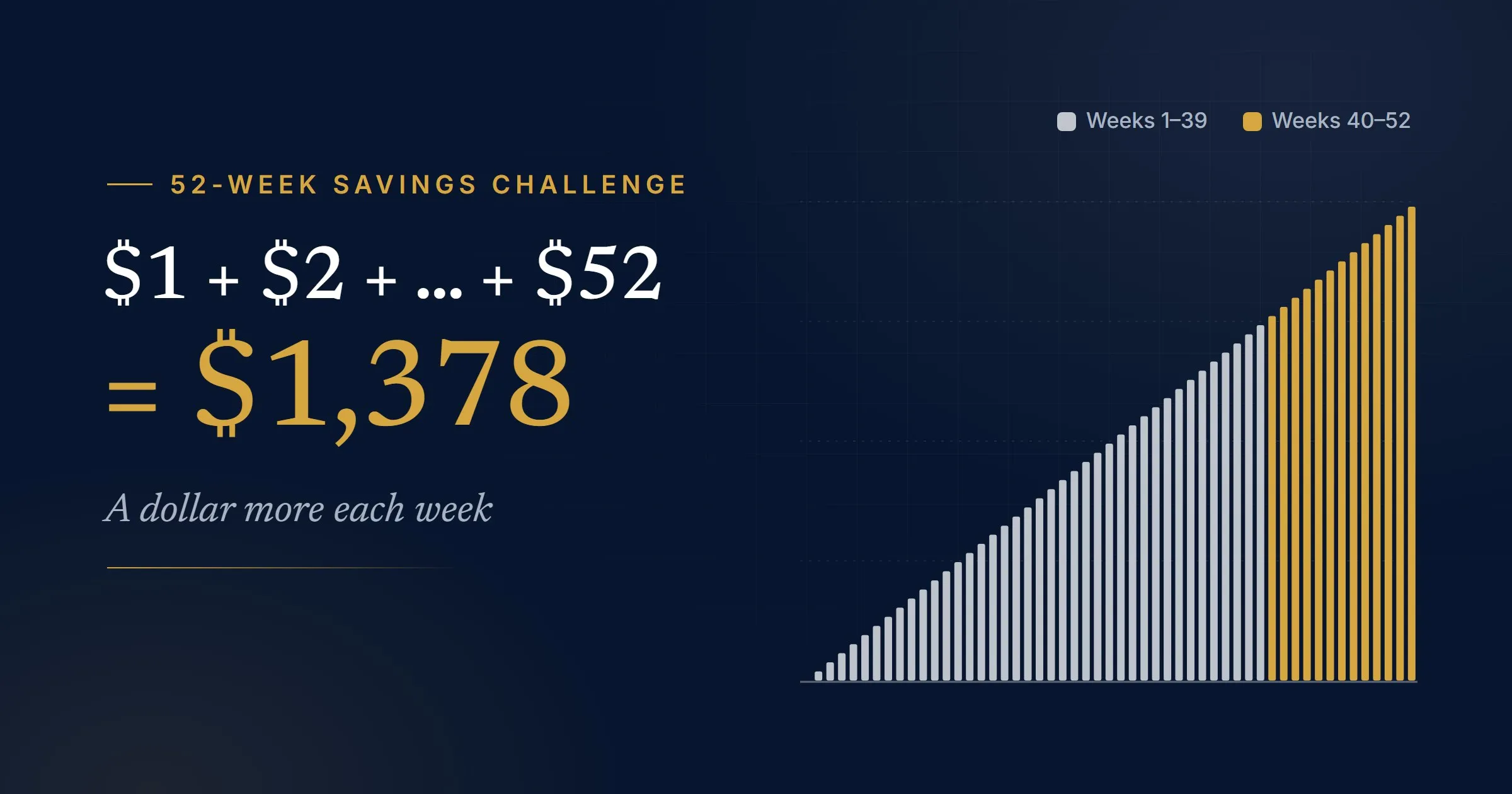
The 52-week savings challenge is a simple way to build a savings habit. You save $1 in the first week, $2 in the second and so on, adding a dollar each week until you save $52 in the last week. By the end of the year, you’ll have saved $1,378.
Below you’ll find the full week-by-week chart, a free printable tracker (PDF), versions that suit different budgets and paychecks, and tips to help you stick with it. Every total in this guide is calculated from the schedules themselves, so the numbers always add up.
How the 52-week savings challenge works
Each week, save the week’s number in dollars: $1 in week 1, $10 in week 10 and $52 in week 52. The first weeks ask for very little, and each week asks for just one dollar more than the last.
Add up all 52 weeks and you get $1,378. That’s $26.50 a week on average, or about $114.83 a month. Here’s the formula behind the total:
Total equals step times weeks times weeks plus one, divided by 2.
- step is how much more you save each week: $1 in the classic challenge
- weeks is how long the challenge runs: 52
With $1 steps, that’s 1 × 52 × 53 ÷ 2 = $1,378. Double the step to $2 and the total doubles too, to $2,756.
The 52-week savings challenge chart
Here’s every week of the classic challenge, with the running total you’ll have once each deposit is made. Prefer paper? Our free printable has the same chart, ready to check off.
Free printable
52-week savings challenge tracker
Three pages: the classic, reverse and every-payday versions, each with a box to check off as you save and a line for your goal. Sized for US Letter paper.
Download the PDF(3 pages, 348 KB)
| Week | Save | Total saved |
|---|---|---|
| Week 1 | $1 | $1 |
| Week 2 | $2 | $3 |
| Week 3 | $3 | $6 |
| Week 4 | $4 | $10 |
| Week 5 | $5 | $15 |
| Week 6 | $6 | $21 |
| Week 7 | $7 | $28 |
| Week 8 | $8 | $36 |
| Week 9 | $9 | $45 |
| Week 10 | $10 | $55 |
| Week 11 | $11 | $66 |
| Week 12 | $12 | $78 |
| Week 13 | $13 | $91 |
| Week 14 | $14 | $105 |
| Week 15 | $15 | $120 |
| Week 16 | $16 | $136 |
| Week 17 | $17 | $153 |
| Week 18 | $18 | $171 |
| Week 19 | $19 | $190 |
| Week 20 | $20 | $210 |
| Week 21 | $21 | $231 |
| Week 22 | $22 | $253 |
| Week 23 | $23 | $276 |
| Week 24 | $24 | $300 |
| Week 25 | $25 | $325 |
| Week 26 | $26 | $351 |
| Week 27 | $27 | $378 |
| Week 28 | $28 | $406 |
| Week 29 | $29 | $435 |
| Week 30 | $30 | $465 |
| Week 31 | $31 | $496 |
| Week 32 | $32 | $528 |
| Week 33 | $33 | $561 |
| Week 34 | $34 | $595 |
| Week 35 | $35 | $630 |
| Week 36 | $36 | $666 |
| Week 37 | $37 | $703 |
| Week 38 | $38 | $741 |
| Week 39 | $39 | $780 |
| Week 40 | $40 | $820 |
| Week 41 | $41 | $861 |
| Week 42 | $42 | $903 |
| Week 43 | $43 | $946 |
| Week 44 | $44 | $990 |
| Week 45 | $45 | $1,035 |
| Week 46 | $46 | $1,081 |
| Week 47 | $47 | $1,128 |
| Week 48 | $48 | $1,176 |
| Week 49 | $49 | $1,225 |
| Week 50 | $50 | $1,275 |
| Week 51 | $51 | $1,326 |
| Week 52 | $52 | $1,378 |
The classic challenge: save the week's number in dollars.
The catch: the classic version saves the most at the end
Because each week asks for a dollar more, most of the saving happens late in the year. Halfway through, you’ll have saved $351, just 25% of the total. The last 13 weeks alone ask for $598, or 43%. If you start in January, those weeks fall in October, November and December: the holiday season.
The reverse challenge flips the order: save $52 in week 1, $51 in week 2 and so on, down to $1 in week 52. The total is the same, but you’ll have $1,027 by the halfway point, and the final weeks ask for only a few dollars.
| Weeks | Classic | Reverse |
|---|---|---|
| 1–13 | $91 | $598 |
| 14–26 | $260 | $429 |
| 27–39 | $429 | $260 |
| 40–52 | $598 | $91 |
Both versions add up to $1,378.
If you’re saving for a $500 starter emergency fund, the reverse version gets you there in week 11, compared with week 32 for the classic version. The trade-off is that the reverse version asks the most of you right away. If $52 in the first week is a stretch, start with the classic version or one of the variations below.
Pick the version that fits your budget
| Version | Amounts | Total |
|---|---|---|
| Classic | $1 in week 1, rising to $52 | $1,378 |
| Reverse | $52 in week 1, falling to $1 | $1,378 |
| Any order | Any amount from $1 to $52 you haven't used yet | $1,378 |
| Same each week | $26.50 every week | $1,378 |
| Every payday | $3 on the first of 26 paydays, rising to $103 | $1,378 |
| Twice a month | $5 on the first of 24 paydays, rising to $120 | $1,500 |
| Double | $2 in week 1, rising to $104 | $2,756 |
| $5 steps | $5 in week 1, rising to $260 | $6,890 |
Paydays assume you're paid every two weeks (26 paydays a year) or twice a month (24).
- Any order. Each week, save any amount from $1 to $52 that you haven’t used yet, and check it off. Pick a small amount in a tight week and a big one when money is looser. Once every amount is checked off, you’ll have $1,378. The classic page of our printable works for this version too.
- Same each week. Saving $26.50 every week reaches the same total, and a fixed amount is the easiest to automate with a single recurring transfer.
- Every payday (biweekly). If you’re paid every two weeks, save two weeks of the chart on each payday: weeks 1 and 2 together come to $3, weeks 3 and 4 to $7, and so on, up to $103 on your 26th payday. That still adds up to $1,378. For a fixed amount instead, save $53 every payday.
- Twice a month. With 24 paydays, start at $5 and save $5 more each payday, up to $120. That adds up to $1,500.
- Bigger steps. Starting at $2 and adding $2 each week doubles the total to $2,756. With $5 steps you’d save $6,890, but the last week alone asks for $260.
If you have a specific target in mind, a steady weekly amount is simpler: $96.16 a week reaches $5,000 in a year, and $192.31 a week reaches $10,000. Our Savings Goal Calculator works out the amount for any goal, date and schedule.
How much interest will you earn?
Not much, and that’s fine. The challenge works because of what you save, not the interest, and since you add the money gradually, most of it sits in the account for only part of the year.
The FDIC’s national average rate for savings accounts was 0.39% in November 2026.Source 1 At that rate, the classic challenge would earn about $1.76 in interest over the year. At a 4% APY, it would earn about $17.84. The reverse version earns more, about $35.86 at 4%, because more of the money goes in early and has longer to grow. These figures assume each deposit is made at the end of its week and the rate stays the same all year.
A higher rate is still worth having. Our checking vs. savings guide explains what to look for in a savings account.
How to make the challenge stick
The Consumer Financial Protection Bureau’s tips for building a savings habit fit the challenge well: set a goal, save consistently, keep an eye on your progress and celebrate your successes.Source 2
Give your savings a purpose
Having a specific goal for your savings can help you stay motivated.Source 2 Before you start, decide what the money is for and write it at the top of your printable.
Start whenever it feels like a fresh start
January 1 is a natural starting point, but you don’t have to wait for it. Research on the “fresh start effect” found that people are more likely to work toward their goals right after the start of a new week, month or year, a birthday or a holiday.Source 3 Next Monday works just as well.
Make each deposit a routine
Saving automatically is one of the easiest ways to save consistently.Source 2 The classic challenge makes that tricky, because the amount changes every week. A few ways around it:
- Schedule several weeks of transfers at once, then add more before they run out.
- Choose the same-each-week version and set up one recurring transfer of $26.50.
- Move the money on the same day each week, ideally right after payday.
If you automate transfers, keep an eye on your checking balance, so a transfer doesn’t overdraw your account and lead to an overdraft fee.Source 2
Track your progress where you can see it
Watching your progress, whether through balance alerts or a running total you write down, can offer gratification and encouragement to keep going.Source 2 Research backs this up: a review of 138 experiments found that monitoring progress toward a goal helped people reach it, and the effect was larger when progress was physically recorded, or when people reported it to others or made it public.Source 4 Check off each week on your printable, and consider taking on the challenge with a partner or a friend.
Keep the money separate
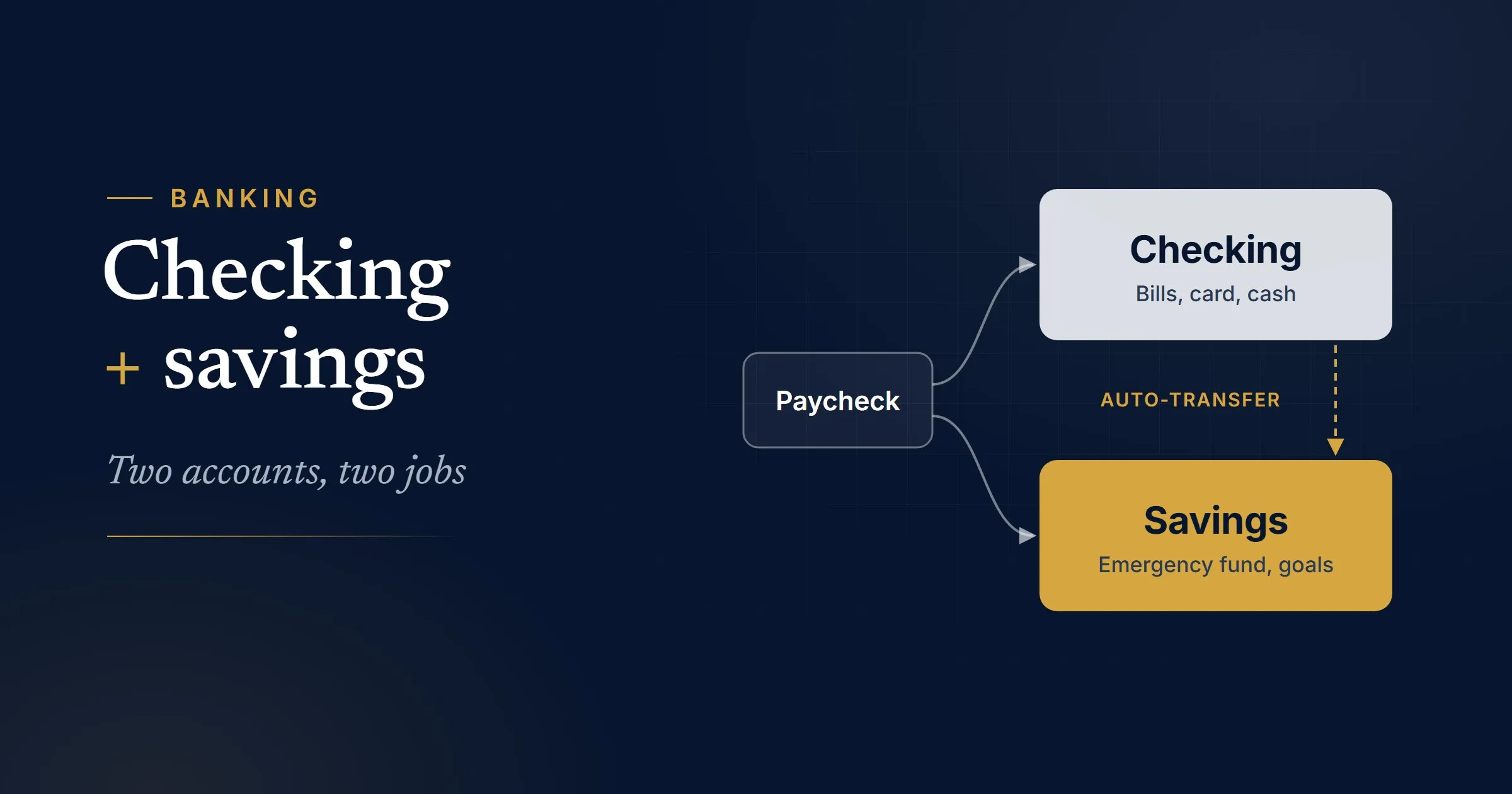
A dedicated savings account keeps the money apart from your everyday spending, so you’re less tempted to dip into it.Source 2 Choose an insured account. At an FDIC-insured bank, deposits are insured up to at least $250,000 per depositor, per ownership category,Source 5 and at a federally insured credit union, the NCUA insures individual accounts up to $250,000.Source 6
Don’t quit after a missed week
If you miss a week, catch up the next week, or switch to the any-order version and pick smaller amounts until you’re back on track. A missed week doesn’t undo the weeks you’ve already saved.
Celebrate your milestones
When you stick with your savings habit, take the time to recognize what you’ve accomplished, and when you reach your goal, set your next one.Source 2 The end of each 13-week quarter makes a natural checkpoint.
What to do with the money
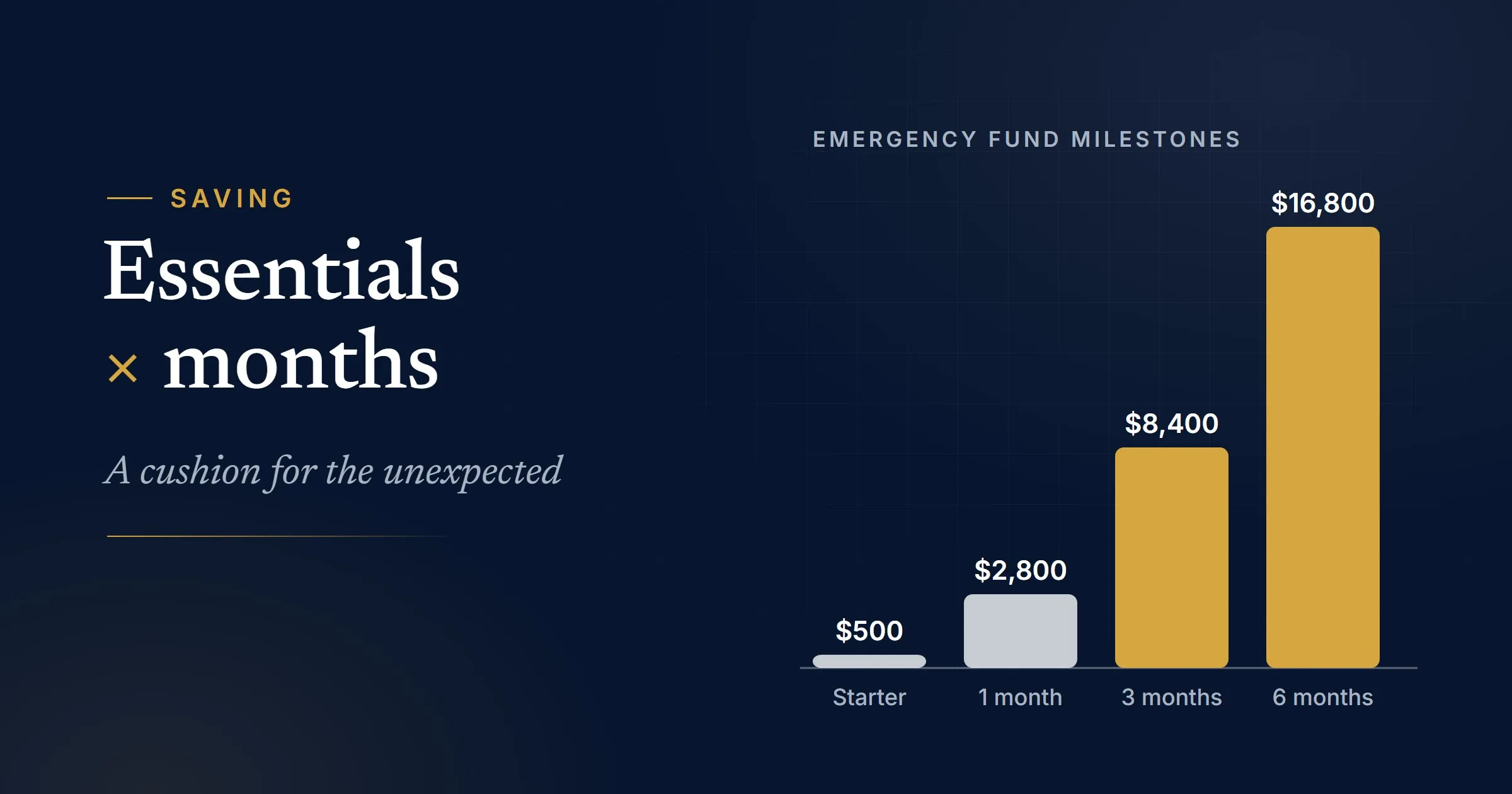
- Start an emergency fund. Our emergency fund guide suggests a $500 starter fund as a first milestone, and the challenge takes you well past it.
- Pay for costs you can see coming. Holidays, annual bills and car registration are easier when the money is already set aside. Our budgeting guide shows how to plan for them each month.
- Pay down high-interest debt. If you carry a credit card balance, our snowball vs. avalanche guide helps you decide which debt to pay first.
- Keep the habit going. Start another round, or turn what you’ve learned into a regular monthly transfer to savings. Our guide to saving money has more ways to find the money.
Common questions
How much money do you save with the 52-week challenge?
You’ll save $1,378 in the classic version, plus a little interest if you keep the money in a savings account. The reverse, any-order, same-each-week and every-payday versions all save the same total.
How much is the 52-week challenge with $5?
If you save $5 in week 1 and $5 more each week, up to $260 in week 52, you’ll save $6,890. Starting at $2 and adding $2 each week saves $2,756.
How do I do the 52-week challenge if I’m paid every two weeks?
Save two weeks of the chart on each payday: $3 on your first payday, $7 on your second and so on, up to $103 on your 26th. You’ll finish with $1,378. The third page of our printable has this schedule.
When should I start the 52-week challenge?
Whenever you’re ready. The challenge works over any 52 weeks, not just a calendar year. If you start in January, keep in mind that the classic version’s biggest weeks land in the holiday season.
What if I can’t afford a week’s amount?
Save what you can and make up the difference later, or switch to the any-order version and choose a smaller amount that week.
Can kids do the 52-week challenge?
Yes, with smaller amounts. In quarters, a child would save 25 cents in week 1, 50 cents in week 2 and so on, up to $13 in week 52, for $344.50 in all. A clear jar makes the progress easy to see.
What’s the 100 envelope challenge?
It’s a similar challenge: you number 100 envelopes from 1 to 100 and fill them in any order, putting in the dollar amount written on each. It adds up to $5,050, about 3.7 times as much as the 52-week challenge, so it asks for a lot more money.
Is the 52-week savings challenge worth it?
If you want to build a savings habit, yes. It starts small, gives you a clear plan for every week and ends with $1,378 saved. If the end of the year is usually tight for you, the reverse or same-each-week version may be a better fit.
Run your own numbers
Work out how much to save, and by when.
Open the calculator
Sources
Numbers in the text link to these sources. We check them whenever we update this page.
- 1
National Rates and Rate Caps – November 2026(external site)
Federal Deposit Insurance Corporation · Updated November 16, 2026 · Accessed November 18, 2026 · Back to text for source 1
- 2
An essential guide to building an emergency fund(external site)
Consumer Financial Protection Bureau · Updated October 29, 2025 · Accessed November 18, 2026 · Back to text for source 2
- 3
The Fresh Start Effect: Temporal Landmarks Motivate Aspirational Behavior(external site)
Hengchen Dai, Katherine L. Milkman and Jason Riis, Management Science (2014) · Accessed November 18, 2026 · Back to text for source 3
- 4
Benjamin Harkin, Thomas L. Webb, Betty P. I. Chang, Andrew Prestwich, Mark Conner, Ian Kellar, Yael Benn and Paschal Sheeran, Psychological Bulletin (2016) · Accessed November 18, 2026 · Back to text for source 4
- 5
Understanding Deposit Insurance(external site)
Federal Deposit Insurance Corporation · Updated April 1, 2024 · Accessed November 18, 2026 · Back to text for source 5
- 6
Share Insurance Coverage(external site)
National Credit Union Administration · Updated November 18, 2026 · Accessed November 18, 2026 · Back to text for source 6
About the author
Wealthistry Editorial Team
Research, writing and editing
The team that researches, writes, fact-checks and updates Wealthistry's guides and calculators, following our published editorial standards.
Author profileEditorial policyHow we researchReport an error