Budgeting is harder when you don’t know what next month’s income will be. It’s a common problem: in 2025, 30% of adults had income that varied at least occasionally during the year, and 11% struggled to pay their bills at some point because their income varied. Among the self-employed, 58% said their income varied from month to month.Source 1
The answer isn’t a different kind of budget. It’s a few habits that turn uneven income into a steady monthly plan. This guide walks through them step by step, following one example year of income with every number worked out.
What counts as irregular income
Your income is irregular if the amount, the timing or both change from month to month. Common examples:
- Freelance, contract and gig work, paid by the project or the job
- Commission sales and tips, which rise and fall with what you sell or serve
- Seasonal work, such as landscaping, tax preparation or holiday retail
- Hourly work with changing shifts, or pay that leans on overtime or bonuses
Step 1: Look back at a year of income
Start with what you actually earned. If you don’t get paid the same amount every month, add up all your income from last year and divide by 12 to estimate your monthly income.Source 2
A year of freelance income
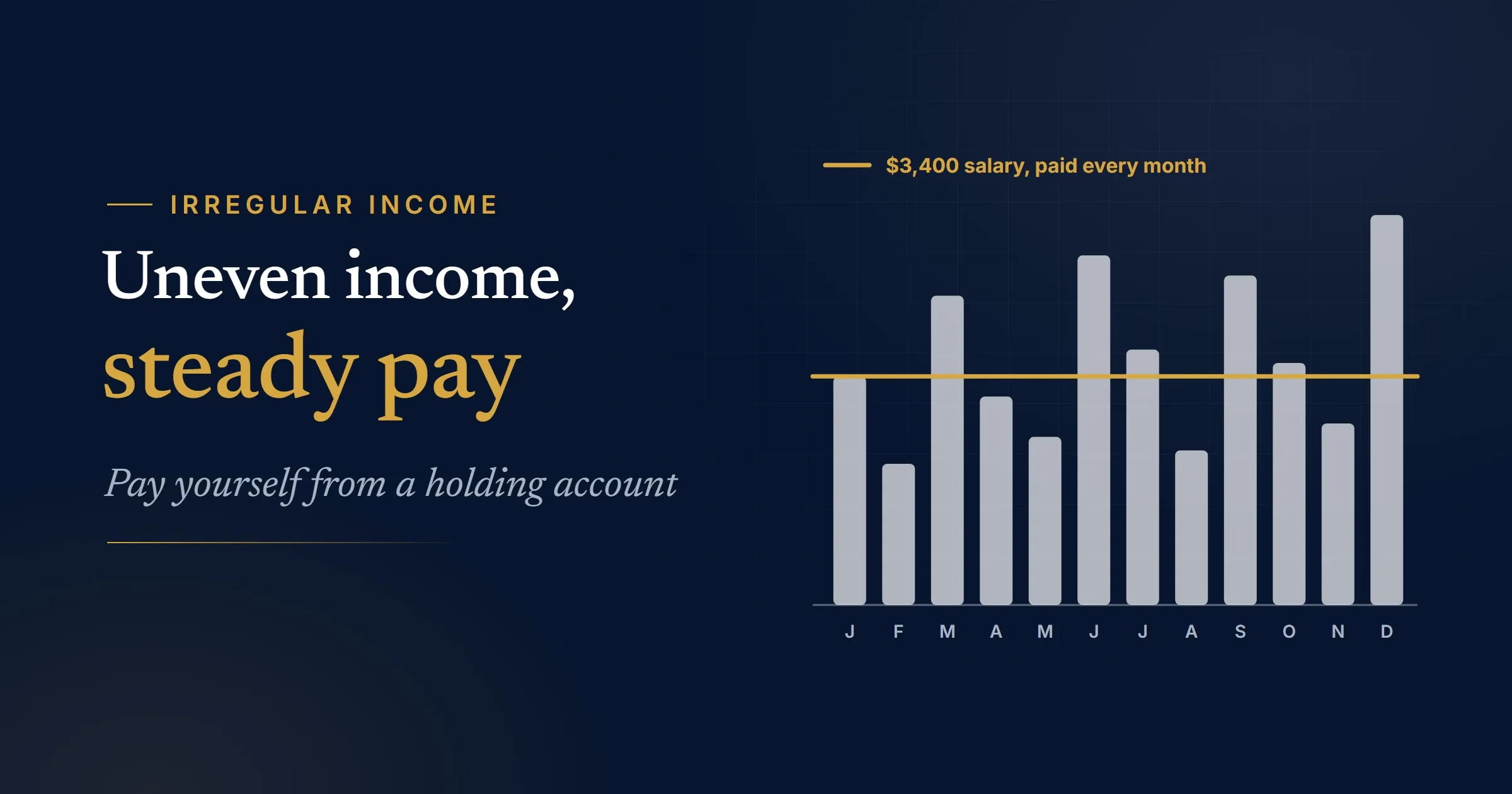
Our example freelancer, after setting money aside for taxes, brought in between $2,100 and $5,800 a month, $44,000 for the year. Divided by 12, that’s $3,666.67 a month.
But 7 of the 12 months came in below that average. A budget that spends the average every month would come up short more often than not.
That’s why the average is a starting point, not the plan. The next steps turn it into one.
Step 2: Set aside money for taxes first
If you work for yourself, no one withholds taxes from your pay. Self-employment tax for Social Security and Medicare is 15.3%: 12.4% for Social Security and 2.9% for Medicare.Source 3 That’s on top of income tax.
You generally have to make estimated tax payments if you expect to owe $1,000 or more when you file. The year is split into four payment periods, each with its own due date, and you may owe a penalty if you pay too little or too late. Your income, deductions and credits from last year are a good starting point for estimating this year’s tax.Source 4
The simplest habit: each time you’re paid, move a share into a separate savings account for taxes before you budget anything else. Treat that money as already spent.
Step 3: Build your budget on your lowest month
List your essential bills, such as housing, utilities, groceries, insurance, transportation and minimum debt payments, and make sure they fit within your lowest typical month. In the example, that’s $2,100. Our budget template and step-by-step budgeting guide show how to list every expense.
If your essentials cost more than your lowest month brings in, you’ll need a bigger cushion (Step 4), lower costs or more income in slow months. Anything you earn above the baseline goes to the priorities you’ll set in Step 5. In the example, that’s $18,800 over the year.
Step 4: Pay yourself a steady salary
Instead of spending what comes in as it arrives, put all your income into one account and pay yourself the same amount each month:
- Open a separate holding account, such as a savings account, and have every payment deposited there.
- Pick a monthly salary between your lowest month and your average. A little below the average lets the account grow over time.
- Start with a buffer, ideally one month’s salary, so a slow first month doesn’t empty the account.
- Transfer the salary to checking on the same day each month, and run your budget on that amount.
Here’s the example year with a $3,400 monthly salary and a $3,400 buffer to start:
| Month | Income | Holding account |
|---|---|---|
| Jan | $3,400 | $3,400 |
| Feb | $2,100 | $2,100 |
| Mar | $4,600 | $3,300 |
| Apr | $3,100 | $3,000 |
| May | $2,500 | $2,100 |
| Jun | $5,200 | $3,900 |
| Jul | $3,800 | $4,300 |
| Aug | $2,300 | $3,200 |
| Sep | $4,900 | $4,700 |
| Oct | $3,600 | $4,900 |
| Nov | $2,700 | $4,200 |
| Dec | $5,800 | $6,600 |
The holding account starts with $3,400. Each month, that month's income goes in and the $3,400 salary comes out.
The account never dropped below $2,100, and it ended the year at $6,600, $3,200 more than it started with. Without it, 5 months would have come up short of the $3,400 budget, by $4,300 in all.
The holding account does what the Consumer Financial Protection Bureau suggests for managing cash flow: in weeks when you have more money available, move a little extra into savings.Source 5
Step 5: Decide where extra money goes
Good months are the time to get ahead, so decide in advance where the extra goes. One order that works:
- Refill the holding account if a slow stretch drew it down.
- Build your emergency fund. A common goal is 3 to 6 months of living expenses;Source 6 with irregular income, aim toward the higher end. Our emergency fund guide shows how.
- Pay down high-interest debt. Our guide to paying off debt or saving first covers the order.
- Save for goals, including retirement.
One-time windfalls deserve the same plan. Saving all or part of a tax refund or a cash gift can help you quickly set up an emergency fund, and the CFPB notes this is particularly helpful for people with irregular income.Source 5
Step 6: Plan for slow months
- Know your due dates. If you come up short at the end of the month, the timing of your bills and your income may not line up.Source 7
- Ask to move due dates. You may be able to work with your landlord, utility companies or credit card companies to adjust when your bills are due.Source 5
- Track your income. The CFPB’s free toolkit includes an income and benefits tracker and a cash flow budget worksheet.Source 8
- Trim before you borrow. If a slow month is coming, cut wants first, so you don’t have to put essentials on a credit card.
Tools that help
Our Monthly Budget Calculator can use a year of income: choose Every year for how often you’re paid and enter your yearly take-home pay, and it divides by 12 for you. To track planned and actual spending each month, use our free budget template.
Common questions
What is irregular income?
Income that changes in amount or timing from month to month, such as freelance or gig pay, commissions, tips or seasonal work.
How do you budget with an irregular income?
Estimate your monthly income from last year’s total divided by 12,Source 2 set aside taxes if you’re self-employed, build your essential budget on your lowest month, and pay yourself a steady salary from a holding account. Put extra money from good months toward a plan you decide in advance.
How much should I keep in my holding account?
At least one month’s salary to start. In our example, a one-month buffer was enough to cover every slow month in the year. If your income swings more, or you’re paid less often, keep more.
How much should I save for taxes if I’m self-employed?
It depends on your income, deductions and credits, so estimate it from last year’s return.Source 4 Remember that self-employment tax alone is 15.3%, before income tax.Source 3
Should my emergency fund be bigger with irregular income?
Yes. A larger fund means a slow stretch or a lost client doesn’t have to go on a credit card. Aim toward the higher end of the common 3-to-6-month goal.Source 6
What are three examples of irregular income?
Freelance or gig pay, sales commissions and seasonal work. Tips and overtime-heavy hourly pay count too.
Run your own numbers
See where your take-home pay goes each month.
Open the calculator
Sources
Numbers in the text link to these sources. We check them whenever we update this page.
- 1
Board of Governors of the Federal Reserve System · Accessed November 18, 2026 · Back to text for source 1
- 2
Making a Budget(external site)
Federal Trade Commission, consumer.gov · Accessed November 18, 2026 · Back to text for source 2
- 3
Self-employment tax (Social Security and Medicare taxes)(external site)
Internal Revenue Service · Last reviewed October 30, 2026 · Accessed November 18, 2026 · Back to text for source 3
- 4
Estimated taxes(external site)
Internal Revenue Service · Last reviewed September 25, 2026 · Accessed November 18, 2026 · Back to text for source 4
- 5
An essential guide to building an emergency fund(external site)
Consumer Financial Protection Bureau · Updated October 29, 2025 · Accessed November 18, 2026 · Back to text for source 5
- 6
Investor Resilience – World Investor Week 2022: Investor Bulletin(external site)
Investor.gov, U.S. Securities and Exchange Commission · Published October 3, 2022 · Accessed November 18, 2026 · Back to text for source 6
- 7
Budgeting: How to create a budget and stick with it(external site)
Consumer Financial Protection Bureau (archived blog post) · Published June 5, 2019 · Accessed November 18, 2026 · Back to text for source 7
- 8
Your Money, Your Goals toolkit(external site)
Consumer Financial Protection Bureau · Updated April 24, 2026 · Accessed November 18, 2026 · Back to text for source 8
About the author
Wealthistry Editorial Team
Research, writing and editing
The team that researches, writes, fact-checks and updates Wealthistry's guides and calculators, following our published editorial standards.
Author profileEditorial policyHow we researchReport an error