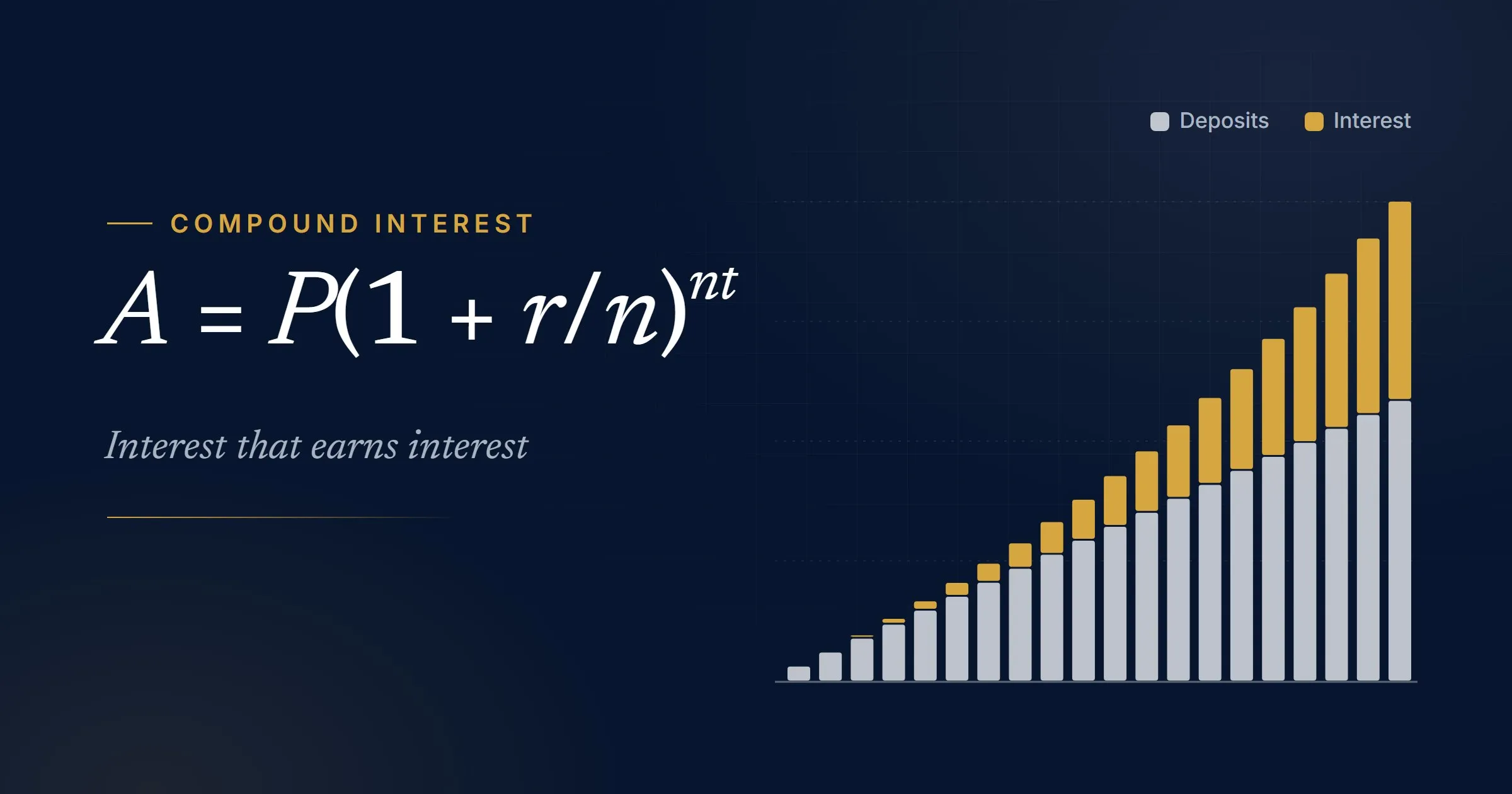
The time value of money is the idea that a dollar today is worth more than a dollar in the future. A dollar you have now can earn interest, and that interest can earn interest of its own. Investor.gov’s example: $100 earning 5% a year grows to $105 after one year and $110.25 after two, and in 10 years it’s worth more than $162.Source 1
That one idea sits behind savings goals, loans, retirement plans and choices like taking a payment now or later. This guide covers the two core formulas, future value and present value, with worked examples, and shows how to use them in a spreadsheet.
Future value: what money will grow to
Future value equals present value times one plus r, to the power of n.
- PV is the amount you have today
- r is the interest rate per period, as a decimal
- n is the number of periods
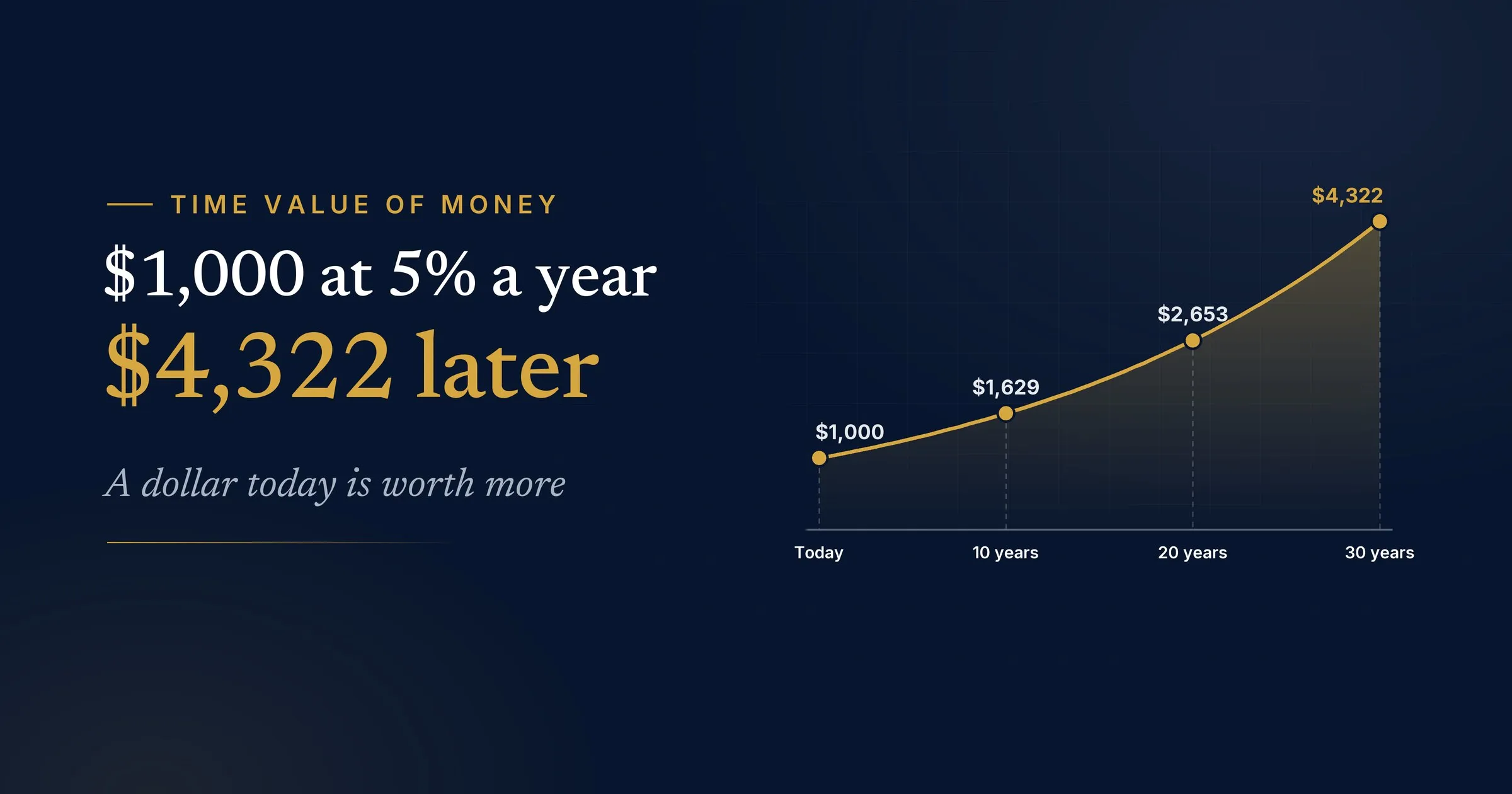
$1,000 at 5% a year for 10 years
- Raise 1.05 to the 10th power: 1.0510 = 1.6289.
- Multiply by $1,000: $1,628.89.
The more often interest compounds, the faster money grows. Compounded monthly instead of yearly, the same $1,000 at 5% reaches $1,647.01 in 10 years. That checks out against Investor.gov’s example, too: $100 at 5% a year comes to $162.89 after 10 years and $338.64 after 25.Source 1
Time matters even more than the rate. Here’s $1,000 at three rates:
| Rate | 10 years | 20 years | 30 years |
|---|---|---|---|
| 3% | $1,344 | $1,806 | $2,427 |
| 5% | $1,629 | $2,653 | $4,322 |
| 7% | $1,967 | $3,870 | $7,612 |
Rounded to the dollar. Assumes a steady rate with nothing added or taken out, and before taxes and fees.
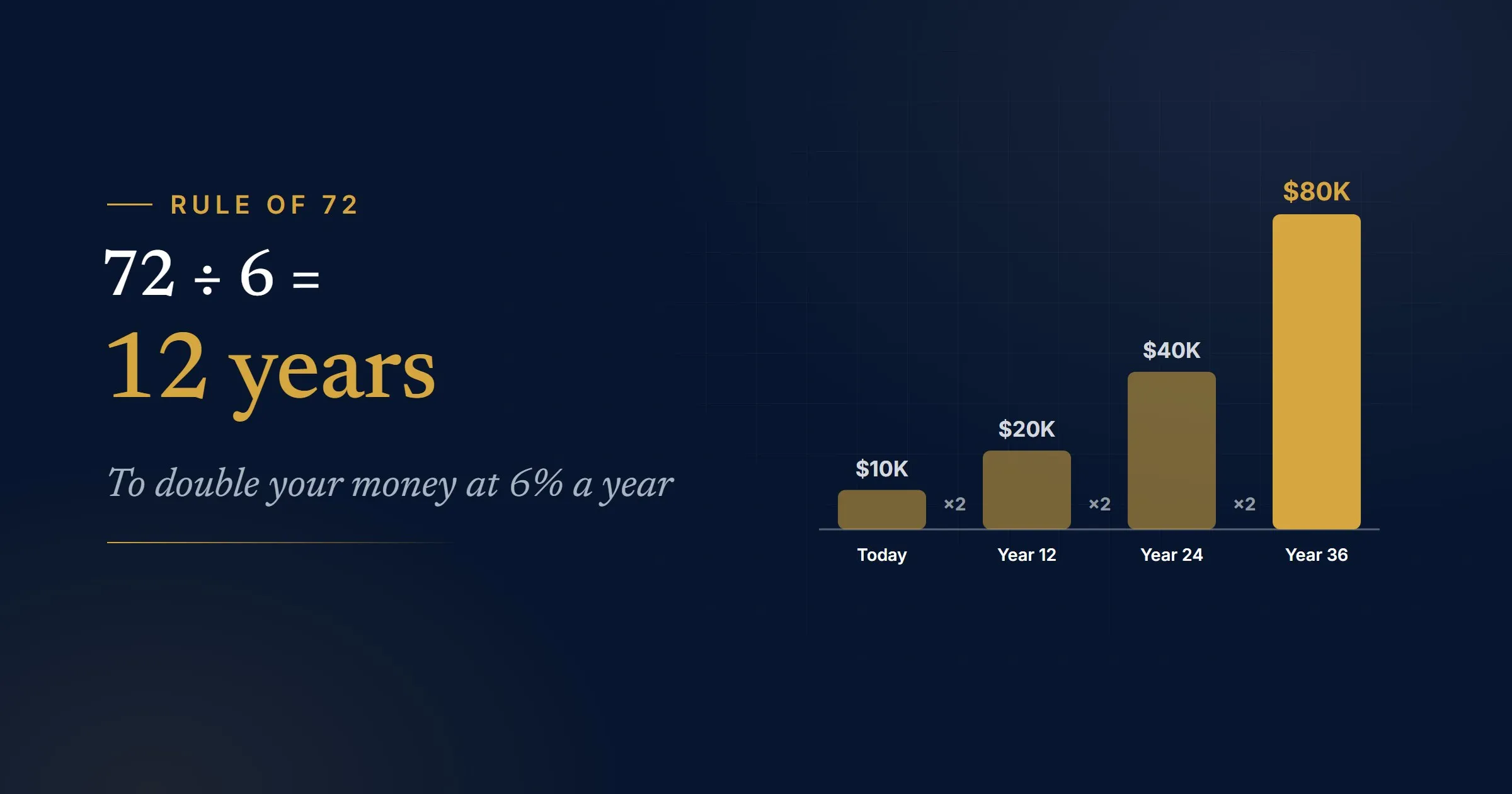
Our compound interest guide explains compounding in depth, and the Rule of 72 is a quick way to estimate how long money takes to double.
Present value: what future money is worth today
Present value runs the formula backward. It answers the question: how much would I need today, at a given rate, to have a certain amount later?
Present value equals future value divided by one plus r, to the power of n.
$10,000 needed in 5 years, at 4% a year
- Raise 1.04 to the 5th power: 1.045 = 1.2167.
- Divide $10,000 by it: $8,219.27.
- Set aside $8,219.27 today at 4% a year, and you’ll have $10,000 in five years.
The rate used here is often called the discount rate. A higher rate means a lower present value, because money today could grow faster.
Regular deposits
Most people save a little at a time rather than all at once. With equal deposits at the end of each period, the future value is:
Future value equals P times the quantity one plus r to the power of n, minus one, divided by r.
- P is the deposit each period
- r is the rate per period, such as an annual rate divided by 12 for monthly deposits
Saving $200 a month for 10 years at 4% a year, compounded monthly, adds up to $29,449.96: $24,000 of deposits and $5,449.96 of interest. Our Savings Calculator runs this for any amount, and the Savings Goal Calculator works backward from a goal.
Money now or money later?
The time value of money is how you compare two amounts paid at different times: bring them to the same point in time first.
$10,000 today or $11,000 in two years
- If you could earn 4% a year, $11,000 in two years is worth $10,170.12 today. That’s more than $10,000, so waiting pays.
- If you could earn 6% a year, it’s worth only $9,789.96 today, so taking $10,000 now is better.
- The break-even rate is 4.88% a year. Below it, waiting wins; above it, take the money now.
Use a rate you could realistically earn on the money, such as what an insured savings account pays, and account for risk: a promise of money later is only worth as much as your confidence that it will arrive. Adding up the present values of several payments like this is called net present value. The rate you use stands for your opportunity cost, what the money could earn elsewhere, as our opportunity cost guide explains.
Inflation and the time value of money
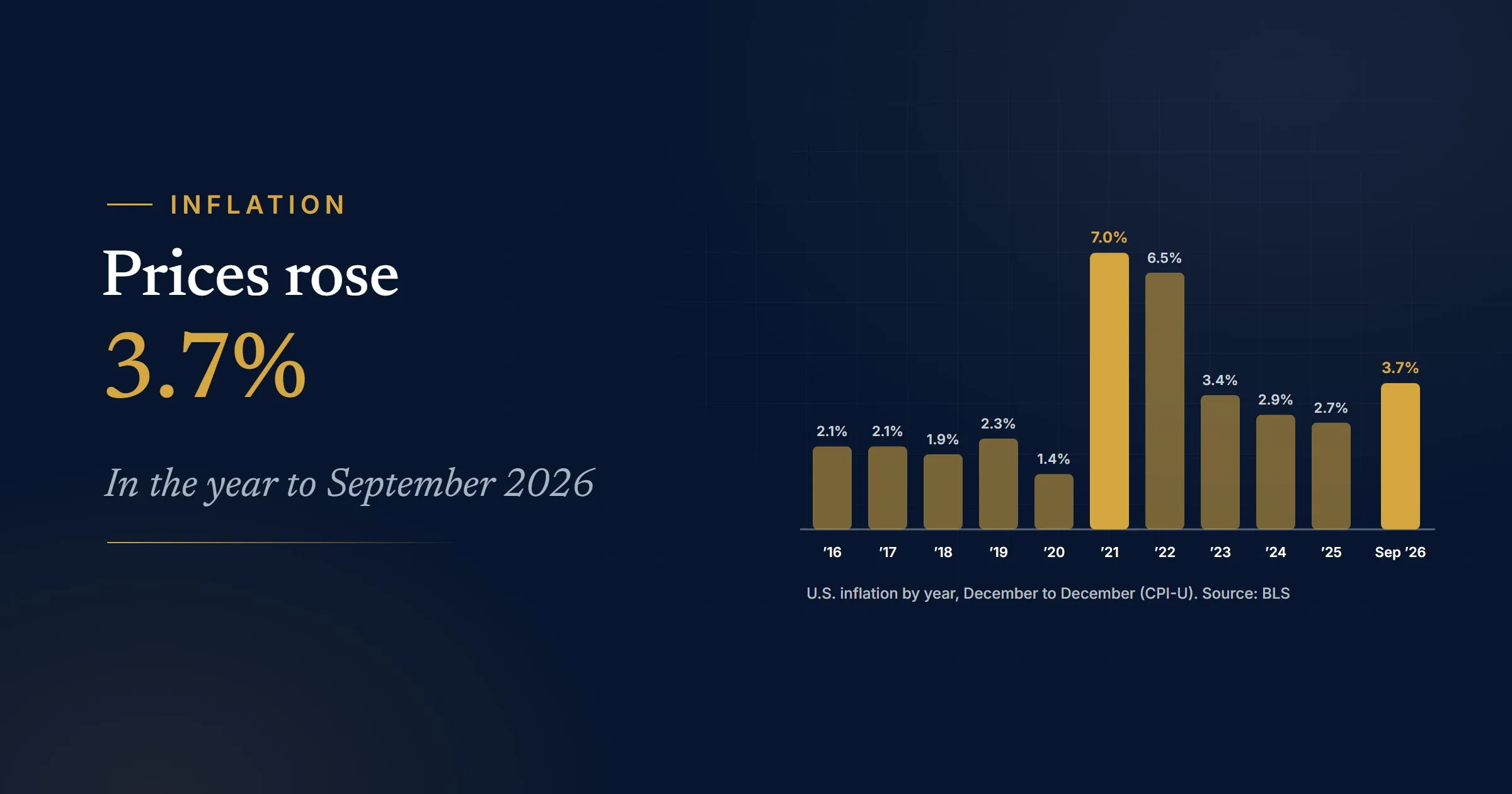
Inflation is a second reason money later is worth less: prices rise, so each future dollar buys less. At 3% inflation a year, $100 received 10 years from now would buy about what $74.41 buys today. Our inflation guide explains how inflation is measured.
That’s why a savings rate is best judged against inflation. Earning less than inflation means your money grows on paper but buys less.
Time value of money in Excel and Google Sheets
Spreadsheets have built-in functions for these formulas. Both use the rate per period and the number of periods, so for monthly calculations, divide an annual rate by 12 and multiply years by 12.Source 2
- Future value:
FV(rate, nper, pmt, [pv], [type]).Source 2=FV(5%, 10, 0, -1000)returns $1,628.89. - Present value:
PV(rate, nper, pmt, [fv], [type]).Source 3=PV(4%, 5, 0, 10000)returns −$8,219.27. - Regular deposits:
=FV(4%/12, 120, -200)returns $29,449.96.
Mind the signs: money you pay out, such as a deposit to savings, is entered as a negative number, and money you receive is positive.Source 3 That’s why the present value above comes back negative: it’s the amount you’d pay in today. The type argument is 0 or omitted when payments come at the end of each period and 1 when they come at the start.Source 2
Common questions
What is the time value of money in simple terms?
Money you have now is worth more than the same amount later, because you can earn interest on it in the meantime.
What’s the difference between present value and future value?
Future value is what money today will grow to. Present value is what money in the future is worth today.
Why is a dollar today worth more than a dollar tomorrow?
Because today’s dollar can be saved or invested to earn interest, and because inflation means a future dollar usually buys less.
What discount rate should I use?
Use the rate you could realistically earn on the money, such as a savings or CD rate for safe money. A higher rate makes future money worth less today.
How is the time value of money used in real life?
Comparing loan offers, choosing between a lump sum and payments, setting savings goals and planning for retirement all rely on it.
Run your own numbers
See how money can grow over time, year by year.
Open the calculator
Sources
Numbers in the text link to these sources. We check them whenever we update this page.
- 1
What is compound interest?(external site)
Investor.gov, U.S. Securities and Exchange Commission · Accessed November 19, 2026 · Back to text for source 1
- 2
Microsoft Support · Accessed November 19, 2026 · Back to text for source 2
- 3
Microsoft Support · Accessed November 19, 2026 · Back to text for source 3
About the author
Wealthistry Editorial Team
Research, writing and editing
The team that researches, writes, fact-checks and updates Wealthistry's guides and calculators, following our published editorial standards.
Author profileEditorial policyHow we researchReport an error