The Rule of 72 is a quick way to estimate how long it takes money to double. Divide 72 by the annual rate of return, and the answer is roughly the number of years. At 9% a year, money doubles about every 8 years, because 72 ÷ 9 = 8.Source 1 The exact answer at 9%, with interest added once a year, is 8.0 years.
This guide shows the formula, how accurate it is, how to use it backward, and how the same shortcut applies to inflation, credit card debt and savings.
The Rule of 72 formula
Years to double is about 72 divided by the annual rate.
- annual rate is the yearly rate of return as a percentage, such as 6 for 6%, not 0.06
Why 72? It divides evenly by 2, 3, 4, 6, 8, 9 and 12, so the math is easy to do in your head, and it lands close to the exact answer for the rates people use most.
How accurate is the Rule of 72?
Here’s how it compares with the Rule of 70, a similar shortcut that divides 70 by the rate, and with the exact answer:
| Rate | Rule of 72 | Rule of 70 | Exact |
|---|---|---|---|
| 1% | 72.0 | 70.0 | 69.7 |
| 2% | 36.0 | 35.0 | 35.0 |
| 3% | 24.0 | 23.3 | 23.4 |
| 4% | 18.0 | 17.5 | 17.7 |
| 6% | 12.0 | 11.7 | 11.9 |
| 8% | 9.0 | 8.8 | 9.0 |
| 10% | 7.2 | 7.0 | 7.3 |
| 12% | 6.0 | 5.8 | 6.1 |
| 20% | 3.6 | 3.5 | 3.8 |
Exact figures assume interest is added once a year: ln 2 ÷ ln(1 + rate), rounded to one decimal place.
At 4% and below, the Rule of 70 lands closer; from 6% up, the Rule of 72 does. Both are close enough for planning. When interest compounds more often, such as monthly or daily, money doubles a little sooner than the exact figures in the table.
Using it backward: the rate you need
Flip the formula to find the rate that doubles your money by a deadline: divide 72 by the number of years. To double in 10 years, you’d need about 7.2% a year. The exact answer is 7.18%.
Doubling more than once
Every doubling period doubles the money again, so you can chain them.
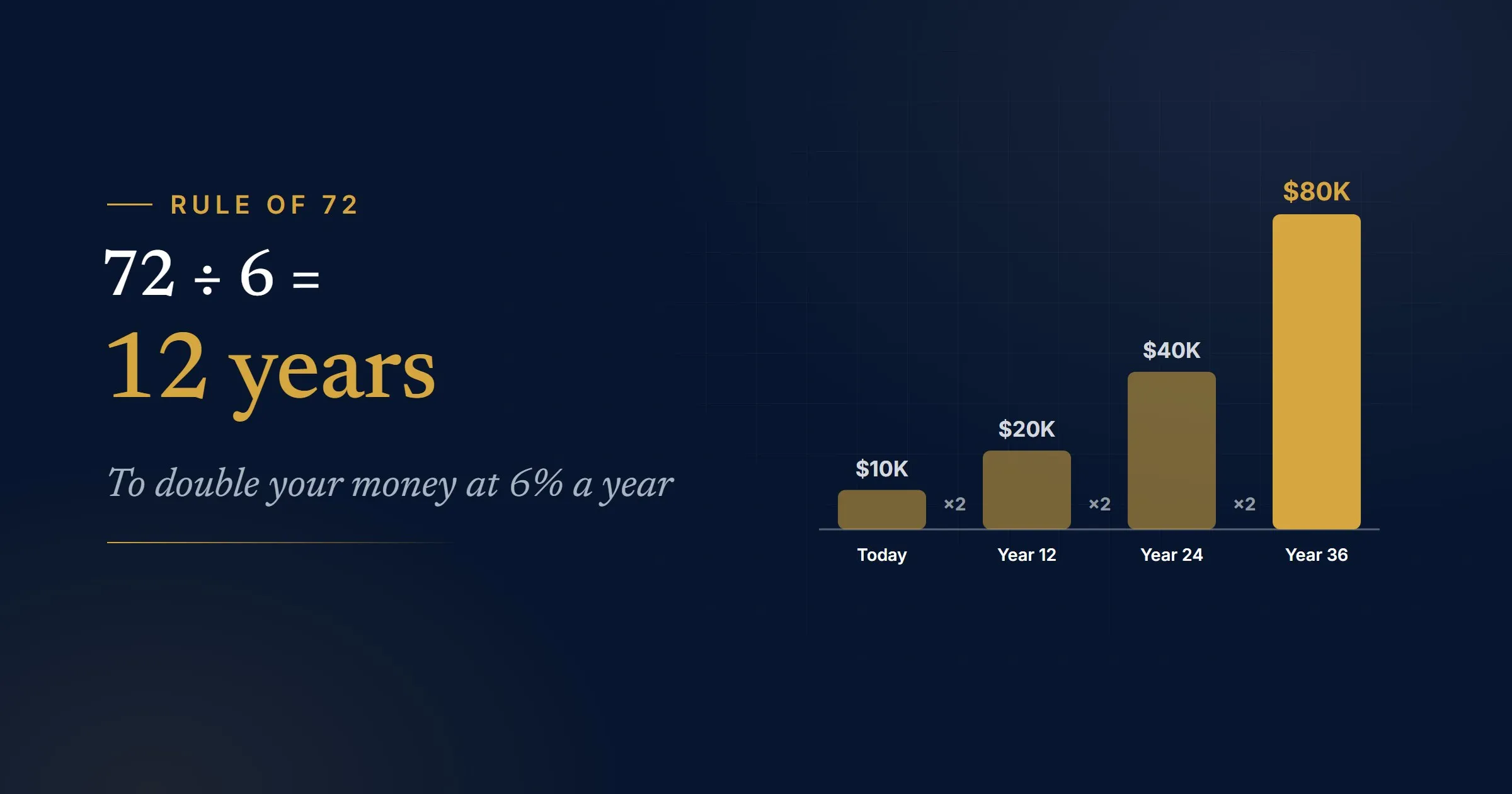
$10,000 at 6% for 36 years
- At 6%, money doubles about every 72 ÷ 6 = 12 years.
- 36 years is three doublings: $10,000 becomes $20,000, then $40,000, then $80,000.
- The exact answer, with interest added once a year, is $81,473, so the shortcut is close.
Similar rules estimate other multiples. Dividing 114 by the rate estimates the years to triple, and 144 the years to quadruple. At 8%, that’s 14.3 and 18.0 years, matching the exact answers of 14.3 and 18.0 years.
The Rule of 72 and inflation
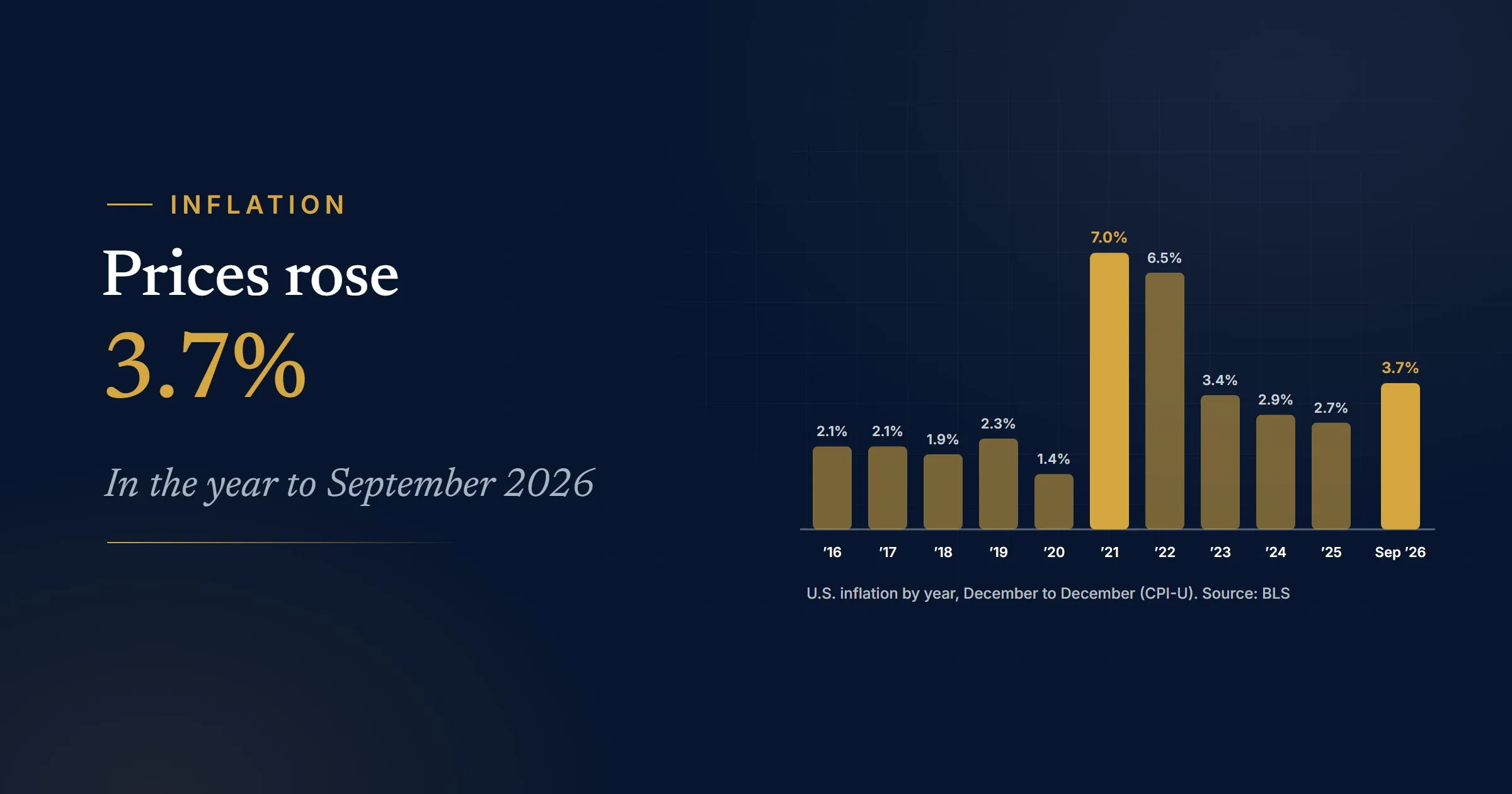
The same math works for prices. Consumer prices rose 3.7% in the 12 months to September 2026.Source 2 At that pace, prices would double in about 19.3 years by the rule, or 18.9 years exactly. Put the other way, money kept in cash would lose half its buying power in that time. Our inflation guide explains how inflation is measured.
The Rule of 72 and debt
Debt grows the same way when interest piles up unpaid. In the third quarter of 2026, the average rate on credit card accounts charged interest was 22.36%.Source 3 By the rule, a balance at that rate, with no payments and no new charges, would double in about 3.2 years. Card interest usually compounds daily, which makes it about 3.1 years. Our guide to how credit card interest works shows how that interest is charged.
The Rule of 72 and savings
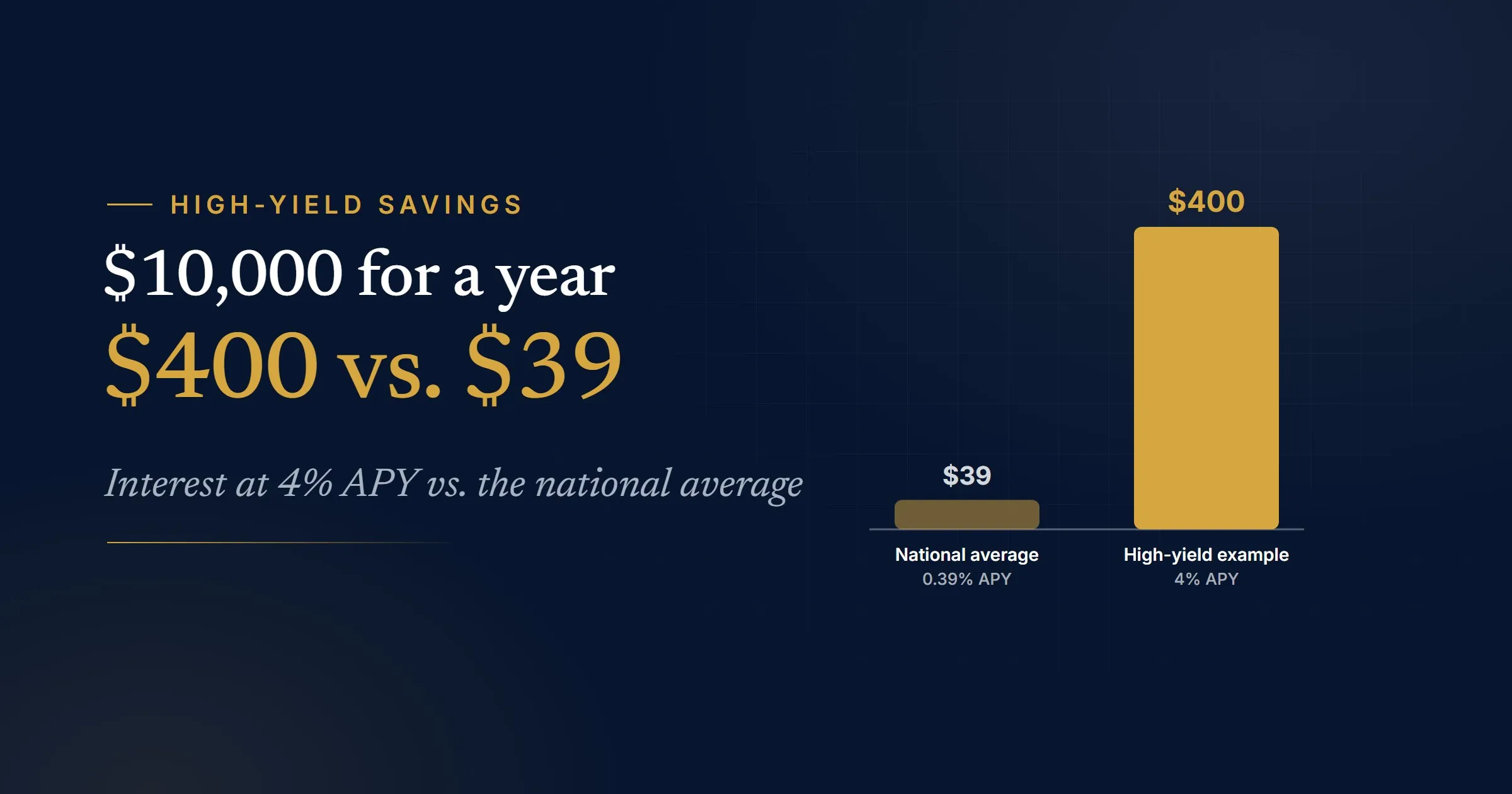
At the national average savings rate of 0.39% in November 2026,Source 4 money would take about 185 years to double. At an example rate of 4% APY, it would take about 18.0. Our high-yield savings guide explains how to find a better rate.
The limits of the Rule of 72
- It assumes a steady rate. Savings rates change, and investment returns vary from year to year, so the rule uses an expected rate, not a promise.Source 1
- It ignores deposits and withdrawals. Adding money makes it double sooner; taking money out slows it down.
- It ignores taxes, fees and inflation, which all reduce real growth. Our compound interest guide shows how much they can matter.
For exact numbers with regular deposits, use our Compound Interest Calculator.
Common questions
What is the Rule of 72?
A shortcut for estimating how long money takes to double: divide 72 by the annual rate of return.
How accurate is the Rule of 72?
It’s within a few months of the exact answer for rates from about 6% to 12%, and less accurate at very low or very high rates.
What’s the difference between the Rule of 72 and the Rule of 70?
They’re the same idea with a different number. The Rule of 70 is a little more accurate at low rates, and the Rule of 72 at higher ones.
Does the Rule of 72 work for debt?
Yes. It shows how fast an unpaid balance can double at a given interest rate, which is why high-rate debt is worth paying off quickly.
Does the Rule of 72 work with monthly compounding?
Roughly. With more frequent compounding, money doubles a little faster than the rule suggests at most rates.
Run your own numbers
See how money can grow over time, year by year.
Open the calculator
Sources
Numbers in the text link to these sources. We check them whenever we update this page.
- 1
What is compound interest?(external site)
Investor.gov, U.S. Securities and Exchange Commission · Accessed November 19, 2026 · Back to text for source 1
- 2
Consumer Price Index for All Urban Consumers (CPI-U), U.S. city average, all items(external site)
U.S. Bureau of Labor Statistics · Accessed November 19, 2026 · Back to text for source 2
- 3
Consumer Credit, G.19 statistical release(external site)
Board of Governors of the Federal Reserve System · Published November 6, 2026 · Accessed November 16, 2026 · Back to text for source 3
- 4
National Rates and Rate Caps – November 2026(external site)
Federal Deposit Insurance Corporation · Updated November 16, 2026 · Accessed November 18, 2026 · Back to text for source 4
About the author
Wealthistry Editorial Team
Research, writing and editing
The team that researches, writes, fact-checks and updates Wealthistry's guides and calculators, following our published editorial standards.
Author profileEditorial policyHow we researchReport an error