A money market account and a savings account are close cousins. Both are deposit accounts at a bank or credit union, both pay interest, and both are insured. The differences are in the details: what they pay, how much you need to keep in them and how easily you can spend from them.
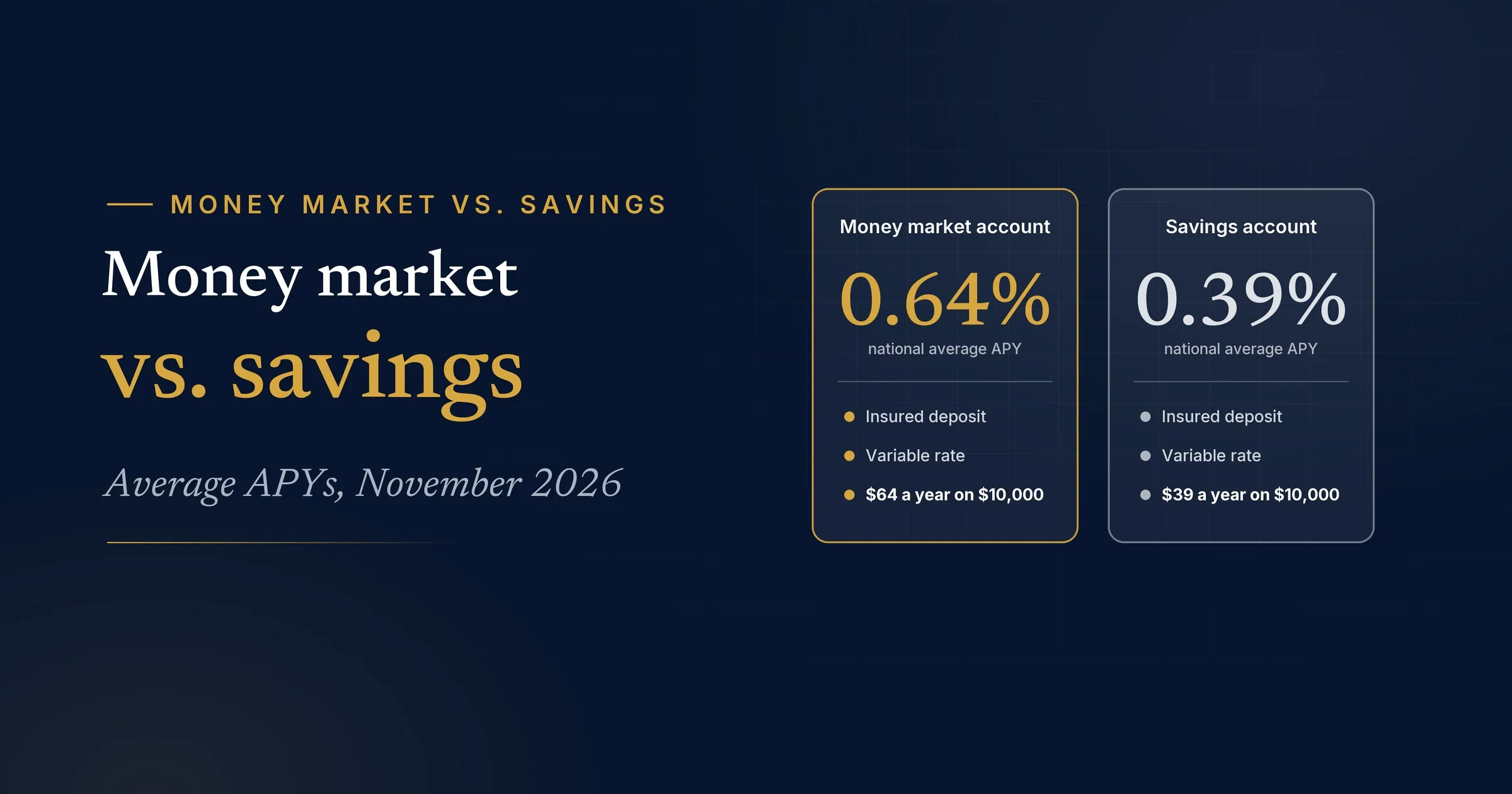
In November 2026, the national average rate was 0.64% for money market accounts and 0.39% for savings accounts.Source 1 This guide compares the two side by side, shows what the gap is worth, and explains how a money market fund differs from both.
Money market account vs. savings account at a glance
| Feature | Money market account | Savings account |
|---|---|---|
| National average rate, Nov. 2026 | 0.64% | 0.39% |
| Insurance | Insured as a deposit | Insured as a deposit |
| Rate | Usually variable | Usually variable |
| Minimum balance | Often higher to open, earn the rate or avoid a fee | Often lower, but check |
| Spending from it | Some offer checks or a debit card | Usually by transfer to checking |
At an FDIC-insured bank, money market deposit accounts and savings accounts are both covered by deposit insurance.Source 2 At a federally insured credit union, the NCUA insures accounts up to $250,000.Source 3
Whatever the account, the bank must tell you its rate and APY, whether the rate can change, and any minimum balance needed to open it, avoid a fee or earn the advertised APY.Source 4 If the rate is variable, the bank can change it without notice.Source 5 A federal limit of six convenient withdrawals a month no longer applies, but the bank may still set its own limit or charge for extra withdrawals.Source 6
What the difference is worth
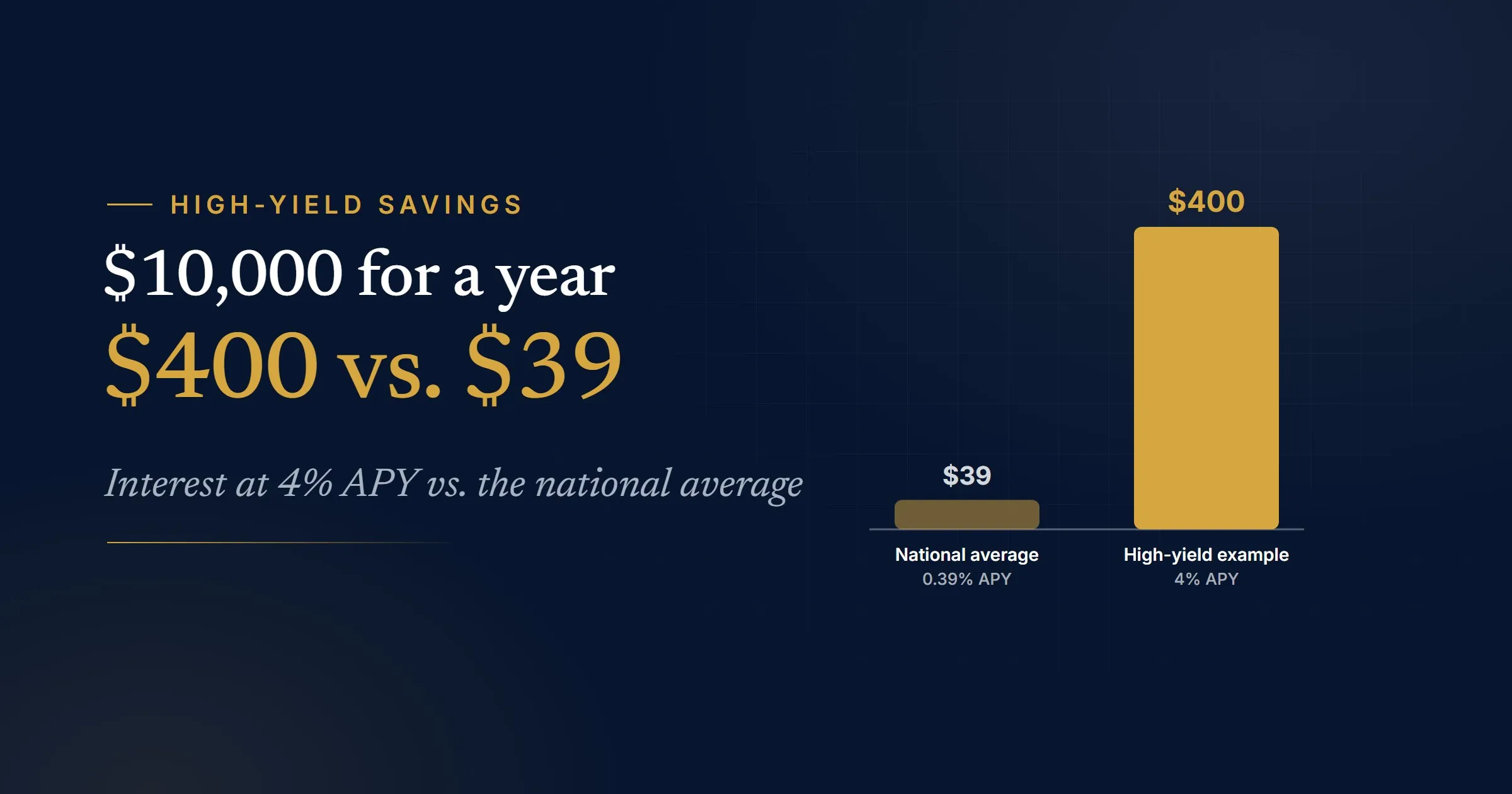
$10,000 for one year at national averages
- In a savings account at 0.39%, $39 in interest.
- In a money market account at 0.64%, $64.
- The money market account earns $25 more.
The bigger difference is between average accounts and the best ones. At an example rate of 4% APY, the same $10,000 would earn about $400 in a year. Our high-yield savings guide explains what to look for, and our Savings Calculator works out any rate.
Watch the minimums and fees
A higher rate doesn’t help if fees take it back.
A balance below the minimum
Suppose a money market account charges $12 a month when your balance falls below $2,500, and you keep $2,000 in it. At 0.64%, you’d earn about $12.80 in a year, but pay $144 in fees.
Read the account disclosures for minimums and fees before you open an account.Source 4 If you can’t keep the balance above the minimum, a savings account with no minimum may leave you with more.
Money market accounts vs. money market funds
The names are confusingly similar, but these are very different products:
- A money market account is a deposit account at a bank or credit union, insured like a savings account.Source 2
- A money market fund is a type of mutual fund that invests in short-term debt, cash and cash equivalents. It has relatively low risk compared with other mutual funds and most investments, and many investors use one to hold cash or as an alternative to bank savings.Source 7
A money market fund isn’t a deposit, so it isn’t FDIC-insured, even if you buy it through an FDIC-insured bank. Investments like mutual funds can lose value.Source 8 If you hold one at a brokerage, SIPC protection can replace missing securities and cash if the brokerage fails, but it doesn’t protect against a loss in value.Source 8
Money market vs. high-yield savings vs. CDs
- High-yield savings accounts are savings accounts that pay well above average, often with low or no minimums. One can easily pay more than an average money market account.
- Certificates of deposit lock in a rate until a set date, and you’ll usually pay a penalty to withdraw early. The national average for a 12-month CD was 1.81% in November 2026.Source 1 Our CD vs. high-yield savings guide compares the trade-off.
How to choose
- Compare APYs, not account names. A savings account with a high APY can beat a money market account with an average one.
- Check the minimums and fees, and whether you can keep your balance above them.
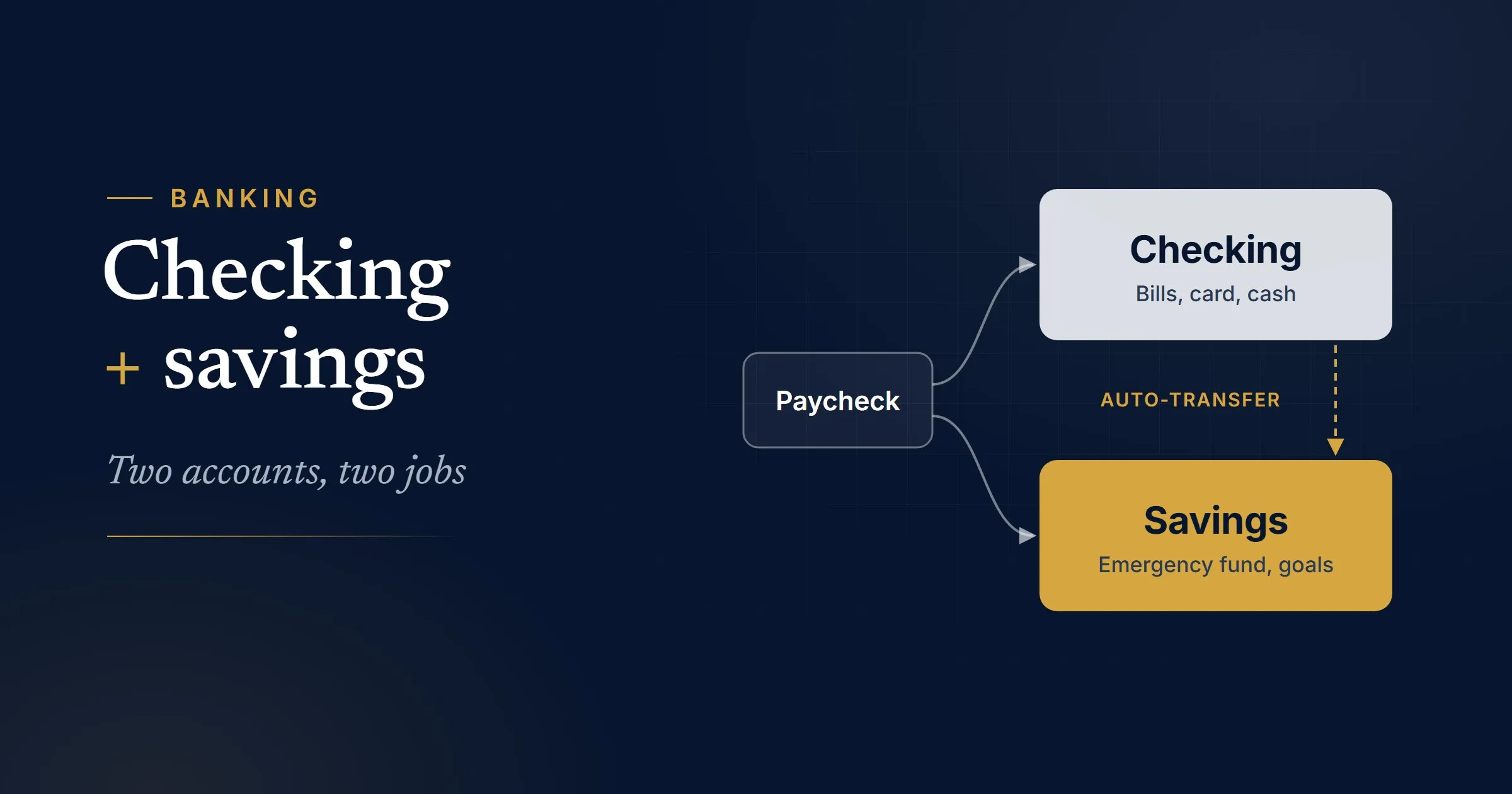
- Think about access. If you want to write the occasional check from the account, a money market account may fit. If you’ll move money to checking first, a savings account works.
- Confirm the insurance, and make sure you’re opening a deposit account, not a fund.
For an emergency fund, either account works if it’s insured, easy to reach and pays a competitive rate. Our emergency fund guide covers how much to keep.
Common questions
Is a money market account better than a savings account?
Not automatically. On average, money market accounts paid slightly more in November 2026, 0.64% vs. 0.39%,Source 1 but individual accounts vary widely. Compare the APY, fees and minimums.
Are money market accounts FDIC-insured?
Yes, at FDIC-insured banks. Money market deposit accounts are covered by deposit insurance.Source 2 Money market funds are not.Source 8
Can you lose money in a money market account?
Not from market moves, because it’s an insured deposit. Fees can reduce your balance, and if the rate is below inflation, the money loses buying power over time.
Is a money market account the same as a money market fund?
No. The account is a bank deposit; the fund is a type of mutual fund.Source 7
Can I write checks from a money market account?
Some money market accounts allow it. Check the account’s terms and any limits before you rely on it for regular payments.
Run your own numbers
Project savings growth using an account's APY.
Open the calculator
Sources
Numbers in the text link to these sources. We check them whenever we update this page.
- 1
National Rates and Rate Caps – November 2026(external site)
Federal Deposit Insurance Corporation · Updated November 16, 2026 · Accessed November 18, 2026 · Back to text for source 1
- 2
Understanding Deposit Insurance(external site)
Federal Deposit Insurance Corporation · Updated April 1, 2024 · Accessed November 18, 2026 · Back to text for source 2
- 3
Share Insurance Coverage(external site)
National Credit Union Administration · Updated November 18, 2026 · Accessed November 18, 2026 · Back to text for source 3
- 4
12 CFR 1030.4, Account disclosures (Regulation DD, Truth in Savings)(external site)
Electronic Code of Federal Regulations · Accessed November 19, 2026 · Back to text for source 4
- 5
12 CFR 1030.5, Subsequent disclosures (Regulation DD, Truth in Savings)(external site)
Electronic Code of Federal Regulations · Accessed November 19, 2026 · Back to text for source 5
- 6
Regulation D: Reserve Requirements of Depository Institutions (interim final rule)(external site)
Board of Governors of the Federal Reserve System · Published April 24, 2020 · Accessed November 18, 2026 · Back to text for source 6
- 7
Money Market Fund(external site)
Investor.gov, U.S. Securities and Exchange Commission · Accessed November 19, 2026 · Back to text for source 7
- 8
Financial Products That Are Not Insured by the FDIC(external site)
Federal Deposit Insurance Corporation · Accessed November 19, 2026 · Back to text for source 8
About the author
Wealthistry Editorial Team
Research, writing and editing
The team that researches, writes, fact-checks and updates Wealthistry's guides and calculators, following our published editorial standards.
Author profileEditorial policyHow we researchReport an error