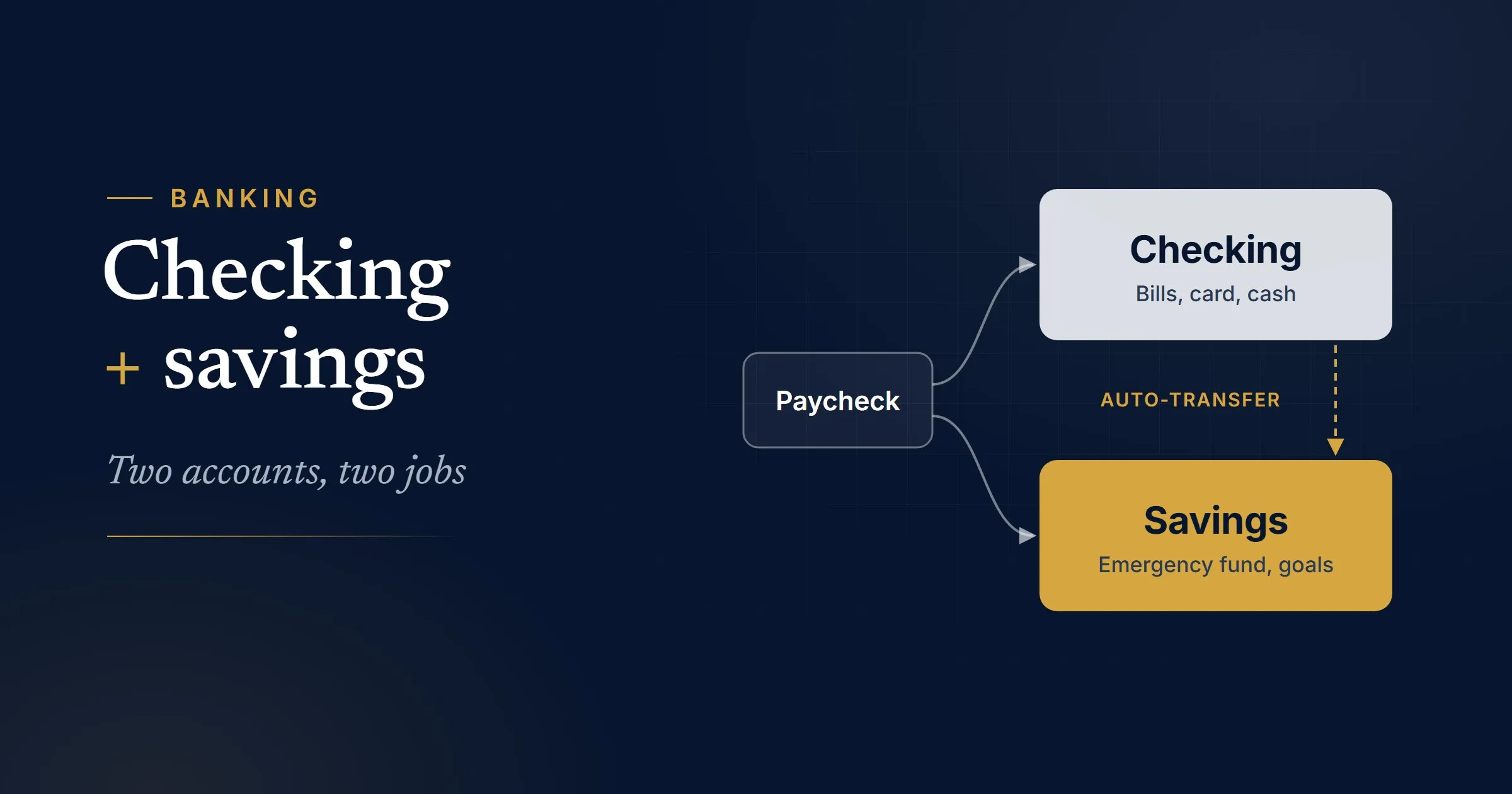
Your routing number tells the payment system which bank holds your money. Your account number tells that bank which account is yours. You need both to set up direct deposit, pay bills straight from your account or get a tax refund deposited. Every bank is assigned a routing number by an agent of the American Bankers Association.Source 1
Routing number vs. account number at a glance
| Routing number | Account number | |
|---|---|---|
| What it identifies | Your bank | Your account at that bank |
| Length | Nine digits | Varies, up to 17 characters |
| Who shares it | Many customers of the same bank | Only your account |
| Where it is on a check | Usually first, along the bottom | Usually second, after the routing number |
| Keep it private? | No, it’s printed on every check you write | Yes, share it only with people you trust |
Where to find your routing and account numbers
On a check
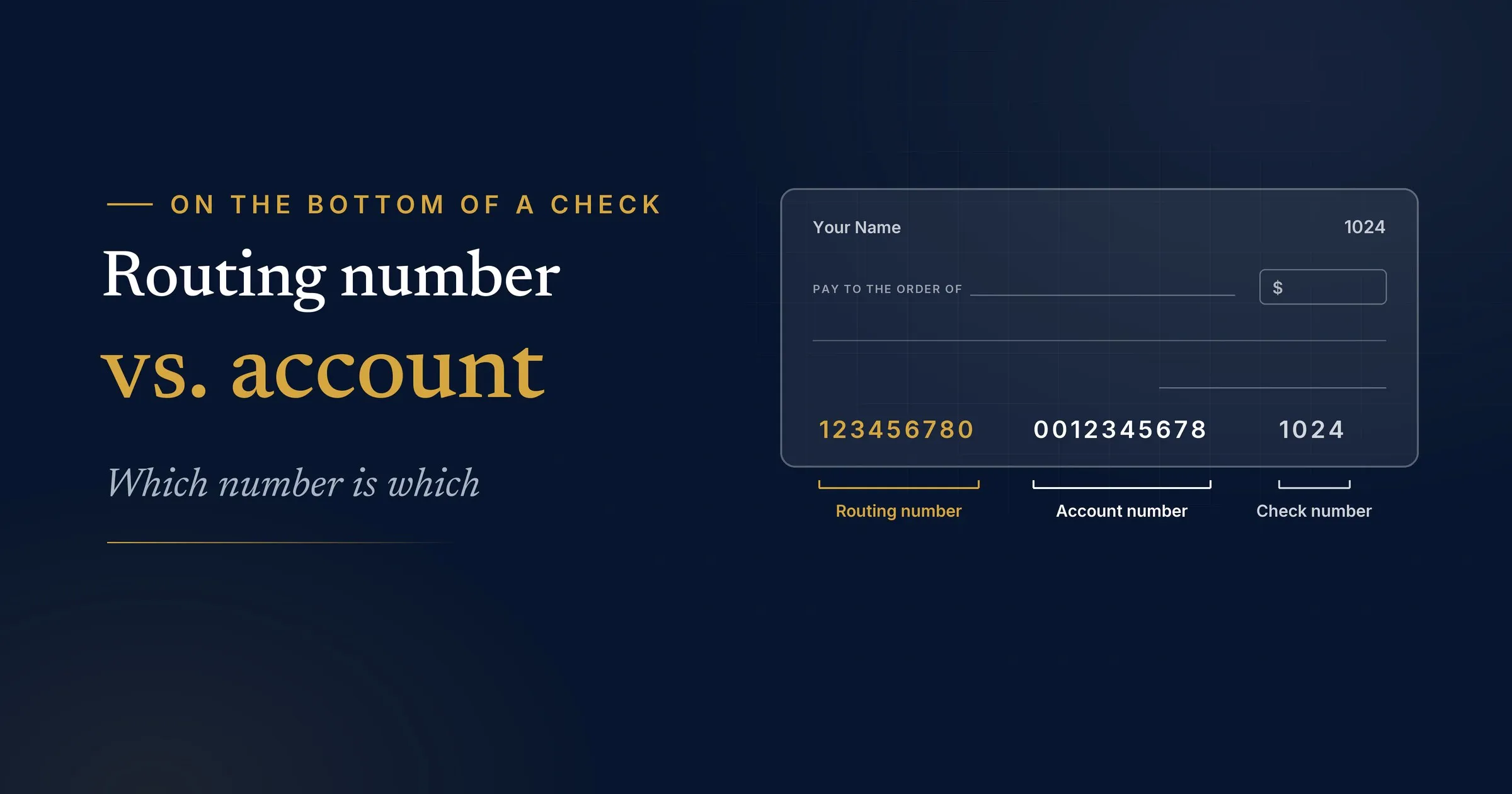
The nine-digit routing number is printed in magnetic ink along the bottom of your checks.Source 1 It usually comes first, followed by your account number and then the check number, but the numbers can be in different places on some checks.Source 2 Don’t include the check number when you give out your account number.Source 2
You may also see the routing number in a fractional form, generally in the upper right-hand corner of the check. And if your checks say they’re payable through a different bank, the routing number on them is that other bank’s, not your own bank’s.Source 1
Without a check
Your bank’s website or app and your statements usually show both numbers, or you can ask the bank. Don’t copy them from a deposit slip: it may contain internal routing numbers that aren’t part of your actual routing number.Source 3
Ask your bank for the right routing number if the number on a deposit slip doesn’t match the one on your checks, if you’re setting up a deposit to a savings account without checks, or if your checks are payable through another institution.Source 2
How a routing number works
Routing numbers follow a set pattern:Source 1
- The first four digits form the Federal Reserve routing symbol.
- The first two digits identify the Federal Reserve district where the bank is located, from 01 for Boston to 12 for San Francisco. Adding 2 to the first digit marks a thrift institution, so 21 through 32 cover thrifts in the same districts.
That’s why a routing number you enter for a direct deposit of your tax refund has to start with 01 through 12 or 21 through 32.Source 2
The last digit is a check digit. Since 1978, it’s been worked out with a formula, “Modulus 10, weights 3, 7, 1,” so that check-processing machines can spot and reject a misread number.Source 4 Multiply the digits by 3, 7 and 1 in turn, add up the results, and a valid routing number’s total divides evenly by 10.
Testing the made-up routing number 123456780
- Multiply each digit by 3, 7 or 1, in turn: 1 × 3, 2 × 7, 3 × 1, 4 × 3, 5 × 7, 6 × 1, 7 × 3, 8 × 7, 0 × 1.
- Add the results: 3 + 14 + 3 + 12 + 35 + 6 + 21 + 56 + 0 = 150.
- 150 divides evenly by 10, so the number passes. Mistype the last digit as 9, making it 123456789, and the total becomes 159, which fails.
Because 3, 7 and 1 share no factor with 10, changing any single digit always breaks the test. But passing only shows that a number is well formed. It doesn’t prove it belongs to the bank or person you think it does.
When you need each number
You’ll usually give both numbers together:
- Direct deposit. An employer or benefits agency needs your routing number, account number and account type. The IRS asks for all three to deposit a tax refund.Source 2
- Automatic payments. A company that withdraws your payments, such as a utility or the IRS for a tax payment, needs both numbers.Source 3
- Transfers between your own accounts at different banks.
- Wire transfers. Before you send a wire, confirm the recipient’s routing number. Many scams use valid routing numbers, so a number that checks out doesn’t prove the payee is legitimate.Source 5
Just opened an account? Our guide to opening a bank account covers setting up direct deposit and online banking.
Is it safe to share them?
Your routing number identifies your bank, not you, and it’s printed on every check you write.Source 1 Your account number is more sensitive: together, the two numbers are what’s needed to pull a payment from your account.Source 3 Share your account number only with people and companies you trust, and check your statements for payments you don’t recognize.
If an electronic transfer you didn’t authorize appears on your statement, tell your bank right away. Under federal rules, you must report it within 60 days of the bank sending the statement to avoid liability for later unauthorized transfers.Source 6
Common questions
Is my routing number the same as everyone else’s at my bank?
Often, yes. Routing numbers are assigned to banks, not to individual customers.Source 1 Some banks use different routing numbers for different purposes, so use the one your bank gives you for the transaction.Source 2
How long is an account number?
It depends on the bank. For a direct deposit of a tax refund, the IRS accepts account numbers of up to 17 characters, including letters.Source 2
Can someone take money with my routing and account number?
They can try to set up an electronic withdrawal, which is why you should share your account number carefully and watch your statements. Report any transfer you didn’t authorize quickly. Waiting more than 60 days after the statement can make you liable for later unauthorized transfers.Source 6
Can I use the routing number on a deposit slip?
It’s safer not to. A deposit slip may contain internal routing numbers that aren’t part of your actual routing number.Source 3
What does the first digit of a routing number mean?
Together with the second digit, it identifies the Federal Reserve district where the bank is located: 01 through 12 for banks, and 21 through 32 for thrift institutions.Source 1
Sources
Numbers in the text link to these sources. We check them whenever we update this page.
- 1
Electronic Code of Federal Regulations · Accessed November 22, 2026 · Back to text for source 1
- 2
2025 Instructions for Form 1040 (lines 35b through 35d, direct deposit)(external site)
Internal Revenue Service · Last reviewed May 7, 2026 · Accessed November 22, 2026 · Back to text for source 2
- 3
Electronic Funds Withdrawal payment record instructions(external site)
Internal Revenue Service · Last reviewed September 5, 2026 · Accessed November 22, 2026 · Back to text for source 3
- 4
Circular No. 8203, Addition of the Check Digit in the Routing Number Field on Checks(external site)
Federal Reserve Bank of New York, via FRASER · Published October 19, 1977 · Accessed November 22, 2026 · Back to text for source 4
- 5
How can I verify the routing number of the payee before I send a wire transfer?(external site)
Office of the Comptroller of the Currency, HelpWithMyBank.gov · Accessed November 22, 2026 · Back to text for source 5
- 6
12 CFR 1005.6, Liability of consumer for unauthorized transfers (Regulation E)(external site)
Electronic Code of Federal Regulations · Accessed November 22, 2026 · Back to text for source 6
About the author
Wealthistry Editorial Team
Research, writing and editing
The team that researches, writes, fact-checks and updates Wealthistry's guides and calculators, following our published editorial standards.
Author profileEditorial policyHow we researchReport an error