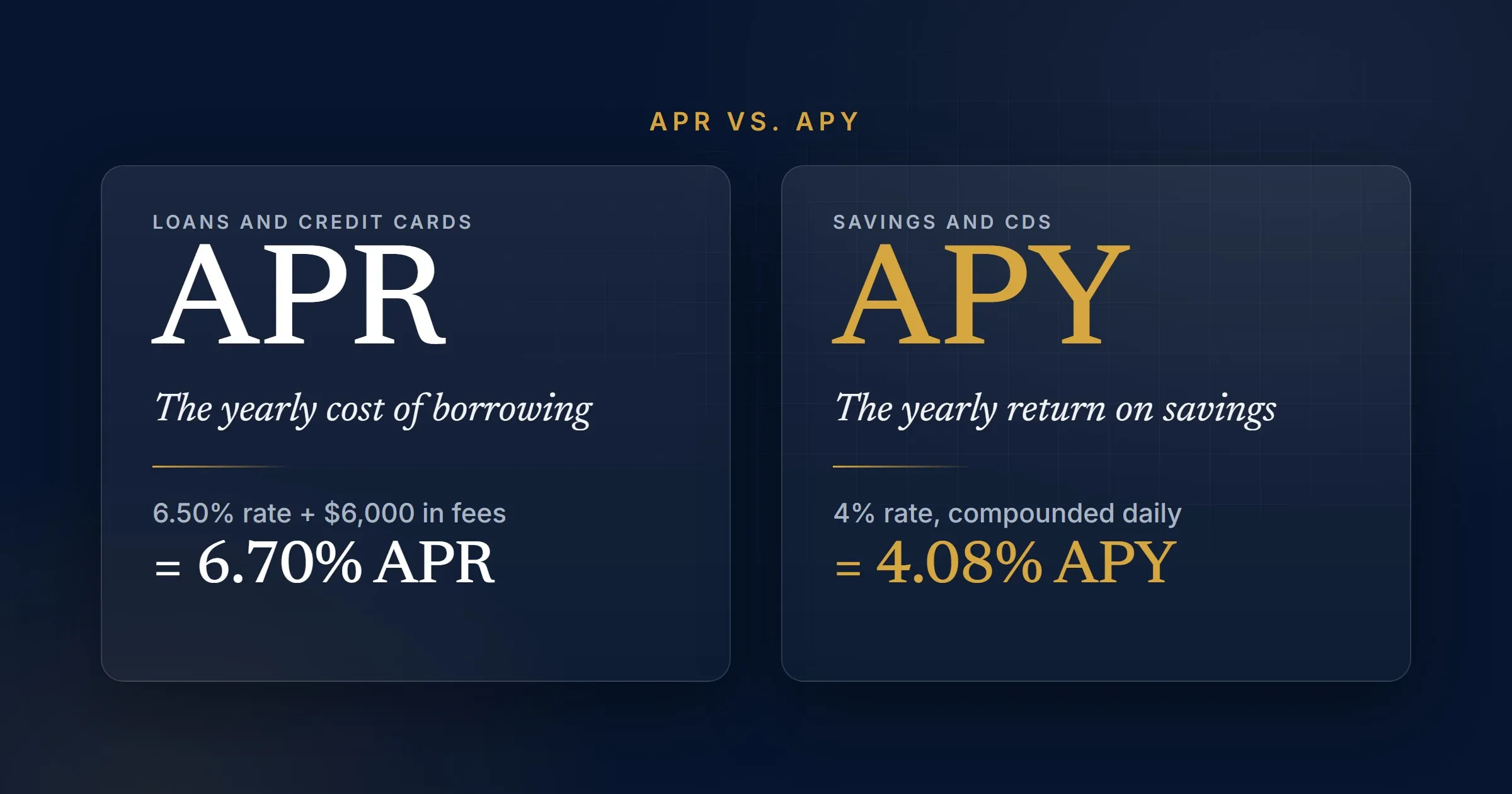
APY, short for annual percentage yield, is the interest a savings account, CD or other deposit account pays over a year, as a percentage of your balance. It counts compounding: the interest your interest earns. Federal rules define it as the total interest paid on an account, based on the interest rate and how often interest compounds, over a 365-day period.Source 1
Banks have to work out the APY with the same formula,Source 2 and an ad that states a rate of return on a deposit account has to state it as an APY.Source 3 That makes it the one number you can use to compare accounts side by side. This guide covers how APY differs from the interest rate, how to turn it into dollars and what it leaves out.
APY vs. interest rate
The interest rate is the yearly rate an account pays before compounding. The APY includes compounding.Source 1 When interest is added to your balance more than once a year, it starts earning interest of its own, so the APY comes out higher than the rate. When interest compounds once a year, the two are the same.
That’s why the APY, not the rate, is the number to compare:
Two savings accounts with $10,000 each
- Account A pays a 4.00% interest rate, compounded monthly. Its APY is 4.07%, so $10,000 earns $407.42 in a year.
- Account B pays a 3.98% rate but compounds daily. Its APY is 4.06%, and $10,000 earns $406.00.
- Account A pays $1.42 more, even though it compounds less often. The APY shows that at a glance.
How often interest compounds nudges the APY; the rate itself moves it far more. An ad can show the interest rate too, but only alongside the APY and no more prominently.Source 3 Our APR vs. APY guide shows how to convert a rate to an APY, and explains APR, the rate used for loans and credit cards.
How to turn an APY into dollars
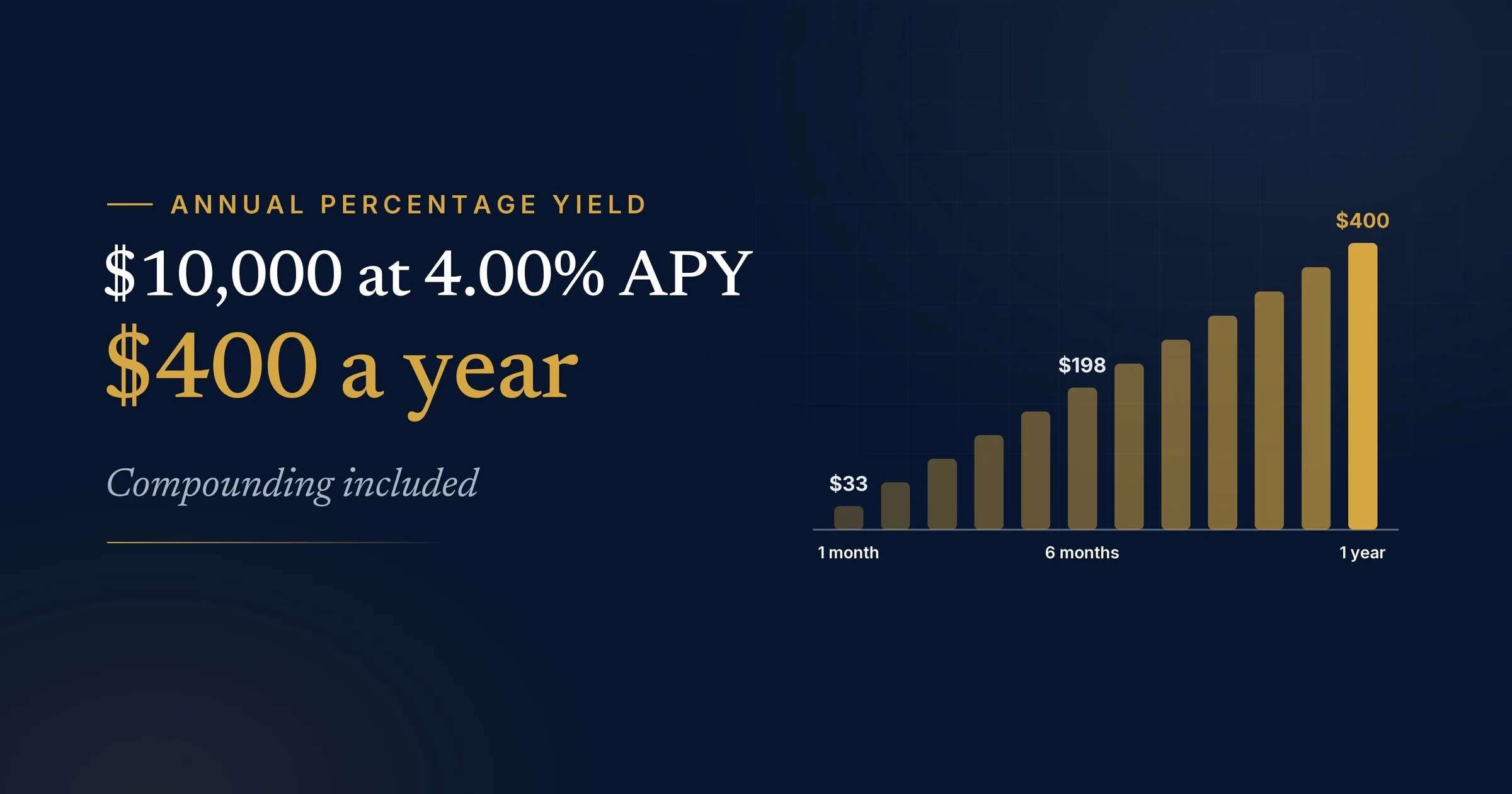
Because the APY already includes compounding, you can treat it as a simple yearly growth rate. If the APY stays the same and you don’t add or take out money, the interest over any length of time is:
Interest equals B times the quantity: 1 plus APY, raised to the power t, minus 1.
- B is your balance
- APY is the annual percentage yield, as a decimal (4% is 0.04)
- t is the time in years: 1 for a year, 1 ÷ 12 for a month, or the number of days ÷ 365
| Time | Interest earned | Balance |
|---|---|---|
| 1 month | $32.74 | $10,032.74 |
| 6 months | $198.04 | $10,198.04 |
| 1 year | $400.00 | $10,400.00 |
| 3 years | $1,248.64 | $11,248.64 |
| 5 years | $2,166.53 | $12,166.53 |
Assumes the APY stays at 4.00%, with no deposits or withdrawals, before taxes. A month is a twelfth of a year.
For a single year, it’s simply your balance times the APY: $10,000 × 0.04 = $400.00. A month’s interest is a little less than a twelfth of that. Dividing the year’s interest by 12 gives $33.33, but the account pays $32.74 in the first month, because part of the APY comes from interest earned on interest later in the year.
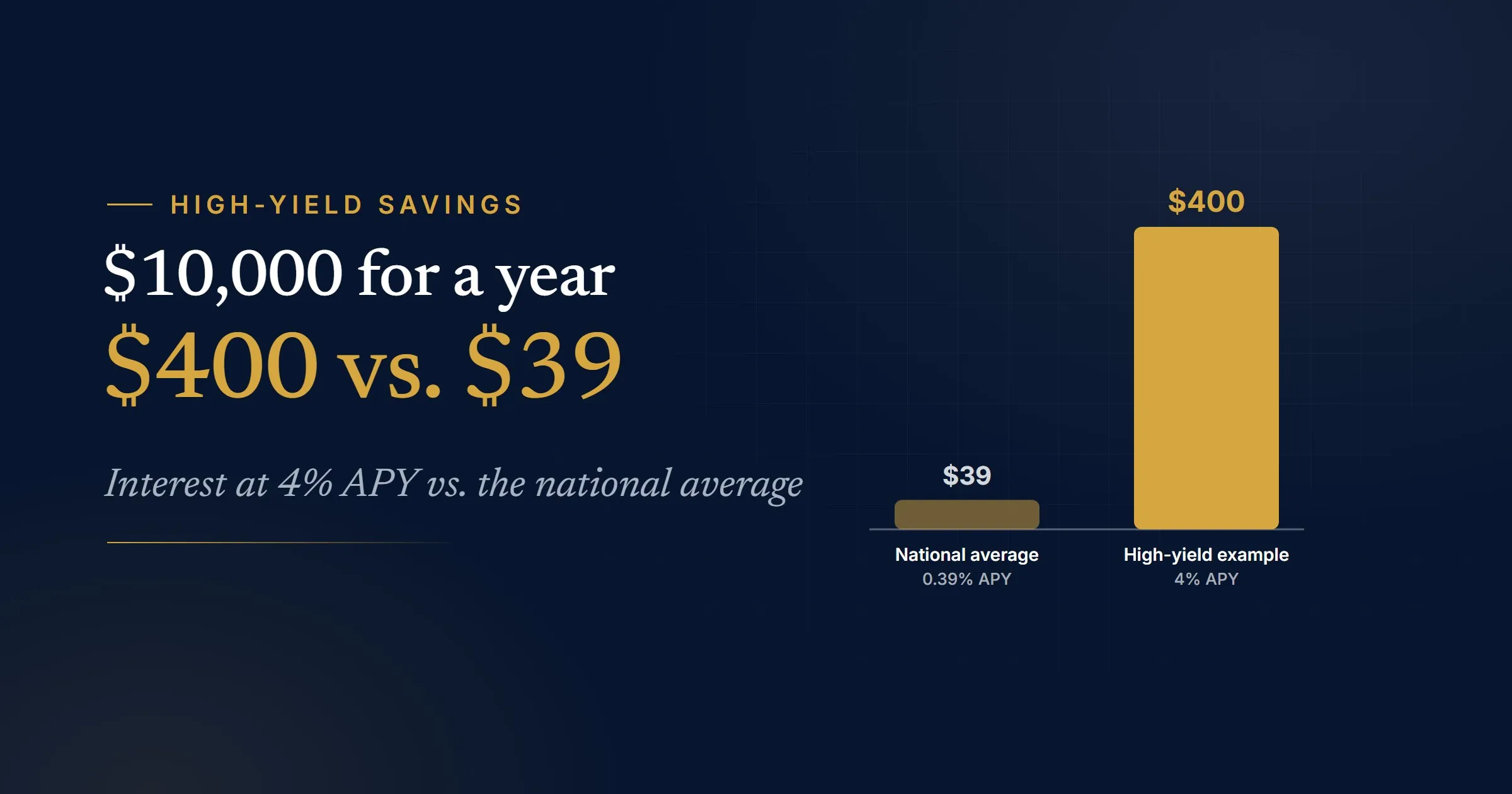
At the national average savings rate of 0.39% in November 2026,Source 4 the same $10,000 would earn about $39 in a year. Our high-yield savings guide explains how to find a better rate, and our Savings Calculator runs these numbers with monthly deposits.
What the APY assumes
The APY is a standardized estimate, not a promise. Under the federal formula:Source 2
- Your money stays put. The APY assumes all the principal and interest stay in the account for the whole term, with no other deposits or withdrawals. Interest you take out can’t compound.
- The rate doesn’t change. For a variable-rate account, the APY uses the rate in effect when you open the account and assumes it lasts a year. In reality, a variable rate can change at any time, and the bank doesn’t have to tell you first.Source 5
- Only interest counts. A cash bonus for opening the account isn’t part of the APY, and fees aren’t taken out of it. That’s why an ad that states an APY has to warn that fees could reduce your earnings.Source 3
Introductory rates
Some accounts pay a higher rate for the first few months. Their APY has to blend the introductory rate with the rate that would apply afterward, each for its share of a year.Source 2Source 6
A 5.00% rate for three months, then 3.00%
- $10,000 earns a 5.00% introductory rate, compounded daily, for the first 91 days, then the account’s regular 3.00% rate for the other 274 days of the year.
- That adds up to $356.04 of interest over the year.
- So the APY is 100 × ($356.04 ÷ $10,000) = 3.56%, much closer to the regular rate than to the headline 5.00%.
And if the regular rate is variable and drops after you open the account, you’ll earn less than that.
Tiered rates
Some accounts pay a higher rate on larger balances. Each balance tier then has its own APY, or a range of APYs when the higher rate applies only to the part of your balance above the tier’s threshold.Source 2 An ad that quotes the APY for one tier has to list the APY and minimum balance for every tier,Source 6 so check which tier your balance falls into.
How to read an APY in an ad
When an ad states an APY, federal rules require it to also tell you, where they apply:Source 3
- Whether the rate can change after you open the account
- How long the APY is offered, or the date it was accurate as of
- The minimum balance you need to earn it, and the minimum deposit to open the account if that’s higher
- That fees could reduce your earnings
- For a CD, its term and that you may pay a penalty for withdrawing early
TV, radio and billboard ads can leave several of these out.Source 3 Ads online and in email can’t, and an online ad has to point you to where the details are, often with a link.Source 6 An account also can’t be advertised as free if any maintenance or activity fee may be charged.Source 3 Before you open an account, read its full disclosures.
APY earned: what your statement shows
If your bank sends statements, each one must show the annual percentage yield earned for the period and the dollar amount of interest earned.Source 7 Unlike the advertised APY, it’s based on the interest you actually earned and your average daily balance:Source 2
APY earned equals 100 times the quantity: 1 plus I divided by B, raised to the power 365 divided by d, minus 1.
- I is the interest earned during the period
- B is the average daily balance for the period
- d is the number of days in the period
A rate cut partway through a statement
- $10,000 sits in a savings account for a 30-day statement period. It earns 4.00% for 15 days, then the bank cuts the rate to 3.50%, both compounded daily.
- The statement shows $30.87 of interest.
- APY earned = 100 × [(1 + $30.87 ÷ $10,000)365 ÷ 30 − 1] = 3.82%, below the 4.08% APY the account was paying before the cut.
Behind the scenes, banks figure interest every day, on each day’s balance or the average daily balance, using a daily rate of at least 1/365 of the interest rate. They don’t have to compound or credit interest on any particular schedule,Source 8 which is one more reason to compare APYs rather than compounding schedules.
APY on CDs
A CD’s APY assumes you leave the interest in the CD until it matures.Source 2 If you have the interest paid out to another account instead, it can’t compound, so you’ll earn less than the APY. Our simple vs. compound interest guide shows the difference compounding makes. For a CD longer than a year that doesn’t compound and must pay out interest at least once a year, the bank may simply state an APY equal to the interest rate.Source 2
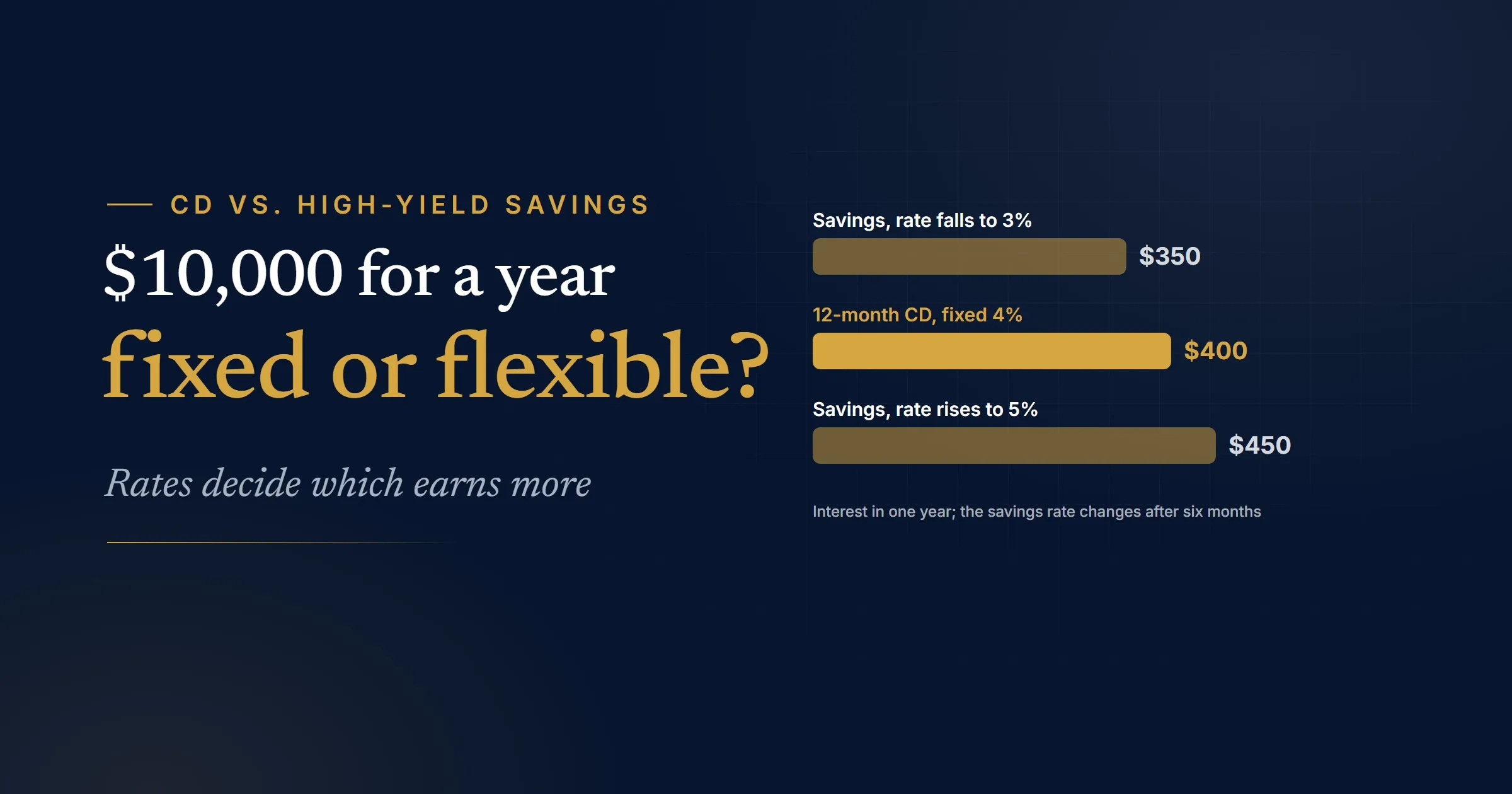
Cashing out early can cost you, too, because a penalty can take back some of the interest. Our CD vs. high-yield savings guide shows an example.
Common questions
What does 4% APY mean?
Leave $1,000 in an account with a 4% APY for a year, and if the rate doesn’t change, you’ll earn $40 in interest, for a balance of $1,040.
Is APY calculated daily or monthly?
APY is a yearly figure. Behind it, banks calculate interest daily, then compound and credit it daily, monthly or on another schedule.Source 8 The APY rolls all of that into one yearly rate.
Is a higher APY always better?
Usually, but check the details first: whether the rate is variable, how long an introductory rate lasts, the minimum balance needed to earn it and any monthly fees, which can outweigh the interest on a small balance. Our money market account guide shows how.
Can my APY change?
On a variable-rate savings or money market account, yes, at any time and without advance notice.Source 5 A CD’s rate usually stays fixed until it matures.
Is APY before or after taxes?
Before. Interest credited to an account you can withdraw from without penalty is generally taxable in the year it becomes available to you, and you should get a Form 1099-INT if you earned $10 or more.Source 9
Do credit unions use APY?
Yes. Credit unions follow the National Credit Union Administration’s version of the same rules, which pairs the APY with a dividend rate instead of an interest rate.Source 10
Run your own numbers
Project savings growth using an account's APY.
Open the calculator
Sources
Numbers in the text link to these sources. We check them whenever we update this page.
- 1
12 CFR 1030.2, Definitions (Regulation DD, Truth in Savings)(external site)
Electronic Code of Federal Regulations · Accessed November 22, 2026 · Back to text for source 1
- 2
Appendix A to Part 1030, Annual Percentage Yield Calculation (Regulation DD)(external site)
Electronic Code of Federal Regulations · Accessed November 22, 2026 · Back to text for source 2
- 3
12 CFR 1030.8, Advertising (Regulation DD, Truth in Savings)(external site)
Electronic Code of Federal Regulations · Accessed November 22, 2026 · Back to text for source 3
- 4
National Rates and Rate Caps – November 2026(external site)
Federal Deposit Insurance Corporation · Updated November 16, 2026 · Accessed November 22, 2026 · Back to text for source 4
- 5
12 CFR 1030.5, Subsequent disclosures (Regulation DD, Truth in Savings)(external site)
Electronic Code of Federal Regulations · Accessed November 19, 2026 · Back to text for source 5
- 6
Supplement I to Part 1030, Official Interpretations (Regulation DD)(external site)
Electronic Code of Federal Regulations · Accessed November 22, 2026 · Back to text for source 6
- 7
12 CFR 1030.6, Periodic statement disclosures (Regulation DD, Truth in Savings)(external site)
Electronic Code of Federal Regulations · Accessed November 22, 2026 · Back to text for source 7
- 8
12 CFR 1030.7, Payment of interest (Regulation DD, Truth in Savings)(external site)
Electronic Code of Federal Regulations · Accessed November 22, 2026 · Back to text for source 8
- 9
Topic no. 403, Interest received(external site)
Internal Revenue Service · Last reviewed October 7, 2026 · Accessed November 22, 2026 · Back to text for source 9
- 10
12 CFR 707.4, Account disclosures (NCUA Truth in Savings)(external site)
Electronic Code of Federal Regulations · Accessed November 22, 2026 · Back to text for source 10
About the author
Wealthistry Editorial Team
Research, writing and editing
The team that researches, writes, fact-checks and updates Wealthistry's guides and calculators, following our published editorial standards.
Author profileEditorial policyHow we researchReport an error