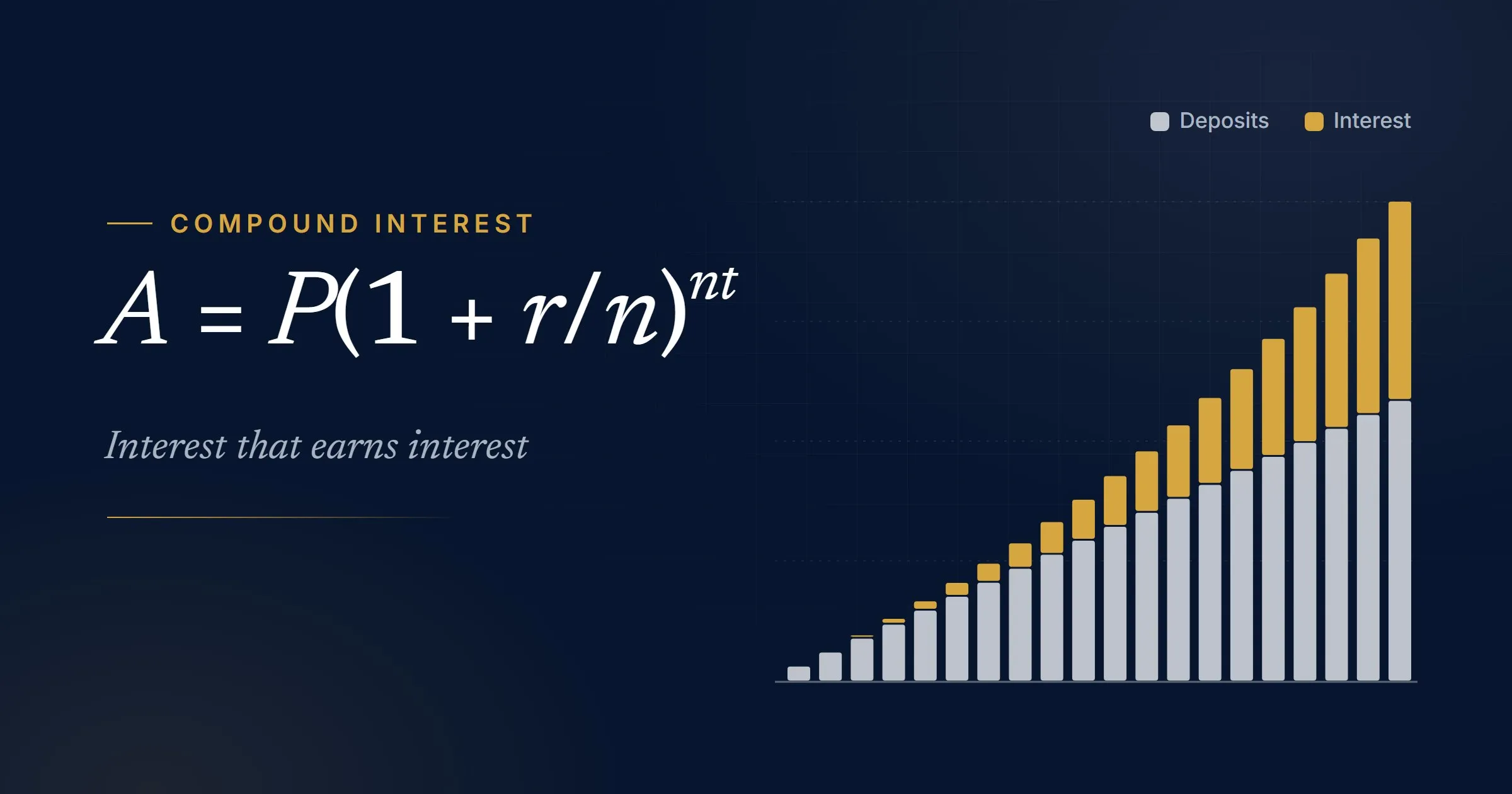
Simple interest is calculated only on the original amount, called the principal. Compound interest is calculated on the principal plus any interest already added, so interest earns interest of its own.Source 1 The difference starts small and grows over time. When you save, compounding works for you. When you borrow, simple interest usually costs less.
Simple vs. compound interest at a glance
| Simple interest | Compound interest | |
|---|---|---|
| Interest is paid on | The principal only | The principal plus interest already added |
| Interest each year | The same amount | A little more each year |
| Formula | I = P × r × t | A = P × (1 + r ÷ n)nt |
| Where you’ll see it | Most auto loans, Treasury notes, unpaid student loan interest | Savings accounts, CDs, credit cards, I bonds |
| Better for | Borrowers | Savers |
The simple interest formula
I equals P times r times t.
- I is the interest
- P is the principal, the amount borrowed or deposited
- r is the yearly interest rate, as a decimal (4% is 0.04)
- t is the time in years
To get the total, add the interest to the principal: A = P × (1 + r × t).
$5,000 at 4% simple interest for 3 years
- Multiply the principal, rate and time: $5,000 × 0.04 × 3 = $600.00.
- Add it to the principal: $5,000 + $600.00 = $5,600.00.
- That’s $200.00 a year, every year, because the interest never joins the balance that earns interest.
Solving for the rate, time or principal
Rearrange the formula to find any other part:
- Rate: r = I ÷ (P × t). If $5,000 earned $600 over 3 years, the rate was $600 ÷ ($5,000 × 3) = 4%.
- Time: t = I ÷ (P × r). For $5,000 at 4% to earn $1,000 takes $1,000 ÷ ($5,000 × 0.04) = 5 years.
- Principal: P = I ÷ (r × t). To earn $600 in 3 years at 4%, you’d need $600 ÷ (0.04 × 3) = $5,000.
For days or months
For less than a year, write the time as a fraction of a year: months ÷ 12, or days ÷ 365. $5,000 at 4% for 90 days earns $5,000 × 0.04 × 90 ÷ 365 = $49.32.
The compound interest formula
With compound interest, the interest is added to the balance at regular intervals, and each period’s interest is figured on the new, larger balance:
A equals P times the quantity 1 plus r divided by n, raised to the power n times t.
- A is the total at the end, principal plus interest
- P is the principal
- r is the yearly interest rate, as a decimal
- n is how many times a year interest compounds (12 for monthly)
- t is the time in years
Here’s the same $5,000 at 4% for 3 years, with simple interest and with compounding:
| Method | Interest | Total |
|---|---|---|
| Simple interest | $600.00 | $5,600.00 |
| Compounded yearly | $624.32 | $5,624.32 |
| Compounded quarterly | $634.13 | $5,634.13 |
| Compounded monthly | $636.36 | $5,636.36 |
| Compounded daily | $637.45 | $5,637.45 |
A fixed rate, with nothing added or taken out.
Compounding yearly instead of using simple interest adds $24.32, while compounding daily instead of yearly adds only $13.13 more. Most of the difference comes from compounding at all. Our compound interest guide explains compounding step by step.
How the gap grows over time
Over a single compounding period, simple and compound interest are the same. In its first year, $5,000 at 4% compounded yearly earns $200.00, exactly what simple interest pays. After that, compounding pulls ahead, and the gap widens with time and with higher rates:
| Rate | 5 years | 10 years | 20 years | 30 years |
|---|---|---|---|---|
| 2% | $41 | $190 | $859 | $2,114 |
| 5% | $263 | $1,289 | $6,533 | $18,219 |
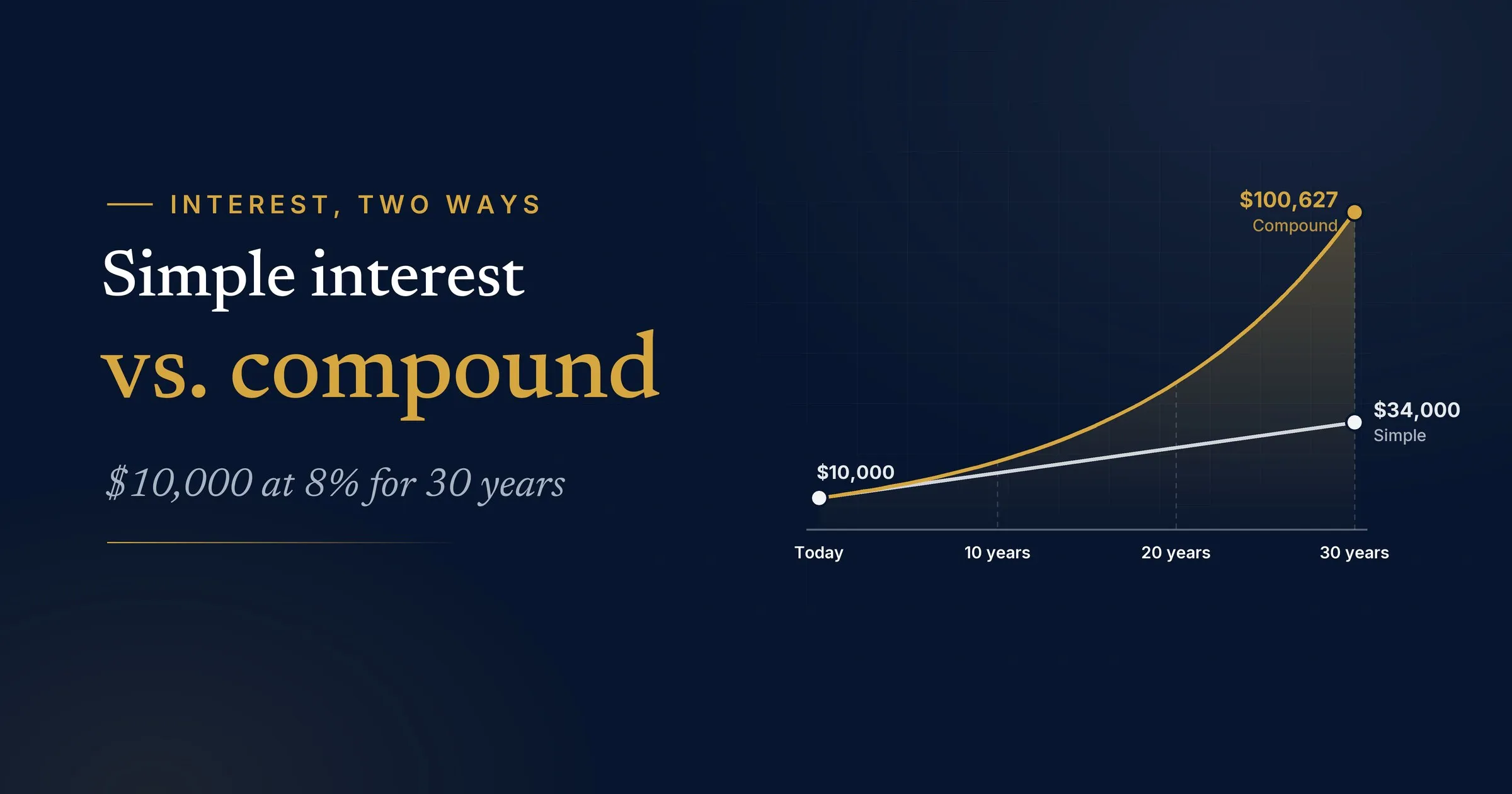
| 8% | $693 | $3,589 | $20,610 | $66,627 |
Interest compounded yearly, compared with simple interest at the same rate. Rounded to the dollar.
At 2% for 5 years, compounding earns just $41 more. At 8% for 30 years, it earns $66,627 more. That’s why compounding matters most for long-term savings, and for debts left to grow for years.
Where you’ll see simple interest
Car loans
Most auto loans charge simple interest, figured on the balance you still owe, either daily or monthly. Paying more than your monthly payment shrinks the principal, so less interest builds up.Source 2 Our loan amortization guide shows how each payment splits between interest and principal over the life of a loan.
On a $25,000 balance at 7%, interest builds up at about $4.79 a day ($25,000 × 0.07 ÷ 365). Paying $1,000 extra brings that down to $4.60, about $70 less over a year.
The less common alternative, precomputed interest, works out all the interest at the start and spreads it over your payments. Extra payments don’t reduce that interest, though you may get a refund of some unearned interest if you pay the loan off early.Source 2
Student loans
Student loan interest that goes unpaid, for example while you’re in school, builds up on top of what you borrowed. In the CFPB’s example below, it builds up as simple interest. Adding that unpaid interest to the principal is called capitalization,Source 3 and once it happens, you’re charged interest on interest.Source 4 On federal Direct Loans, unpaid interest on an unsubsidized loan is capitalized when a deferment ends.Source 3 Private student loans typically capitalize interest when a grace period, deferment or forbearance ends.Source 4
Capitalized interest, from the CFPB's example
- You borrow $5,000 at 10% for a 12-month program. Interest of $500 builds up during school and $250 during a six-month grace period, $750 in all.Source 4
- Capitalization adds the $750 to the principal, which becomes $5,750.
- From then on, a year’s interest at 10% is $575 instead of $500. You’re paying interest on interest.
Only unpaid interest is capitalized,Source 3 so paying the interest as it builds up keeps your balance from growing.
Treasury notes
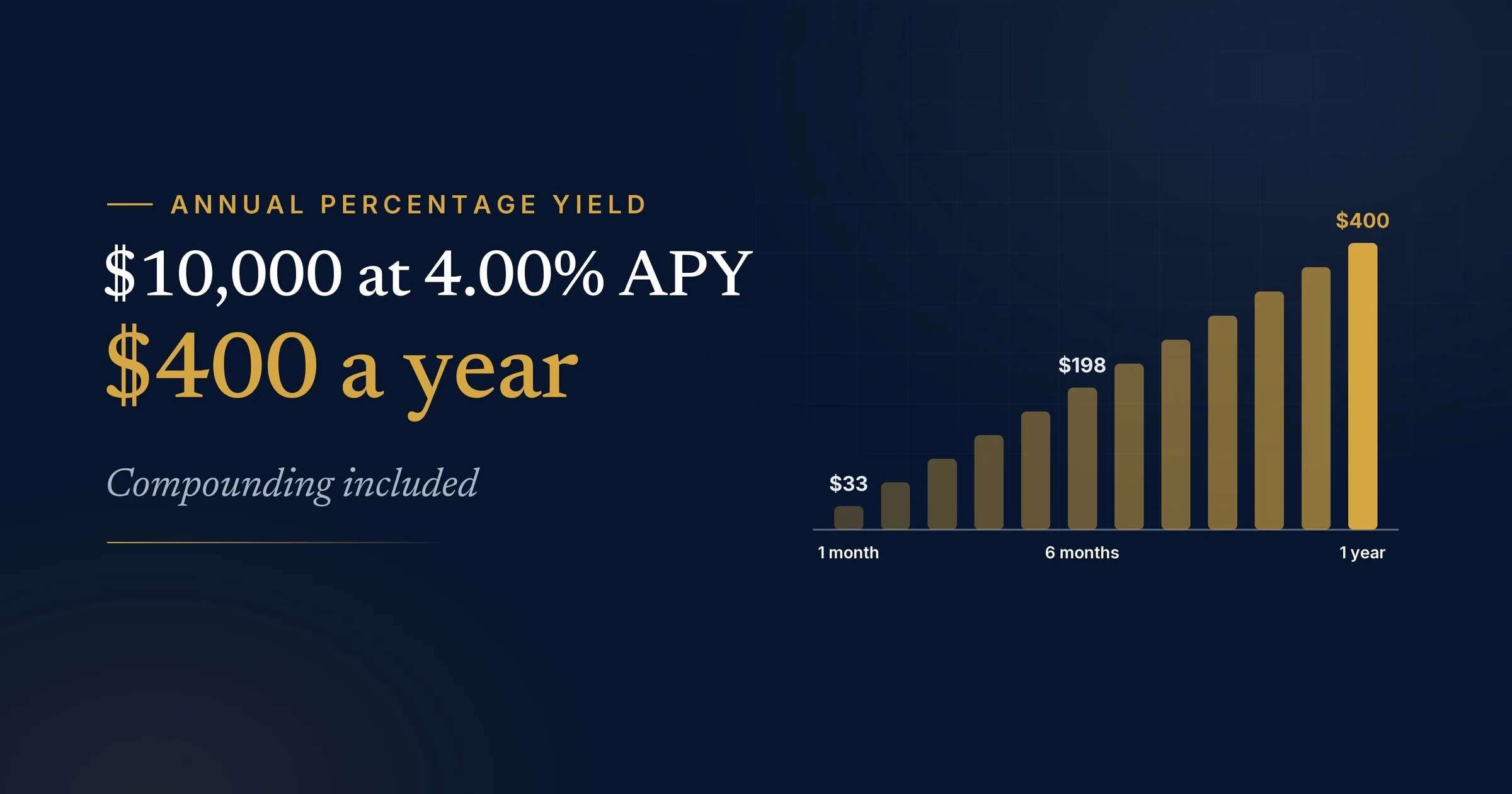
Treasury notes pay a fixed rate of interest every six months until they mature.Source 5 Because the interest is paid out to you rather than added to the note, the note itself earns simple interest: a $10,000 note paying 4% sends you $200 every six months, or $400 a year. Reinvesting those payments is how you’d compound them yourself.
Interest paid out of a CD
If a CD’s interest is paid into another account instead of being left in the CD, it can’t compound, so the CD earns simple interest on its principal. A CD’s APY assumes the interest stays in until the CD matures.Source 6 Our APY guide explains how to read it.
Where you’ll see compound interest
- Savings accounts, money market accounts and CDs. Interest credited to your balance earns interest too, and the APY reflects that compounding.Source 7
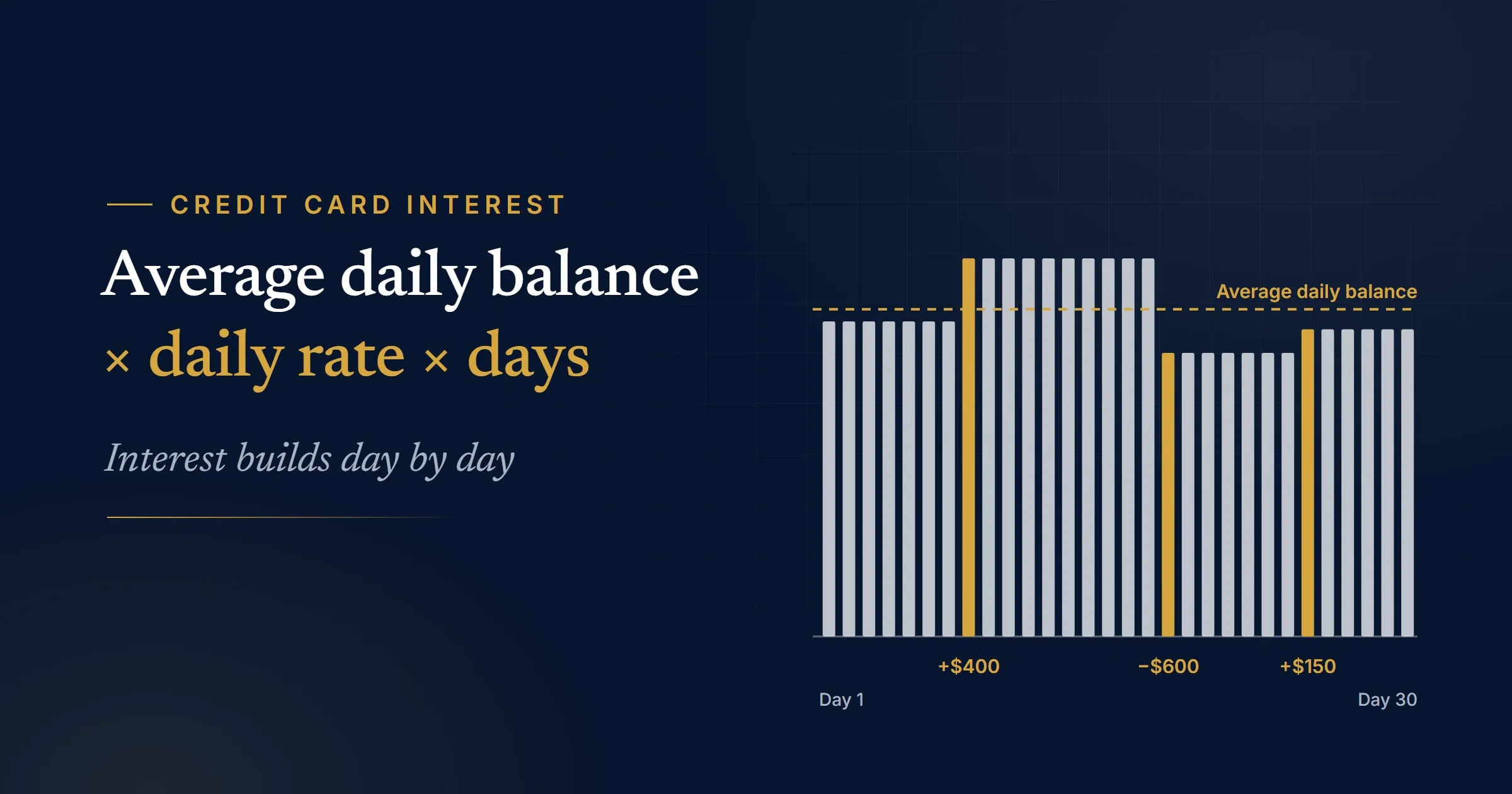
- Credit cards. Card issuers that use a daily periodic rate add each day’s interest to the balance, so interest compounds daily.Source 8 Our credit card interest guide shows what that costs.
- I bonds. Interest compounds every six months: the rate applies to a new principal that includes the interest earned in the previous six months.Source 9
- Capitalized loan interest, as in the student loan example above.
Which is better?
It depends on which side of the interest you’re on:
- Saving: compound interest is better. Leave the interest in the account so it can compound, and compare accounts by APY.
- Borrowing: simple interest usually costs less, especially if you pay extra. Where you can, pay interest before it’s capitalized, and compare loans by APR.
Our APR vs. APY guide explains both rates.
Common questions
What is the formula for simple interest?
Interest = principal × rate × time, or I = P × r × t, with the rate as a decimal and the time in years. $5,000 at 4% for 3 years earns $600.00.
Is simple interest better than compound interest?
For a borrower, yes: you pay interest only on what you borrowed. For a saver, compound interest is better, because your interest earns interest too.
Do banks pay simple or compound interest?
Savings accounts and CDs usually compound, daily or monthly, and the APY includes the effect. Banks don’t have to compound on any particular schedule,Source 10 so compare APYs rather than compounding schedules.
Is credit card interest simple or compound?
Usually compound. With a daily periodic rate, each day’s interest is added to the balance, so the next day’s interest is charged on it.Source 8
Are car loans simple interest?
Most are. The alternative, precomputed interest, is uncommon.Source 2 Check your loan contract to be sure.
When are simple and compound interest the same?
Over a single compounding period. $5,000 at 4% compounded yearly earns $200.00 in its first year, the same as simple interest.
Run your own numbers
See how money can grow over time, year by year.
Open the calculator
Sources
Numbers in the text link to these sources. We check them whenever we update this page.
- 1
What is compound interest?(external site)
Investor.gov, U.S. Securities and Exchange Commission · Accessed November 22, 2026 · Back to text for source 1
- 2
Consumer Financial Protection Bureau · Last reviewed January 30, 2024 · Accessed November 22, 2026 · Back to text for source 2
- 3
34 CFR 685.202, Charges for which Direct Loan Program borrowers are responsible(external site)
Electronic Code of Federal Regulations · Accessed November 22, 2026 · Back to text for source 3
- 4
How does interest accrue while I am in school?(external site)
Consumer Financial Protection Bureau · Last reviewed May 14, 2024 · Accessed November 22, 2026 · Back to text for source 4
- 5
U.S. Department of the Treasury, TreasuryDirect · Accessed November 22, 2026 · Back to text for source 5
- 6
Appendix A to Part 1030, Annual Percentage Yield Calculation (Regulation DD)(external site)
Electronic Code of Federal Regulations · Accessed November 22, 2026 · Back to text for source 6
- 7
12 CFR 1030.2, Definitions (Regulation DD, Truth in Savings)(external site)
Electronic Code of Federal Regulations · Accessed November 22, 2026 · Back to text for source 7
- 8
What is a “daily periodic rate” on a credit card?(external site)
Consumer Financial Protection Bureau · Last reviewed September 23, 2024 · Accessed November 22, 2026 · Back to text for source 8
- 9
U.S. Department of the Treasury, TreasuryDirect · Accessed November 22, 2026 · Back to text for source 9
- 10
12 CFR 1030.7, Payment of interest (Regulation DD, Truth in Savings)(external site)
Electronic Code of Federal Regulations · Accessed November 22, 2026 · Back to text for source 10
About the author
Wealthistry Editorial Team
Research, writing and editing
The team that researches, writes, fact-checks and updates Wealthistry's guides and calculators, following our published editorial standards.
Author profileEditorial policyHow we researchReport an error