Amortization is how an installment loan gets paid off: the same payment every month, with part going to interest and the rest to the amount you borrowed, the principal. Early on, a bigger share of each payment goes to interest; later, a bigger share goes to principal. The table that shows the split for every payment is called an amortization schedule.Source 1
The higher the rate, the more that split tilts toward interest. New 60-month car loans at commercial banks averaged 7.54% in the third quarter of 2026,Source 2 and 30-year fixed mortgages averaged 7.21% in Freddie Mac’s survey for November 25, 2026.Source 3 This guide shows how the payment is figured and what full schedules look like at those rates.
How amortization works
Each month, the lender charges interest on the balance you still owe. Your payment covers that interest first, and whatever is left reduces the balance. Because the balance is largest at the start, so is the interest, leaving less of the payment for principal. As the balance shrinks, the interest does too, and more of the same payment goes to principal. That’s why the balance falls slowly at first and then faster toward the end.Source 1
The amortization formula
Lenders set the payment so that equal payments clear the loan exactly by the last month:
Payment equals P times r, divided by one minus one plus r to the power of negative n.
- P is the amount borrowed
- r is the monthly rate, the annual rate divided by 12
- n is the number of monthly payments
Each month’s interest is simply the balance times the monthly rate. For a $30,000 car loan over 60 months at 7.54%, the formula gives a payment of $601.71. The first month’s interest is $30,000 × 7.54% ÷ 12, or $188.50, so $413.21 of the first payment goes to principal.
An amortization schedule for a car loan
Here’s that $30,000 loan, year by year:
| Year | Interest | Principal | Balance left |
|---|---|---|---|
| Year 1 | $2,087 | $5,134 | $24,866 |
| Year 2 | $1,686 | $5,534 | $19,332 |
| Year 3 | $1,254 | $5,966 | $13,366 |
| Year 4 | $789 | $6,432 | $6,934 |
| Year 5 | $286 | $6,934 | $0 |
Each month's interest is the balance times 7.54% ÷ 12, rounded to the cent. Totals are rounded to the dollar.
Interest over the life of the loan comes to $6,103. Notice how the yearly interest falls from the first year to the last, while the principal paid rises: the payment never changes, only the split. Most auto loans charge simple interest on the balance, figured daily or monthly,Source 4 so a lender that figures interest daily will show slightly different numbers.
How a 30-year mortgage amortizes
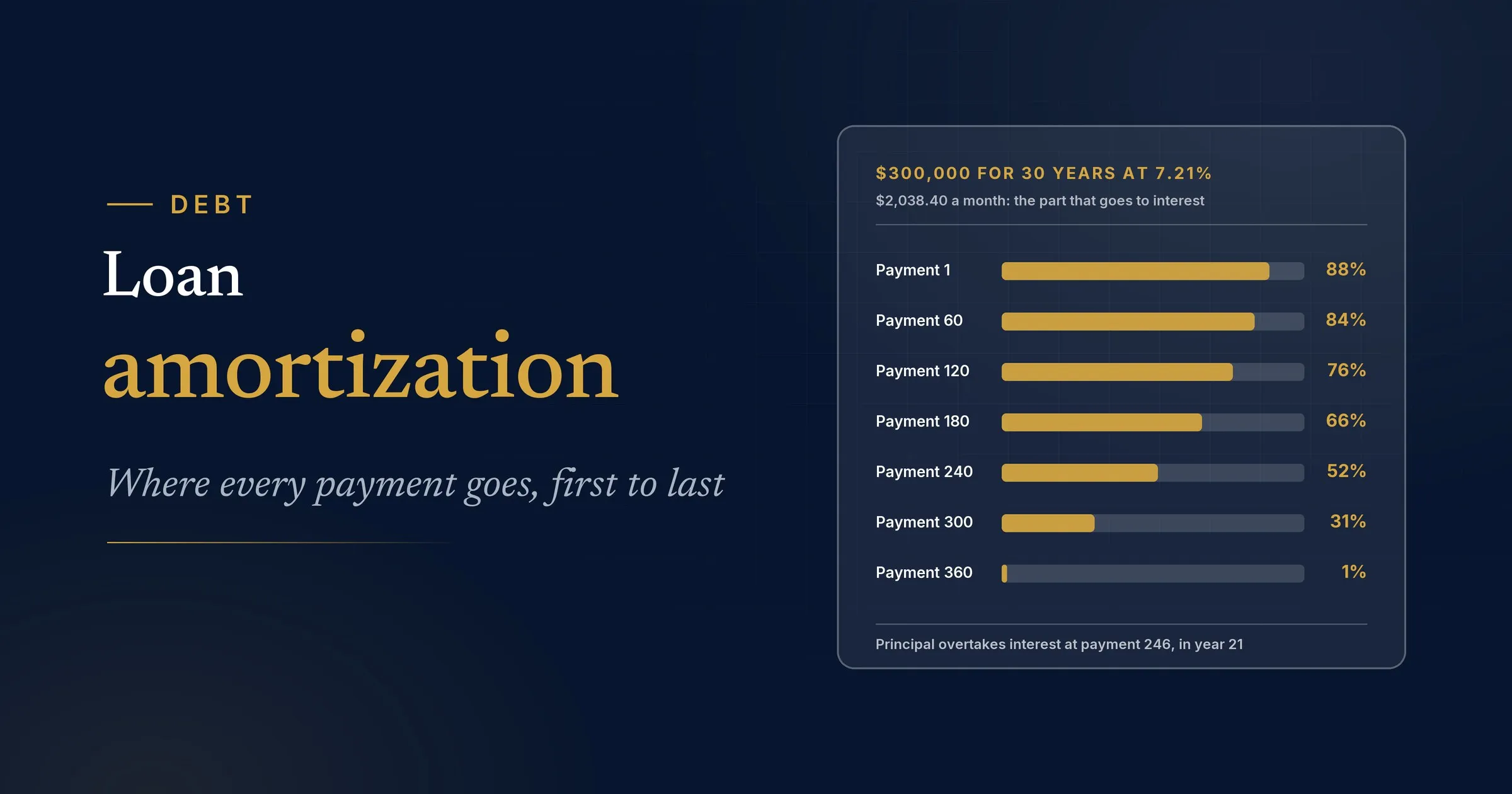
The same math stretched over 360 payments makes the early tilt toward interest much stronger. Here’s a $300,000 mortgage at 7.21%, with a principal and interest payment of $2,038.40:
| Payment no. | To interest | To principal | Balance after |
|---|---|---|---|
| 1 | $1,803 | $236 | $299,764 |
| 60 | $1,702 | $336 | $283,019 |
| 120 | $1,557 | $481 | $258,694 |
| 180 | $1,349 | $689 | $223,848 |
| 240 | $1,051 | $987 | $173,932 |
| 300 | $624 | $1,414 | $102,426 |
| 360 | $12 | $2,021 | $0 |
Principal and interest only, rounded to the dollar; property taxes and insurance would be added to a real payment. Payment 60 is the last of year 5. The final payment is a little smaller because it only has to clear what's left.
What the schedule shows
- Of the first payment, $1,802.50, or 88%, goes to interest and only $235.90 to principal.
- Principal doesn’t overtake interest until payment 246, in year 21.
- Half the loan isn’t paid off until year 22.
- Over 30 years, interest adds up to $433,819, more than the amount borrowed.
Shorter terms: 15 years vs. 30 years
Stretching a loan over more years lowers the monthly payment but raises the total interest you pay.Source 1 Fifteen-year mortgages also tend to carry lower rates: they averaged 6.54% in the same survey.Source 3 For the $300,000 loan, a 15-year term means a payment of $2,619.92, $581.52 more a month, but total interest of $171,587 instead of $433,819. That’s $262,232 less. Our guide to debt-to-income ratios shows how lenders judge whether a payment that size fits your income.
What paying extra does
An extra payment toward principal lowers the balance right away, so every later payment carries less interest and more of it goes to principal. The loan ends sooner, and the interest you skip adds up:
- On the car loan, paying $50 more each month pays it off in 55 months instead of 60 and saves $579 in interest.
- On the 30-year mortgage, paying $200 more each month pays it off in about 22.8 years, 86 payments early, and saves $122,460 in interest.
Two things to check first:
- Prepayment penalties. Not all mortgages have one. When a mortgage does, it typically applies only if you pay off the whole balance within a set number of years, usually three or five, for example by selling or refinancing, and sometimes if you pay off a large amount at once. Extra principal paid in small chunks doesn’t normally trigger it, but check with your lender.Source 5
- Precomputed interest. Some car loans work out all the interest up front instead of charging it on the balance. On those, extra payments don’t cut the interest, though paying the loan off early may get you a refund of some of it.Source 4
Loans that don’t fully amortize
Not every loan pays itself off with equal payments:
- Interest-only loans. For a set time, you pay only the interest, so the amount you owe doesn’t go down. When that time ends, you’ll need to pay off the balance at once, refinance if you can, or start monthly payments that are higher than before.Source 6 If the $300,000 loan at 7.21% were interest-only for its first 10 years, the payment would be $1,802.50, and after 10 years, all $300,000 would still be owed. Paying it off over the remaining 20 years would take $2,363.86 a month, $561.36 more.
- Negative amortization. If your payment is less than the interest due, the unpaid interest is added to what you owe, so the balance grows even though you’re paying. Later, the payments usually rise to cover principal and interest. With a home loan, you can end up owing more than the home is worth.Source 7
- Balloon loans. Payments are set too low to pay off the loan over its term, so a large final payment, the balloon, comes due at the end. Balloon mortgages usually run 5 to 10 years, and the balloon is generally more than twice the average monthly payment, often a big share of the whole loan. Balloon payments aren’t allowed in Qualified Mortgages, with limited exceptions.Source 8
- Credit cards. A card balance isn’t amortized on a fixed schedule; the minimum payment changes as the balance does. Our guide to credit card minimum payments shows how long paying only the minimum takes.
Make your own amortization schedule in a spreadsheet
Excel and Google Sheets both have built-in functions for this, taking the same arguments in the same order.Source 9 Use the monthly rate and the number of months, not the yearly figures: for monthly payments on a four-year loan at 12%, Microsoft’s example uses 12%/12 for the rate and 4*12 for the number of payments.Source 10
- PMT gives the payment.
=PMT(7.54%/12, 60, -30000)returns the $601.71 car payment above. Money you pay out counts as a negative number,Source 11 so with the loan entered as a positive amount, the payment shows up negative; the minus sign flips it. PMT covers principal and interest only, not taxes or fees.Source 10 - IPMT gives the interest part of any single payment.
=IPMT(7.54%/12, 1, 60, -30000)returns the $188.50 of interest in payment 1.Source 11 - PPMT gives the principal part.
=PPMT(7.54%/12, 1, 60, -30000)returns $413.21.Source 12
Put payment numbers 1 to 60 down one column, add IPMT and PPMT beside them, and subtract each PPMT from the previous balance to build the full schedule. To see the total you’ll pay over the loan, multiply the payment by the number of payments.Source 10 Our Debt Payoff Calculator does the same for several debts at once, with extra payments.
Common questions
What is an amortization schedule?
A table of every payment on a loan, showing how much goes to interest, how much to principal and the balance left after each one.Source 1
Why does so much of each early payment go to interest?
Interest is charged on the balance, and the balance is highest at the start. As you pay it down, the interest shrinks and more of the same payment goes to principal.Source 1 The longer the loan, the stronger the effect: interest takes 88% of the first payment on the 30-year mortgage above, but 31% on the five-year car loan.
Can you pay off an amortized loan early?
Usually, yes, and it saves interest. Check your loan documents for a prepayment penalty first, which some mortgages charge when you pay off the whole balance in the first few years.Source 5
What does a 5-year term with a 20-year amortization mean?
The payments are figured as if the loan would be paid off over 20 years, but the loan comes due after 5. On $300,000 at 7.21%, that’s $2,363.86 a month, and after five years $259,591, 87% of the loan, is still owed in one balloon payment. You may be able to refinance before it’s due, but that may not be possible if your home loses value or your finances get worse.Source 8
What’s the monthly payment on a $400,000 mortgage?
At 7.21% over 30 years, principal and interest come to $2,717.86 a month, and interest over the full term adds up to $578,431. Over 15 years at 6.54%, it’s $3,493.23 a month and $228,782 of interest. Property taxes and insurance come on top.
Is amortization the same as simple interest?
No. Amortization is the payment schedule; simple interest is how the interest is figured. Most auto loans charge simple interest on the balance you still owe,Source 4 and as long as each payment covers the interest due, you never pay interest on interest. That happens when unpaid interest is added to the balance, as with negative amortization.Source 7 Our guide to simple vs. compound interest explains the difference.
Run your own numbers
Compare snowball and avalanche plans side by side.
Open the calculator
Sources
Numbers in the text link to these sources. We check them whenever we update this page.
- 1
What is amortization and how could it affect my auto loan?(external site)
Consumer Financial Protection Bureau · Last reviewed September 24, 2024 · Accessed November 25, 2026 · Back to text for source 1
- 2
Consumer Credit, G.19 statistical release(external site)
Board of Governors of the Federal Reserve System · Published November 6, 2026 · Accessed November 25, 2026 · Back to text for source 2
- 3
Primary Mortgage Market Survey(external site)
Freddie Mac · Published November 25, 2026 · Accessed November 25, 2026 · Back to text for source 3
- 4
Consumer Financial Protection Bureau · Last reviewed January 30, 2024 · Accessed November 25, 2026 · Back to text for source 4
- 5
What is a prepayment penalty?(external site)
Consumer Financial Protection Bureau · Last reviewed September 11, 2024 · Accessed November 25, 2026 · Back to text for source 5
- 6
What is an "interest-only" loan?(external site)
Consumer Financial Protection Bureau · Last reviewed September 11, 2024 · Accessed November 25, 2026 · Back to text for source 6
- 7
What is negative amortization?(external site)
Consumer Financial Protection Bureau · Last reviewed September 11, 2024 · Accessed November 25, 2026 · Back to text for source 7
- 8
What is a balloon payment? When is one allowed?(external site)
Consumer Financial Protection Bureau · Last reviewed August 28, 2026 · Accessed November 25, 2026 · Back to text for source 8
- 9
Google Sheets function list(external site)
Google Docs Editors Help · Accessed November 25, 2026 · Back to text for source 9
- 10
Microsoft Support · Accessed November 25, 2026 · Back to text for source 10
- 11
Microsoft Support · Accessed November 25, 2026 · Back to text for source 11
- 12
Microsoft Support · Accessed November 25, 2026 · Back to text for source 12
About the author
Wealthistry Editorial Team
Research, writing and editing
The team that researches, writes, fact-checks and updates Wealthistry's guides and calculators, following our published editorial standards.
Author profileEditorial policyHow we researchReport an error