APR, short for annual percentage rate, is the cost of credit expressed as a yearly rate.Source 1 On a credit card, the APR is the card’s interest rate, stated as a yearly figure.Source 2 On a loan, it’s the interest rate plus certain fees the lender charges to make the loan, such as origination charges, so it’s often higher than the rate.Source 3 Lenders have to disclose it, which makes APR the standard way to compare what credit costs.
APR vs. interest rate
A loan’s interest rate is what the lender charges you for borrowing the principal. The APR measures the interest rate plus the additional fees charged with the loan.Source 3 Under federal rules, it relates the amount and timing of the money you receive to the amount and timing of the payments you make.Source 1 So a fee taken out of your loan raises the APR: you repay the full loan amount but receive less.
That’s why the APR, not the rate, tells you which loan costs less:
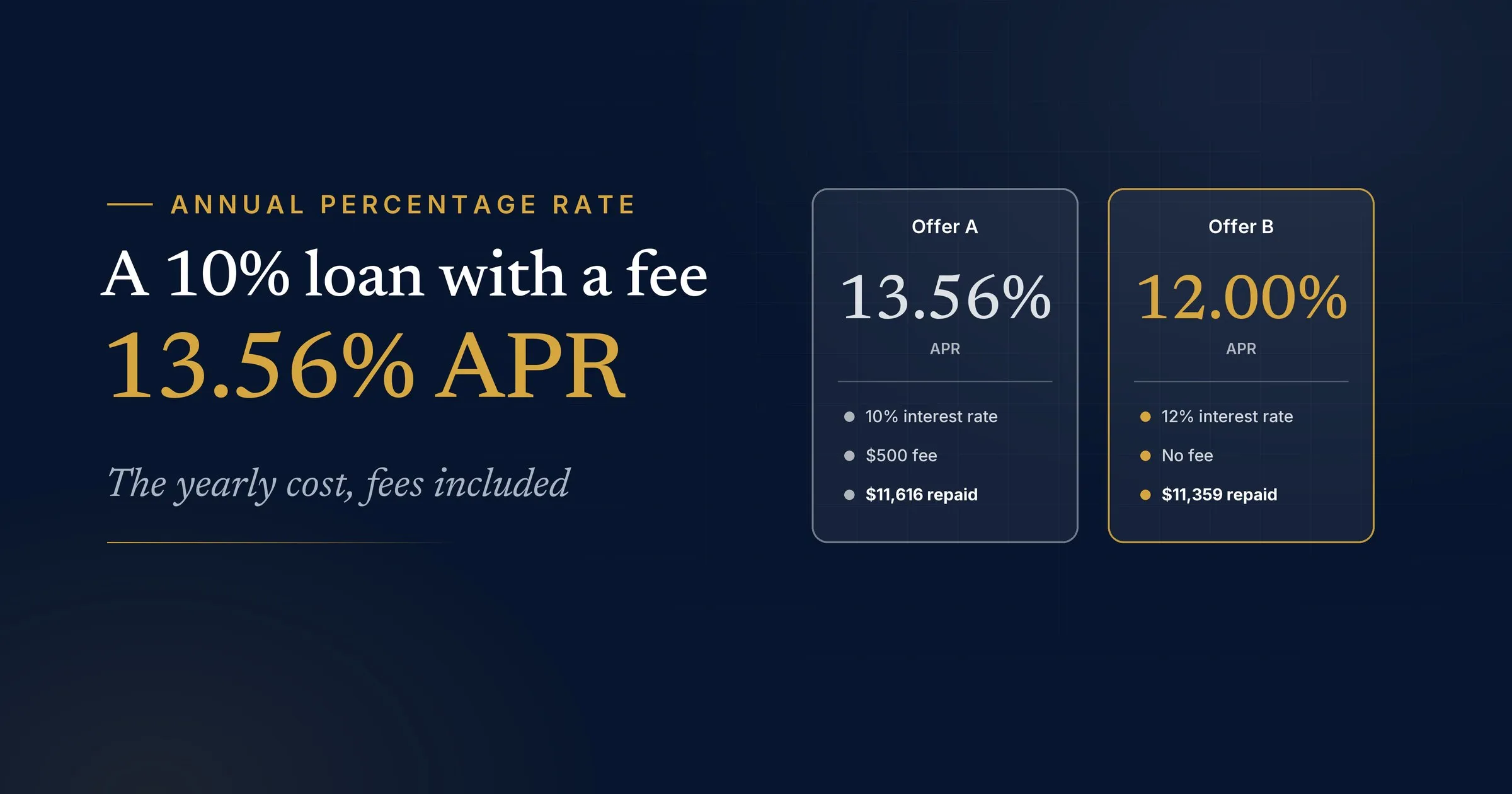
Two offers for $9,500 over three years
- Offer A: a 10% interest rate, with a 5% origination fee taken out of the loan. To receive $9,500, you borrow $10,000 and pay a $500 fee. The payment is $322.67 a month, and the APR is 13.56%.
- Offer B: a 12% interest rate with no fee. You borrow $9,500, the payment is $315.54 a month, and the APR is 12.00%.
- Over 36 months, you’d pay $11,616.12 on Offer A and $11,359.44 on Offer B. The loan with the higher interest rate saves you $256.68, and its lower APR shows it.
You can check a loan’s APR with a spreadsheet’s RATE function, which works out the rate per period from the number of payments, the payment and the amount you receive. Enter the payment as a negative number and multiply the result by 12 to get a yearly rate.Source 4 For Offer A, =RATE(36, -322.67, 9500) * 12 returns 13.56%. To work out the payment itself, or how each payment splits between interest and principal, see our loan amortization guide.
What counts toward APR, and what doesn’t
The fees in a loan’s APR are the ones federal rules treat as finance charges: charges you pay as a condition of getting the credit, but not ones you’d also pay in a comparable cash purchase.Source 5
Counts toward the APR:
- Interest
- Origination fees, loan fees, points and finder’s fees
- Service, transaction and carrying charges
- Credit report, appraisal and investigation fees, though reasonable ones on a mortgage are left out
- Insurance the lender requires to protect itself if you don’t repay
Doesn’t count:
- Application fees charged to everyone who applies, whether or not they’re approved
- Late fees, over-limit fees and other charges for default
- Annual or other periodic fees for having a credit plan, such as a card’s annual fee
- Optional credit insurance, as long as the lender doesn’t require it, tells you so in writing and you ask for it yourself
Because annual fees and late fees sit outside the APR, check them separately. Two cards with the same APR can cost quite different amounts if one charges an annual fee.
The APRs on a credit card
A card can carry several APRs at once. Its account-opening disclosures must list the rates for purchases, cash advances and balance transfers, plus any introductory or penalty rate, with the purchase APR in large type.Source 6
- Purchase APR: the rate on purchases you don’t pay off in full.
- Balance transfer APR: the rate on debt moved over from another card. Our balance transfer guide explains when moving a balance pays off.
- Cash advance APR: the rate on cash you borrow against the card. Grace periods typically cover only purchases, so interest on a cash advance generally starts on the day you take it.Source 7
- Introductory APR: a lower rate for a set time. The disclosures must also show the rate that applies once it ends.Source 6
- Penalty APR: a higher rate that can apply if you pay late. On balances you already have, it can apply only if you’re more than 60 days behind on a minimum payment.Source 8
Our credit card interest guide explains how these rates turn into daily interest charges and when an issuer can raise them.
Fixed vs. variable APR
A variable APR moves with an index, such as the prime rate published in The Wall Street Journal. A fixed APR doesn’t follow an index.Source 9 For a variable rate, a card’s disclosures must explain how the rate is set, including the margin added to the index.Source 6
A variable APR of prime plus 14 points
Fixed doesn’t mean permanent. The issuer generally must notify you before a change, and in most cases can apply a higher rate only to purchases and other transactions you make after the notice.Source 9 On a credit card, that notice must come at least 45 days before the change.Source 11
Average APRs
Here’s what banks charged on average in the third quarter of 2026, according to the Federal Reserve:Source 12
| Type of credit | Average APR |
|---|---|
| Credit cards, all accounts | 21.19% |
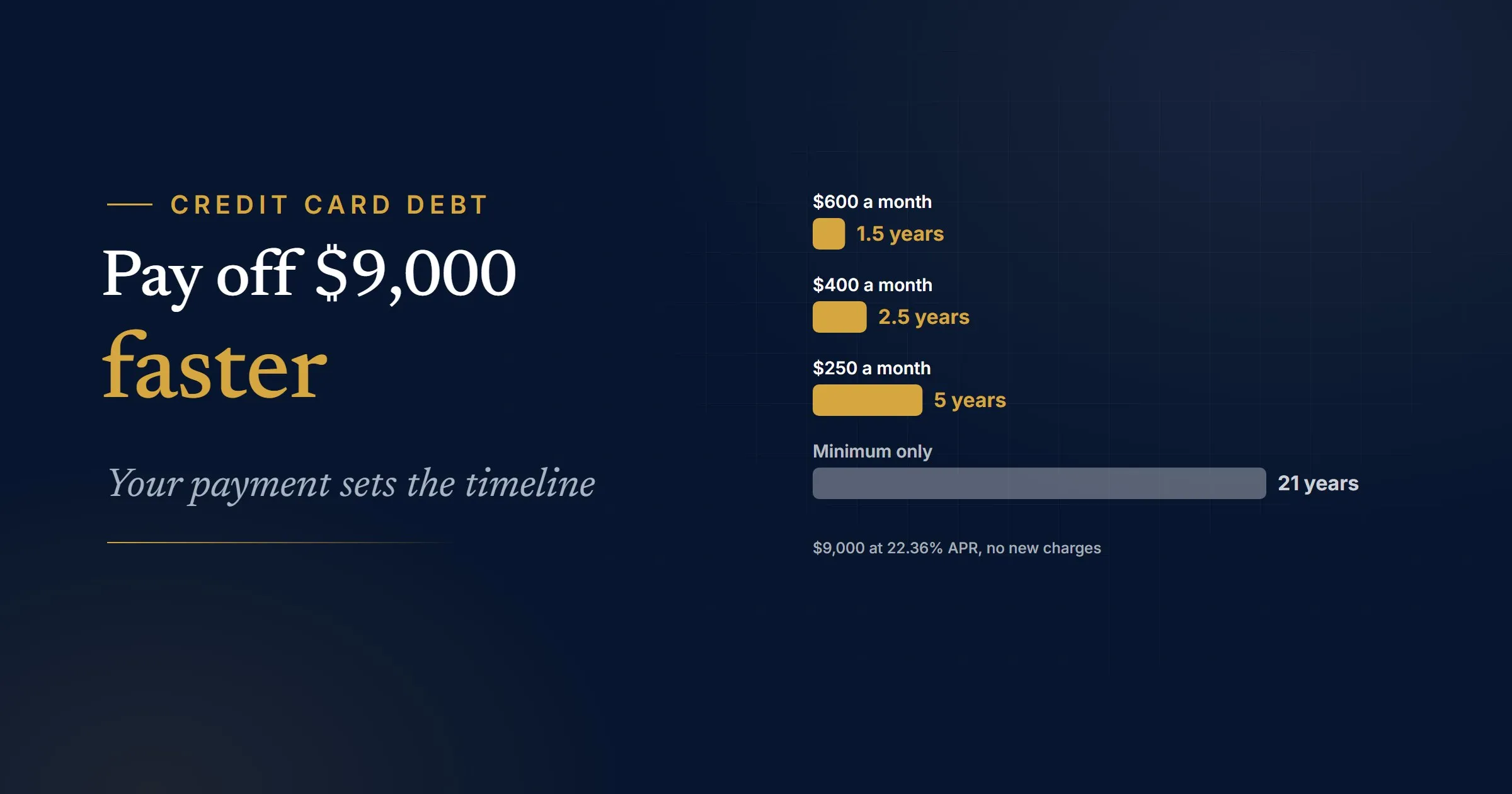
| Credit cards, accounts charged interest | 22.36% |
| Personal loans, 24 months | 11.90% |
| New car loans, 60 months | 7.54% |
| New car loans, 72 months | 7.17% |
Not seasonally adjusted. The all-accounts card rate averages the stated APR on every account; the rate for accounts charged interest reflects the interest actually charged on balances that carried interest. Loan rates average each bank's most common rate.
Your own rate can be higher or lower. In general, the higher your credit score, the lower your rates will be, and lenders don’t have to offer you their best rate, so it pays to shop around.Source 3
How to compare APRs
- Compare APRs with APRs, not APRs with interest rates, because the two aren’t the same.Source 3
- Match the loan length. An up-front fee raises the APR more on a short loan than on a long one, as our APR vs. APY guide shows, so compare loans with the same term.
- Check what the APR leaves out, such as annual fees and late fees.
- On a card, pay in full. On most cards, paying your balance in full by the due date each month avoids interest on purchases, whatever the APR.Source 2
Common questions
Is APR the same as the interest rate?
On a credit card, the APR is the card’s interest rate stated as a yearly rate.Source 2 On a loan, the APR adds certain fees to the interest rate, so it’s usually higher.Source 3
What’s a good APR?
One below the average for that kind of credit. In the third quarter of 2026, the average was 21.19% for credit cards, 11.90% for 24-month personal loans and 7.54% for 60-month new car loans at commercial banks.Source 12
How is APR charged on a credit card?
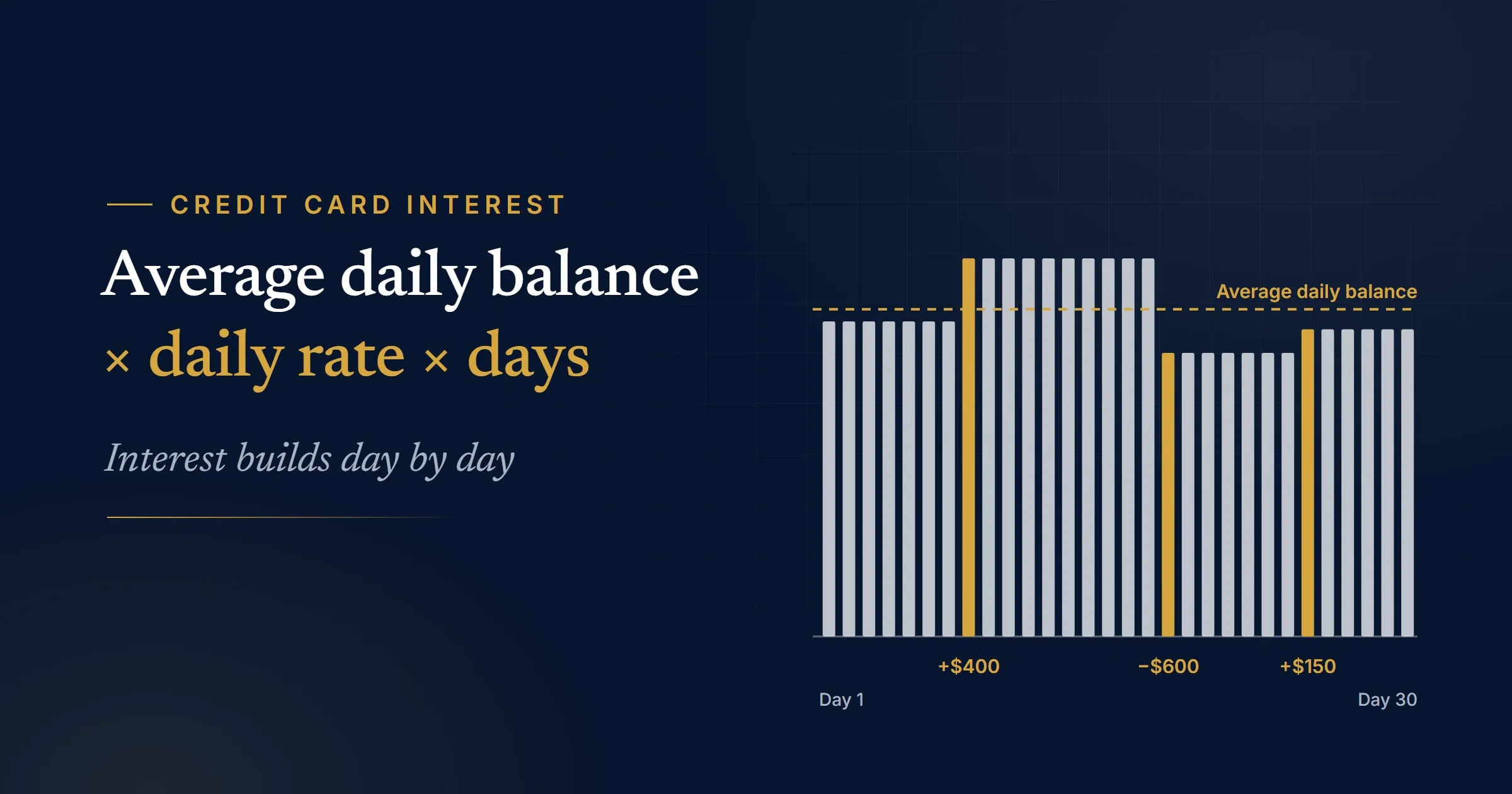
Card interest is usually figured with a daily periodic rate: the APR divided by 360 or 365, depending on the issuer. Each day’s interest is added to the balance.Source 13 Our credit card interest guide works through an example.
Can my APR go up?
A variable APR rises when its index does. Otherwise, a card issuer generally can’t raise the APR on your existing balance unless an introductory rate ends or you’re more than 60 days late,Source 8 and higher rates on new transactions need 45 days’ notice.Source 11
What’s the difference between APR and APY?
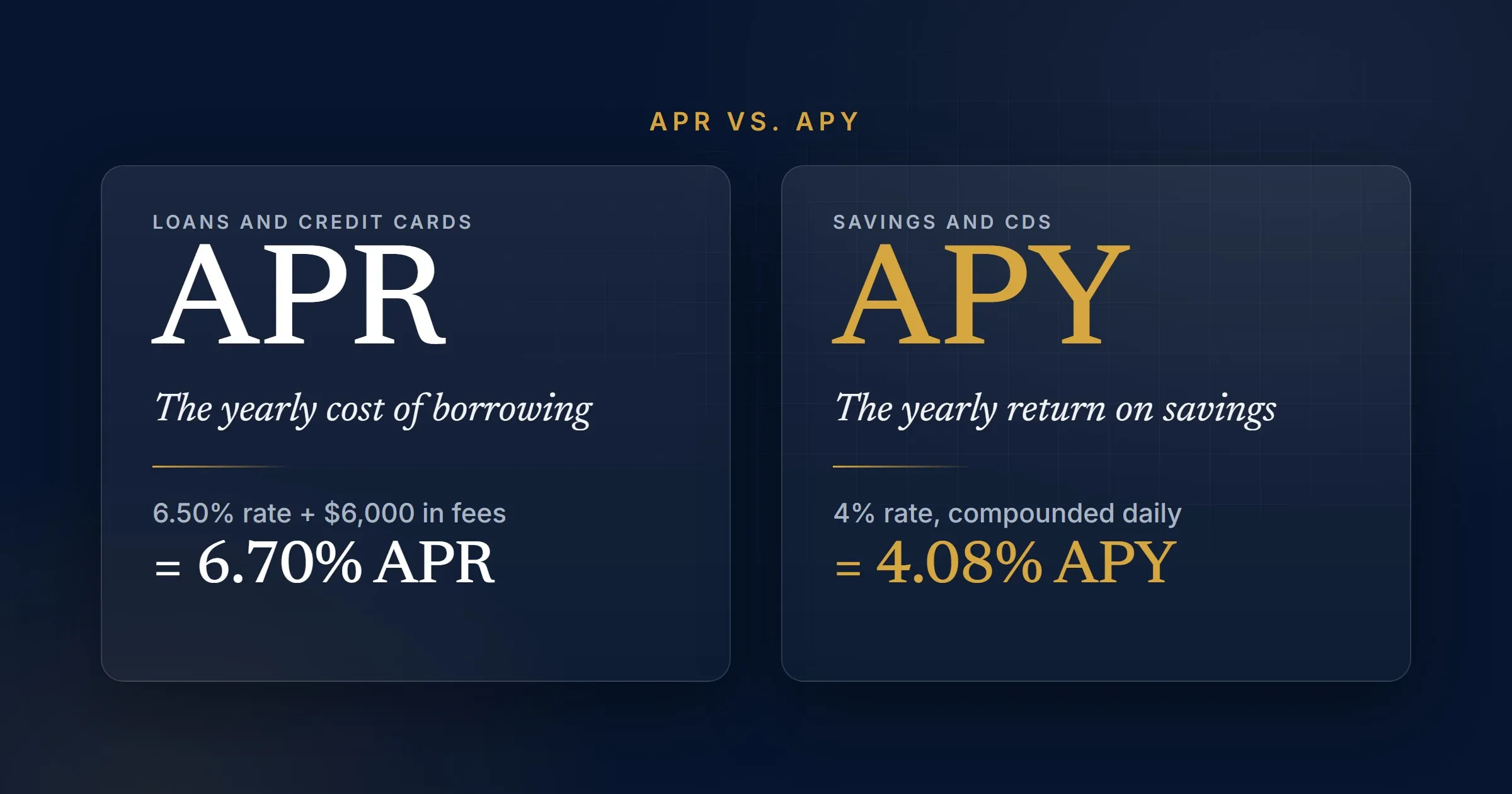
APR is the yearly cost of borrowing. APY is the yearly return on savings, with compounding included. Our APR vs. APY guide explains both, and our APY guide covers savings rates in depth.
Run your own numbers
Estimate your payoff date and the total interest you'd pay.
Open the calculator
Sources
Numbers in the text link to these sources. We check them whenever we update this page.
- 1
Electronic Code of Federal Regulations · Accessed November 22, 2026 · Back to text for source 1
- 2
What is a credit card interest rate? What does APR mean?(external site)
Consumer Financial Protection Bureau · Last reviewed August 28, 2023 · Accessed November 22, 2026 · Back to text for source 2
- 3
What is the difference between a loan interest rate and the APR?(external site)
Consumer Financial Protection Bureau · Last reviewed August 28, 2026 · Accessed November 22, 2026 · Back to text for source 3
- 4
Microsoft Support · Accessed November 22, 2026 · Back to text for source 4
- 5
12 CFR 1026.4, Finance charge (Regulation Z, Truth in Lending)(external site)
Electronic Code of Federal Regulations · Accessed November 22, 2026 · Back to text for source 5
- 6
12 CFR 1026.6, Account-opening disclosures (Regulation Z, Truth in Lending)(external site)
Electronic Code of Federal Regulations · Accessed November 22, 2026 · Back to text for source 6
- 7
What is a grace period for a credit card?(external site)
Consumer Financial Protection Bureau · Last reviewed September 23, 2024 · Accessed November 22, 2026 · Back to text for source 7
- 8
Electronic Code of Federal Regulations · Accessed November 18, 2026 · Back to text for source 8
- 9
What is the difference between a fixed APR and a variable APR?(external site)
Consumer Financial Protection Bureau · Last reviewed August 28, 2020 · Accessed November 22, 2026 · Back to text for source 9
- 10
Selected Interest Rates (Daily) - H.15, November 20, 2026(external site)
Board of Governors of the Federal Reserve System · Published November 20, 2026 · Accessed November 22, 2026 · Back to text for source 10
- 11
12 CFR 1026.9, Subsequent disclosure requirements (Regulation Z, Truth in Lending)(external site)
Electronic Code of Federal Regulations · Accessed November 18, 2026 · Back to text for source 11
- 12
Consumer Credit - G.19(external site)
Board of Governors of the Federal Reserve System · Published November 6, 2026 · Accessed November 22, 2026 · Back to text for source 12
- 13
What is a “daily periodic rate” on a credit card?(external site)
Consumer Financial Protection Bureau · Last reviewed September 23, 2024 · Accessed November 22, 2026 · Back to text for source 13
About the author
Wealthistry Editorial Team
Research, writing and editing
The team that researches, writes, fact-checks and updates Wealthistry's guides and calculators, following our published editorial standards.
Author profileEditorial policyHow we researchReport an error