A balance transfer moves debt you owe on one credit card to a different card, usually one offering a 0% or low introductory rate. The card company charges a fee for it, and it’s allowed to do that even when the offer is 0%.Source 1 With credit card accounts that pay interest averaging 22.36% in the third quarter of 2026,Source 2 a few months at 0% can save real money. Whether it does depends on the fee, how fast you pay and what else goes on the card.
How a balance transfer works
- Find an offer and read the terms. Before you apply, the card company has to tell you how long the introductory rate lasts and what rate applies after it ends.Source 3 Note the transfer fee too, which is usually a percentage of the amount you move or a fixed amount, whichever is more.Source 4
- Ask for the transfer. You give the new card company the account you’re paying off and the amount to move. It pays the old card, and the transferred amount plus the fee becomes your new balance.
- Keep paying the old card until the transfer shows up. Until the old balance is paid, any payment due there is still yours to make.
- Pay the new balance down before the offer ends. Whatever is left afterward starts collecting interest at the rate the card company disclosed.Source 3
What the fee really costs
Think of the fee as interest paid up front. At a 22.36% APR, interest runs a little under 2% of the balance a month, so a typical transfer fee equals several weeks of interest:
| Transfer fee | Months of interest | About |
|---|---|---|
| 3% | 1.6 | 7 weeks |
| 4% | 2.1 | 9 weeks |
| 5% | 2.7 | 12 weeks |
The fee as a share of the balance, divided by a month's interest, which is the APR divided by 12.
That gives a quick test. If you could pay the balance off in about two months anyway, a 3% fee costs about as much as the interest you’d avoid, or more. The longer you’ll carry the balance, the better a transfer looks, as long as the 0% period covers most of that time. For the day-by-day math behind card interest, see our credit card interest guide.
How much to pay each month
To clear a transfer before the rate goes up, spread the whole amount, fee included, over the months the offer lasts:
Monthly payment equals the balance plus the transfer fee, divided by the number of months at 0%.
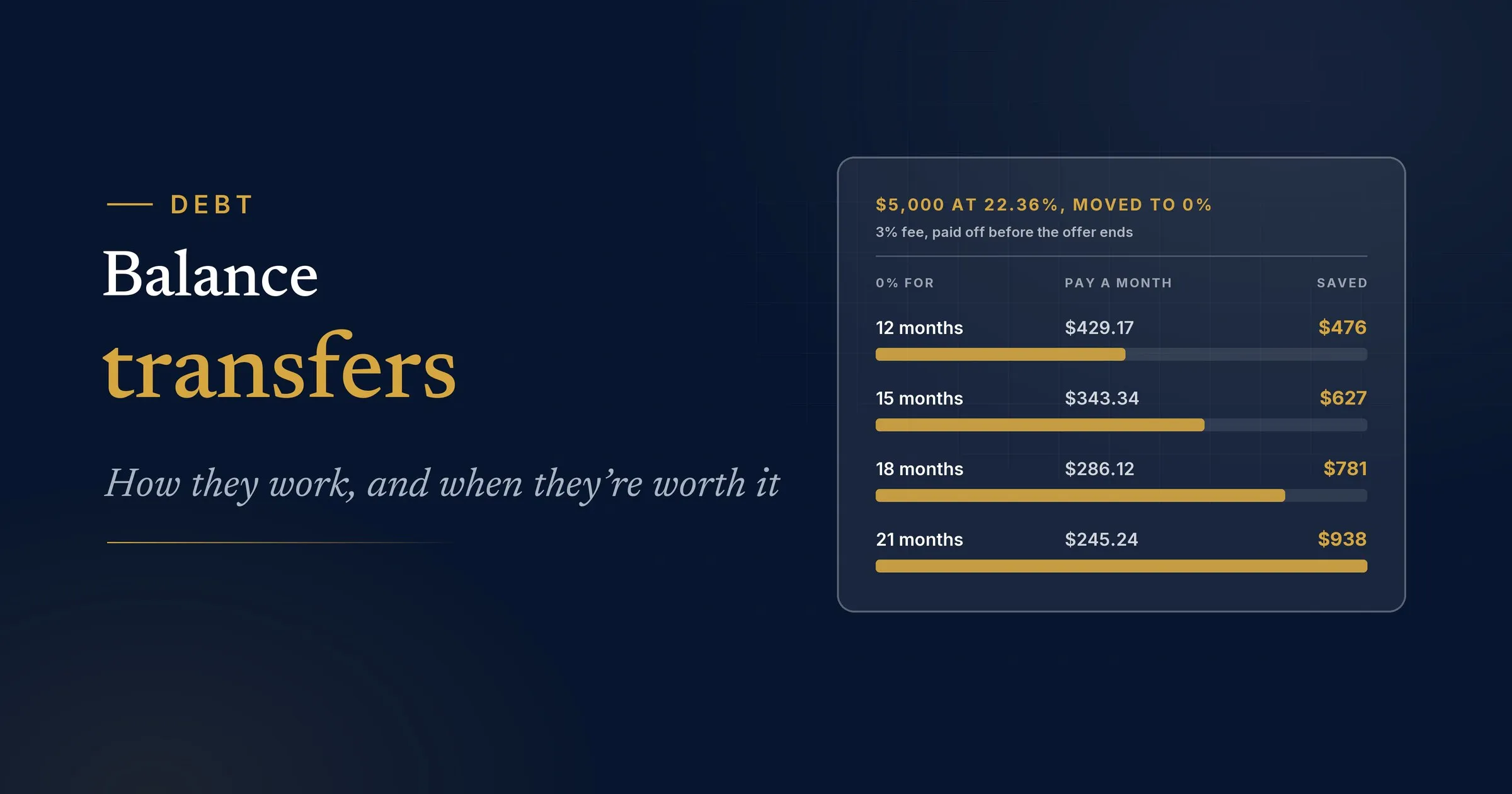
Here’s what that means for $5,000 moved with a 3% fee of $150, so you owe $5,150. The last column compares the fee with the interest you’d pay to clear the same $5,000 over the same months at 22.36%:
| 0% period | Pay each month | Saved vs. staying |
|---|---|---|
| 12 months | $429.17 | $476 |
| 15 months | $343.34 | $627 |
| 18 months | $286.12 | $781 |
| 21 months | $245.24 | $938 |
Payments rounded up to the cent. Savings are the interest at 22.36% minus the 3% fee.
A longer 0% period means a smaller payment and bigger savings. Our Credit Card Payoff Calculator works out the payment for your own balance and rate.
The rules that protect you
Federal rules set a few limits on transfer offers:
- The introductory rate has to last at least six months, unless you’re more than 60 days late on a payment. If the rate is variable, it can still move with its index, such as the prime rate, during that time.Source 3
- The card company must tell you how long the rate lasts and what rate comes next, before you sign up.Source 3
- Payments above the minimum go to your highest-rate balance first. When different parts of your balance carry different rates, the card company has to apply anything you pay over the minimum to the highest-rate part, then the next highest.Source 5
The traps to avoid
New purchases on the same card
On most cards, while you carry a balance from month to month, new purchases collect interest from the day you make them, even if the transferred balance is at 0%. To get your grace period back, you’d have to pay the entire balance, transfer included, by the due date.Source 6 The simplest fix is not to use the transfer card for spending until it’s paid off.
Paying late
Being more than 60 days late can end the introductory rate early.Source 3 Set up automatic payments for at least the minimum so a busy month doesn’t cost you the offer.
Running out of time
If the balance isn’t gone when the offer ends, the rest starts collecting interest. That still usually beats staying put, as long as you keep paying:
Paying $200 a month on an 18-month offer
- After 18 months at 0%, $200 a month leaves $1,550 of the $5,150.
- At 22.36% from then on, paying off the rest takes until month 27 and adds $140 of interest, or $290 counting the fee.
- Paying the same $200 a month on the original $5,000 at 22.36% would take 34 months and cost $1,793 in interest.
- The transfer saves $1,503, even though it wasn’t paid off in time.
Moving the debt without changing the habit
A transfer lowers the cost of a balance; it doesn’t pay it. If the old card fills up again, you’ll have two balances instead of one. Our guide to paying off credit card debt covers a full plan, including what to do if you can only afford the minimum payment.
How a balance transfer affects your credit
- Applying for a new card adds an inquiry. New credit makes up about 10% of a FICO Score, and FICO Scores count inquiries from the past 12 months, although they stay on your credit report for two years.Source 7
- Your utilization changes. About 30% of a FICO Score comes from amounts owed, which includes the share of your credit limits in use.Source 7 A new card’s credit limit can lower your overall usage, while a transfer that fills most of the new card raises that card’s.
- Closing the old card has trade-offs. Its credit limit stops counting toward your available credit, and the length of your credit history makes up about 15% of a FICO Score.Source 7 If you close it, call the card company and follow up in writing.Source 8
Balance transfer or consolidation loan?
A personal loan used to pay off cards gives you a fixed payment and a set end date, possibly at a lower rate than your cards, but check the rate, fees and total cost, and make sure a longer term doesn’t make you pay more overall.Source 4 A balance transfer usually costs less if you can clear it within the 0% period; a loan can make more sense for a balance that will take longer to pay off. Our guide to paying off debt compares the options, and our guide to APR explains how to compare their costs.
Common questions
How much is the fee to transfer a $1,000 balance?
At a 3% fee, $30. At 5%, $50. Some cards set a minimum fee in dollars, and you pay whichever is more.Source 4
Is a balance transfer worth it?
Usually, if you’ll carry the balance for more than a couple of months and can pay most of it off during the 0% period. A 3% fee equals about 7 weeks of interest at 22.36%, so for a balance you’d clear in a month or two, it’s not worth it.
What happens when the 0% period ends?
Any balance left starts collecting interest at the rate the card company told you about before you signed up.Source 3
Do balance transfers hurt your credit score?
Usually only a little, and often only for a while. The new card’s inquiry and new account count against you at first, but paying down the balance lowers the share of your limits in use, and amounts owed carry more weight.Source 7
Can you use the card for purchases after a balance transfer?
You can, but new purchases usually collect interest right away while you carry the transferred balance.Source 6 Use another card or debit until the transfer is paid off.
Run your own numbers
Estimate your payoff date and the total interest you'd pay.
Open the calculator
Sources
Numbers in the text link to these sources. We check them whenever we update this page.
- 1
Consumer Financial Protection Bureau · Last reviewed September 23, 2024 · Accessed November 25, 2026 · Back to text for source 1
- 2
Consumer Credit, G.19 statistical release(external site)
Board of Governors of the Federal Reserve System · Published November 6, 2026 · Accessed November 25, 2026 · Back to text for source 2
- 3
How long can I keep a low rate on a balance transfer or other introductory rate?(external site)
Consumer Financial Protection Bureau · Last reviewed September 23, 2024 · Accessed November 25, 2026 · Back to text for source 3
- 4
What do I need to know about consolidating my credit card debt?(external site)
Consumer Financial Protection Bureau · Accessed November 25, 2026 · Back to text for source 4
- 5
12 CFR 1026.53, Allocation of payments (Regulation Z)(external site)
Electronic Code of Federal Regulations · Accessed November 25, 2026 · Back to text for source 5
- 6
Do I pay interest on new purchases after I get a zero or low rate balance transfer?(external site)
Consumer Financial Protection Bureau · Last reviewed January 22, 2024 · Accessed November 25, 2026 · Back to text for source 6
- 7
What's in my FICO Scores?(external site)
myFICO, Fair Isaac Corporation · Accessed November 25, 2026 · Back to text for source 7
- 8
I want to close my credit card account. What should I do?(external site)
Consumer Financial Protection Bureau · Accessed November 25, 2026 · Back to text for source 8
About the author
Wealthistry Editorial Team
Research, writing and editing
The team that researches, writes, fact-checks and updates Wealthistry's guides and calculators, following our published editorial standards.
Author profileEditorial policyHow we researchReport an error