Your debt-to-income ratio, or DTI, is the share of your gross monthly income that goes to debt payments. Lenders use it to judge whether you can manage the payments on a new loan, and each type of loan and each lender sets its own limit.Source 1 It’s also a quick health check for your own budget: a ratio of 36% means 36 cents of every dollar you earn goes to debt, leaving 64 cents for everything else.Source 2
This guide shows how to work out your ratio, what counts as debt, the limits for the main types of mortgage and how to bring the number down.
How to calculate debt-to-income ratio
Debt-to-income ratio equals monthly debt payments divided by gross monthly income, times 100.
- monthly debt payments are the required payments on everything you owe, such as loans, credit card minimums and court-ordered support
- gross monthly income is what you earn before taxes and other deductions
- Total the debt payments you make each month. Count car, student and personal loans, the minimum payment on each credit card and court-ordered payments such as child support.Source 2 If you’re applying for a mortgage, add the new housing payment too.
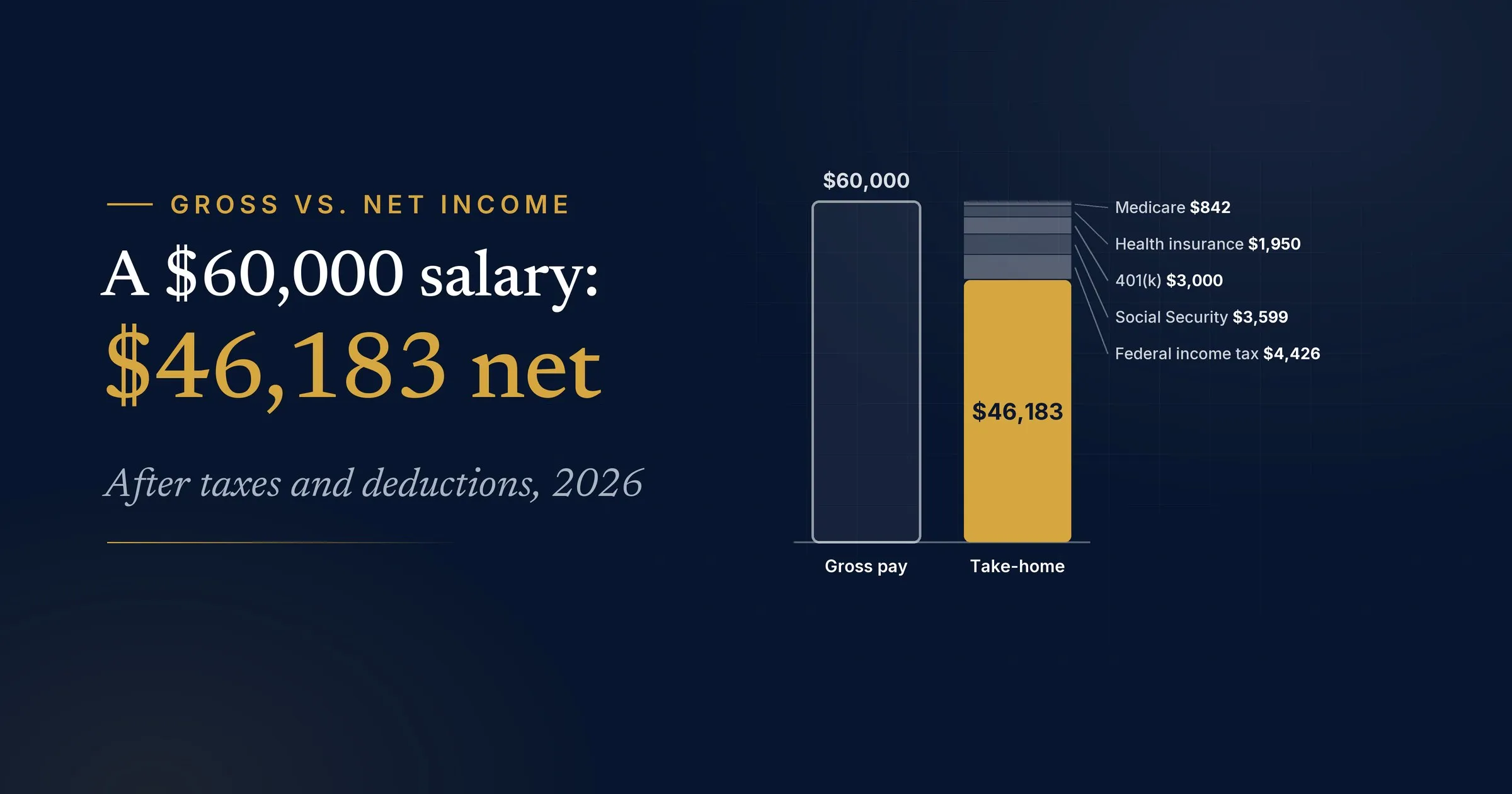
- Work out your monthly income before taxes. That’s your pay before taxes and deductions come out, not your take-home pay.Source 1 If your income changes from month to month, use a typical month, and it’s better to estimate on the low side.Source 2 Our gross vs. net income guide shows how the two differ.
- Divide, then multiply by 100. The result is your ratio as a percentage.
One household's ratio
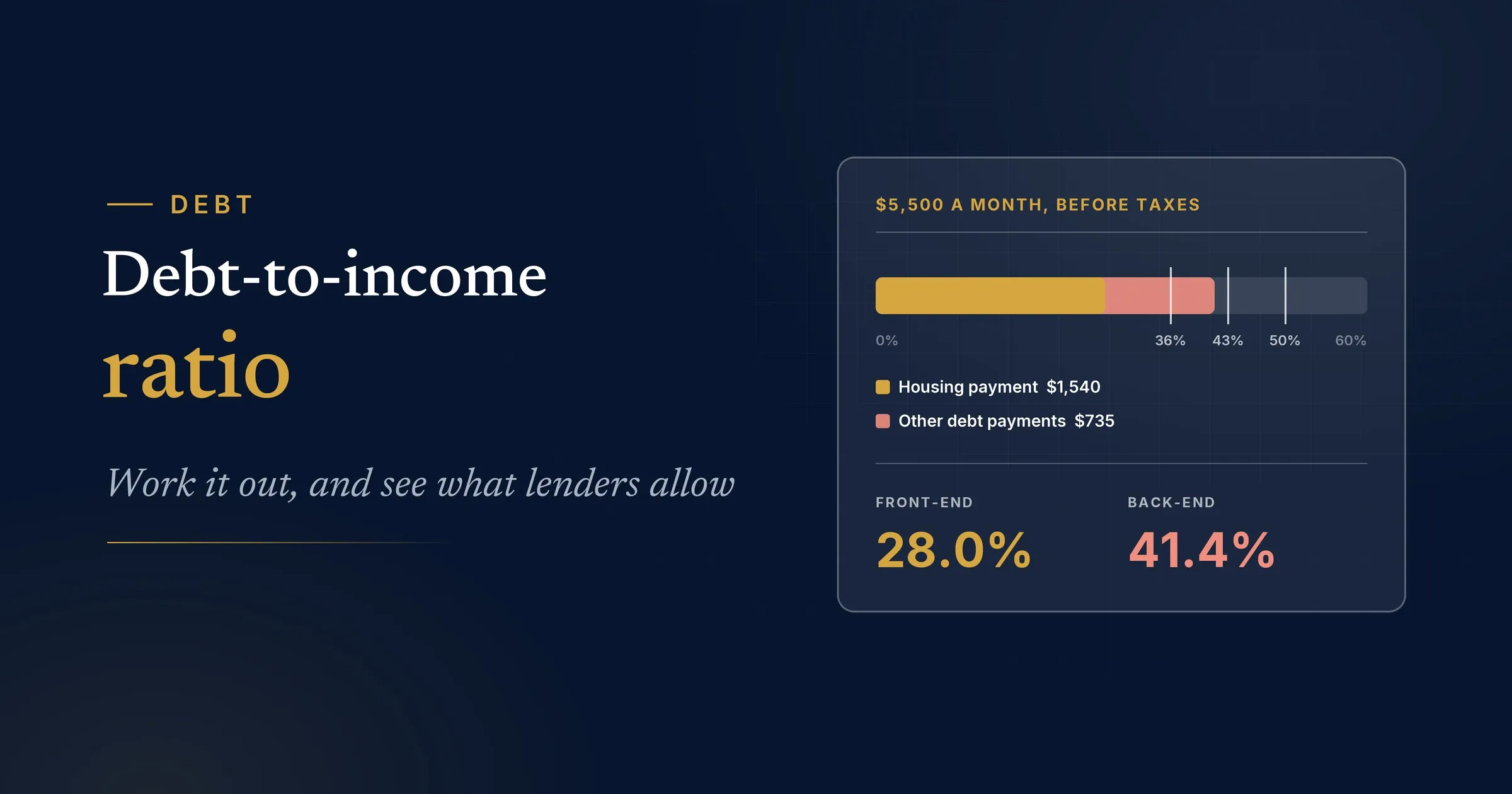
- Gross income is $5,500 a month, or $66,000 a year.
- Debt payments are a $385 car loan, a $240 student loan and $110 in credit card minimums, for $735 a month. That’s 13.4% of income.
- Applying for a mortgage with a $1,540 monthly housing payment, total debt payments would be $2,275, a ratio of 41.4%.
What counts as debt
Lenders count payments you’re required to make on money you owe, not the cost of living. Fannie Mae’s Selling Guide spells out how lenders that sell it mortgages must count each kind of payment:
- The housing payment on the home you’re buying: principal, interest, property taxes, homeowners insurance and association dues.Source 3
- Installment loans, such as car and personal loans, when more than ten payments remain. A loan with fewer payments left still counts if those payments would significantly affect your ability to pay your other debts.Source 4
- Leases, such as a car lease, no matter how many months are left.Source 4
- Credit cards and other revolving accounts, at the minimum payment. If your credit report doesn’t show one, the lender uses 5% of the balance.Source 4
- Student loans, at the payment on your credit report or loan statement. For loans in deferment or forbearance, the lender can use 1% of the balance or a fully amortizing payment, and a verified $0 payment on an income-driven plan can count as $0.Source 4
- Alimony, child support and separate maintenance that must continue for more than ten months.Source 3
Everyday costs such as groceries, utilities, phone plans and car insurance aren’t debts, so they’re left out. USDA’s rules, for example, say income taxes, retirement contributions, savings, commuting costs, union dues and child care don’t count toward its total debt ratio.Source 5
Does rent count?
It depends on why you’re working out the ratio. On a mortgage application, the payment on the home you’re buying is the housing payment that counts,Source 3 so your current rent drops out. Other lenders may count rent, and the CFPB’s guideline for renters leaves it out.Source 2 In the example, debts alone are 13.4% of income, but adding $1,400 of rent brings payments to $2,135, or 38.8%.
Front-end and back-end ratios
Mortgage lenders often look at two ratios:
- The front-end ratio, or housing ratio, is the housing payment alone divided by gross income. FHA calls it the mortgage payment-to-income ratio.Source 6
- The back-end ratio is all debt payments, including housing, divided by gross income. This is the number most people mean by DTI.
In the example, the front-end ratio is 28.0% and the back-end ratio is 41.4%. Not every program uses both. Fannie Mae’s maximums apply only to the total ratio,Source 3 while FHA and USDA set a limit for each.Source 6Source 5
What’s a good debt-to-income ratio?
The CFPB offers these guidelines for planning:Source 2
- Homeowners: 36% or less for all debts, including the mortgage. Some lenders go up to 43% or higher.
- Renters: 15% to 20% or less, not counting rent.
- Mortgage payment alone: 28% to 35% of gross income.
A lower ratio leaves more room in your budget and more room to borrow if you need to. A ratio above a guideline isn’t an automatic no, because lenders also weigh things like your credit history, savings and how steady your income is. VA’s list of compensating factors, for example, includes long-term employment, significant liquid assets and conservative use of consumer credit.Source 7
Debt-to-income limits by loan type
| Loan | Housing payment | All debts |
|---|---|---|
| Conventional (Fannie Mae), manual underwriting | No separate limit | 36%, or up to 45% with the required credit score and reserves |
| Conventional (Fannie Mae), Desktop Underwriter | No separate limit | Up to 50% |
| FHA, manual underwriting | 31%, or up to 37% with one compensating factor and 40% with two | 43%, or up to 47% with one compensating factor and 50% with two |
| VA | No separate limit | 41%, or more with residual income at least 20% above VA's guideline or a written justification |
| USDA guaranteed | 29% | 41%, or more with a debt ratio waiver |
FHA's higher limits require a credit score of 580 or higher. Lenders can set stricter limits of their own.
- Conventional loans sold to Fannie Mae: 36% of stable monthly income for loans underwritten by hand, or up to 45% if you meet its credit score and reserve requirements. Loans run through its automated system, Desktop Underwriter, can go up to 50%.Source 3
- FHA loans underwritten by hand: this happens when FHA’s automated scorecard refers the loan or can’t score it, or an underwriter downgrades it. The housing payment can’t exceed 31% of income and all debts 43%. Borrowers with credit scores of 580 or higher can go to 37% and 47% with one compensating factor, or 40% and 50% with two.Source 6
- VA loans: the standard is 41% or less, counting the full housing payment, association dues and long-term debts. Above 41%, the lender needs a supervisor’s written justification, unless your residual income, the money left each month after housing costs and other obligations, is at least 20% above VA’s guideline. VA rounds the ratio to the nearest whole percent.Source 7
- USDA guaranteed loans: the housing payment can be up to 29% of repayment income and total debts up to 41%. Higher ratios need compensating factors.Source 5
The 43% rule no longer caps qualified mortgages
For most home loans, the lender has to make a reasonable, good-faith determination that you can repay, and must consider your debt-to-income ratio or residual income along the way.Source 8 For years, a loan couldn’t count as a general qualified mortgage, a category that gives lenders legal protection, if its ratio was above 43%. A CFPB rule issued in December 2020 removed that limit and replaced it with limits based on the loan’s price,Source 9 and lenders have had to use the new definition since October 1, 2022.Source 10 The 43% figure still appears in FHA’s manual limits and in the CFPB’s planning guidelines, but it’s no longer the legal line for a qualified mortgage.
How much of a house payment your ratio allows
Turn the formula around and you can see how much room a limit leaves for housing. Using the example household’s $5,500 income and $735 of other debt payments:
| Total limit | All debt payments | Left for housing |
|---|---|---|
| 36%: Fannie Mae, manual underwriting | $1,980 | $1,245 |
| 41%: VA guideline and USDA | $2,255 | $1,520 |
| 43%: FHA, manual underwriting | $2,365 | $1,630 |
| 45%: Fannie Mae, manual, with credit score and reserves | $2,475 | $1,740 |
| 50%: Fannie Mae, Desktop Underwriter | $2,750 | $2,015 |
Housing means the full payment: principal, interest, taxes, insurance and any association dues.
For this household, the total limit is the one that binds. FHA’s 31% housing cap would allow $1,705 and USDA’s 29% cap $1,595, more than their total limits leave. Paying off the $385 car loan before applying would add $385 to every figure in the last column.
Ways to lower your debt-to-income ratio
The ratio moves only when a monthly payment changes or your income does, so focus on payments rather than balances.
- Pay off debts with large payments for their size. Say you have $3,300 to spare. Clearing that much in credit card balances removes the $110 minimum and cuts the example’s ratio by 2.0 points, to 39.4%. Putting the same $3,300 toward the car loan as an extra payment usually shortens the loan without lowering its $385 payment, so the ratio doesn’t move until the loan is paid off. Paying it off entirely would cut 7.0 points, to 34.4%.
- Don’t take on new debt before you apply. If a new debt turns up between approval and closing, Fannie Mae requires the loan to be underwritten again when the ratio rises beyond set tolerances.Source 3
- Lower the payment you’re aiming for. A bigger down payment or a less expensive home lowers both ratios at once. Our guide to saving for a house shows what each down payment level takes.
- Raise your income. Lenders qualify you on stable monthly income,Source 3 so ask a lender what history it needs before it will count a raise, overtime or a second job.
- Be careful with refinancing. Stretching a loan over more years lowers the payment, but you’ll usually pay more interest in total.
Our guides to paying off debt and the debt snowball and avalanche show how to order your payoffs, and our guide to credit card minimum payments explains why paying only the minimum keeps balances around.
Does DTI affect your credit score?
No. FICO Scores don’t consider your salary, occupation or employment history,Source 11 so your income, and with it your DTI, isn’t part of the score. What the score does consider is how much you owe: amounts owed make up about 30% of a FICO Score, including how much of your available revolving credit you’re using.Source 12
The two measures overlap, though. Paying down credit card balances lowers your minimum payments, which helps your DTI, and lowers the share of your credit you’re using, which can help your score. Lenders look at both when you apply.
Common questions
Is debt-to-income ratio based on gross or net income?
Gross. You divide your monthly debt payments by what you earn before taxes and deductions.Source 1 That’s why a ratio that looks manageable on paper can feel tight against your take-home pay.
Is a 20% or a 42% debt-to-income ratio good?
At 20%, you’re well within the CFPB’s 36% guideline for homeowners, though at the top of its range for renters, which leaves rent out.Source 2 At 42%, you’re above the 36% guideline, Fannie Mae’s 36% manual limit and VA’s 41% standard, but within FHA’s 43% manual limit and Fannie Mae’s higher limits of 45% and 50%.Source 3Source 6Source 7
What debt-to-income ratio do you need for a car loan?
There’s no single standard. Car lenders, like other lenders, set their own limits.Source 1 Ask the lender what it uses, and check your own ratio against the CFPB’s guidelines before you add a new payment.
What is the average debt-to-income ratio?
There’s no official average of DTI as lenders measure it. The closest national figure is the Federal Reserve’s household debt service ratio: required debt payments were 11.11% of disposable personal income in the second quarter of 2026.Source 13 It uses after-tax income and averages across all households, including those with no debt, so it isn’t directly comparable with your own ratio.
Run your own numbers
Compare snowball and avalanche plans side by side.
Open the calculator
Sources
Numbers in the text link to these sources. We check them whenever we update this page.
- 1
What is a debt-to-income ratio?(external site)
Consumer Financial Protection Bureau · Last reviewed November 9, 2026 · Accessed November 25, 2026 · Back to text for source 1
- 2
Your Money, Your Goals: A financial empowerment toolkit (Debt-to-income calculator)(external site)
Consumer Financial Protection Bureau · Accessed November 25, 2026 · Back to text for source 2
- 3
B3-6-02, Debt-to-Income Ratios (Selling Guide)(external site)
Fannie Mae · Updated April 2, 2025 · Accessed November 25, 2026 · Back to text for source 3
- 4
B3-6-05, Monthly Debt Obligations (Selling Guide)(external site)
Fannie Mae · Updated August 5, 2026 · Accessed November 25, 2026 · Back to text for source 4
- 5
Electronic Code of Federal Regulations · Accessed November 25, 2026 · Back to text for source 5
- 6
U.S. Department of Housing and Urban Development, Federal Register · Published December 11, 2013 · Accessed November 25, 2026 · Back to text for source 6
- 7
Electronic Code of Federal Regulations · Accessed November 25, 2026 · Back to text for source 7
- 8
Electronic Code of Federal Regulations · Accessed November 25, 2026 · Back to text for source 8
- 9
Consumer Financial Protection Bureau, Federal Register · Published December 29, 2020 · Accessed November 25, 2026 · Back to text for source 9
- 10
General QM Loan Definition; Delay of Mandatory Compliance Date (86 FR 22844)(external site)
Consumer Financial Protection Bureau, Federal Register · Published April 30, 2021 · Accessed November 25, 2026 · Back to text for source 10
- 11
What's not in my FICO Scores(external site)
myFICO, Fair Isaac Corporation · Accessed November 25, 2026 · Back to text for source 11
- 12
What's in my FICO Scores?(external site)
myFICO, Fair Isaac Corporation · Accessed November 25, 2026 · Back to text for source 12
- 13
Household Debt Service Ratios(external site)
Board of Governors of the Federal Reserve System · Updated September 22, 2026 · Accessed November 25, 2026 · Back to text for source 13
About the author
Wealthistry Editorial Team
Research, writing and editing
The team that researches, writes, fact-checks and updates Wealthistry's guides and calculators, following our published editorial standards.
Author profileEditorial policyHow we researchReport an error