Gross income is what you earn before anything is taken out. Net income is what’s left after taxes and other deductions: the money that actually reaches your bank account, often called take-home pay. The gap between the two can be bigger than people expect, and knowing which number you’re looking at matters for budgets, loans and job offers.
Your pay stub shows both: how much you earned, and how much your employer took out for taxes and benefits.Source 1 This guide explains what comes out, works through a paycheck with 2026 tax figures, and shows when to use each number. Understanding your pay is the first of the five money basics in our financial literacy guide.
Gross vs. net income at a glance
| Gross income | Net income | |
|---|---|---|
| What it is | Everything you earn, before deductions | What's left after taxes and deductions |
| Also called | Gross pay, pretax income | Net pay, take-home pay |
| On your pay stub | Total earnings | The amount paid to you |
| Use it for | Loan and debt-to-income calculations, comparing salaries | Budgeting and planning your spending |
What comes out of your paycheck
Employers must take out money for federal and state employment taxes; Social Security and Medicare taxes, under the Federal Insurance Contributions Act (FICA); and disability or unemployment insurance where required. They also deduct for benefits you’ve signed up for, such as health insurance or a retirement savings account.Source 1
- Federal income tax, withheld based on your earnings and the Form W-4 you give your employer.
- Social Security tax: 6.2% of your wages, up to $184,500 of earnings in 2026.Source 2
- Medicare tax: 1.45% of all your wages, plus an extra 0.9% on wages above $200,000.Source 2
- State and local income tax, depending on where you live and work.
- Retirement contributions, such as to a 401(k).
- Health, dental and vision insurance premiums.
Not all deductions are taxed the same way. Money you put into a traditional 401(k) isn’t subject to income tax withholding when it’s deducted, but it still counts as wages for Social Security and Medicare taxes.Source 3 Health insurance paid through an employer’s cafeteria plan comes out on a pretax basis,Source 4 exempt from income tax withholding and from Social Security and Medicare taxes.Source 4
The formula
Net income equals gross income minus taxes minus other deductions.
- taxes are income taxes plus Social Security and Medicare taxes
- other deductions include retirement contributions and insurance premiums
A paycheck example with 2026 tax figures
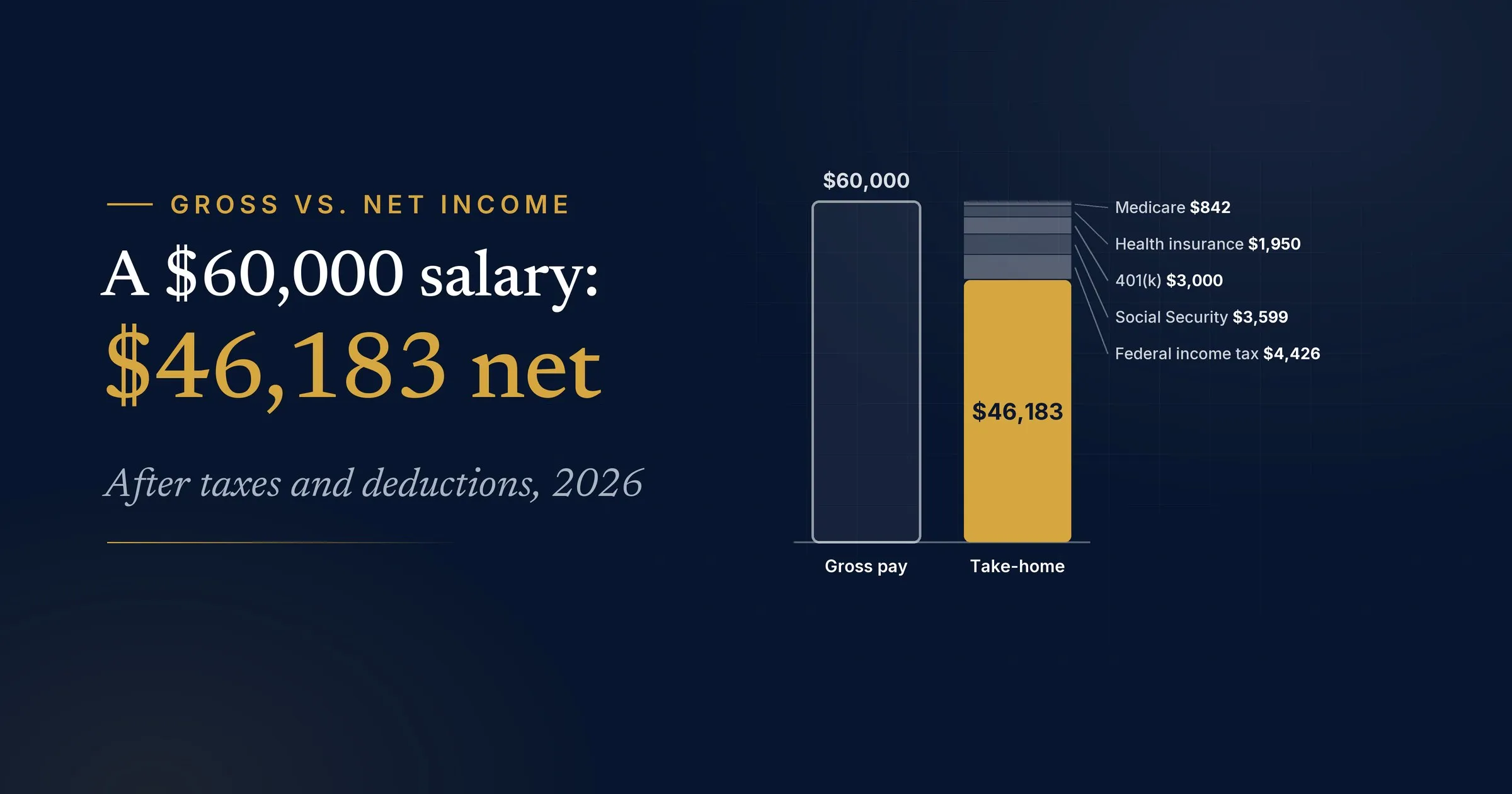
Here’s a single person earning $60,000 a year, paid every two weeks. They put 5% of their pay in a traditional 401(k) and pay $75 per paycheck for health insurance through a cafeteria plan. For 2026, the standard deduction for a single filer is $16,100, and the first $12,400 of taxable income is taxed at 10%, with the next layer, up to $50,400, at 12%.Source 5
Working out the federal income tax
- Wages for income tax: $60,000 − $3,000 for the 401(k) − $1,950 for health insurance = $55,050.
- Subtract the $16,100 standard deduction: $38,950 of taxable income.
- The first $12,400 is taxed at 10%, or $1,240.00. The remaining $26,550 is taxed at 12%, or $3,186.00.
- Federal income tax for the year: $4,426.00, about 7.4% of gross pay.
Social Security and Medicare taxes apply to $58,050, the salary minus the health insurance, because the 401(k) contribution still counts as wages for those taxes.Source 3 Here’s the whole year, and one paycheck:
| Line | Per year | Per paycheck |
|---|---|---|
| Gross pay | $60,000.00 | $2,307.69 |
| 401(k) contribution, 5% | −$3,000.00 | −$115.38 |
| Health insurance | −$1,950.00 | −$75.00 |
| Federal income tax | −$4,426.00 | −$170.23 |
| Social Security tax, 6.2% | −$3,599.10 | −$138.43 |
| Medicare tax, 1.45% | −$841.73 | −$32.37 |
| Net pay (take-home) | $46,183.17 | $1,776.28 |
A single filer taking the standard deduction, with no other income, deductions or credits. State and local income taxes aren't included. Each paycheck line is the yearly amount divided by 26 and rounded to the cent.
This person grosses $5,000 a month but takes home about $3,848.60, or 77% of their gross pay before any state or local income tax. That’s the number to build a budget around.
Your actual withholding is set by your Form W-4 and your employer’s payroll calculations, so it won’t match a year-end estimate exactly. And remember that when your income moves into a higher tax bracket, only the part in the new bracket is taxed at the higher rate.Source 6
When to use gross vs. net income
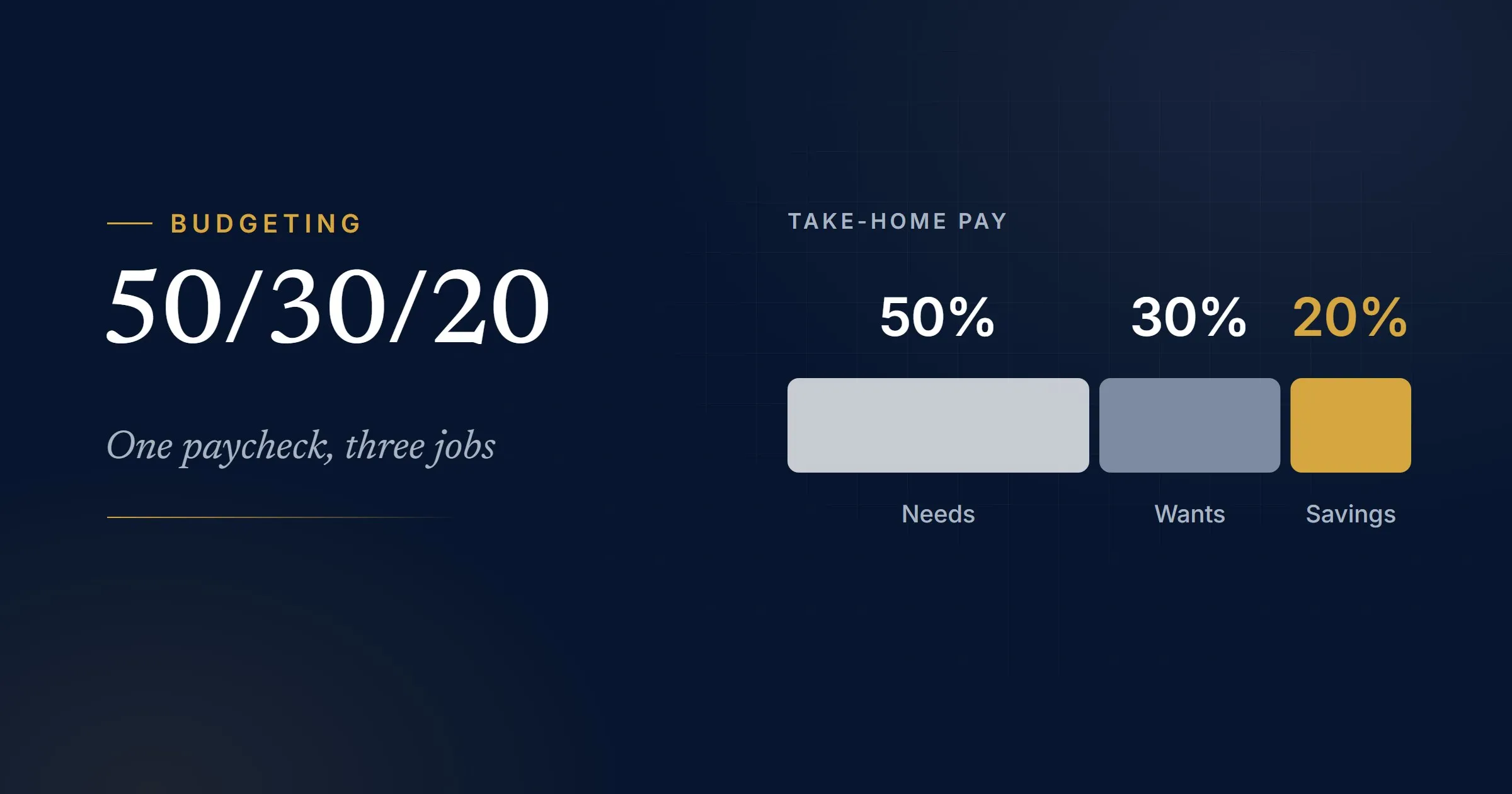
- Budgeting: use net income, since that’s what you can spend. Our guide to making a budget starts from take-home pay, and the 50/30/20 rule is based on it too.
- Loans: lenders often look at gross income. Your debt-to-income ratio is all your monthly debt payments divided by your gross monthly income, and lenders use it to measure your ability to manage the payments on new borrowing.Source 7 Our debt-to-income ratio guide covers what counts and the limits for each type of mortgage.
- Comparing job offers: salaries are quoted gross, but benefits change the picture. Cheaper health insurance or a bigger retirement match can be worth more than a slightly higher salary.
- Forms and applications: if a form asks for your income, check whether it wants gross or net. When it doesn’t say, ask.
If you’re paid by the hour or on commission, or your income changes from month to month, see our guide to budgeting on an irregular income.
Gross vs. net income for a business
The same idea applies to a business, with different words. Gross profit is revenue minus the direct cost of the goods or services sold. Net income, sometimes called the bottom line, is what’s left after all expenses, including operating costs, interest and taxes. A business can have a healthy gross profit and still lose money overall.
Common questions
Is salary gross or net?
A salary is usually quoted as gross pay, before taxes and deductions.
How do I calculate my net income?
Start with your gross pay and subtract taxes and other deductions. Your pay stub shows each one.Source 1
How much of my gross pay will I take home?
It depends on your taxes, where you live and your benefits. In the example, a $60,000 salary took home about 77% before state and local income taxes.
Do you budget with gross or net income?
Net income. It’s the money that actually reaches your account each month.
What’s the difference between net income and disposable income?
They’re close. Disposable income is income after taxes. Take-home pay also excludes things like retirement contributions and insurance premiums that come out of your paycheck.
Run your own numbers
See where your take-home pay goes each month.
Open the calculator
Sources
Numbers in the text link to these sources. We check them whenever we update this page.
- 1
Your Paycheck Explained(external site)
Federal Trade Commission, consumer.gov · Accessed November 18, 2026 · Back to text for source 1
- 2
Topic no. 751, Social Security and Medicare withholding rates(external site)
Internal Revenue Service · Accessed November 19, 2026 · Back to text for source 2
- 3
Topic no. 424, 401(k) plans(external site)
Internal Revenue Service · Updated November 9, 2026 · Accessed November 19, 2026 · Back to text for source 3
- 4
Publication 15-B (2026), Employer's Tax Guide to Fringe Benefits(external site)
Internal Revenue Service · Updated April 30, 2026 · Accessed November 19, 2026 · Back to text for source 4
- 5
Internal Revenue Service · Published October 9, 2025 · Accessed November 19, 2026 · Back to text for source 5
- 6
Federal income tax rates and brackets(external site)
Internal Revenue Service · Accessed November 19, 2026 · Back to text for source 6
- 7
What is a debt-to-income ratio?(external site)
Consumer Financial Protection Bureau · Last reviewed November 9, 2026 · Accessed November 18, 2026 · Back to text for source 7
About the author
Wealthistry Editorial Team
Research, writing and editing
The team that researches, writes, fact-checks and updates Wealthistry's guides and calculators, following our published editorial standards.
Author profileEditorial policyHow we researchReport an error