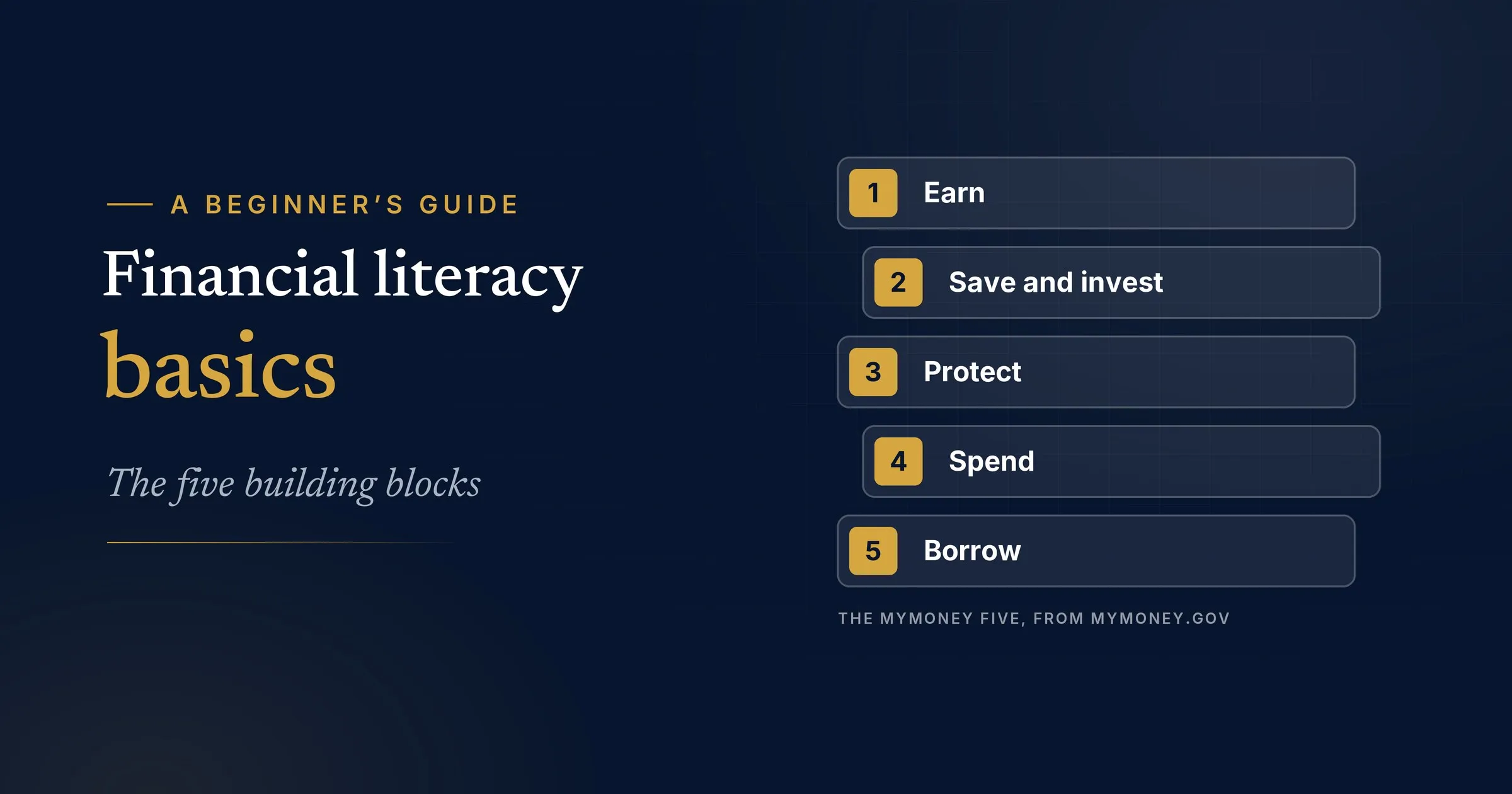
Financial literacy describes the skills, knowledge and tools that equip people to make their own financial decisions and take actions to reach their goals.Source 1 Put simply, it’s knowing how money works well enough to earn it, spend it, save it, protect it and borrow it wisely.
This guide explains what financial literacy means, how U.S. adults score on the core concepts, the five building blocks to learn, and the ideas behind them, with worked examples and links to our guides on each topic.
What financial literacy means
The U.S. National Strategy for Financial Literacy, updated in 2026 by the federal Financial Literacy and Education Commission, uses three related terms:Source 1
- Financial literacy is the skills, knowledge and tools to make financial decisions and act on them.
- Financial capability is the ability to apply that knowledge to decisions, use financial products and services appropriately and manage your money effectively.
- Financial well-being is the goal: you can meet current and ongoing obligations, feel secure about your financial future and make choices that let you enjoy life.
In other words, financial literacy is knowing, and financial capability is doing. Personal finance is the subject both apply to: your own income, spending, saving, borrowing and protection.
How financially literate are Americans?
Every three years, the FINRA Investor Education Foundation’s National Financial Capability Study surveys more than 25,000 U.S. adults and asks seven questions on fundamental concepts of economics and personal finance. Here’s how people did in 2024:Source 2
| Question topic | Correct | Incorrect | Don't know |
|---|---|---|---|
| Interest rates | 69% | 14% | 16% |
| Mortgage term and total interest | 69% | 9% | 22% |
| Inflation | 58% | 18% | 23% |
| Risk and diversification | 41% | 11% | 47% |
| Probability | 35% | 28% | 36% |
| Compounding interest on a loan | 29% | 41% | 30% |
| Bond prices and interest rates | 25% | 33% | 42% |
Share of respondents giving each answer. Rows may not add to 100% because of rounding.
Only 4% answered all seven questions correctly, and 46% got at least four right, little changed from 2021. Confidence runs ahead of knowledge: 64% rated their own financial knowledge highly, but only 32% of that group could say how quickly compound interest would double a debt.Source 2
One concept improved. The share answering the inflation question correctly rose from 53% in 2021 to 58%, and from 34% to 44% among adults ages 18 to 34. The study’s authors suggest that living through higher inflation helped people understand how it affects buying power.Source 2 Overall, though, the 2026 National Strategy notes that basic financial literacy has shown little improvement over the past decade.Source 1
The five building blocks: the MyMoney Five
The federal government’s MyMoney.gov organizes the basics into five principles, called the MyMoney Five.Source 3 They’re a useful map of what to learn.
1. Earn
Make the most of what you earn by understanding your pay and benefits.Source 3 Start with the difference between what you earn and what you take home: our gross vs. net income guide walks through a paycheck.
2. Save and invest
It’s never too early to start saving for goals such as a house or retirement, even in small amounts.Source 3
- How to save money and how much to save each month help you get started.
- Compound interest explained shows how savings grow.
- What is a high-yield savings account? covers where to keep savings, and what is APY? shows how to compare rates.
3. Protect
Take precautions with your finances, build emergency savings and have the right insurance.Source 3 Our emergency fund guide covers how much to keep and how to build it, and our FDIC insurance guide explains how your deposits are protected.
Protecting yourself from fraud matters too. Consumers reported losing $15.9 billion to fraud in 2025, up from more than $12 billion the year before.Source 4 The FTC lists four signs of a scam: the caller or sender pretends to be from an organization you know, says there’s a problem or a prize, pressures you to act immediately, and tells you to pay in a specific way, such as with cryptocurrency, a wire transfer, a payment app or a gift card.Source 5
4. Spend
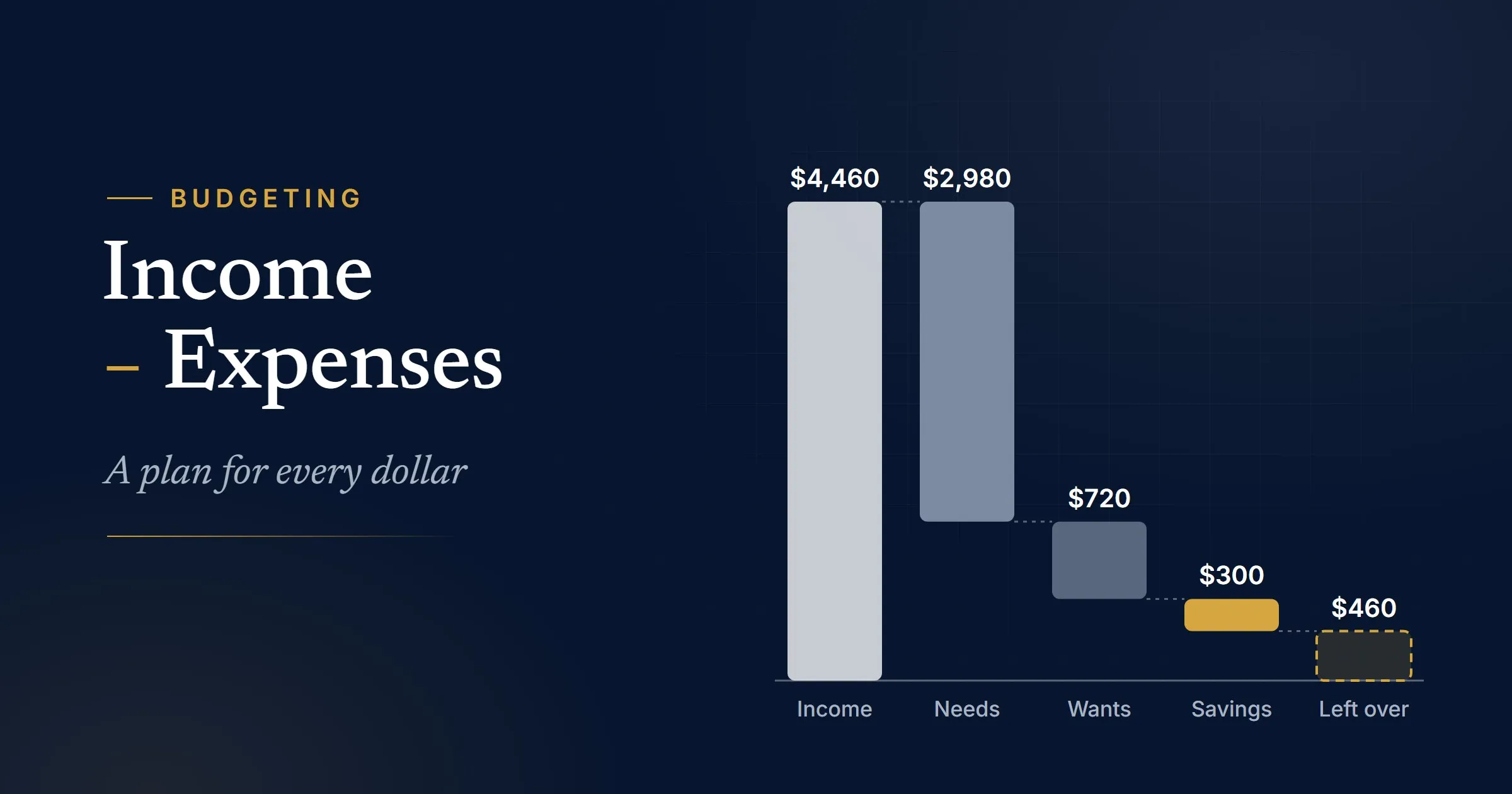
Get good value, especially on big purchases, by shopping around and comparing prices and products.Source 3 A budget is the tool that makes this work:
- How to make a budget shows the steps.
- Budgeting methods compares seven ways to do it, including the 50/30/20 rule.
- Fixed vs. variable expenses explains the difference and how to lower each kind.
- Opportunity cost explains the trade-off behind every spending choice.
5. Borrow
Borrowing can make some essential purchases possible and builds credit, but interest is a cost, and borrowing too much leaves you with a large debt to repay.Source 3
- What is APR? explains the cost of borrowing.
- How credit card interest works shows how card interest is charged.
- How to pay off debt and debt snowball vs. avalanche cover getting out of debt.
Five concepts, with examples
Five of the quiz topics come up in everyday money decisions. Here’s what each one looks like in practice.
Five money concepts, with examples
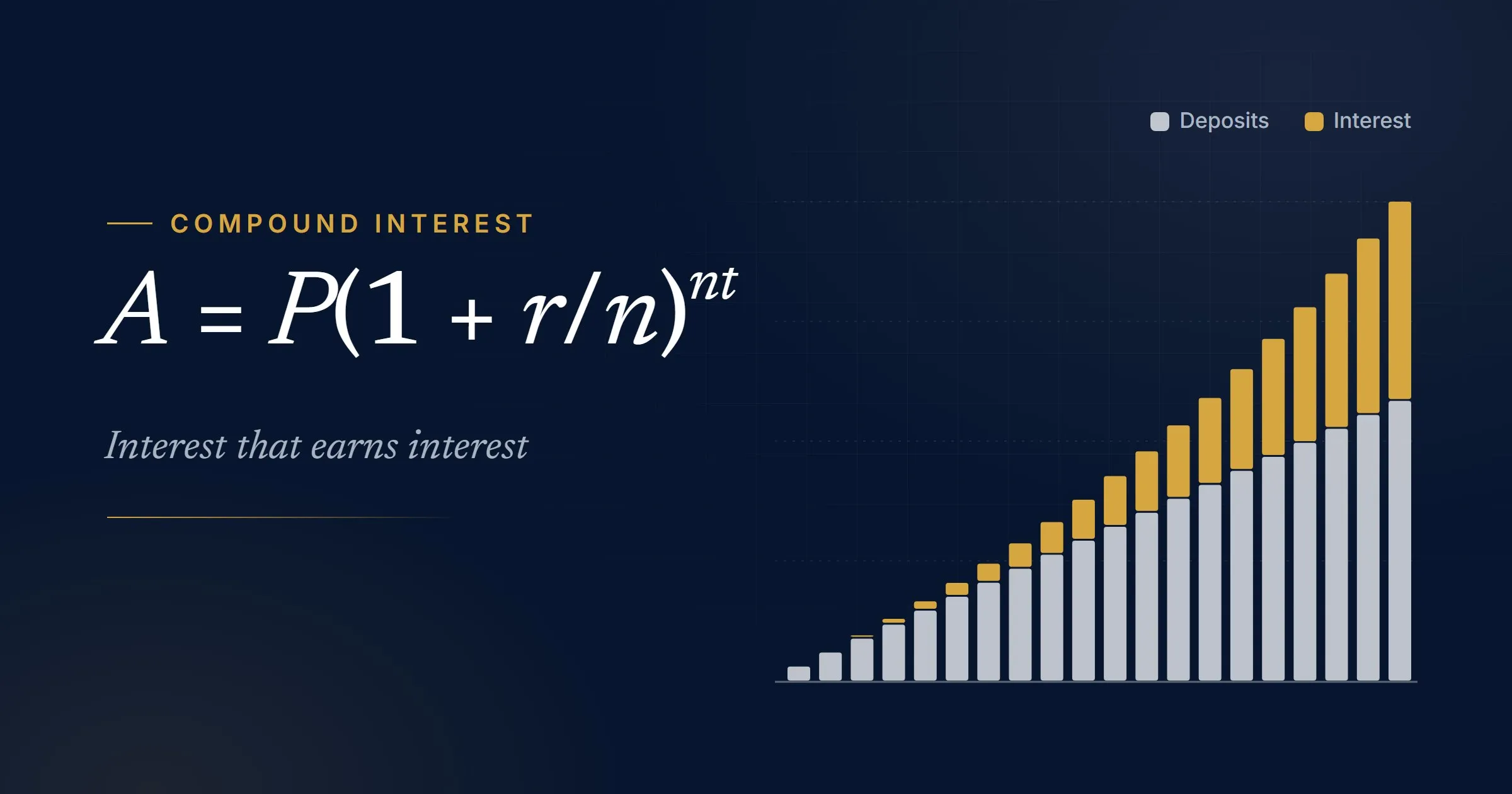
- Interest compounds. At a 4% APY, $1,000 grows to $1,216.65 in five years. That’s $16.65 more than the $1,200 simple interest would pay, because each year’s interest earns interest too.
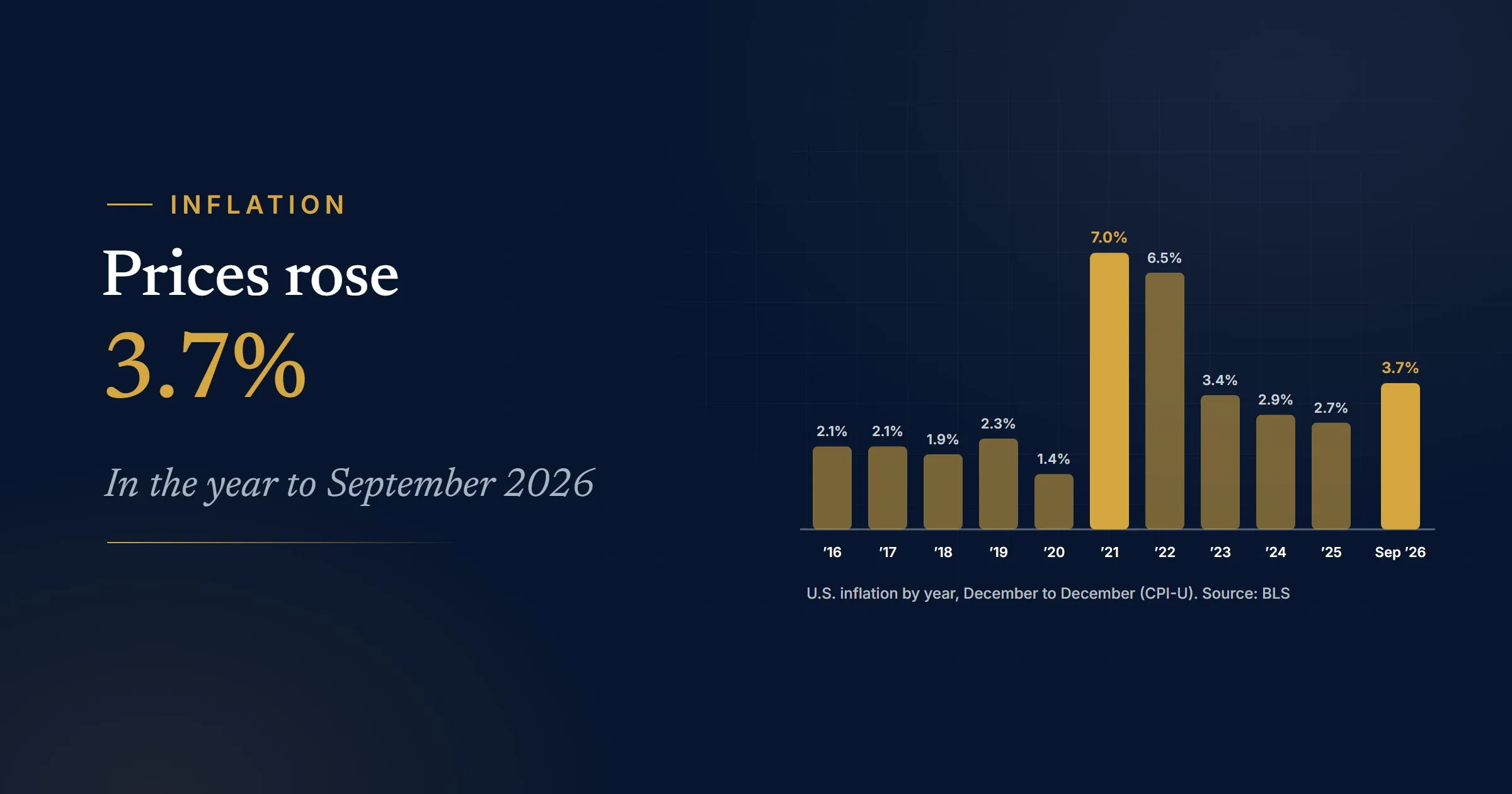
- Inflation shrinks savings. Prices rose 3.7% in the 12 months to September 2026.Source 6 At the national average savings rate of 0.39%,Source 7 $1,000 grows to $1,003.90 in a year. If prices rise 3.7% over that year, it buys only what about $968 bought at the start.
- Debt compounds too. The average rate on credit card accounts charged interest was 22.36% in the third quarter of 2026.Source 8 At that rate, with interest compounding daily and no payments or new charges, a balance would double in about 3.1 years.
- A shorter loan costs less overall. A $25,000 new car loan at the commercial bank average of 7.54% for 60 months costs $501.42 a month and $5,085.20 in interest. At the 72-month average of 7.17%, the payment falls to $428.27, but the interest rises to $5,835.44, which is $750.24 more.Source 8
- Spreading money out lowers risk. Diversification means spreading money among different investments to reduce risk. Mutual funds and exchange-traded funds make it easier, because they let you own a small portion of many investments.Source 9
To go deeper, see simple vs. compound interest, what is inflation?, the Rule of 72 and the time value of money.
Personal finance basics for beginners: where to start
If you’re starting from scratch, take these steps in order. Each builds on the one before.
- Know your take-home pay. Your budget starts with what actually reaches your account. See gross vs. net income.
- Make a budget. Plan where each dollar goes with our budgeting guide.
- Set up checking and savings. See how to open a bank account and checking vs. savings.
- Build an emergency fund. Start small and add to it automatically. See how much you should have in savings.
- Pay down high-interest debt. See how to pay off credit card debt and whether to pay off debt or save.
- Track your progress. Your net worth shows the big picture, and our calculators help you plan.
You don’t have to learn everything at once. The National Strategy points to milestones such as getting a first job, buying a home or having a child, and routine moments such as paying taxes or getting a raise, as natural times to learn what you need.Source 1
Financial literacy for students
More students are learning about money in school. As of June 2026, 30 states had policies requiring high school students to complete a personal finance course before graduating, up from five in 2020. More than 11 million students, over 70% of U.S. high school students, are expected to receive financial education by 2031.Source 1
The skills young adults should learn early include recognizing when they need information, finding trusted sources, evaluating information to make decisions, making plans to reach their goals and following through.Source 1
Education seems to help, though the evidence isn’t conclusive. Among adults who took part in financial education at school, college or work, 58% answered at least four of the seven quiz questions correctly, compared with 44% of those who didn’t. The study’s authors note that this doesn’t prove the education caused the difference.Source 2
Where to keep learning
- FDIC Money Smart offers financial education for people of all ages, including 14 interactive games on everyday financial topics.Source 10
- MyMoney.gov collects calculators, budget worksheets, planning checklists and other resources from the federal government.Source 3
- Investor.gov, from the Securities and Exchange Commission, covers investing basics such as diversification.Source 9
- Our guides and calculators cover budgeting, saving, banking, debt and the concepts behind them, with every figure worked out and every source listed.
Common questions
What is financial literacy?
The skills, knowledge and tools to make your own financial decisions and act on them to reach your goals.Source 1 In practice, that means understanding how to earn, save and invest, protect, spend and borrow.Source 3
What’s the difference between financial literacy and personal finance?
Personal finance is the subject: managing your own income, spending, savings, debt and protection. Financial literacy is how well you understand that subject and can make decisions about it.
What’s the difference between financial literacy and financial capability?
Financial literacy is knowledge and skill. Financial capability is putting them to work: applying what you know to decisions, using financial products and services appropriately and managing your money effectively.Source 1
What are examples of financial literacy?
Knowing your take-home pay, comparing savings accounts by APY, understanding that an unpaid card balance at 22.36% can double in about 3.1 years,Source 8 and recognizing the warning signs of a scamSource 5 are all examples.
Why is financial literacy important?
According to the 2026 National Strategy, higher financial literacy is associated with building more wealth, more participation in investing and better debt management.Source 1 It also helps you avoid costly mistakes, such as letting high-rate debt compound or falling for a scam.
Sources
Numbers in the text link to these sources. We check them whenever we update this page.
- 1
U.S. National Strategy for Financial Literacy 2026(external site)
Financial Literacy and Education Commission · Accessed November 23, 2026 · Back to text for source 1
- 2
FINRA Investor Education Foundation · Accessed November 23, 2026 · Back to text for source 2
- 3
MyMoney Five & Tools(external site)
MyMoney.gov, Financial Literacy and Education Commission · Accessed November 23, 2026 · Back to text for source 3
- 4
FTC Testifies before the Joint Economic Committee on Agency's Efforts to Combat Fraud(external site)
Federal Trade Commission · Published March 25, 2026 · Accessed November 23, 2026 · Back to text for source 4
- 5
How To Avoid a Scam(external site)
Federal Trade Commission, Consumer Advice · Accessed November 23, 2026 · Back to text for source 5
- 6
Consumer Price Index for All Urban Consumers (CPI-U), U.S. city average, all items(external site)
U.S. Bureau of Labor Statistics · Accessed November 19, 2026 · Back to text for source 6
- 7
National Rates and Rate Caps – November 2026(external site)
Federal Deposit Insurance Corporation · Updated November 16, 2026 · Accessed November 18, 2026 · Back to text for source 7
- 8
Consumer Credit, G.19 statistical release(external site)
Board of Governors of the Federal Reserve System · Published November 6, 2026 · Accessed November 16, 2026 · Back to text for source 8
- 9
Asset Allocation and Diversification(external site)
Investor.gov, U.S. Securities and Exchange Commission · Accessed November 23, 2026 · Back to text for source 9
- 10
Federal Deposit Insurance Corporation · Updated November 12, 2026 · Accessed November 23, 2026 · Back to text for source 10
About the author
Wealthistry Editorial Team
Research, writing and editing
The team that researches, writes, fact-checks and updates Wealthistry's guides and calculators, following our published editorial standards.
Author profileEditorial policyHow we researchReport an error