A budgeting method is a system for deciding where your money goes before you spend it. There’s no single best one. The right method is one that works for you and that you’ll keep using.Source 1 Here are seven common methods, what each one is good at, and the same take-home pay budgeted several ways.
Budgeting methods compared
| Method | Best for | Effort |
|---|---|---|
| Line-item budget | Seeing exactly where your money goes | Medium |
| 50/30/20 rule | A simple place to start | Low |
| Zero-based budget | Tight budgets and paying off debt | High |
| Envelope method | Reining in overspending | Medium |
| Pay yourself first | Saving without tracking every category | Low |
| Paycheck budget | Pay that arrives every week or two | Medium |
| Irregular income budget | Freelance, gig or commission pay | Medium |
1. Line-item budget
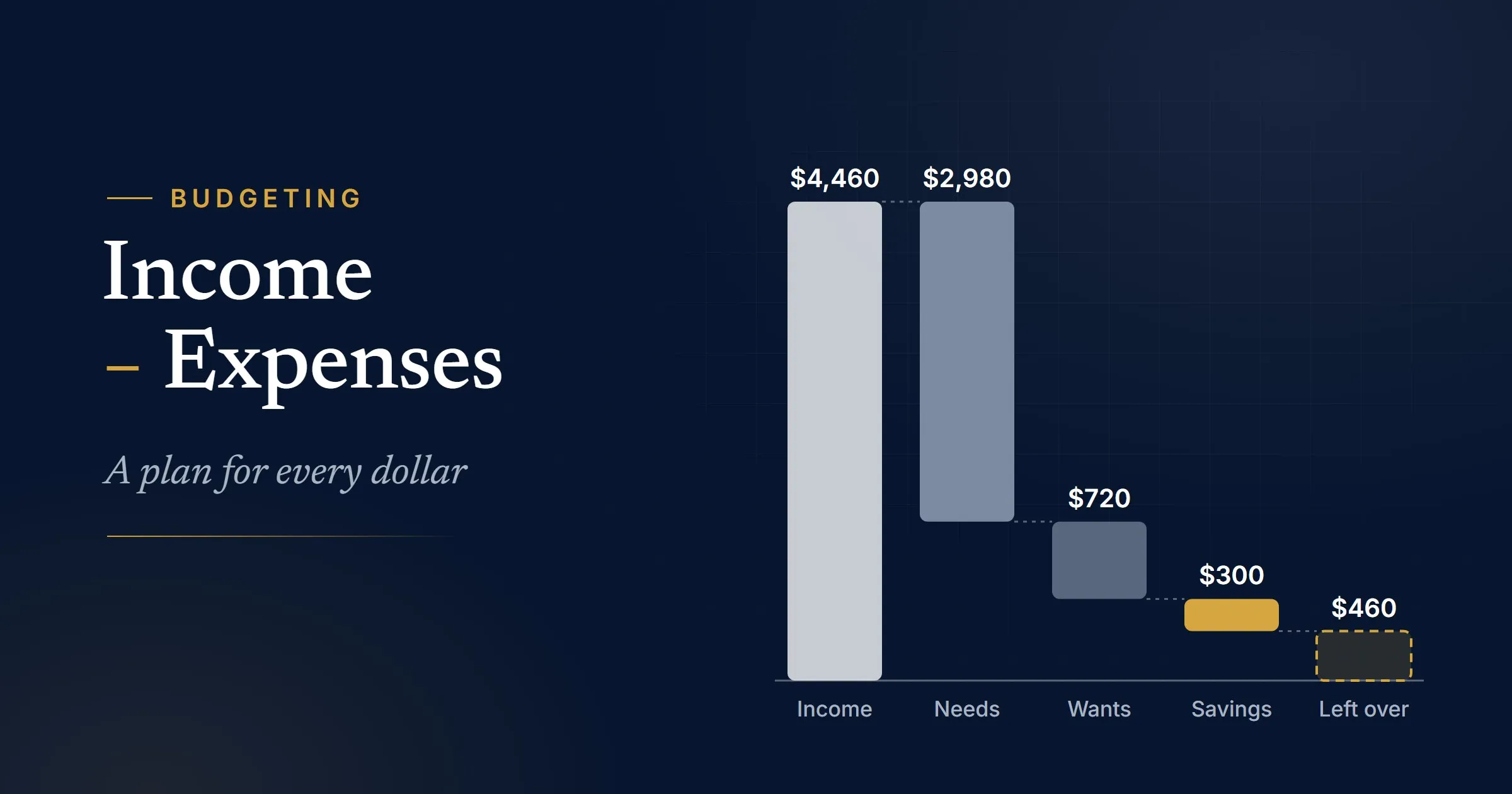
The traditional approach: list your income, set an amount for each spending category, such as rent, groceries and transportation, and track what you actually spend. At its simplest, you subtract your monthly bills and expenses from what you make, and the result should be more than zero.Source 2 Track spending in whatever way is easiest for you, whether that’s a daily journal or a folder of receipts you review each week.Source 1
Our budgeting guide walks through it step by step, and our budget template and list of budget categories help you set it up.
2. The 50/30/20 rule
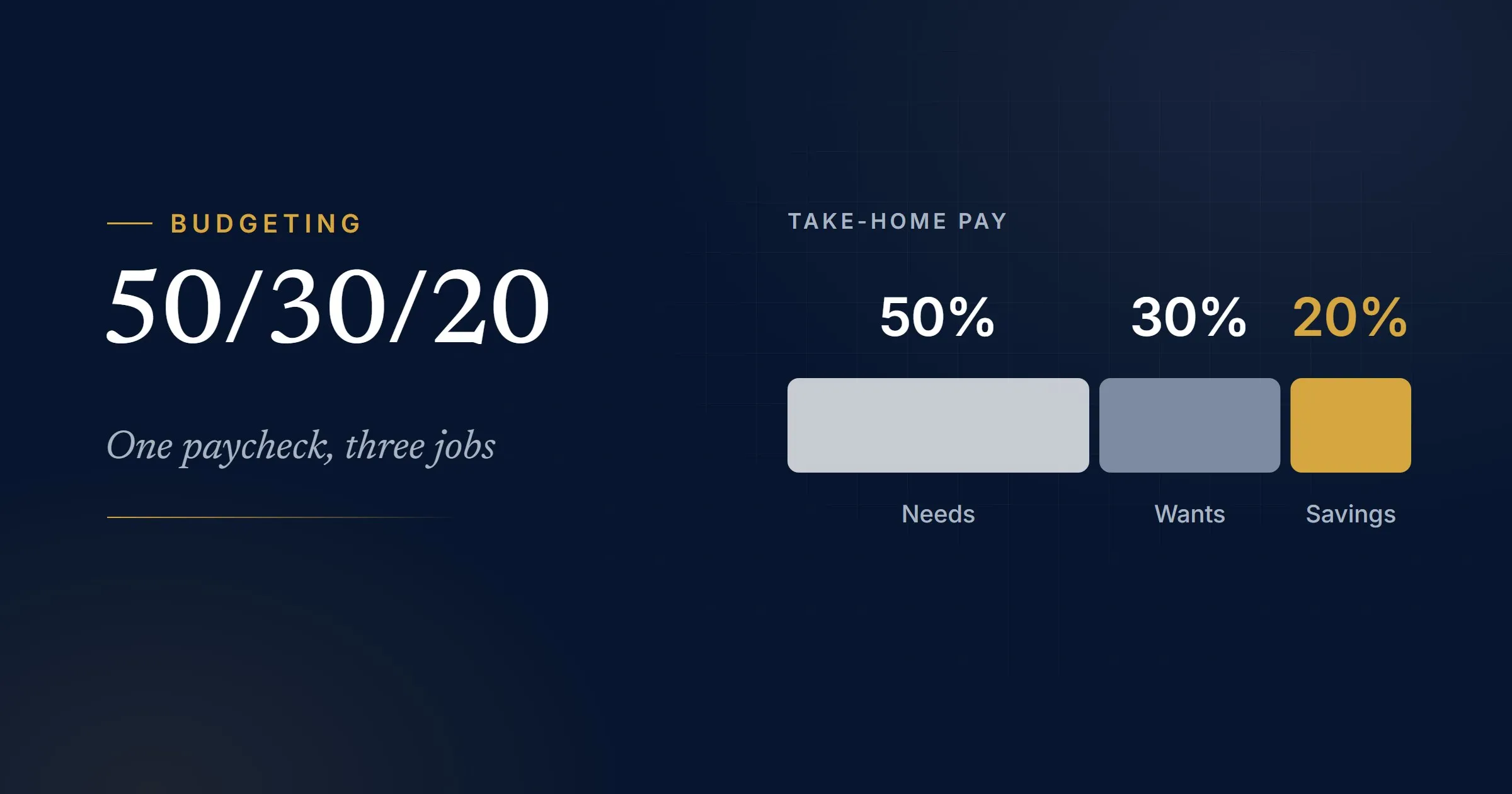
Split your take-home pay into about 50% for needs, 30% for wants and 20% for savings and debt payments. Elizabeth Warren and Amelia Warren Tyagi popularized the split in their 2005 book All Your Worth.Source 3 It takes little tracking, because you only watch three totals. If rent alone takes a large share of your pay, the 50% target can be hard to hit; our 50/30/20 guide covers what to do.
3. Zero-based budget
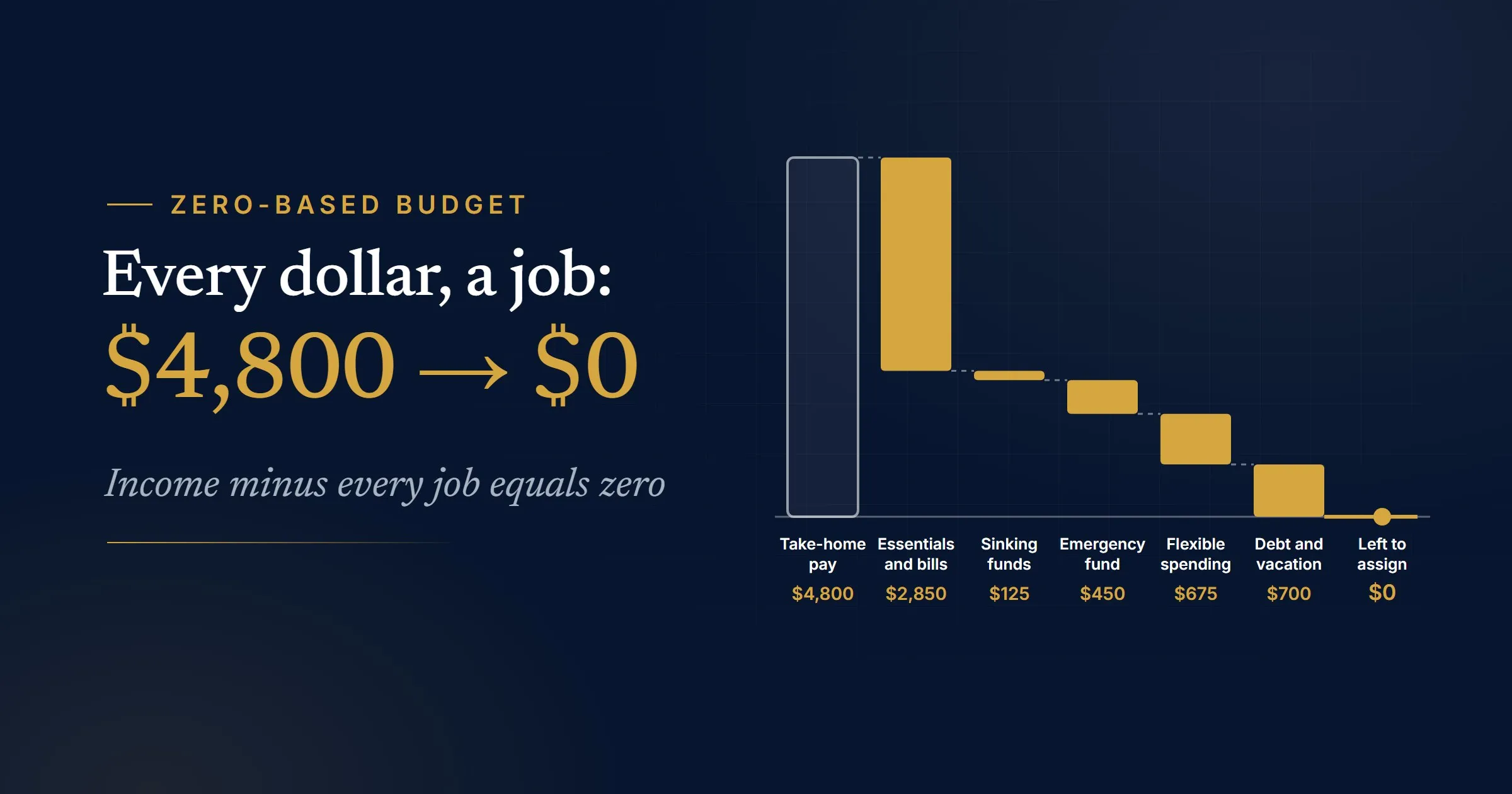
Give every dollar of income a job, including savings and debt payments, until your income minus everything you’ve planned equals zero. It takes the most effort of any method, but nothing is left to chance, which helps when money is tight or you’re paying off debt. Our zero-based budgeting guide has a worked example.
4. The envelope method
Decide how much you’ll spend in each flexible category, such as groceries or dining out, and put that amount in an envelope, either in cash or in a digital version. When an envelope is empty, you stop spending in that category or move money over from another one. It’s a good fit for categories where you tend to overspend. Our envelope budgeting guide shows how to set it up.
5. Pay yourself first
Move a set amount to savings as soon as you’re paid, then spend the rest without tracking every category. Automatic recurring transfers are often one of the easiest ways to save, and you can make it a specific amount each payday.Source 4 The 80/20 budget is a version of this: save 20% of take-home pay and spend the other 80%.
It works best when the amount you save is big enough to cover your goals, and when your bills are paid before you spend what’s left. Our pay yourself first guide shows how to set it up and how much each share of a paycheck adds up to.
6. Paycheck budget
Plan each paycheck on its own, matching every bill to the paycheck that arrives before it’s due. It suits people paid every week or two. Biweekly is the most common pay schedule: in February 2023, 43.0% of private establishments paid every two weeks and 27.0% paid weekly.Source 5 Our budget by paycheck guide has a biweekly example.
7. Irregular income budget
If your pay changes from month to month, budget from your baseline, the amount you can count on in a slow month, and set the extra aside in good months to cover the lean ones. It’s a common need: in 2025, 30% of adults had income that varied at least occasionally during the year.Source 6 Our irregular income guide explains how to find your baseline.
One income, budgeted five ways
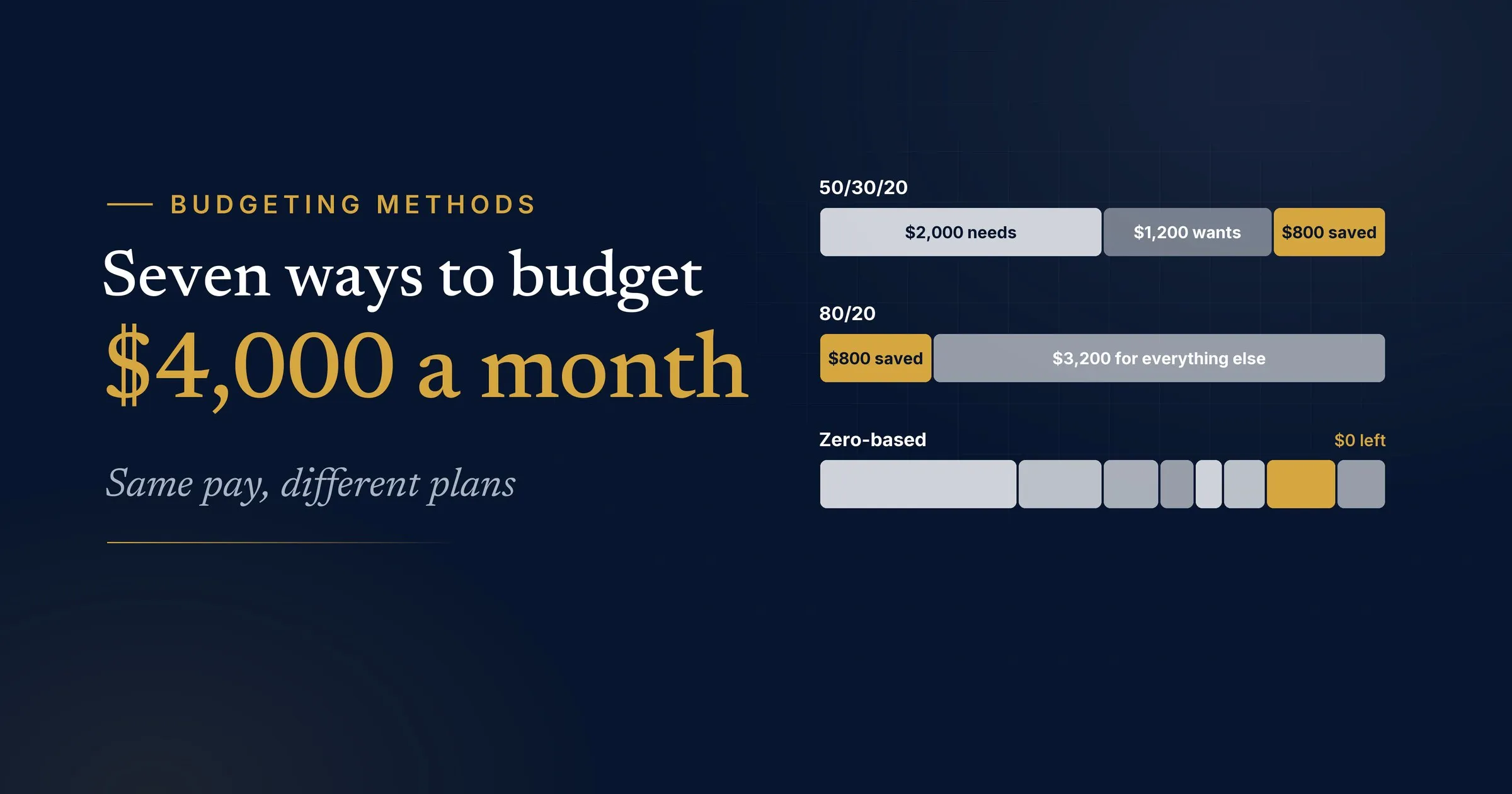
Here’s how take-home pay of $4,000 a month might look under five of these methods:
| Method | How the $4,000 is planned |
|---|---|
| 50/30/20 | $2,000 for needs, $1,200 for wants and $800 for savings and debt |
| Pay yourself first (80/20) | $800 to savings on payday, then $3,200 for everything else |
| Zero-based | All $4,000 assigned to bills, spending, savings and debt, leaving $0 |
| Envelope | Bills paid from checking, and a set amount for groceries, gas and fun in envelopes |
| Paycheck | $1,846.15 every two weeks, each paycheck covering the bills due before the next |
Example amounts. The paycheck figure assumes the same pay spread over 26 biweekly paychecks a year.
The income is the same in every row. What changes is how far ahead you plan and how closely you track. Our Monthly Budget Calculator shows how your own income and spending compare with the 50/30/20 split.
How to choose a budgeting method
- New to budgeting? Start with the 50/30/20 rule or pay yourself first. Both take little time.
- Spending more than you earn, or paying off debt? A zero-based budget gives you the closest control.
- Overspending in a few categories? Use envelopes for just those categories.
- Paid every week or two, with bills that land at awkward times? Budget by paycheck.
- Income that rises and falls? Build an irregular income budget around your baseline.
- Don’t want to track every purchase? Pay yourself first, and make sure your bills are covered.
Whichever you choose, start with one month at a time and adjust as you learn where your money goes.Source 1
Mixing methods
Methods combine well. You might pay yourself first on payday, check your spending against 50/30/20 once a month and keep envelopes for groceries and dining out. Whatever you choose, plan for bills that don’t come every month, such as car insurance or holiday gifts, with sinking funds, and build an emergency fund for the surprises.
Common questions
What is the easiest budgeting method?
The 50/30/20 rule and pay yourself first take the least time: one splits your pay into three totals, and the other saves first and leaves the rest to spend.
Which budgeting method is best?
The one you’ll stick with. Match it to your situation: how steady your income is, whether you overspend in particular categories and how much tracking you’re willing to do.
What is the 80/20 budget?
A simple version of paying yourself first: 20% of your take-home pay goes to savings, and you spend the other 80% however you need to. On take-home pay of $4,000 a month, that’s $800 saved and $3,200 to spend.
Can I switch methods?
Yes. Many people start with a simple method, then move to a more detailed one, or the reverse. Review your budget each month and change what isn’t working.
Do I need an app to budget?
No. A notebook, a spreadsheet or an app can all work. The CFPB’s free Your Money, Your Goals toolkit includes a spending tracker, a bill calendar and a cash flow budget worksheet.Source 7
Run your own numbers
See where your take-home pay goes each month.
Open the calculator
Sources
Numbers in the text link to these sources. We check them whenever we update this page.
- 1
Budgeting: How to create a budget and stick with it(external site)
Consumer Financial Protection Bureau (archived blog post) · Published June 5, 2019 · Accessed November 18, 2026 · Back to text for source 1
- 2
Making a Budget(external site)
Federal Trade Commission, consumer.gov · Accessed November 18, 2026 · Back to text for source 2
- 3
All Your Worth: The Ultimate Lifetime Money Plan(external site)
Elizabeth Warren and Amelia Warren Tyagi, Free Press (2005) · Accessed November 18, 2026 · Back to text for source 3
- 4
An essential guide to building an emergency fund(external site)
Consumer Financial Protection Bureau · Updated October 29, 2025 · Accessed November 18, 2026 · Back to text for source 4
- 5
Length of pay periods in the Current Employment Statistics survey(external site)
U.S. Bureau of Labor Statistics · Updated August 4, 2023 · Accessed November 19, 2026 · Back to text for source 5
- 6
Board of Governors of the Federal Reserve System · Accessed November 18, 2026 · Back to text for source 6
- 7
Your Money, Your Goals toolkit(external site)
Consumer Financial Protection Bureau · Updated April 24, 2026 · Accessed November 18, 2026 · Back to text for source 7
About the author
Wealthistry Editorial Team
Research, writing and editing
The team that researches, writes, fact-checks and updates Wealthistry's guides and calculators, following our published editorial standards.
Author profileEditorial policyHow we researchReport an error