Paying yourself first means saving before you spend. On payday, a set amount goes to savings, and the bills and everything else come out of what’s left. The FDIC describes it as setting aside a fixed amount on a regular basis, so the money is saved before you’re tempted to spend it.Source 1 MyMoney.gov, the federal government’s financial education site, suggests doing it every pay period, with an automatic transfer from your paycheck or checking account to savings.Source 2
It’s a habit worth building. In 2025, only 35% of adults who weren’t retired thought their retirement saving was on track.Source 3 This guide covers how the method works, three ways to automate it, how much to save from each paycheck and when something else should come first.
How paying yourself first works
Many budgets run in this order: pay the bills, spend on everything else, then save whatever happens to be left. Paying yourself first moves saving to the front:
- Payday. Your savings amount moves out first, ideally without you lifting a finger.
- Bills. Rent, utilities, loan payments and other fixed costs are paid from what remains.
- Everything else. The rest is yours to spend, with no need to track every category.
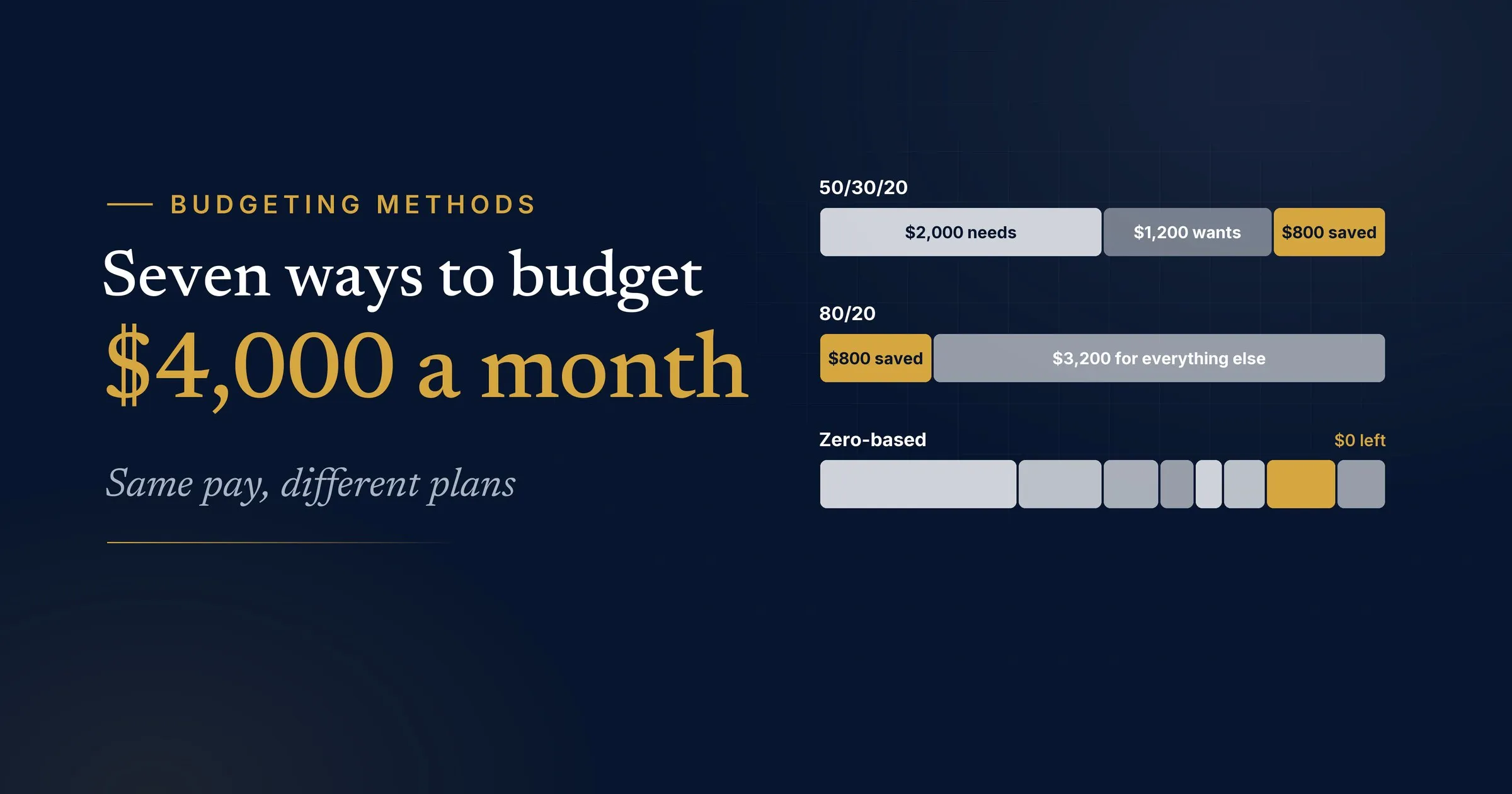
Saving first doesn’t mean skipping bills. The amount you pick has to leave enough for them, which is why the first step below starts with your bills. The 80/20 budget is the same idea with a fixed split: a fifth of take-home pay goes to savings and the other four-fifths is yours to spend. Our guide to budgeting methods compares it with the alternatives.
How to pay yourself first, step by step
1. Start from your take-home pay and your bills
Plan around your take-home pay, the money that lands in your account after taxes and deductions, rather than your salary. Our guide to gross vs. net income explains the difference. Then list the bills each paycheck has to cover. The gap between the two is the most you could save, and your day-to-day spending has to fit in it as well. If you don’t know what you spend, track your expenses for a month first.
2. Pick an amount you can keep up
A common benchmark, the savings slice of the 50/30/20 rule, is 20% of take-home pay, counting extra payments on debt. If that’s out of reach, start lower. The FDIC’s advice is to begin with any amount you can afford, however small, and to save more once you see you can manage your expenses while saving.Source 1 To turn a specific goal into a monthly number, see our guide to how much to save each month.
3. Decide where the money goes
Give each dollar a purpose, such as an emergency fund, retirement or a down payment. Keep the savings out of your everyday checking account. The FDIC suggests holding emergency savings in a separate insured savings account, which makes it easier to resist using it for everyday spending.Source 1 A high-yield savings account earns more while the money waits, and our savings goals guide shows how to split one savings amount across several goals.
4. Automate it for payday
The method works best when you never have to remember it. The next section covers the three common ways to make the savings move on their own.
5. Spend what’s left, and raise the amount over time
Once the savings are out, budget the rest however suits you. Check the amount every few months. When you get a raise or pay off a debt, send some or all of the difference to savings. The FDIC’s suggestion for a paid-off debt is to keep making those monthly payments, but to yourself.Source 1
Three ways to automate it
Split your direct deposit
Your employer may be able to send part of each paycheck to savings and the rest to checking, so ask whether your direct deposit can be split.Source 4 You choose a dollar amount or a percentage for savings, and the rest lands in checking. Your employer or your bank or credit union may be able to set it up for you.Source 1 Because the savings never pass through checking, there’s no transfer that could overdraw it.
Contribute to a workplace retirement plan
Workplace plans such as a 401(k) take your contribution out of each paycheck before the money reaches you, so they pay you first by design. The Department of Labor’s advice is to sign up and contribute all you can: your taxes will be lower, your employer may add more, and automatic deductions make it easy. Before you pick a rate, check two things the department flags: what you’d have to put in to receive your employer’s full contribution, and how many years you’d have to stay before that money is yours.Source 5
Contributions to a traditional 401(k) generally aren’t subject to income tax withholding when they’re deducted, though they still count as wages for Social Security and Medicare taxes.Source 6 That’s why your paycheck shrinks by less than you put in. If your top federal tax bracket is 12%, each $100 you contribute lowers your federal withholding by about $12, so your take-home pay drops by about $88. State taxes can change the result.
For 2027, you can contribute up to $25,500 to a 401(k), a 403(b), a governmental 457 plan or the Thrift Savings Plan, up from $24,500 in 2026. Workers 50 and older can generally add up to $8,500 more, and a higher catch-up limit of $11,750 applies at ages 60 to 63. The IRA contribution limit stays at $7,500.Source 7
Schedule an automatic transfer
Without a split deposit, set up a recurring transfer from checking to savings through your bank or credit union.Source 4 Schedule it for payday or the day after, once your pay has arrived, and watch your balance so a transfer doesn’t overdraw your account and cost you a fee.Source 4 An IRA can be funded the same way, with an amount deducted automatically from your checking or savings account.Source 5 Our guide to avoiding bank fees covers what to do if an overdraft happens anyway.
How much to pay yourself from each paycheck
Here’s what different shares of a $1,600 paycheck, paid every two weeks, add up to. That’s an average of about $3,467 a month.
| Share | Per paycheck | Per year | After 3 years |
|---|---|---|---|
| 5% | $80 | $2,080 | $6,617 |
| 10% | $160 | $4,160 | $13,234 |
| 15% | $240 | $6,240 | $19,851 |
| 20% | $320 | $8,320 | $26,468 |
Example figures, with 26 paychecks a year. After 3 years includes interest at an example 4% APY.
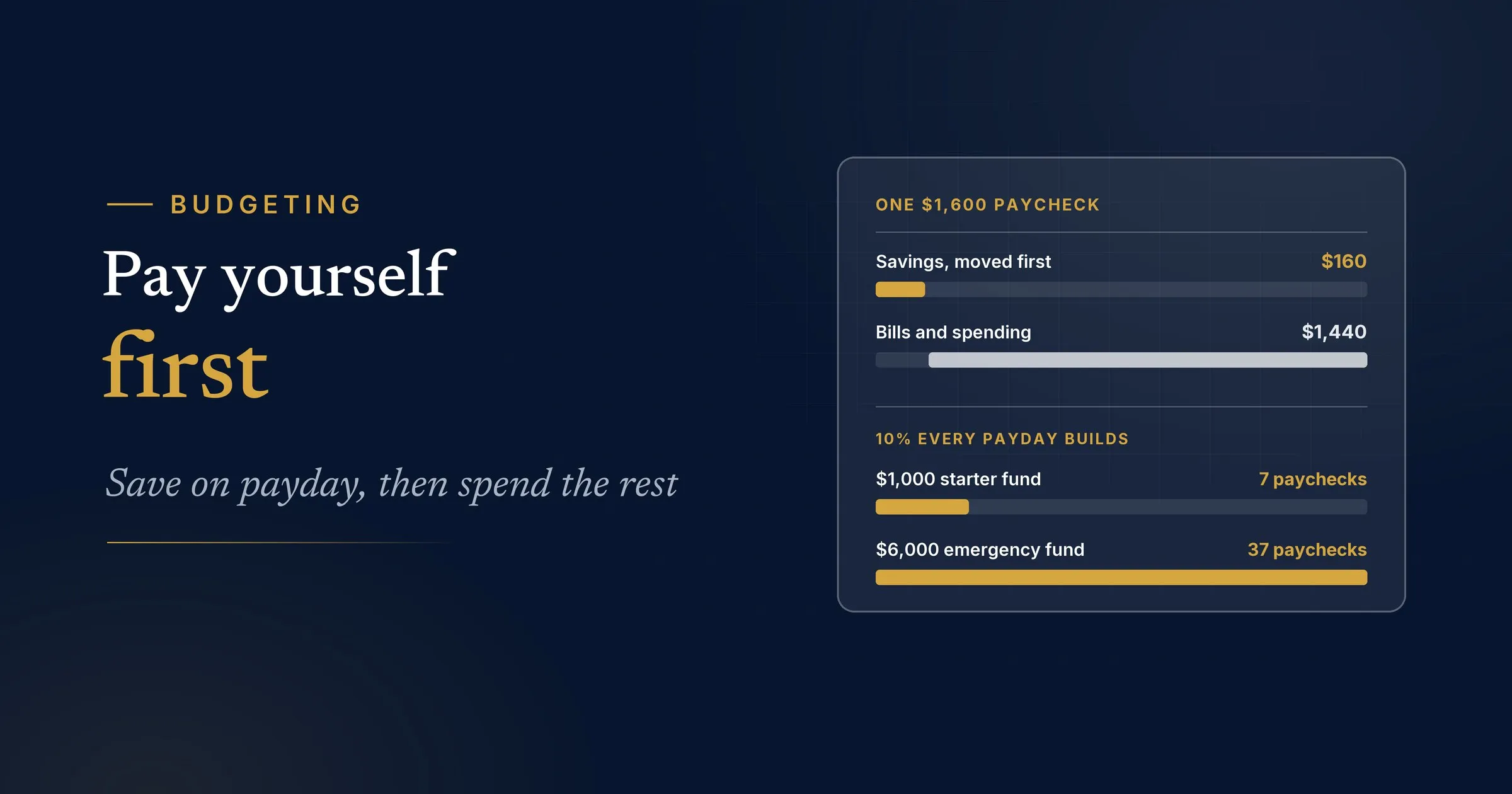
Saving 10% of each paycheck
- Each payday, $160 goes to savings first and $1,440 is left for bills and spending.
- A $1,000 starter emergency fund takes seven paychecks, about three months.
- A $6,000 emergency fund takes 37 paychecks, about 17 months, with interest at an example 4% APY.
Our emergency fund guide explains how to choose your own target.
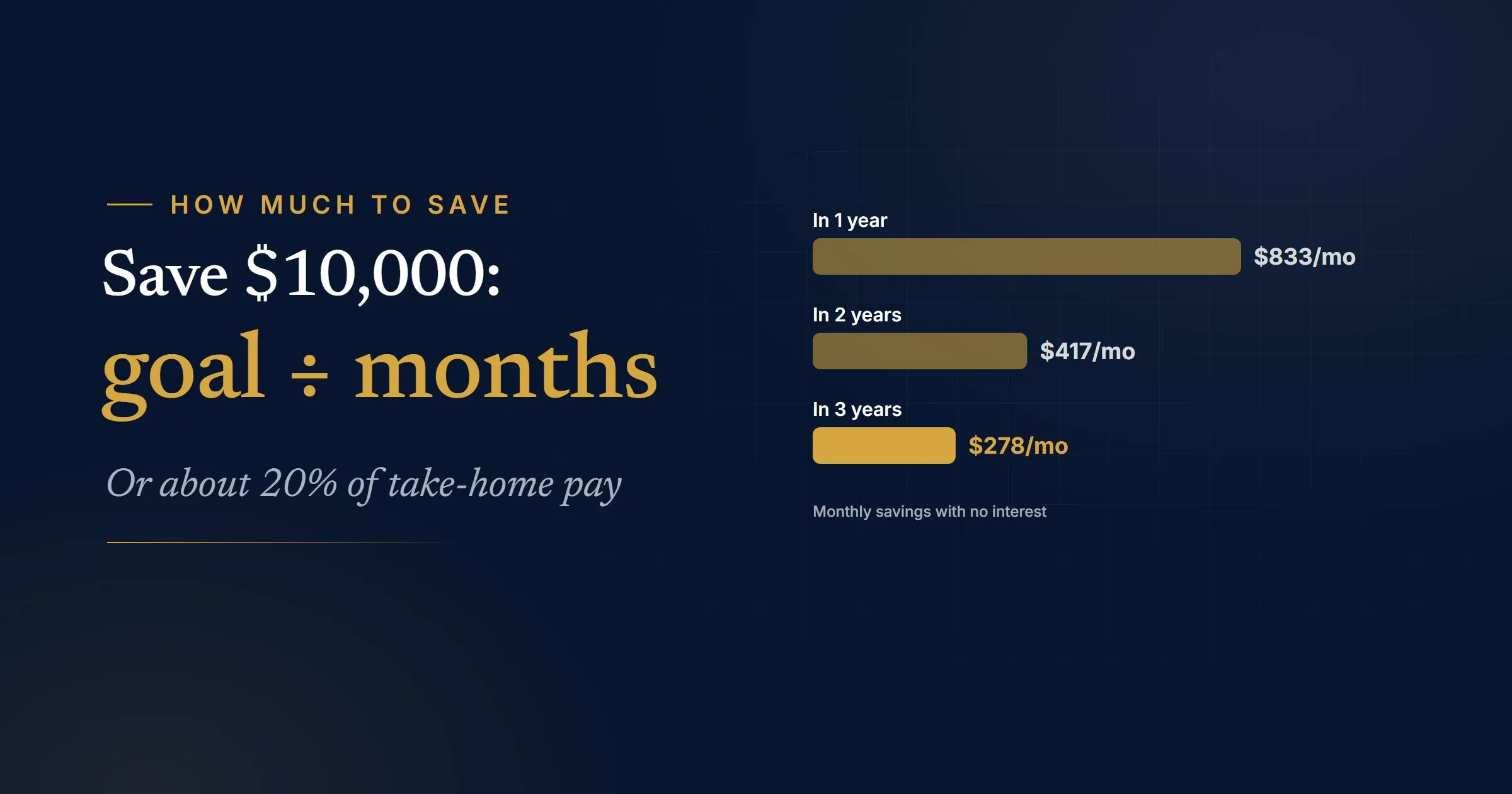
Turning a monthly target into an amount per paycheck
Savings goals are usually set by the month, but money moves on payday. To convert:
Per paycheck equals the monthly target times 12, divided by the number of paydays a year.
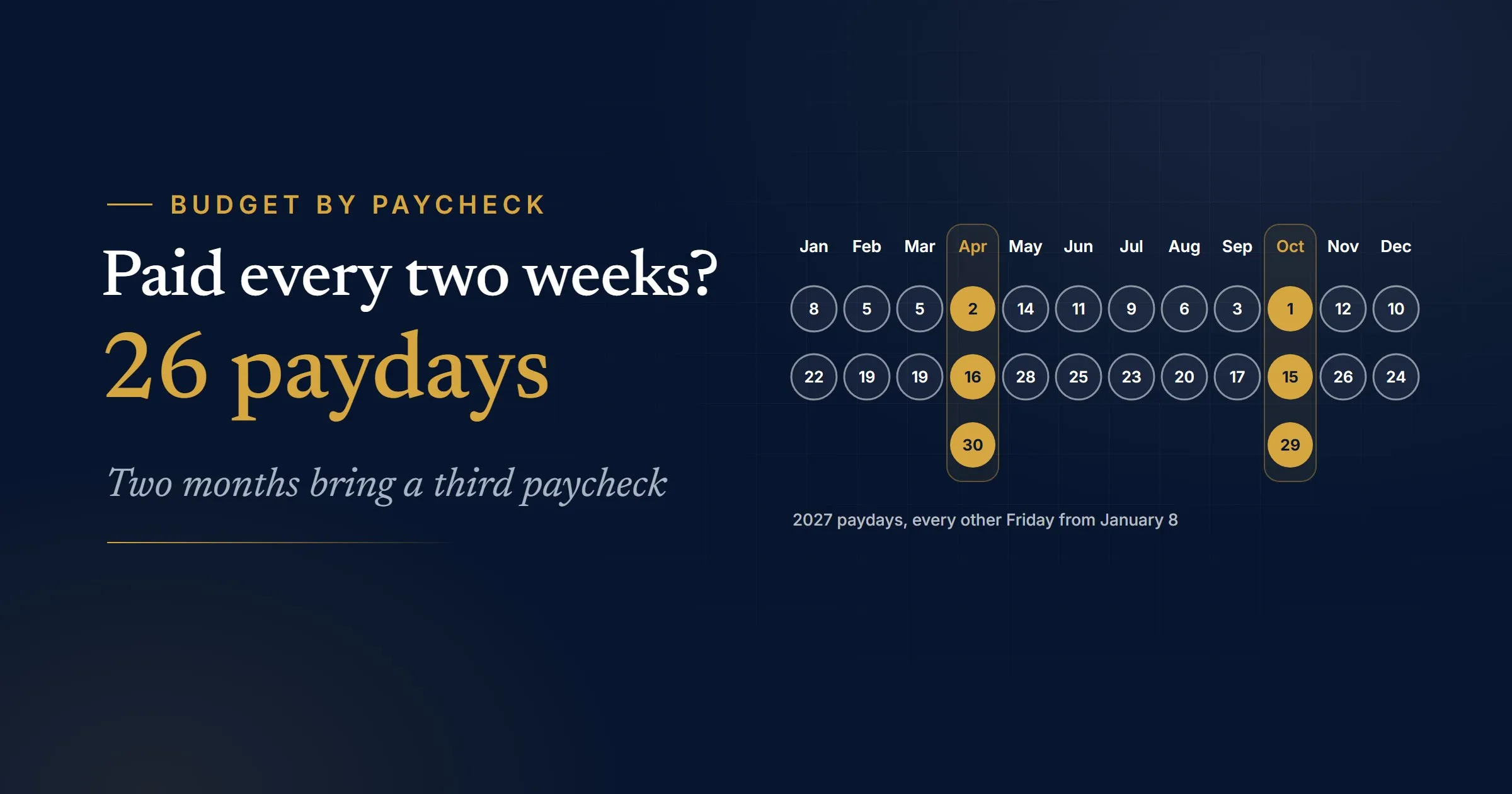
- paydays a year is 52 if you’re paid weekly, 26 if you’re paid every two weeks and 24 if you’re paid twice a month
Saving $400 a month works out to $92.31 a week, $184.62 every two weeks or $200.00 twice a month. Halving the monthly amount only works with twice-a-month pay. On a biweekly schedule, $200 a paycheck adds up to $5,200 a year instead of $4,800, because the year has 26 paydays, not 24, so $400 more comes out of your spending money than you planned. Our budget by paycheck guide covers the months with a third paycheck, and the Savings Goal Calculator works out weekly, biweekly or monthly amounts for any goal.
Pros and cons of paying yourself first
Advantages
- Saving happens first, not last. The money is set aside before everyday spending can claim it.
- It runs on its own. Saving automatically is one of the easiest ways to keep your savings consistent, so you start to see it build.Source 4
- It takes little tracking. You don’t need to sort every purchase into a category, as long as the bills are covered.
- It works at any income. Any amount counts, and you can start with a few dollars a paycheck.Source 1
Disadvantages
- It doesn’t show where the rest goes. If your spending keeps running past what’s left, the gap tends to land on a credit card, which undoes the saving.
- Transfers can overdraw checking if they run before your pay arrives or when your balance is low.Source 4
- A fixed amount can be too much in a lean month if your income varies.
- Saving while carrying high-interest debt can cost more than it earns. Credit card accounts charged interest averaged a 22.36% rate in the July-to-September quarter of 2026,Source 8 far above the 0.39% that savings accounts paid on average nationally in November 2026.Source 9
When something else should come first
Paying yourself first assumes your bills are covered. Put these ahead of it:
- Bills you can’t fall behind on. If saving would leave rent, utilities or a car payment short, save a smaller amount until they’re covered. Our guide to breaking the paycheck-to-paycheck cycle shows how to free up room.
- High-interest debt. Build a small emergency fund and get any employer match, then send extra money to credit card balances before bigger savings goals. Should you pay off debt or save first? walks through the numbers.
- Income that changes from month to month. Save a percentage of each deposit rather than a fixed amount, so you save more in good months and less in slow ones. Our irregular income guide explains how to budget from a baseline.
Use raises and refunds to pay yourself first
A raise, a bonus or a tax refund is a chance to save more without cutting your current spending. For many Americans, a tax refund is one of the largest checks they get all year, and the CFPB suggests putting all or part of it into savings.Source 4 If your refund is deposited directly, the IRS lets you split it between two or three accounts, including an IRA. Tax software can do it, or you can use Form 8888 with a paper return. The accounts should be U.S. accounts in your name, your spouse’s name or both.Source 10
Common questions
What does pay yourself first mean?
It means setting aside part of every paycheck for savings as soon as you’re paid, then covering your bills and spending with what’s left. Done automatically, saving becomes a bill you pay to yourself.
How much should I pay myself first?
As much as your bills leave room for. A common target is 20% of take-home pay, including extra debt payments. If that’s too much, begin with any amount you can manage and increase it over time.Source 1
What are the disadvantages of paying yourself first?
It doesn’t track the rest of your spending, so overspending can end up on a credit card. Automatic transfers can overdraw a low checking balance, and saving while you carry high-interest debt usually costs more in interest than the savings earn.
Is paying yourself first the same as the 50/30/20 rule?
No. The 50/30/20 rule divides all of your take-home pay into needs, wants and savings. Paying yourself first only sets the savings amount and leaves the rest up to you. They combine well: move the 20% to savings on payday, then aim to keep needs near half of your pay.
Does a 401(k) contribution count as paying yourself first?
Yes. Contributions leave your paycheck before you see it, and the automatic deductions make it easy to keep going.Source 5 But 401(k) withdrawals before age 59½ generally face an additional 10% tax unless an exception applies,Source 6 so for an emergency fund or shorter-term goals, add a split deposit or a transfer to a savings account.
How much should I save per paycheck to reach a goal?
Divide the goal by the number of paydays before your deadline. Three months usually holds six or seven biweekly paydays, so saving $5,000 in three months takes $833.34 a paycheck over six paydays, or $714.29 over seven.
Run your own numbers
Work out how much to save, and by when.
Open the calculator
Sources
Numbers in the text link to these sources. We check them whenever we update this page.
- 1
Starting Small Can Lead to Big Savings(external site)
Federal Deposit Insurance Corporation · Updated January 5, 2024 · Accessed November 25, 2026 · Back to text for source 1
- 2
Save and Invest(external site)
MyMoney.gov, Financial Literacy and Education Commission · Accessed November 25, 2026 · Back to text for source 2
- 3
Board of Governors of the Federal Reserve System · Accessed November 25, 2026 · Back to text for source 3
- 4
An essential guide to building an emergency fund(external site)
Consumer Financial Protection Bureau · Updated October 29, 2025 · Accessed November 25, 2026 · Back to text for source 4
- 5
Top 10 Ways to Prepare for Retirement(external site)
Employee Benefits Security Administration, U.S. Department of Labor · Accessed November 25, 2026 · Back to text for source 5
- 6
Topic no. 424, 401(k) plans(external site)
Internal Revenue Service · Updated November 9, 2026 · Accessed November 25, 2026 · Back to text for source 6
- 7
401(k) limit increases to $25,500 for 2027, IRA limit remains $7,500(external site)
Internal Revenue Service · Published November 12, 2026 · Accessed November 25, 2026 · Back to text for source 7
- 8
Consumer Credit - G.19(external site)
Board of Governors of the Federal Reserve System · Published November 6, 2026 · Accessed November 25, 2026 · Back to text for source 8
- 9
National Rates and Rate Caps – November 2026(external site)
Federal Deposit Insurance Corporation · Updated November 16, 2026 · Accessed November 25, 2026 · Back to text for source 9
- 10
Internal Revenue Service · Updated May 18, 2026 · Accessed November 25, 2026 · Back to text for source 10
About the author
Wealthistry Editorial Team
Research, writing and editing
The team that researches, writes, fact-checks and updates Wealthistry's guides and calculators, following our published editorial standards.
Author profileEditorial policyHow we researchReport an error