There’s no single right amount to save each month. It depends on your income, your costs and what you’re saving for. Most people save less than they’d like: the U.S. personal saving rate, the share of income left after taxes and spending, was 3.8% in September 2026.Source 1
This guide gives you three ways to find your number: a rule of thumb, a goal-based formula, and an order for what to save for first.
The 20% rule of thumb
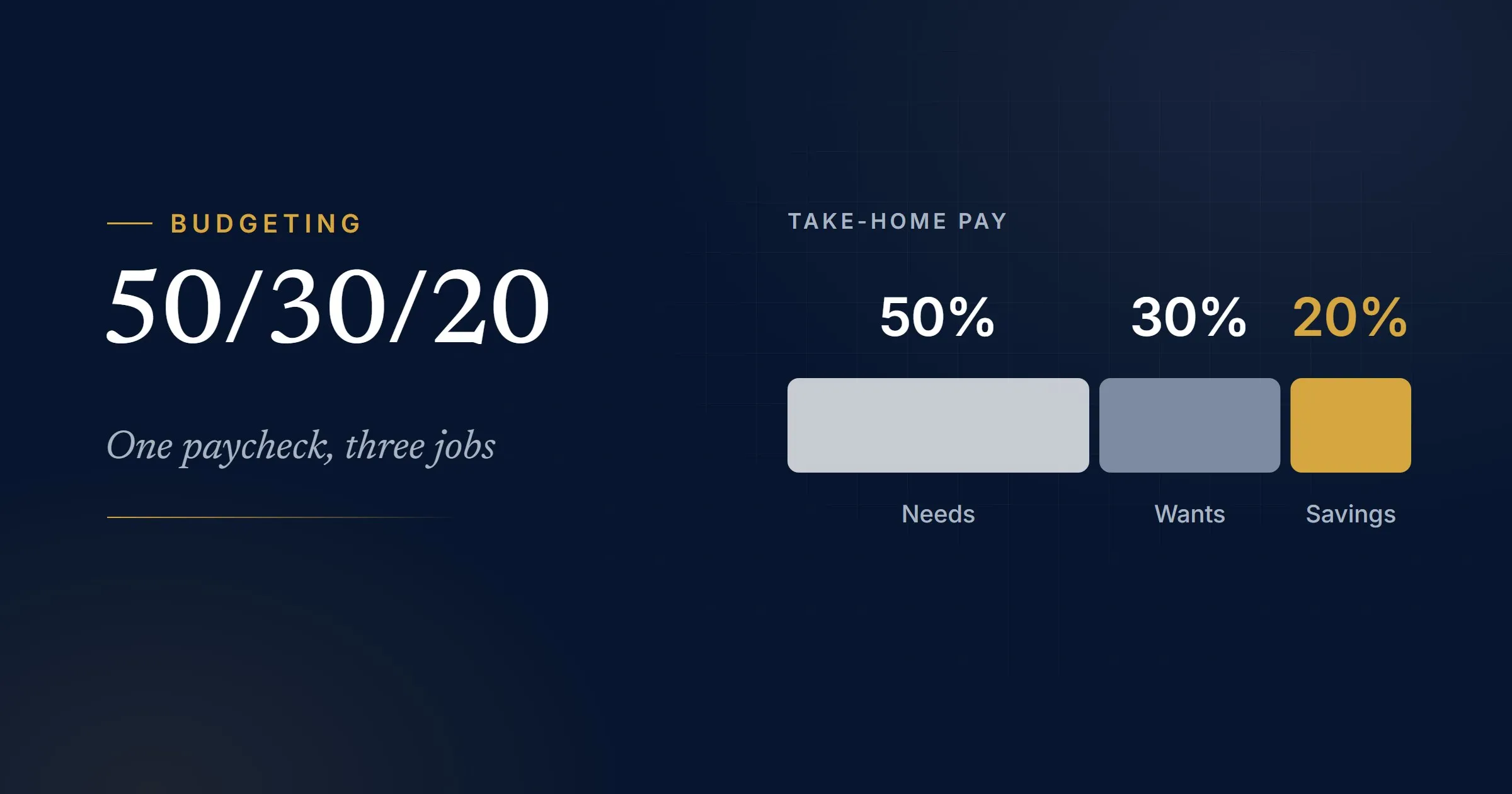
The 50/30/20 rule suggests putting about 20% of your take-home pay toward savings and extra debt payments, with 50% for needs and 30% for wants. Here’s what 10%, 15% and 20% come to:
| Take-home pay a month | 10% | 15% | 20% |
|---|---|---|---|
| $3,000 | $300 | $450 | $600 |
| $4,500 | $450 | $675 | $900 |
| $6,000 | $600 | $900 | $1,200 |
Twenty percent is a target, not a test. If your needs take more than half your pay, start with what you can and work up. As the Department of Labor puts it, start small if you have to and try to increase the amount you save each month.Source 2
How to calculate your savings rate
Savings rate equals what you save divided by take-home pay, times 100.
- what you save is everything you set aside in a month, including extra debt payments if you count them toward your goal
- take-home pay is what reaches your account after taxes and other deductions
If you save $600 a month out of $4,800 of take-home pay, your savings rate is 12.5%. If retirement contributions come out of your paycheck before you’re paid, you can count them too: add them to both what you save and your pay, so the rate isn’t understated.
A savings rate isn’t the same as an account’s APY. Your savings rate is how much of your income you save; the APY is how much interest an account pays on what you’ve saved. Our APR vs. APY guide explains APY.
How much to save for a goal
For a specific goal, work backward from the amount and the date:
Each month equals goal minus already saved, divided by months until you need it.
Here’s what common goals take, starting from zero:
| Goal | Time | No interest | At 4% APY |
|---|---|---|---|
| $5,000 | 1 year | $416.67 | $407.89 |
| $5,000 | 2 years | $208.34 | $199.95 |
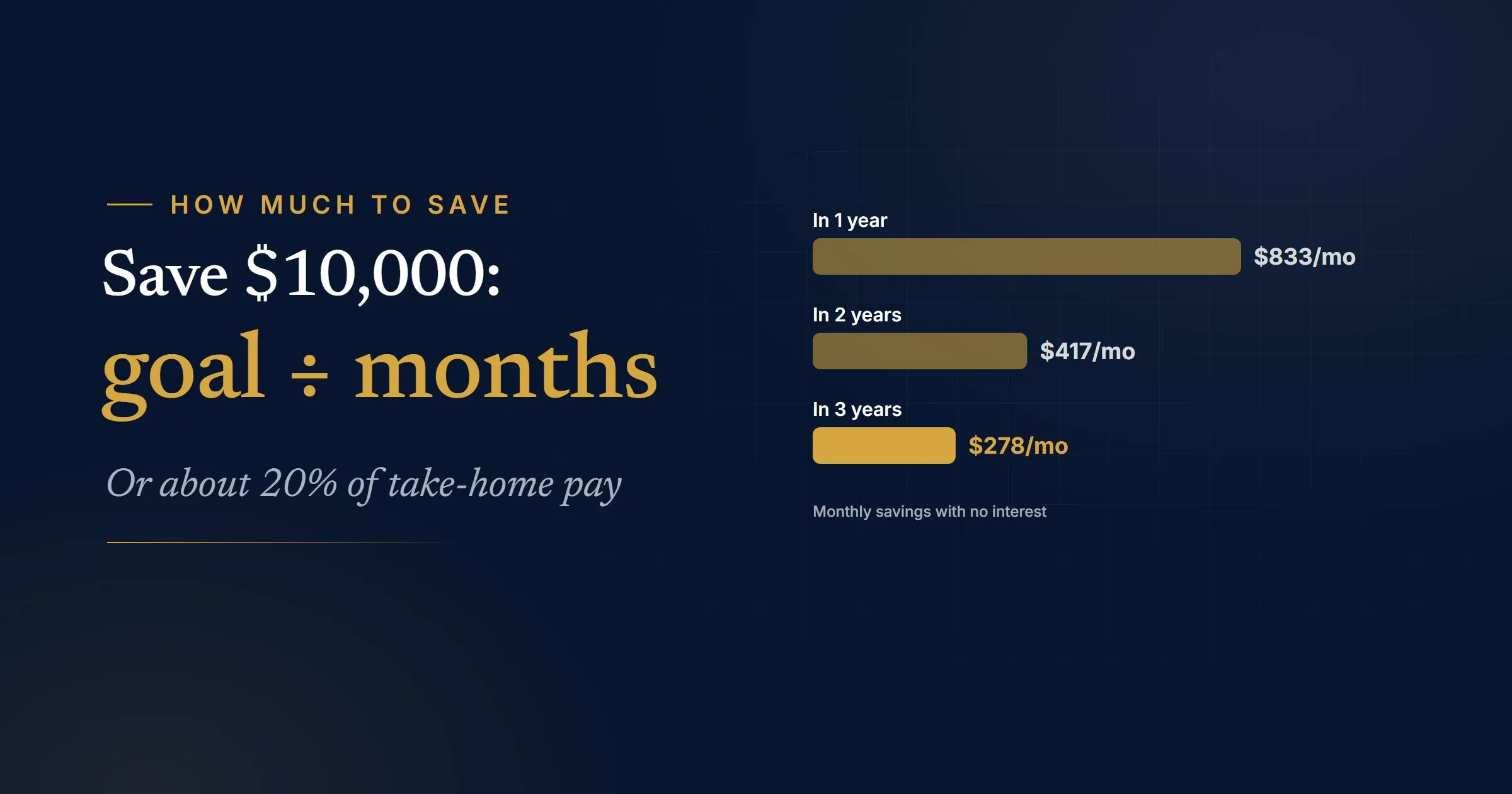
| $10,000 | 1 year | $833.34 | $815.77 |
| $10,000 | 2 years | $416.67 | $399.89 |
| $10,000 | 3 years | $277.78 | $261.33 |
| $30,000 home down payment | 5 years | $500 | $451.84 |
One deposit right away and one each month after. Amounts are rounded up to the cent, so the goal is reached. 4% APY is an example rate.
Interest helps most on bigger, longer goals. A $30,000 home down payment over five years takes $500 a month with no interest, or $451.84 at 4% APY. The national average savings rate was much lower, 0.39% in November 2026,Source 3 so where you keep the money matters; our high-yield savings guide explains what to look for. For a home, our guide to saving for a house works out the full target, closing costs included.
The same math works for smaller costs that don’t come every month. If car repairs and maintenance run about $900 a year, set aside $75 a month. Our sinking funds guide shows how to plan several costs like this, and the Savings Goal Calculator works out any goal and date.
What to save for first
If you’re not sure where your savings should go, this order works for most people:
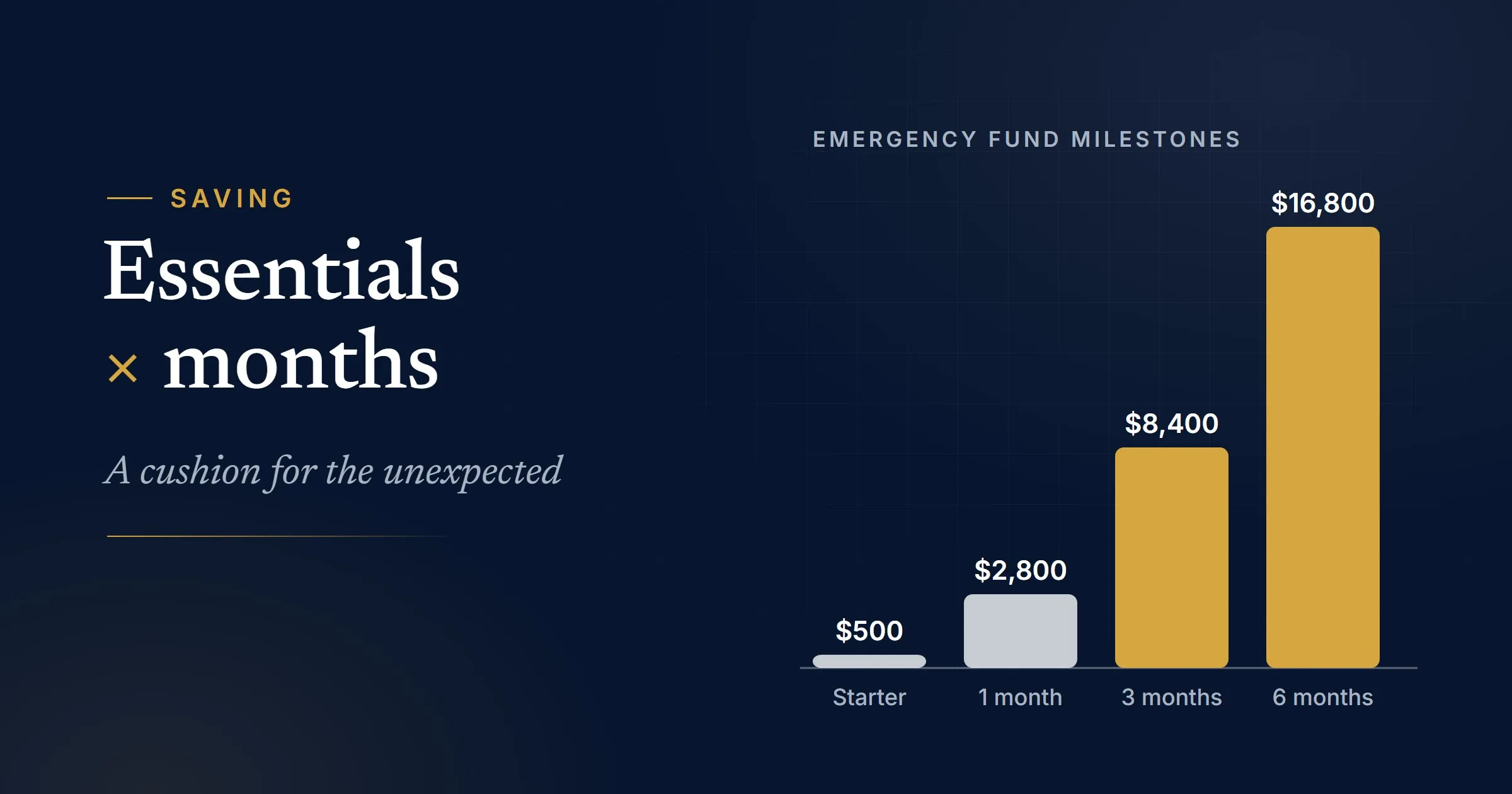
- A starter emergency fund. An emergency fund is cash set aside for unplanned expenses such as car repairs, medical bills or a loss of income.Source 4 Even a small one keeps a surprise bill off a credit card. Our emergency fund guide suggests milestones.
- Your employer’s full retirement match. If your employer offers a plan such as a 401(k), find out how much you’d need to contribute to get the full employer contribution.Source 2
- High-interest debt. As Investor.gov puts it, no investment strategy pays off as well as, or with less risk than, eliminating high-interest debt.Source 5 Our guide to paying off credit card debt shows how.
- A full emergency fund, of several months of essential expenses. Our Emergency Fund Calculator sets a target.
- Retirement and longer-term goals. Experts estimate you’ll need 70% to 80% of your preretirement income to keep your standard of living in retirement,Source 2 so retirement savings usually deserve a steady share once the basics are covered.
Our guide to paying off debt or saving first shows the math behind steps 1 to 3, and our savings goals guide shows how to fund several goals at once.
Make it automatic, then raise it
Setting up automatic recurring transfers from checking to savings is one of the easiest ways to save consistently.Source 4 Pick an amount you can keep up, schedule it for payday, and review it once or twice a year. When your pay goes up, raise the transfer before the extra money gets absorbed into spending.
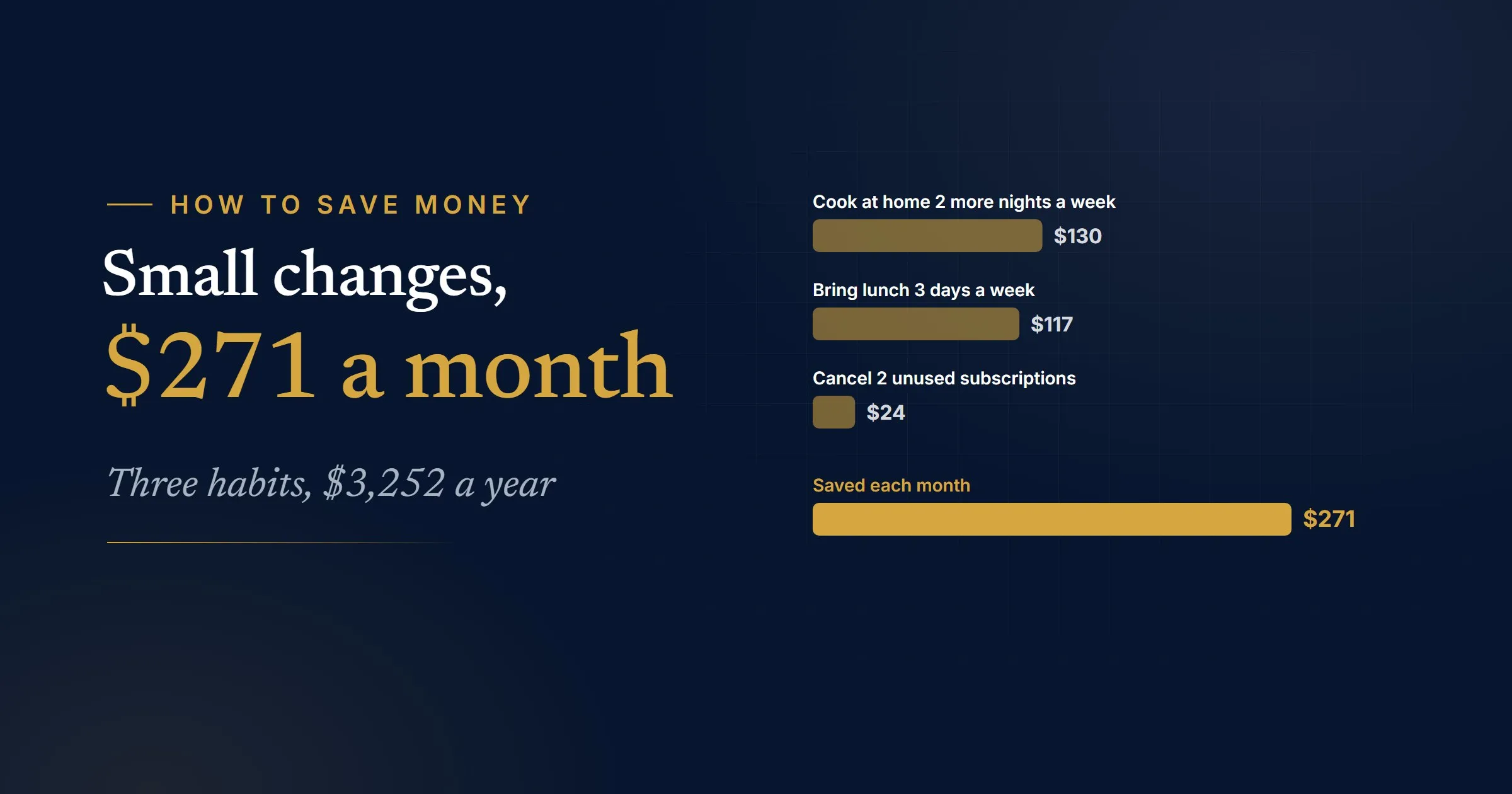
If money is tight, start with a small amount. Even a small amount can provide some financial security.Source 4 Our guide to saving money has practical ways to free some up.
Common questions
How much should I save each month?
A common target is about 20% of your take-home pay for savings and extra debt payments. If that’s not possible yet, start with what you can and raise it over time. Our guide to how much to have in savings covers the total to aim for.
Is saving 10% of my income enough?
It’s a solid start, and it’s well above the average U.S. personal saving rate of 3.8% in September 2026.Source 1 Whether it’s enough depends on your goals. Use the goal formula above to check whether you’re on track.
How much should I save a month to have $10,000?
With no interest, about $833.34 a month for one year, $416.67 for two years or $277.78 for three years.
What’s a good savings rate?
One you can keep up every month. The 50/30/20 rule suggests about 20% of take-home pay, including extra debt payments, but the right rate depends on your goals and costs.
Should I save or pay off debt first?
Build a small emergency fund, get any employer match, then focus on high-interest debt before bigger savings goals.
Run your own numbers
Work out how much to save, and by when.
Open the calculator
Sources
Numbers in the text link to these sources. We check them whenever we update this page.
- 1
Personal Saving Rate(external site)
U.S. Bureau of Economic Analysis · Updated October 29, 2026 · Accessed November 19, 2026 · Back to text for source 1
- 2
Top 10 Ways to Prepare for Retirement(external site)
Employee Benefits Security Administration, U.S. Department of Labor · Accessed November 18, 2026 · Back to text for source 2
- 3
National Rates and Rate Caps – November 2026(external site)
Federal Deposit Insurance Corporation · Updated November 16, 2026 · Accessed November 18, 2026 · Back to text for source 3
- 4
An essential guide to building an emergency fund(external site)
Consumer Financial Protection Bureau · Updated October 29, 2025 · Accessed November 18, 2026 · Back to text for source 4
- 5
Pay Off Credit Cards or Other High Interest Debt(external site)
Investor.gov, U.S. Securities and Exchange Commission · Accessed November 18, 2026 · Back to text for source 5
About the author
Wealthistry Editorial Team
Research, writing and editing
The team that researches, writes, fact-checks and updates Wealthistry's guides and calculators, following our published editorial standards.
Author profileEditorial policyHow we researchReport an error