There’s no single right amount to have in savings. A useful way to find your number is to add two things: an emergency fund for the surprises, and money set aside for the costs you can already see coming. Retirement savings are a separate pot. Here’s how to work out your own target, and what U.S. families actually have.
Step 1: Start with an emergency fund
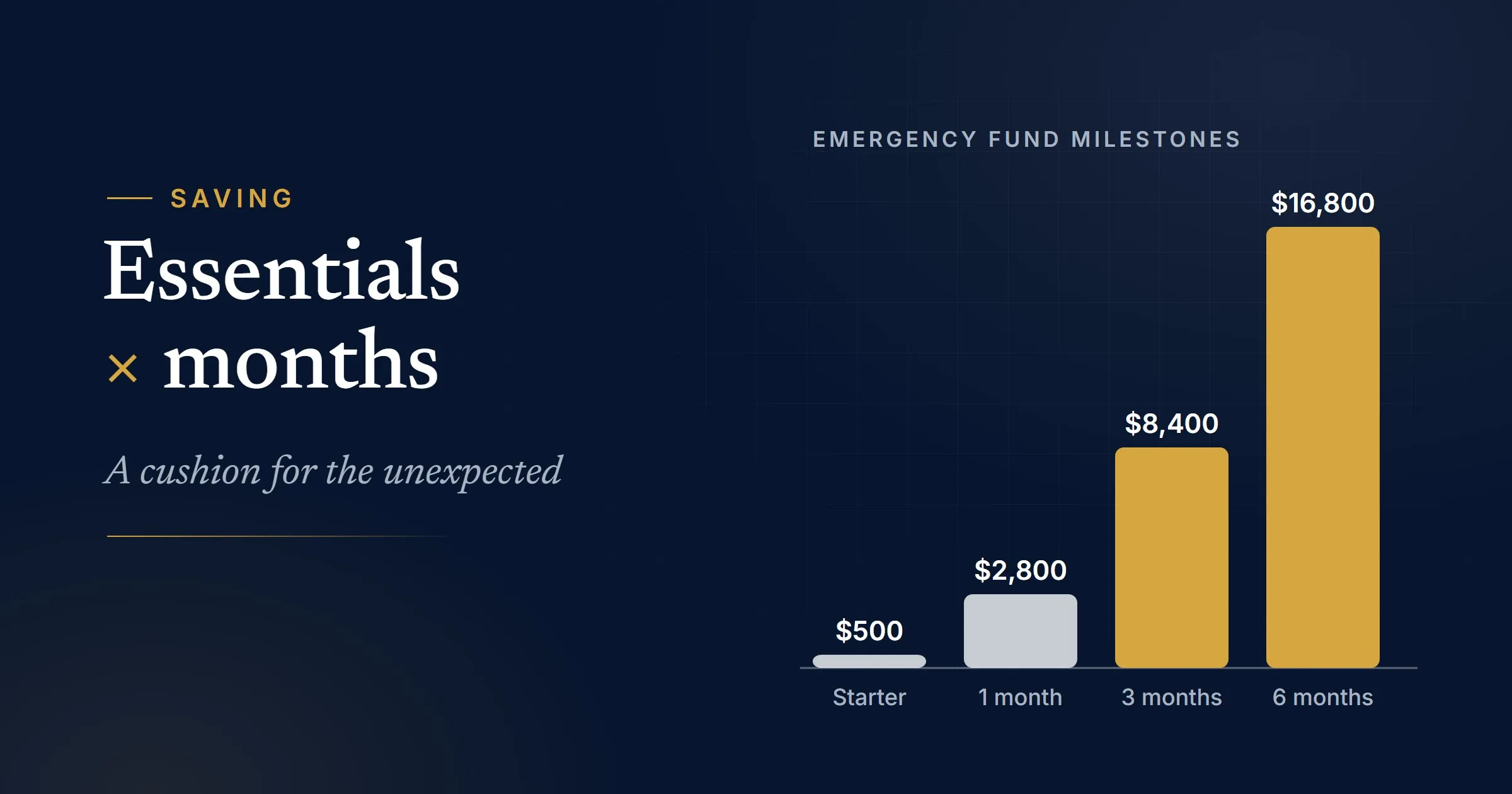
A common savings goal for emergencies is three to six months of living expenses.Source 1 Base it on your essentials: the bills you’d still have to pay if your income stopped, such as housing, utilities, groceries, insurance and minimum debt payments.
Aim for the higher end if your income is irregular, your household depends on one paycheck or your job would take a while to replace. In 2025, 55% of adults said they had set aside enough to cover three months of expenses in an emergency or rainy day fund.Source 2 Our emergency fund guide shows how to build one in steps, starting with a small first milestone.
Step 2: Add savings for goals you can see coming
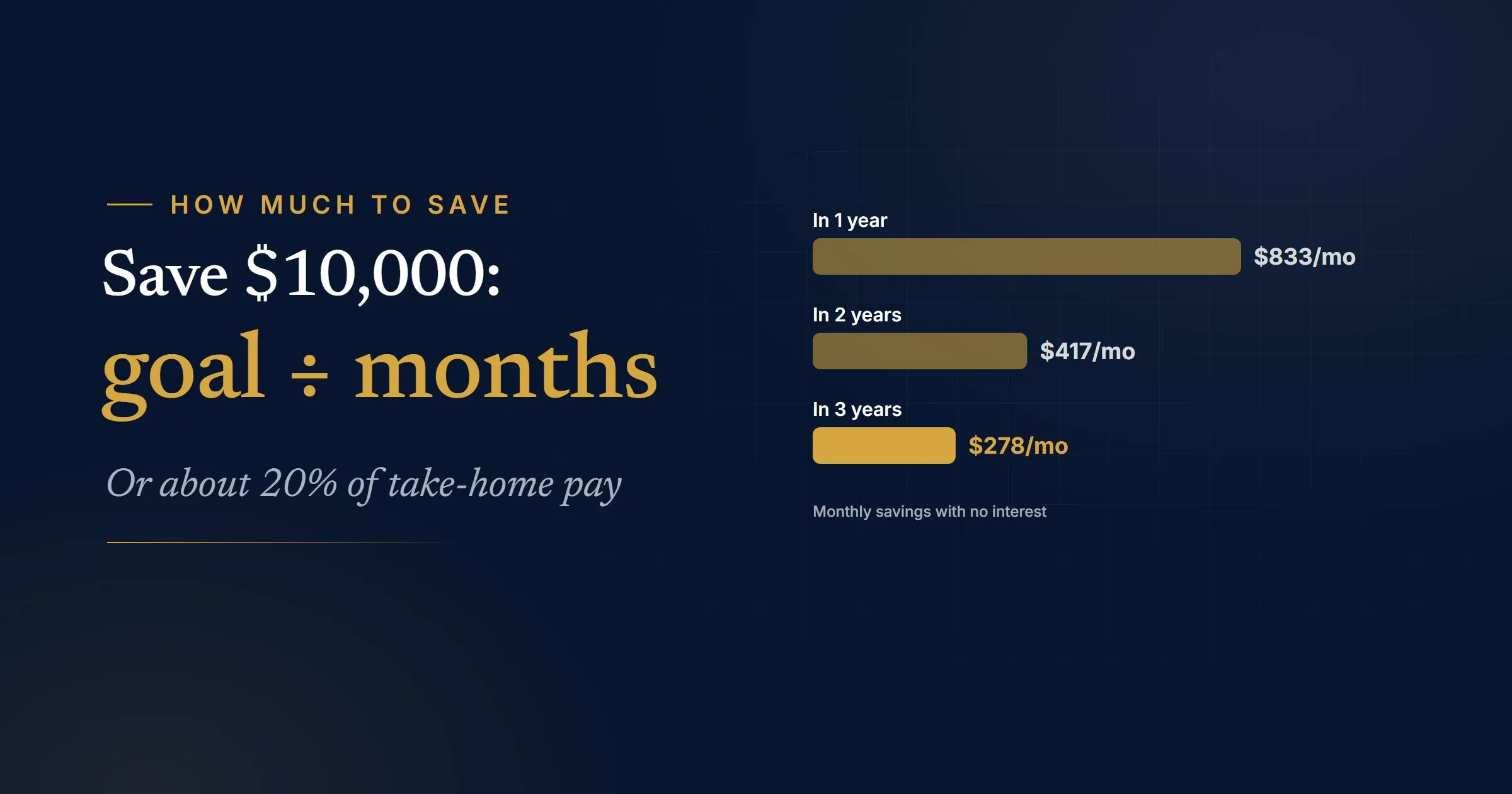
Next, set aside money for larger costs you know are on the way in the next few years, such as a car, a move, a trip or holiday gifts. Divide each goal by the number of months until you need it, and save that much each month. Keeping each goal in its own sinking fund stops it from being mixed up with your emergency money.
Your savings number: an example
A household with $3,000 a month of essentials
- Emergency fund: three months of essentials is $9,000, and six months is $18,000.
- A trip next year: $2,400 in 12 months means saving $200 a month.
- A car down payment in two years: $6,000 in 24 months means $250 a month.
- Once everything is fully funded, the household’s savings target is $26,400: six months of essentials plus both goals.
Our Savings Goal Calculator works out the monthly amount for any goal, with interest if you’d like, and our guide to how much to save each month covers savings rates.
Don’t count your retirement savings
Retirement accounts are for retirement, not emergencies. Money taken out of an IRA or a workplace retirement plan before age 59½ is generally subject to an additional 10% tax on top of income tax, unless an exception applies.Source 3 Count only money you can reach without a penalty toward your savings target.
How much people actually have in savings
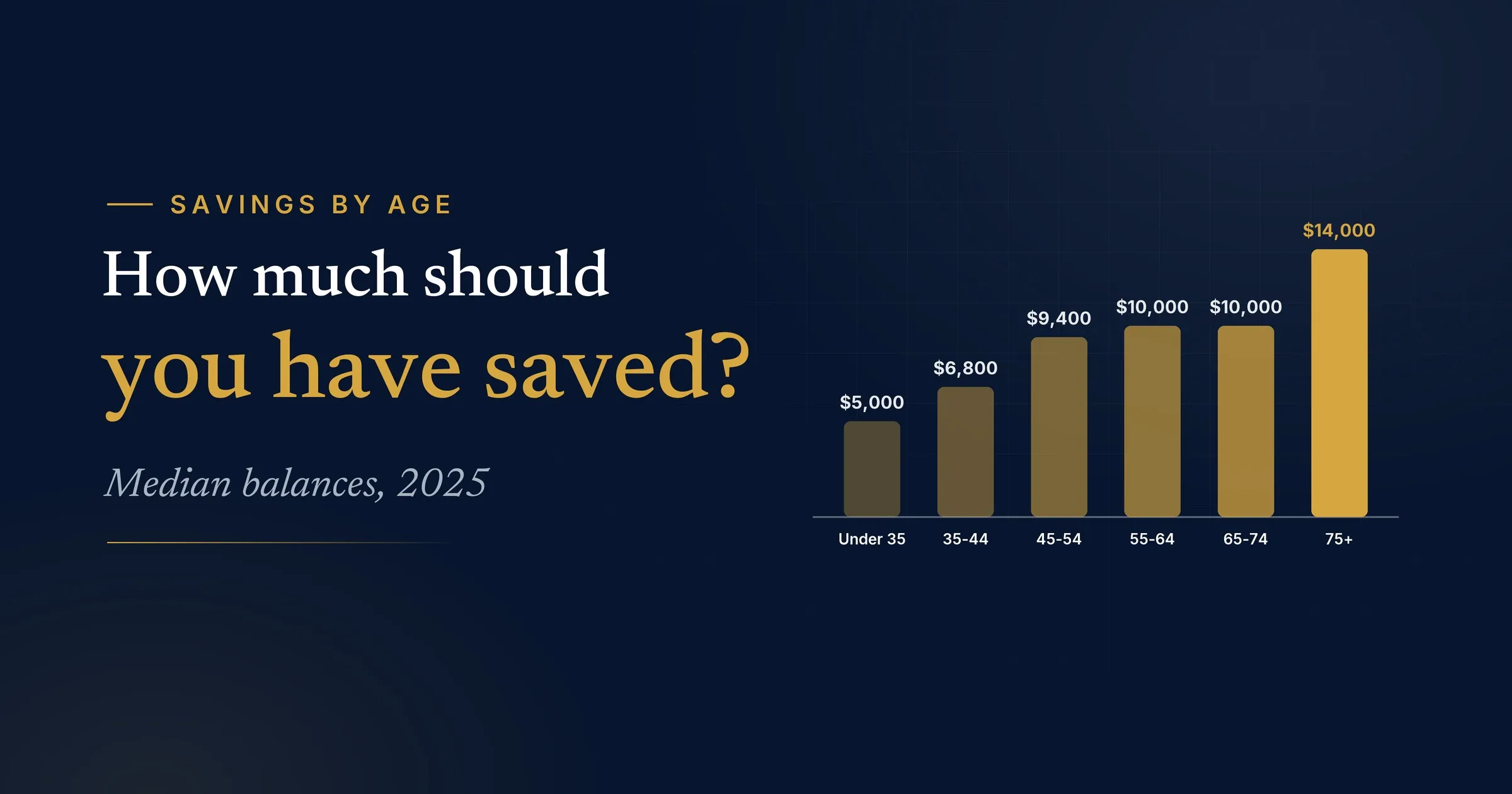
The Federal Reserve’s Survey of Consumer Finances tracks what families hold in transaction accounts: checking, savings and money market accounts, money market funds, brokerage cash accounts and prepaid cards.Source 4 Among families with these accounts, here were the median balances in 2025:Source 5
| Age of the family's head | Median balance |
|---|---|
| Under 35 | $5,000 |
| 35 to 44 | $6,800 |
| 45 to 54 | $9,400 |
| 55 to 64 | $10,000 |
| 65 to 74 | $10,000 |
| 75 or older | $14,000 |
| All families | $8,200 |
Medians for families that hold transaction accounts, by age of the family's head, from the 2025 Survey of Consumer Finances. Half of families had more and half had less.
The overall median of $8,200 was 6% lower than in 2022, after adjusting for inflation.Source 4 Balances rise steeply with income: the median ran from $800 for the lowest-income fifth of families to $105,000 for the top tenth.Source 5 These balances also include money set aside for everyday bills, not just savings.
Emergency savings are thin for many households. In 2025, 63% of adults said they’d cover an unexpected $400 expense with cash or its equivalent, while 12% said they couldn’t pay it by any means.Source 2
Treat these numbers as context, not a target. Your own number depends on your expenses and goals, not on what other families have.
Can you have too much in savings?
Once your emergency fund and near-term goals are covered, extra cash usually earns little. The national average savings rate was 0.39% in November 2026,Source 6 while consumer prices rose 3.7% in the 12 months to September 2026.Source 7 Money earning less than inflation buys less each year, even as the balance grows.
That’s the point to put extra money to work: pay down high-interest debt, as our guide to paying off debt or saving first explains, or save for long-term goals such as retirement. Keep what stays in savings in a high-yield account.
How to build up to your number
- Start small. A first milestone, such as $500, is easier to reach than six months of expenses.
- Make it automatic. Automatic recurring transfers are often one of the easiest ways to save consistently.Source 8
- Use windfalls. Putting part of a tax refund toward savings is one of the easier ways to get started.Source 8
- Keep it separate. Our guide to where to keep an emergency fund compares the safe options.
Common questions
How much should I have in savings at 30?
Enough for an emergency fund of three to six months of essential expenses,Source 1 plus whatever you’re saving for upcoming goals. For context, the median balance in checking and savings accounts for families headed by someone under 35 was $5,000 in 2025.Source 5
Is $10,000 a lot to have in savings?
It’s more than the median family had in checking and savings accounts in 2025, $8,200.Source 5 Whether it’s enough depends on your expenses: for a household spending $3,000 a month on essentials, it’s a little over three months.
Should I have three or six months of expenses saved?
Three months can be enough if your income is steady and your household has two earners. Aim for six if your income varies, you rely on one paycheck or you support others.
Do retirement accounts count as savings?
Not toward your emergency fund. Early withdrawals generally cost an additional 10% tax unless an exception applies.Source 3
How much should I keep in checking?
Enough to cover your bills until your next paycheck, plus a small buffer so you don’t overdraw. Keep the rest in savings, where it earns more and is less tempting to spend. Our checking vs. savings guide explains how to use both.
Run your own numbers
Find a savings target based on your essential expenses.
Open the calculator
Sources
Numbers in the text link to these sources. We check them whenever we update this page.
- 1
Investor Resilience – World Investor Week 2022: Investor Bulletin(external site)
Investor.gov, U.S. Securities and Exchange Commission · Published October 3, 2022 · Accessed November 18, 2026 · Back to text for source 1
- 2
Board of Governors of the Federal Reserve System · Accessed November 18, 2026 · Back to text for source 2
- 3
Retirement topics - Exceptions to tax on early distributions(external site)
Internal Revenue Service · Updated November 13, 2026 · Accessed November 19, 2026 · Back to text for source 3
- 4
Board of Governors of the Federal Reserve System · Published October 9, 2026 · Accessed November 19, 2026 · Back to text for source 4
- 5
Board of Governors of the Federal Reserve System · Accessed November 23, 2026 · Back to text for source 5
- 6
National Rates and Rate Caps – November 2026(external site)
Federal Deposit Insurance Corporation · Updated November 16, 2026 · Accessed November 22, 2026 · Back to text for source 6
- 7
Consumer Price Index for All Urban Consumers (CPI-U), U.S. city average, all items(external site)
U.S. Bureau of Labor Statistics · Accessed November 23, 2026 · Back to text for source 7
- 8
An essential guide to building an emergency fund(external site)
Consumer Financial Protection Bureau · Updated October 29, 2025 · Accessed November 18, 2026 · Back to text for source 8
About the author
Wealthistry Editorial Team
Research, writing and editing
The team that researches, writes, fact-checks and updates Wealthistry's guides and calculators, following our published editorial standards.
Author profileEditorial policyHow we researchReport an error