An emergency fund has one job: to be there, in full, when something goes wrong. That means keeping it somewhere safe and easy to get to, but not so easy that you’re tempted to spend it on things that aren’t emergencies.Source 1 Interest is a bonus. Here’s how the main options compare, and how to combine them.
What to look for
- Safety. The money shouldn’t be at risk of losing value. Insured deposits and short-term U.S. government securities fit; stocks don’t.
- Access. You should be able to reach the money within a day or two, without a big penalty.
- Separation. A separate account keeps the fund apart from your everyday spending.Source 1
- Interest. Once the first three are covered, earn what you can, so the fund keeps up better with rising prices.
Your options compared
| Option | Rate, November 2026 | Safety and access |
|---|---|---|
| Savings account | 0.39% national average | Insured; quick to reach |
| High-yield savings account | Varies; 4.00% in our examples | Insured; transfer to checking |
| Money market account | 0.64% national average | Insured; quick to reach |
| Interest checking | 0.07% national average | Insured; instant, but easy to spend |
| 12-month CD | 1.81% national average | Insured; penalty to withdraw early |
| Treasury bills | 4.20% to 4.62% yield | Backed by the U.S. government; paid at maturity or sold |
| Money market fund | Varies | Not FDIC-insured; sell shares to get cash |
| I bonds | 5.51% | Issued by the U.S. Treasury; locked for 12 months |
Bank averages are the FDIC's as of November 16, 2026. Treasury yields are for one month to one year, as of November 19, 2026. The I bond rate is for bonds issued November 2026 through April 2027.
Sources: FDIC national rates,Source 2 the Federal Reserve’s H.15 releaseSource 3 and TreasuryDirect.Source 4
Savings and money market accounts
For most people, the best home for an emergency fund is a savings account at a bank or credit union, which is generally considered one of the safest places for your money.Source 1 At an FDIC-insured bank, deposits are insured up to at least $250,000 per depositor, per ownership category,Source 5 and the NCUA insures individual accounts at federally insured credit unions up to $250,000.Source 6
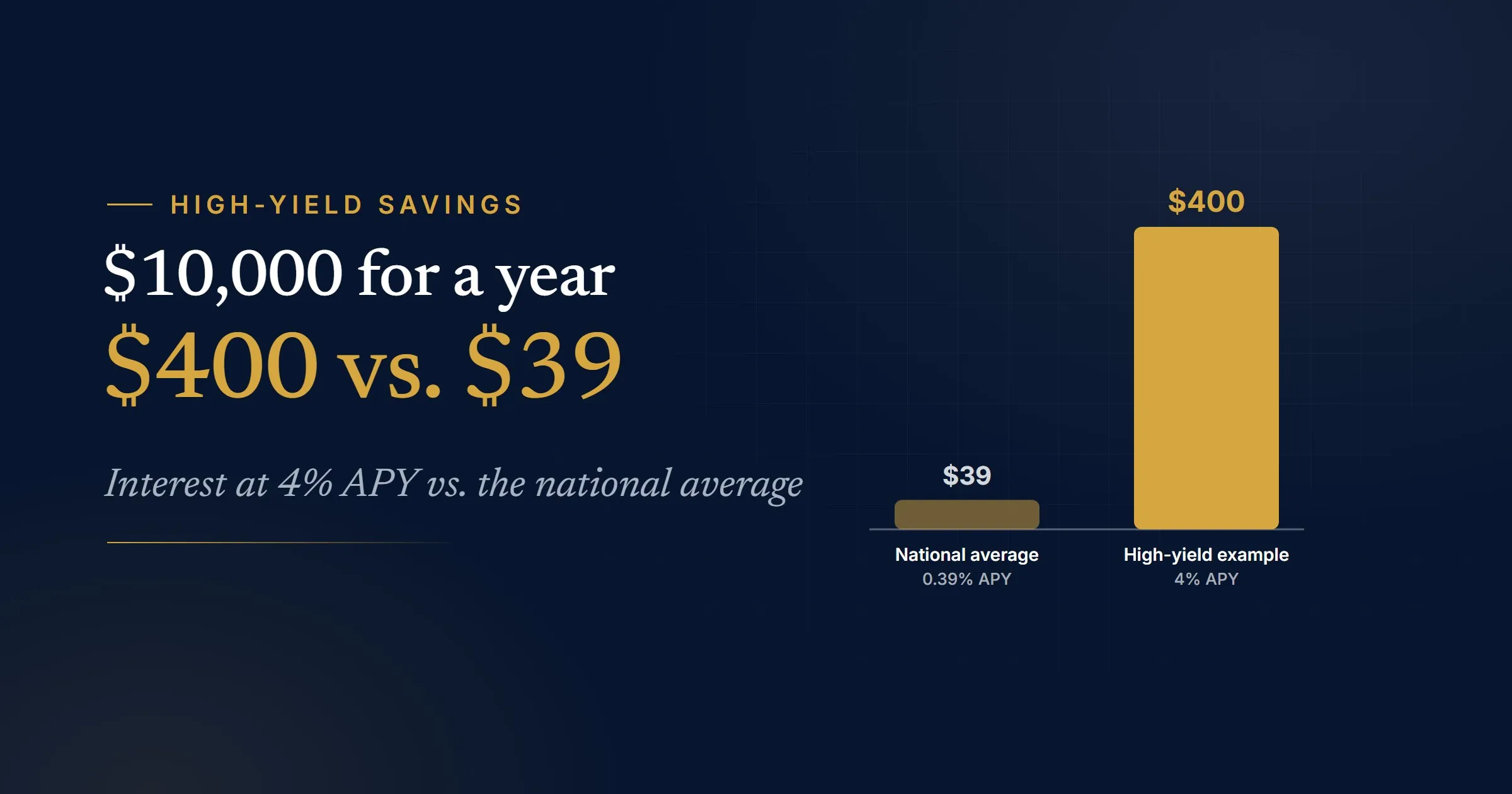
The rate is what varies. At the national averages, $10,000 earns very little in a year; at an example high-yield rate of 4.00%, it earns far more:
| Where the $10,000 sits | A year's interest |
|---|---|
| Interest checking, 0.07% average | $7.00 |
| Savings account, 0.39% average | $39.00 |
| Money market account, 0.64% average | $64.00 |
| 12-month CD, 1.81% average | $181.00 |
| High-yield savings, 4.00% example | $400.00 |
Rates are APYs held for a year, with nothing added or taken out, before taxes. National averages as of November 16, 2026.
A money market account works much like a savings account and is insured the same way; our money market vs. savings guide compares the two. Our high-yield savings guide explains how to find a better rate. Keep the fund out of your checking account, though: it pays the least, and money that sits with your spending money tends to get spent.
CDs
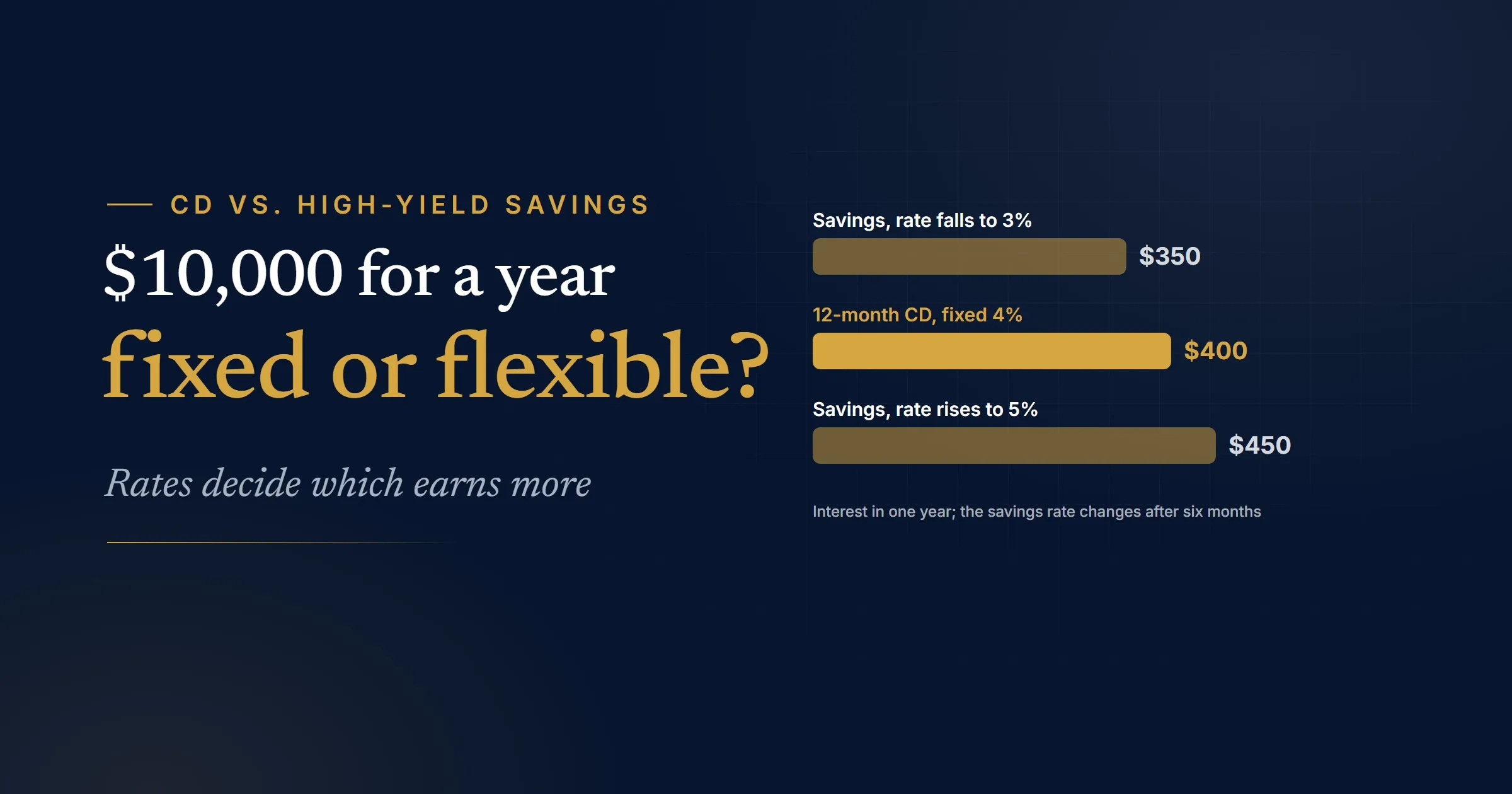
Most CDs pay a fixed rate for a set term, and the bank must tell you up front about any penalty for withdrawing early.Source 7 That penalty is the catch for an emergency fund: you might need the money before the CD matures. CDs can suit the part of the fund you’re least likely to touch, but only if the rate beats the best savings rate you can get. At the national average of 1.81%, a 12-month CD earns $181.00 on $10,000, less than the $400.00 a high-yield savings account would pay at an example 4.00%. Our CD vs. high-yield savings guide shows how a penalty works.
Treasury bills
Treasury bills are short-term U.S. government securities, sold for terms of 4 to 52 weeks with a $100 minimum. You can hold a bill until it matures or sell it before then, and the interest is free from state and local income taxes, though not federal tax.Source 8 They aren’t FDIC-insured, but they’re backed by the full faith and credit of the U.S. government.Source 9
In mid-November 2026, Treasury yields ranged from 4.20% for one month to 4.62% for one year.Source 3 The trade-off is effort: you buy bills through TreasuryDirect or a brokerage account, and money tied up in a bill isn’t as quick to reach as savings.
Money market funds
A money market fund isn’t a bank account. It’s a type of mutual fund that invests in short-term debt and cash, with relatively low risk, and many people use one to store cash or as an alternative to a savings account.Source 10 But mutual funds aren’t FDIC-insured, even when you buy them at a bank, and their value can go down. SIPC protection, which covers up to $500,000 including $250,000 in cash if a brokerage firm fails, doesn’t cover a loss in value.Source 9
I bonds
I bonds bought from November 1, 2026 through April 30, 2027 pay 5.51%, including a fixed rate of 1.40%. You can buy up to $10,000 a year in electronic I bonds. But you can’t cash one in for the first 12 months, and if you cash it in before five years, you lose the last three months of interest.Source 4 That makes I bonds a fit only for the part of the fund you won’t need for at least a year, if at all. Our I bonds guide explains how the rate is set and how the bonds are taxed.
A two-tier emergency fund
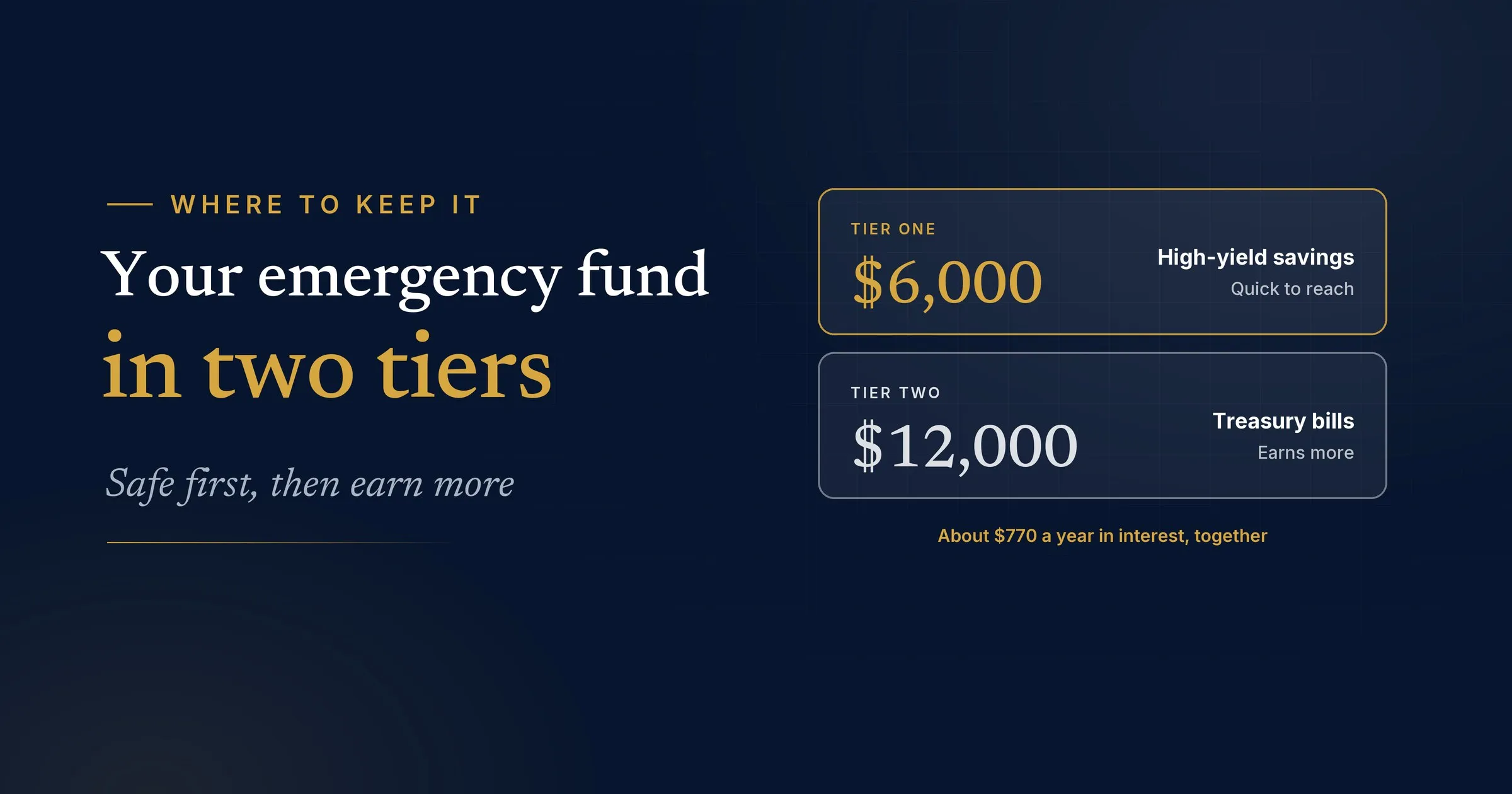
You don’t have to choose just one place. A common approach is to keep a month or two of expenses where you can reach it today, and the rest somewhere that pays more.
An $18,000 fund in two tiers
- A household’s essential expenses are $3,000 a month, so six months comes to $18,000.
- Tier one: $6,000, two months of expenses, sits in a high-yield savings account at an example 4.00% APY. It earns $240.00 a year and can be moved to checking at any time.
- Tier two: the other $12,000 goes into 26-week Treasury bills at a 4.42% yield, earning about $530.40 a year if yields stay the same as the bills come due and are replaced.
- Together, that’s about $770.40 a year. The same $18,000 at the 0.39% national average savings rate would earn $70.20.
If an emergency is bigger than tier one, you can sell bills before they mature or wait for the next one to come due.Source 8
Where not to keep your emergency fund
- Stocks, crypto and other investments. All investments involve some degree of risk,Source 11 and their value can fall just when you need to sell.Source 9
- Retirement accounts. Money taken out of an IRA or retirement plan before age 59½ generally faces an additional 10% tax unless an exception applies, on top of income tax.Source 12
- Cash at home. It’s quick to reach, but it can be stolen, lost or destroyed.Source 1
- Your checking account. It’s insured, but it pays little and makes the fund easy to spend.
Common questions
Should my emergency fund be in a high-yield savings account?
For most people, yes, or at least the first part of it. It’s insured, quick to reach and separate from checking, and a high-yield account pays well above the national average. Our emergency fund guide covers how much to save.
Is a money market account safe for an emergency fund?
A money market deposit account at a bank or credit union is insured like a savings account. A money market fund is different: it’s an investment, not a deposit, and isn’t FDIC-insured.Source 9
Can I keep my emergency fund in Treasury bills?
Part of it, if you’re comfortable buying them. Bills are backed by the U.S. government,Source 9 and you can sell one before it matures,Source 8 but they’re less convenient than savings for money you might need today.
Should I invest my emergency fund?
Generally not. The fund’s job is to be there in full when you need it, and investments can lose value.Source 11
Is it OK to keep my emergency fund in a CD?
Only the part you’re unlikely to need soon, and only if the rate beats a high-yield savings account. Withdrawing early usually means paying a penalty.Source 7
Run your own numbers
Find a savings target based on your essential expenses.
Open the calculator
Sources
Numbers in the text link to these sources. We check them whenever we update this page.
- 1
An essential guide to building an emergency fund(external site)
Consumer Financial Protection Bureau · Updated October 29, 2025 · Accessed November 18, 2026 · Back to text for source 1
- 2
National Rates and Rate Caps – November 2026(external site)
Federal Deposit Insurance Corporation · Updated November 16, 2026 · Accessed November 22, 2026 · Back to text for source 2
- 3
Selected Interest Rates (Daily) - H.15, November 20, 2026(external site)
Board of Governors of the Federal Reserve System · Published November 20, 2026 · Accessed November 22, 2026 · Back to text for source 3
- 4
U.S. Department of the Treasury, TreasuryDirect · Accessed November 22, 2026 · Back to text for source 4
- 5
Understanding Deposit Insurance(external site)
Federal Deposit Insurance Corporation · Updated April 1, 2024 · Accessed November 18, 2026 · Back to text for source 5
- 6
Share Insurance Coverage(external site)
National Credit Union Administration · Updated November 18, 2026 · Accessed November 18, 2026 · Back to text for source 6
- 7
12 CFR 1030.4, Account disclosures (Regulation DD, Truth in Savings)(external site)
Electronic Code of Federal Regulations · Accessed November 19, 2026 · Back to text for source 7
- 8
U.S. Department of the Treasury, TreasuryDirect · Accessed November 23, 2026 · Back to text for source 8
- 9
Financial Products That Are Not Insured by the FDIC(external site)
Federal Deposit Insurance Corporation · Updated May 12, 2026 · Accessed November 23, 2026 · Back to text for source 9
- 10
Money Market Fund(external site)
Investor.gov, U.S. Securities and Exchange Commission · Accessed November 19, 2026 · Back to text for source 10
- 11
Investor.gov, U.S. Securities and Exchange Commission · Accessed November 18, 2026 · Back to text for source 11
- 12
Retirement topics - Exceptions to tax on early distributions(external site)
Internal Revenue Service · Updated November 13, 2026 · Accessed November 19, 2026 · Back to text for source 12
About the author
Wealthistry Editorial Team
Research, writing and editing
The team that researches, writes, fact-checks and updates Wealthistry's guides and calculators, following our published editorial standards.
Author profileEditorial policyHow we researchReport an error