A savings goal turns “I should save more” into a number and a date: $6,000 for emergencies by next December, or $24,000 toward a home within five years. Once a goal has both, you can work out what to set aside each week or month and tell at a glance whether you’re on track.
This guide covers how to set goals that hold up, examples for each time frame, how to decide which goal comes first, a worked plan for funding three goals at once, and where to keep the money for each.
What makes a good savings goal
The Consumer Financial Protection Bureau recommends making goals SMART:Source 1
- Specific: what the money is for. “A car” is a wish; “$9,000 toward a used car” is a goal.
- Measurable: a dollar amount, so you know when you’ve arrived.
- Achievable: a weekly or monthly amount your budget can carry.
- Relevant: it matters enough to you that you’ll keep going.
- Time-bound: a date to aim for.
Start with what you value. Goals that line up with the values that matter to you and your family are easier to put first, and the CFPB notes that focusing on one or two priorities gives you a better chance of reaching them.Source 1
Short-, medium- and long-term savings goals
Grouping goals by when you’ll need the money helps with two decisions: how much to save each month and where to keep it. In this guide:
- Short-term goals fall within about a year: a starter emergency fund, holiday gifts, an insurance premium, a new laptop, a security deposit.
- Medium-term goals are one to five years away: a car, a home down payment, a wedding, a full emergency fund, education costs.
- Long-term goals are more than five years out, such as retirement or a young child’s college costs.
How to set a savings goal, step by step
- Name the goal and price it. Use a quote, a listing or last year’s bills rather than a guess.
- Pick a date and divide. Divide the amount by the weeks or months you have. The CFPB’s savings plan uses a weekly target, which breaks a big number into manageable pieces.Source 2 Our monthly savings guide has the formula and a table of common goals.
- Check it against your budget. If the target doesn’t fit, look for ways to spend less or earn more,Source 2 or move the date.
- Give the money its own place. A separate savings account, or a named savings bucket if your bank offers them, keeps goal money from blending into spending money.
- Make it automatic. Saving automatically is one of the easiest ways to save consistently, for example with a recurring transfer from checking to savings.Source 3
- Watch your progress. A balance alert or a running total of what you’ve added can be the encouragement that keeps you going.Source 3
Which savings goal comes first
Most people have more goals than money, so the order matters. A sensible order starts with a small emergency fund, then any employer match on retirement savings and paying down high-interest debt, then a full emergency fund. Our monthly savings guide explains why. After that, fund your other goals nearest deadline first.
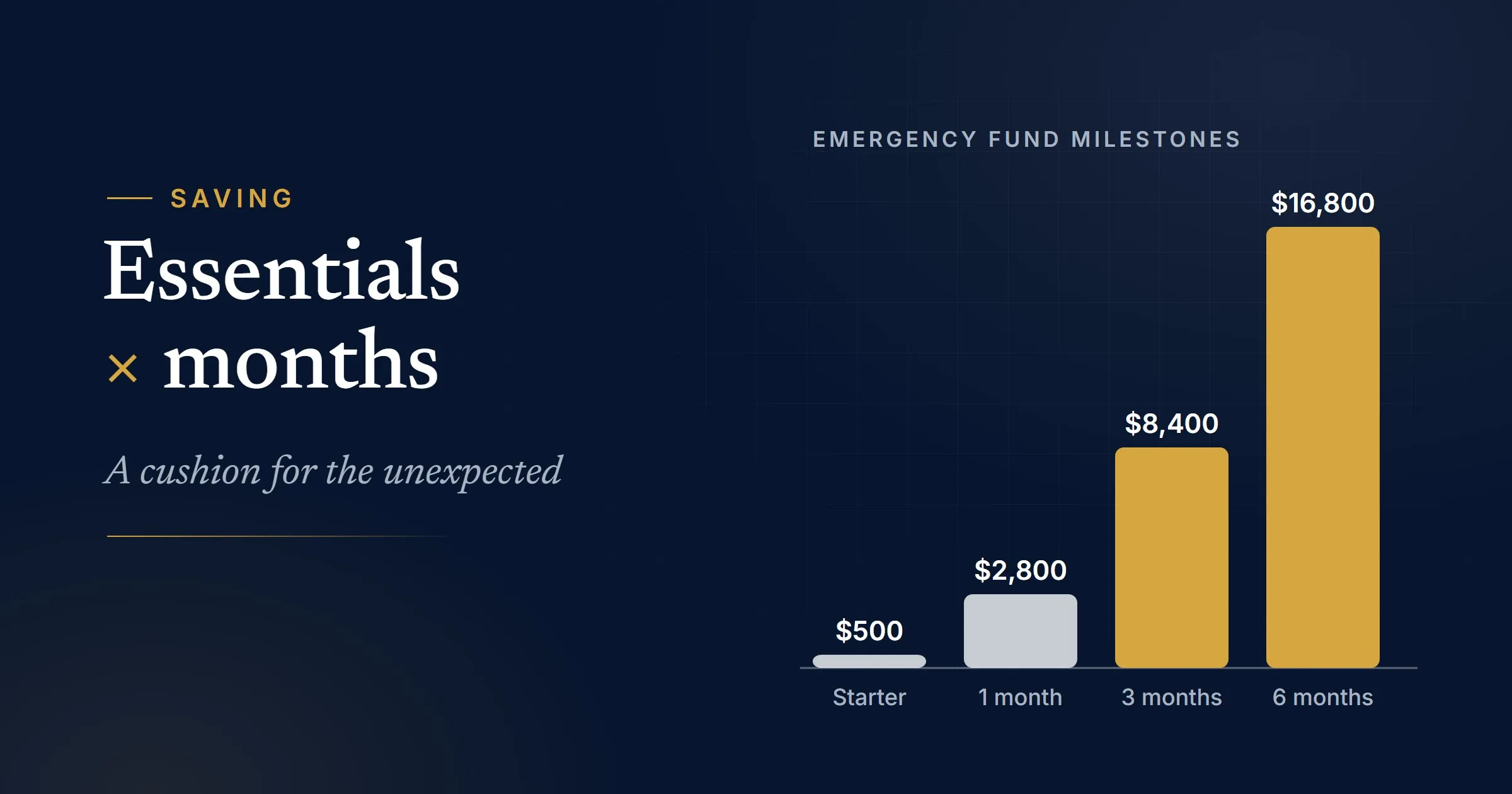
The emergency fund earns its place at the top because it protects every other goal from the next surprise. In 2025, 55% of adults said they had three months of expenses set aside for emergencies.Source 4 Our emergency fund guide covers how much to aim for, and our guide to paying off debt or saving first works through the trade-off with high-interest debt.
How to fund several savings goals at once
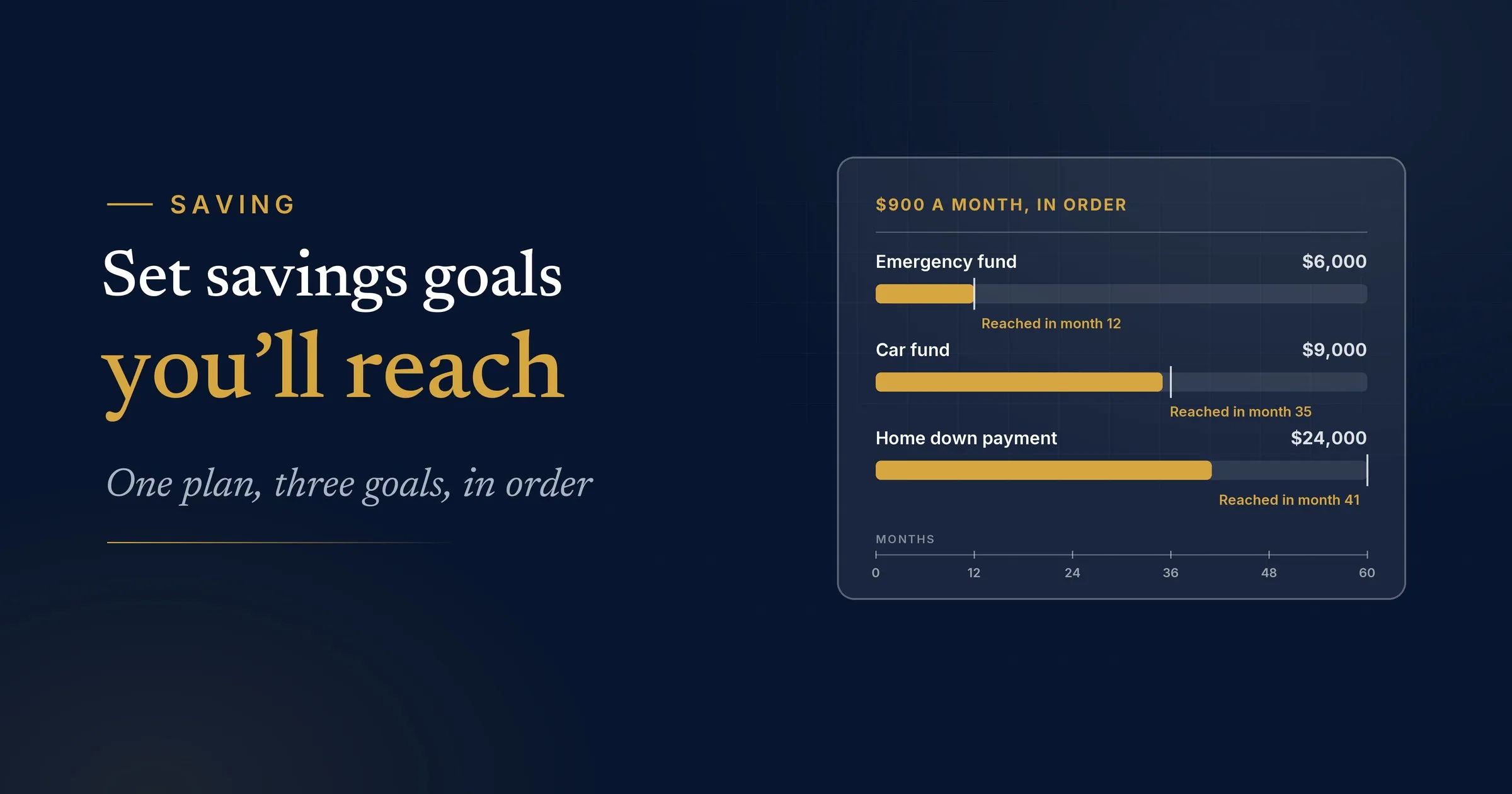
Splitting your savings evenly across every goal sounds fair, but it slows down the one you need first. A steadier approach is to give each goal a share in priority order, and when a goal is reached, move its share to the next one.
| Goal | Target | Deadline | Reached |
|---|---|---|---|
| Emergency fund | $6,000 | Month 12 | Month 12 |
| Car fund | $9,000 | Month 36 | Month 35 |
| Home down payment | $24,000 | Month 60 | Month 41 |
Example. Shares of $500, $250 and $150 a month, every balance earning a 4% APY. When the emergency fund and then the car fund are reached, their shares move to the home down payment.
How the plan plays out
- For the first 12 months, $500 a month goes to the emergency fund, $250 to the car fund and $150 to the home fund. The emergency fund is full in month 12, right on its deadline.
- Its $500 then moves to the home fund. The car fund keeps getting $250 and is reached in month 35.
- With the whole $900 going to it from then on, the home fund reaches $24,000 in month 41, well ahead of its five-year deadline. Interest adds about $2,561 across the three funds along the way.
- Split evenly instead, at $300 a month each, the emergency fund wouldn’t be full until month 20.
For a single goal, our Savings Goal Calculator works out the monthly amount at any interest rate.
Where to keep the money for each goal
The CFPB suggests weighing three things about any place you keep savings: how secure it is, what it costs and how easy it is to reach.Source 5 For goals, the time frame settles most of it.
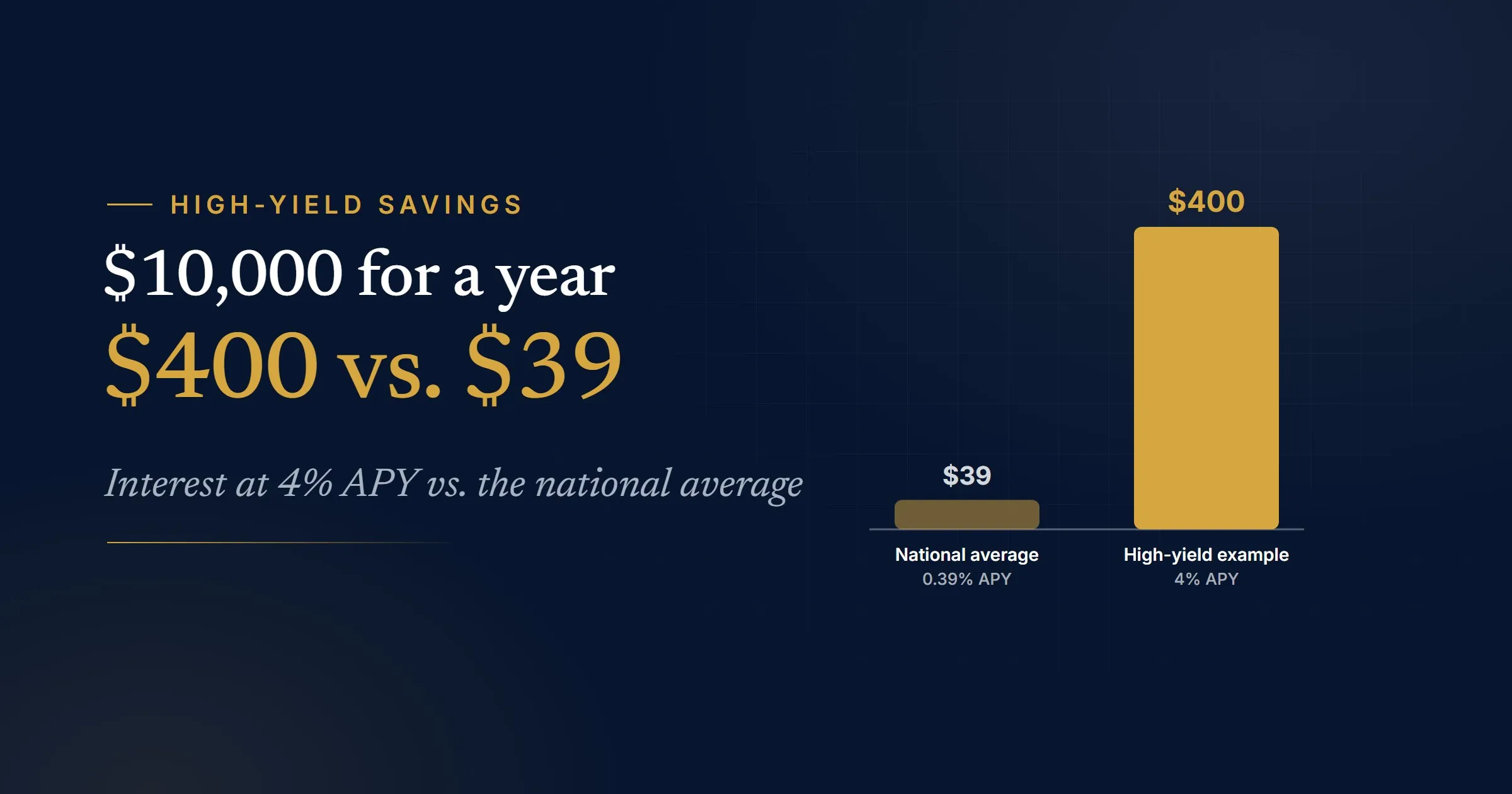
- Within about a year: a savings or money market account at an insured bank or credit union, where you can reach the money when you need it. The FDIC insures deposits to at least $250,000 per depositor, per ownership category, at each insured bank.Source 6 Rates vary widely: in November 2026 the national averages were 0.39% for savings and 0.64% for money market accounts,Source 7 while some accounts pay far more. Our high-yield savings guide explains how to compare them.
- One to five years: if you won’t need the money before a set date, a CD can lock in a rate; the national average for a 12-month CD was 1.81%.Source 7 Treasury bills are sold for terms of 4 to 52 weeks,Source 8 and 6-month bills yielded 4.42% in the Federal Reserve’s November 20, 2026 release.Source 9 I bonds bought through April 30, 2027 pay 5.51%, but you can’t cash them for 12 months and you lose three months of interest if you cash them within five years.Source 10 Our CD vs. high-yield savings guide compares the first two.
- More than five years: money for distant goals such as retirement is often invested. The right mix of investments depends on your time horizon and your risk tolerance,Source 11 and investments aren’t insured like deposits: their value can go down.Source 12
Keep each goal on track
- Name each account or bucket after its goal, so moving money out of it feels like a decision rather than a habit.
- Review once a month. Compare each balance with where it should be by now, and adjust the transfer if you’ve fallen behind.
- Revisit the date when life changes. A new job, a move or a new baby can change what a goal costs or when you need it, so update the plan rather than abandoning it.
- Put windfalls to work. A tax refund or a bonus can close a gap in one step.
Common questions
What are examples of savings goals?
Short-term goals include a starter emergency fund, holiday gifts, an annual insurance premium and a new phone or laptop. Medium-term goals include a car, a home down payment, a wedding and a full emergency fund. Long-term goals include retirement and a child’s college costs.
What’s a good savings goal to start with?
An emergency fund, because it protects every other goal. In 2025, 55% of adults had three months of expenses set aside for emergencies.Source 4 Our guide to how much you should have in savings shows typical balances by age.
How many savings goals should I have?
As many as you need, but only one or two you push hard at a time. The CFPB notes that focusing on one or two priorities that match your values gives you a better chance of reaching them.Source 1 The others can wait or get a smaller share until a top goal is reached.
How much should I save each month for a goal?
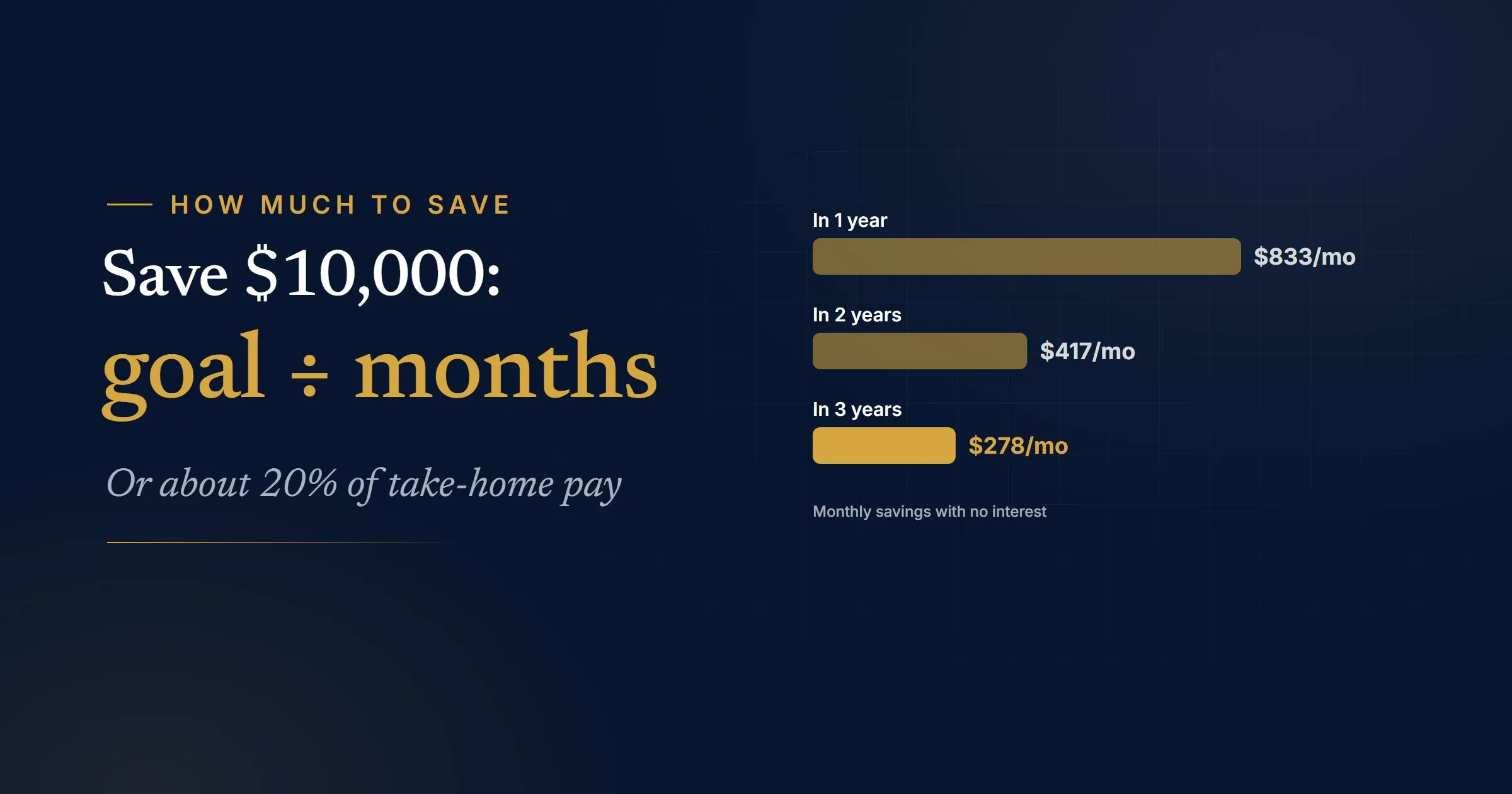
Divide what you still need by the months until you need it: $9,000 over 36 months is $250 a month. Our monthly savings guide and Savings Goal Calculator do the math, including interest.
Is it possible to save $10,000 in 6 months?
It takes $1,666.67 a month, or $384.62 a week over 26 weeks. Interest barely changes that over so short a time: at a 4% APY, the monthly amount drops only to $1,653.08. For most budgets, that means a big cut in spending, extra income or a windfall.
Is $50,000 saved at 25 a lot?
It’s well above typical. Among families headed by someone under 35 that have checking, savings or similar accounts, the median balance in those accounts was $5,000 in 2025.Source 13 What matters more is whether your savings cover an emergency fund and the goals you’ve set. Our guide to how much you should have in savings shows the medians for every age group.
Should I invest money for a short-term goal?
Generally not money you’ll need within a few years. Investments can lose value,Source 12 and a drop just before your deadline could leave you short. Insured savings, CDs and Treasury bills are the usual choices for money you’ll need soon.
Run your own numbers
Work out how much to save, and by when.
Open the calculator
Sources
Numbers in the text link to these sources. We check them whenever we update this page.
- 1
Setting SMART goals (Your Money, Your Goals toolkit)(external site)
Consumer Financial Protection Bureau · Accessed November 25, 2026 · Back to text for source 1
- 2
Savings plan (Your Money, Your Goals toolkit)(external site)
Consumer Financial Protection Bureau · Accessed November 25, 2026 · Back to text for source 2
- 3
An essential guide to building an emergency fund(external site)
Consumer Financial Protection Bureau · Updated October 29, 2025 · Accessed November 25, 2026 · Back to text for source 3
- 4
Board of Governors of the Federal Reserve System · Accessed November 25, 2026 · Back to text for source 4
- 5
Finding a place for savings (Your Money, Your Goals toolkit)(external site)
Consumer Financial Protection Bureau · Accessed November 25, 2026 · Back to text for source 5
- 6
Understanding Deposit Insurance(external site)
Federal Deposit Insurance Corporation · Updated April 1, 2024 · Accessed November 25, 2026 · Back to text for source 6
- 7
National Rates and Rate Caps – November 2026(external site)
Federal Deposit Insurance Corporation · Updated November 16, 2026 · Accessed November 25, 2026 · Back to text for source 7
- 8
U.S. Department of the Treasury, TreasuryDirect · Accessed November 25, 2026 · Back to text for source 8
- 9
Selected Interest Rates (Daily) - H.15, November 20, 2026(external site)
Board of Governors of the Federal Reserve System · Published November 20, 2026 · Accessed November 22, 2026 · Back to text for source 9
- 10
U.S. Department of the Treasury, TreasuryDirect · Accessed November 25, 2026 · Back to text for source 10
- 11
Asset Allocation and Diversification(external site)
Investor.gov, U.S. Securities and Exchange Commission · Accessed November 25, 2026 · Back to text for source 11
- 12
Financial Products That Are Not Insured by the FDIC(external site)
Federal Deposit Insurance Corporation · Updated May 12, 2026 · Accessed November 25, 2026 · Back to text for source 12
- 13
Board of Governors of the Federal Reserve System · Accessed November 25, 2026 · Back to text for source 13
About the author
Wealthistry Editorial Team
Research, writing and editing
The team that researches, writes, fact-checks and updates Wealthistry's guides and calculators, following our published editorial standards.
Author profileEditorial policyHow we researchReport an error