Living paycheck to paycheck means each paycheck is gone, or nearly gone, by the time the next one arrives. With nothing carried over, one unexpected bill turns into a late fee, an overdraft or a loan you’d rather not take. It’s common at every income level: in 2025, only 41% of U.S. adults said they always or often had money left over at the end of the month.Source 1
The way out starts with a diagnosis. Some households spend more than they take home. Others earn enough over a month, but their biggest bills come due before the money does. This guide shows how to tell which problem you have, then walks through six steps to get a month ahead, with every number worked out.
What living paycheck to paycheck means
There’s no official definition. In everyday use, it means spending what you earn about as fast as it comes in, so little or nothing carries over to the next pay period and any surprise has to be covered by borrowing or by falling behind.
The Federal Reserve’s yearly survey of U.S. households gets at it with a simple question: how often do you have money left over at the end of the month? In 2025, 12% of adults said never and 18% said rarely. Money was tighter at lower incomes, but even among adults with family income of $100,000 or more, 4% said never and 11% said rarely.Source 1
| Family income | Never | Rarely | Sometimes | Often | Always |
|---|---|---|---|---|---|
| Less than $25,000 | 29% | 25% | 27% | 10% | 10% |
| $25,000 to $49,999 | 19% | 25% | 31% | 13% | 13% |
| $50,000 to $99,999 | 9% | 20% | 33% | 20% | 18% |
| $100,000 or more | 4% | 11% | 25% | 25% | 34% |
| All adults | 12% | 18% | 28% | 19% | 22% |
Share of adults in each income group, as published. Rows may not add to 100% because of rounding.
Other surveys point the same way. In the FINRA Investor Education Foundation’s 2024 National Financial Capability Study, 26% of adults said they spend more than their income, up from 19% in 2021 and the highest share in the study’s history.Source 2 And in the month before the Fed’s 2025 survey, 16% of adults didn’t pay all their bills in full.Source 3
Find out why your money runs out
Running short before payday usually comes from one of three problems, and each needs a different fix:
- You spend more than you take home. Over a full month, more goes out than comes in. Cutting costs, earning more or both is the only lasting fix.
- Your bills come due before your pay arrives. The month adds up, but the big bills cluster just before payday. Moving due dates can solve this without cutting anything.
- Irregular costs keep knocking you off track. Repairs, insurance premiums and medical bills don’t arrive monthly, so a plan built on regular bills doesn’t see them coming. In the Fed’s 2025 survey, 59% of adults had at least one major unexpected expense in the previous 12 months, most often a vehicle repair or replacement (30%), a major house or appliance repair (22%) or a major medical bill (21%). For each of those three, the median cost among people who knew the amount was $1,000 to $1,999.Source 3
Income that changes from month to month makes all three harder. In 2025, 30% of adults had income that varied at least occasionally, and 11% struggled to pay their bills because of it.Source 1 Plenty of households face more than one of these problems at once, which is why the plan starts with the numbers.
Step 1: Map one month of money in and out
List every amount that comes in, with the date it arrives, and every bill and purchase that goes out, with its due date. Include automatic payments, since they’re the easiest to forget. Bank and card statements cover most of it, and a simple log catches the cash. Our guide to tracking your expenses compares four ways to do it.
Then add the costs that aren’t monthly. Look back over the past year for anything irregular, such as car registration, an insurance premium paid twice a year or holiday gifts, and divide each yearly total by 12.
That list answers two questions:
- Over the whole month, is more coming in than going out? If not, you have a spending gap, and Step 2 comes first.
- Week by week, do you run short even though the month adds up? To check, start each week with your balance, add the income you’ll receive, subtract everything you’ll spend, and carry the ending balance into the next week, as in the CFPB’s cash flow budget. A negative balance means you’ll fall short that week.Source 4 If that happens in a month that adds up overall, you have a timing problem, and Step 3 is your fix.
Our budgeting guide walks through gathering these numbers, and the Monthly Budget Calculator adds them up for you.
Step 2: Close the gap between what you earn and what you spend
If more goes out than comes in, small cuts rarely close the gap on their own, so start where the money is. In 2025, the average household spent 33.9% of its budget on housing, 16.5% on transportation and 13.0% on food, 63.4% in all.Source 5 A cheaper phone plan helps. A lower rent, a less expensive car or a better insurance rate can change the whole month.
Places to look first:
- Fixed bills you can renegotiate or replace, such as insurance, phone and internet plans, and subscriptions. Our guide to fixed vs. variable expenses shows how to lower each kind.
- The full cost of your car, not just the payment. A less expensive car can free up money each month, but count insurance, fuel and maintenance too, since an older car can cost more to keep running.Source 6
- Help you may qualify for. Energy assistance programs, for example, can pay part of a low-income family’s energy costs.Source 6
- More income, from extra hours, a raise, a second job or selling things you no longer use.
Our guide to how to save money has more ways to trim spending.
Step 3: Line up your bills with your paydays
If the month adds up but you still run short, change when the money goes out. The CFPB suggests several ways:Source 6
- Ask for new due dates so bills fall after payday. Start with companies where you have a long record of on-time payments, since they’re more likely to agree.
- Split a large payment into two smaller ones due at different times, such as half the rent on the 1st and half on the 15th.
- Pay large lump sums in monthly installments, such as car insurance, even if there’s a small fee, or save toward them every month.
- Ask for a level payment plan on utilities, which averages a year of use so you pay about the same amount each month.
A bill calendar keeps the dates straight. Mark each due date and each payday, and plan to send mailed payments at least seven days early and online payments two or three days early.Source 7
Same pay, same bills, no more shortfall
A household takes home $3,600 a month, paid $1,800 on the 1st and the 15th. Rent ($1,400), the car payment ($380), the phone ($70), car insurance ($150) and the credit card minimum ($120) all come due between the 1st and the 14th. Utilities, internet and subscriptions come due later. Groceries, gas and other day-to-day spending run about $500 in each half of the month.
- Over the month, the household spends $3,410 and has $190 left. There’s no spending gap.
- But the bills due in the first half total $2,120. With day-to-day spending, the first half costs $2,620, so the first paycheck comes up $820 short, while $1,010 sits unused after the second.
- The landlord agrees to two rent payments of $700, on the 1st and the 15th, and the insurer and the card issuer move their due dates to the 18th and the 25th.
- Now the first half costs $1,650, leaving $150, and the second half costs $1,760, leaving $40.
Nothing was cut and no one earned more. The shortfall disappeared because the money now arrives before the bills do. Our budget by paycheck guide shows how to assign each bill to the paycheck that will cover it.
Step 4: Build a buffer so you’re a month ahead
A buffer is money that stays in your account so this month’s bills are paid with last month’s income. Once it’s there, an early due date or a late deposit stops mattering, and a small surprise no longer means a fee.
Start with half a month of spending, then build to a full month. How long that takes depends on how much you can set aside each month:
| Saved each month | Half a month ($1,705) | A full month ($3,410) |
|---|---|---|
| $100 | 18 months | 35 months |
| $190 | 9 months | 18 months |
| $300 | 6 months | 12 months |
| $500 | 4 months | 7 months |
Months to save half or all of the example household's $3,410 of monthly spending, rounded up, before any interest.
At the example household’s $190 a month, a full month’s buffer takes 18 months. That’s a long time, so put windfalls such as a tax refund or a bonus toward it. You’ll feel the benefit before you finish: half a month, $1,705, would have covered the household’s $820 first-half shortfall even before the due dates moved.
Keep the buffer where you can reach it quickly, such as a savings account linked to your checking account, and move money into it automatically each payday. Once you’re a month ahead, keep going and build an emergency fund for bigger shocks. Our emergency fund guide covers how much to save and where to keep it.
Step 5: Plan for the costs that don’t come every month
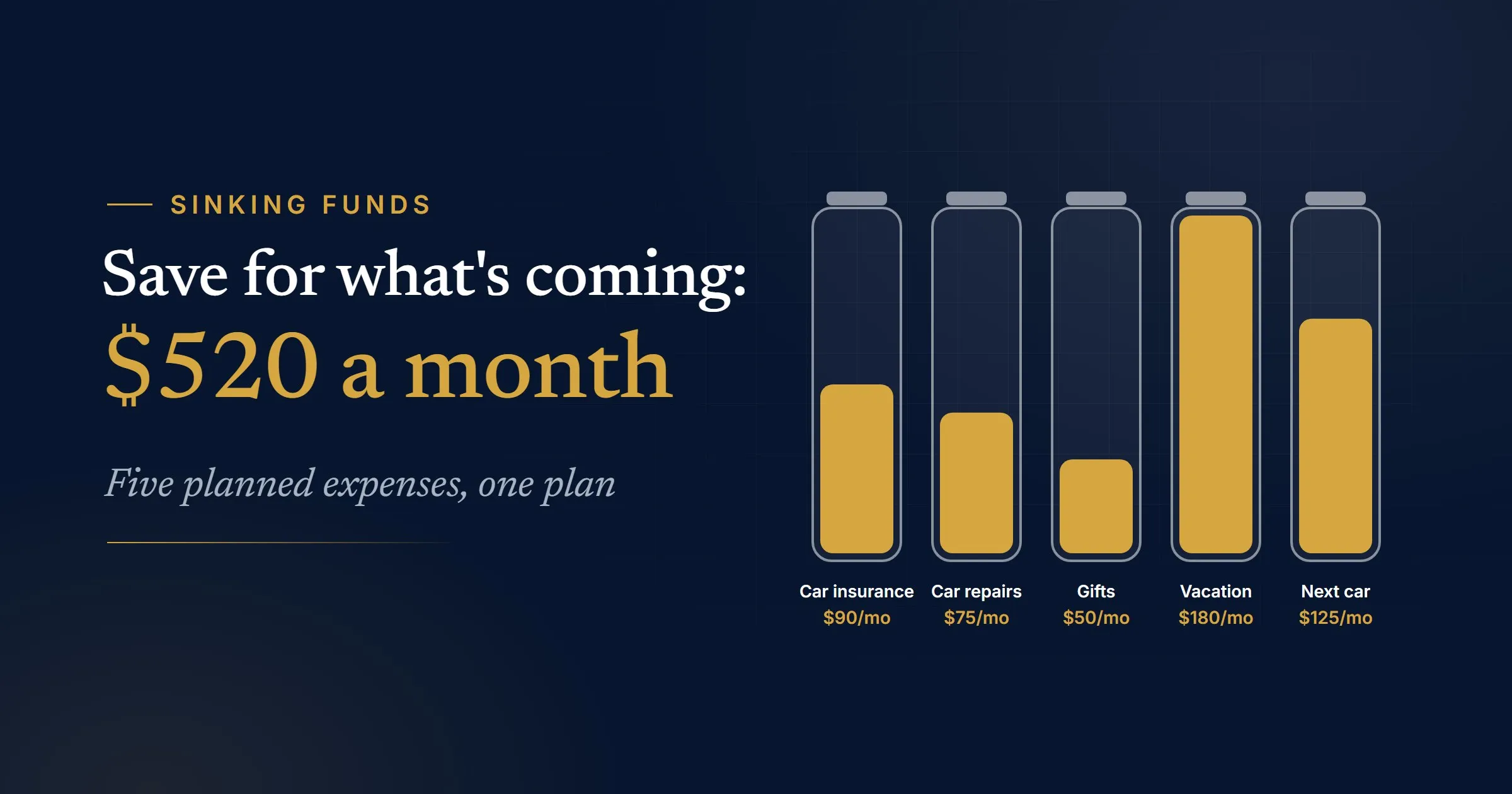
Irregular bills are more predictable than they feel. Divide each one’s yearly cost by 12 and save that much every month, so the money is waiting when the bill arrives. The CFPB suggests the same approach: with a set amount going into savings automatically each month, a large periodic payment such as car insurance is already covered when it comes due.Source 6 Our sinking funds guide shows how to set these up.
If your income varies, plan around what a lean month brings in, and save the extra from better months to fill the gaps. Our guide to budgeting on an irregular income walks through it.
Step 6: Avoid the stopgaps that keep you stuck
When money runs out, the quickest fixes are often the most expensive, and they take a bite out of the next paycheck too.
- Payday loans. Fees typically run $10 to $30 for every $100 borrowed, and $15 is common, which works out to an annual percentage rate of almost 400% on a two-week loan. At that fee, borrowing $300 costs $345 to repay two weeks later. Roll it over and you pay another $45 while still owing the full $300: $90 in fees for four weeks.Source 8
- Overdrafts. Many banks and credit unions charge $30 or more for each overdraft, and you can be charged more than once in a day. You can opt out of overdraft coverage for debit card and ATM transactions, or link a savings account to cover a shortfall for a smaller transfer fee.Source 9
- Late fees. Paying even a few days late can mean a fee and a negative entry on your credit record.Source 7
If you can’t pay everything this month, choose the order on purpose instead of paying whoever calls loudest. The CFPB suggests putting first the bills that protect your housing and your income, keep your insurance in place and meet any court-ordered obligations. Don’t ignore the rest: call each company you can’t pay, explain why, and consider talking with a certified housing or credit counselor about a plan.Source 10
If you earn a good income and still run short
A bigger paycheck doesn’t always fix it. In the Fed’s 2025 survey, even among adults with family income of $100,000 or more, 4% said they never had money left over at the end of the month and 11% said rarely.Source 1
When income rises, fixed costs often rise with it: a larger rent or mortgage, a newer car, more services on autopay. Those commitments are hard to undo, so the margin never grows. Two habits help. First, move a set amount into savings automatically on payday, before you have a chance to spend it. That’s the idea behind paying yourself first. Second, keep your fixed costs to a share of take-home pay that leaves room for the unexpected. Our guide to the 50/30/20 rule gives one benchmark.
Common questions
What qualifies as living paycheck to paycheck?
There’s no official threshold. Generally, you’re living paycheck to paycheck if most or all of each paycheck is spent before the next one arrives, so an unexpected bill means borrowing, carrying a credit card balance or falling behind. A useful test is the Fed’s own question: how often do you have money left over at the end of the month?Source 1
How many Americans live paycheck to paycheck?
There’s no single official count, because surveys measure it in different ways. In the Fed’s 2025 survey, 12% of adults never had money left over at the end of the month and 18% rarely did.Source 1 In the FINRA Foundation’s 2024 study, 26% said they spend more than their income.Source 2
Is living paycheck to paycheck bad?
It leaves no room for surprises, and surprises are common: 59% of adults had at least one major unexpected expense in the year before the Fed’s 2025 survey.Source 3 Without a buffer, each one becomes debt or a missed bill. That’s why the plan aims for a buffer first and an emergency fund after it.
Does living paycheck to paycheck mean having no savings?
Not necessarily. It describes your cash flow, whether each paycheck lasts until the next, rather than your balance, so you can have some savings and still spend every paycheck as it arrives. Savings make the difference when something goes wrong: in 2025, 63% of adults said they would cover an unexpected $400 expense with cash or its equivalent, such as savings or a credit card paid off in full at the next statement.Source 11
How long does it take to stop living paycheck to paycheck?
It depends on which problem you have. A timing problem can be fixed within a billing cycle or two, once due dates move. A buffer takes longer: in the example, saving $190 a month builds half a month’s buffer in 9 months and a full month’s in 18, while saving $500 a month cuts that to 4 and 7 months.
How do I get by in the meantime?
Pay the bills that protect your housing, income and insurance first,Source 10 keep a bill calendar so nothing is paid late,Source 7 and steer clear of payday loans, overdrafts and new buy now, pay later plans, which shrink the next paycheck. Then start the buffer with whatever you can, even a small amount each payday.
Sources
Numbers in the text link to these sources. We check them whenever we update this page.
- 1
Board of Governors of the Federal Reserve System · Accessed November 25, 2026 · Back to text for source 1
- 2
FINRA Investor Education Foundation · Accessed November 25, 2026 · Back to text for source 2
- 3
Board of Governors of the Federal Reserve System · Accessed November 25, 2026 · Back to text for source 3
- 4
Creating a cash flow budget (Your Money, Your Goals toolkit)(external site)
Consumer Financial Protection Bureau · Accessed November 25, 2026 · Back to text for source 4
- 5
Consumer Expenditures--2025(external site)
U.S. Bureau of Labor Statistics · Published October 29, 2026 · Accessed November 25, 2026 · Back to text for source 5
- 6
Improving cash flow (Your Money, Your Goals toolkit)(external site)
Consumer Financial Protection Bureau · Accessed November 25, 2026 · Back to text for source 6
- 7
Bill calendar (Your Money, Your Goals toolkit)(external site)
Consumer Financial Protection Bureau · Accessed November 25, 2026 · Back to text for source 7
- 8
What are the costs and fees for a payday loan?(external site)
Consumer Financial Protection Bureau · Last reviewed November 25, 2024 · Accessed November 25, 2026 · Back to text for source 8
- 9
Know your overdraft options(external site)
Consumer Financial Protection Bureau · Updated June 4, 2025 · Accessed November 25, 2026 · Back to text for source 9
- 10
Prioritizing bills (Your Money, Your Goals toolkit)(external site)
Consumer Financial Protection Bureau · Accessed November 25, 2026 · Back to text for source 10
- 11
Board of Governors of the Federal Reserve System · Accessed November 25, 2026 · Back to text for source 11
About the author
Wealthistry Editorial Team
Research, writing and editing
The team that researches, writes, fact-checks and updates Wealthistry's guides and calculators, following our published editorial standards.
Author profileEditorial policyHow we researchReport an error