Buy now, pay later, or BNPL, is a loan that splits a purchase into a few smaller payments. You’ll see it at checkout online, in shopping apps and in some stores, and the most common plans charge no interest if every payment arrives on time.Source 1 It has caught on fast: 16% of adults used it in the 12 months before the Federal Reserve’s 2025 household survey, up from 10% in 2021, the first year the survey asked.Source 2
The catch is what happens when money is tight. This guide explains how the plans work, what they cost when a payment slips, how they affect your credit and how to use one without falling behind.
How buy now, pay later works
The most common plan splits the price into four interest-free payments two weeks apart. The first may be due at checkout or two weeks later.Source 1 Buy something for $400 on November 27 with the first payment at checkout, and you’d pay $100 on Nov 27, Dec 11, Dec 25 and Jan 8.
Applying takes a few details, such as your name, email address, phone number and date of birth. You generally need to be at least 18, with a mobile phone number and a debit card, credit card or bank account to pay from.Source 1 Most of these loans don’t involve a hard credit inquiry, but unlike a credit card, your creditworthiness may be checked each time you make a purchase.Source 1 Most users have to sign up for automatic payments, which often come straight out of a checking account.Source 2
Longer plans can charge interest
Some point-of-sale loans let you borrow more and repay it over a longer time. These work more like a traditional installment loan, and some of them involve a hard credit inquiry and report your payments to the credit bureaus.Source 3 And while many BNPL loans charge no interest,Source 1 longer plans may, so check the APR before you agree. Here’s what interest adds to a $1,200 purchase repaid over 12 months:
| APR | Monthly payment | Total interest |
|---|---|---|
| 0% | $100.00 | $0.00 |
| 15% | $108.31 | $99.72 |
| 30% | $116.98 | $203.76 |
Example APRs. Payments are rounded to the cent.
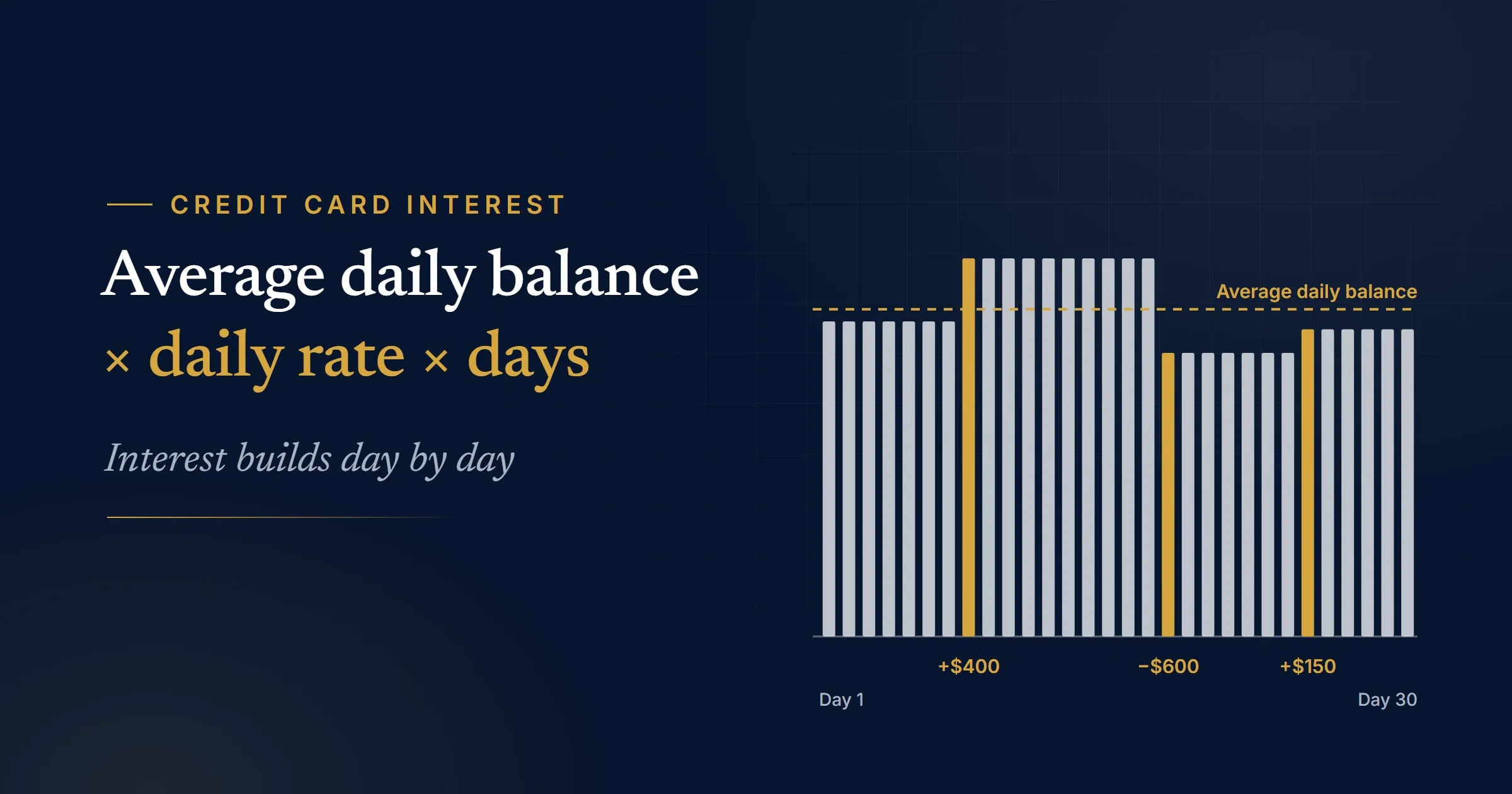
Our guide to how credit card interest works explains how an APR turns into dollars.
What it costs if you pay late
Many BNPL loans charge no interest, but most charge late fees, and each lender sets its own fees and rules.Source 4 A missed payment can also lead the lender to freeze your account so you can’t make new purchases, and an unpaid loan can be sent to a debt collector.Source 5
Late payments are common. In the Federal Reserve’s 2025 survey, 26% of BNPL users had paid late in the past year, and 64% of those, or 17% of all users, said they were charged extra for it. Lower-income users were far more likely to fall behind:Source 2
| Family income | Used BNPL | Paid late (users) |
|---|---|---|
| Less than $25,000 | 18% | 40% |
| $25,000 to $49,999 | 23% | 33% |
| $50,000 to $99,999 | 18% | 25% |
| $100,000 or more | 12% | 11% |
| All adults | 16% | 26% |
Federal Reserve, Survey of Household Economics and Decisionmaking, table 41. Used BNPL is the share of all adults; paid late is the share of users.
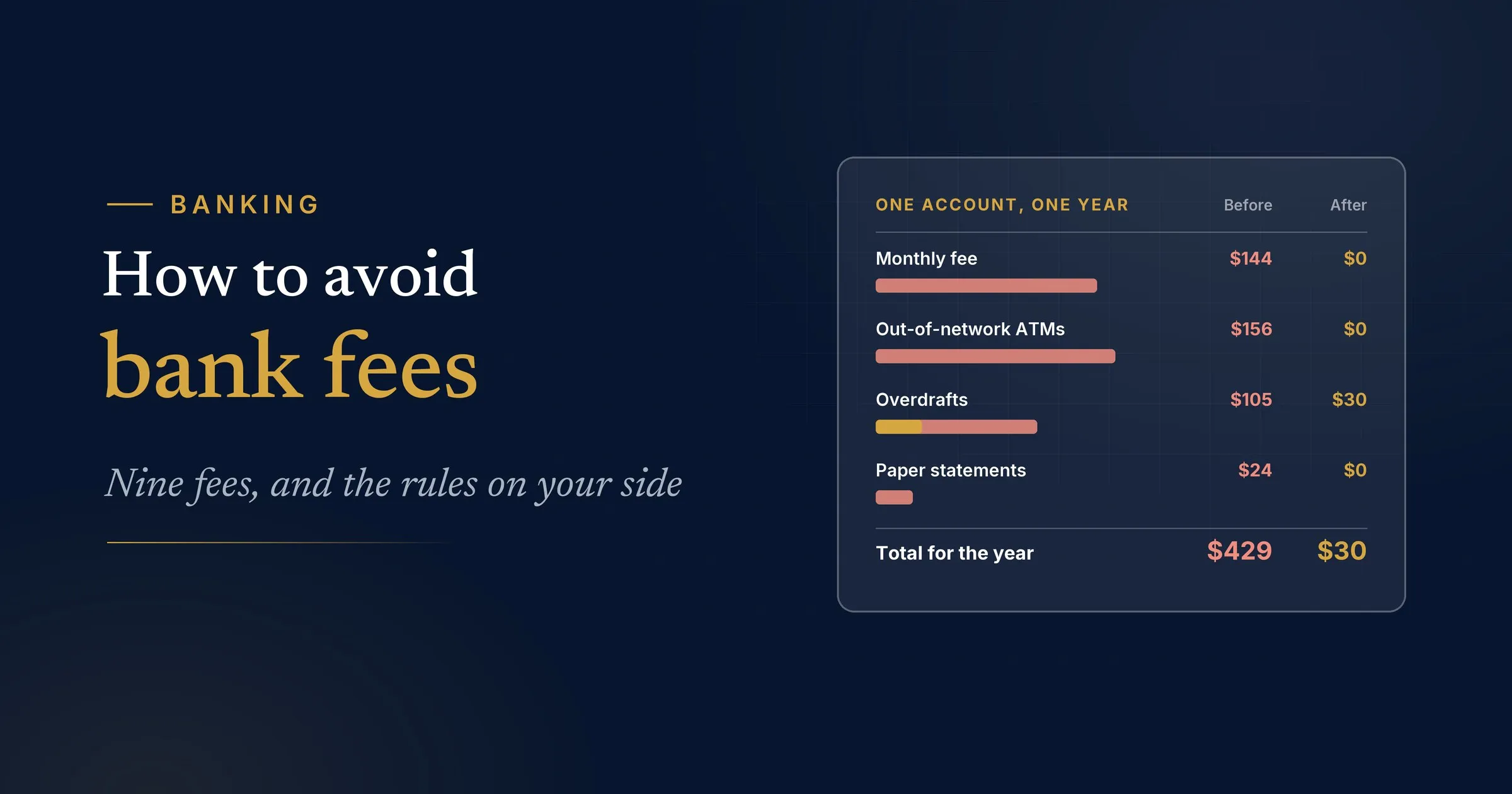
Automatic payments add a second cost. If your checking account is short when a BNPL payment comes out, your bank may charge an overdraft or insufficient-funds fee.Source 4 In the survey, 11% of BNPL users had a payment set off one of those fees, including 38% of users who’d been charged for paying late.Source 2 Our guide to avoiding bank fees explains how overdraft coverage works and how to turn it off.
Why people use it
When the survey asked BNPL users for their main reason, the most common answers were spreading out payments and that they couldn’t have afforded the purchase otherwise. The reasons changed sharply with income:Source 2
| Main reason | Under $25,000 | $100,000 or more | All users |
|---|---|---|---|
| Wanted to spread out payments | 25% | 38% | 31% |
| Only way I could afford it | 40% | 15% | 29% |
| Avoid interest charges | 9% | 26% | 16% |
| Convenience | 13% | 12% | 12% |
Federal Reserve, Survey of Household Economics and Decisionmaking, table 42. Shares of adults who used BNPL in the past year; less common reasons not shown.
Spreading out a payment you can already cover is one thing. Using a plan because there’s no other way to afford the purchase is a warning sign: the payments will come out of future paychecks that may already be spoken for. If that sounds familiar, our guide to breaking the paycheck-to-paycheck cycle is a better place to start.
When small plans stack up
Each plan looks small on its own. The trouble starts when several overlap, because every new purchase adds payments to weeks that may already have one.
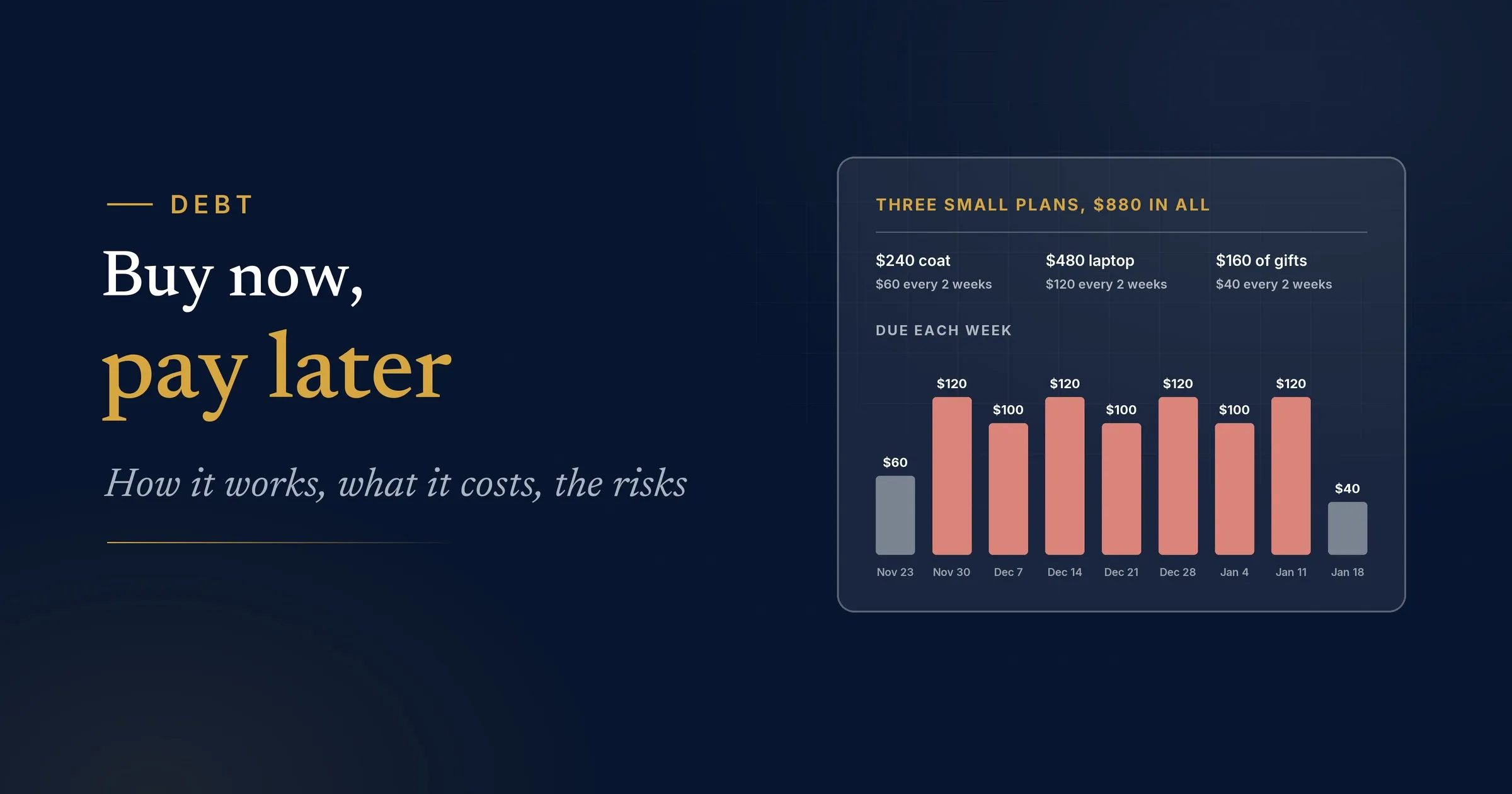
Three holiday purchases, $880 in all
- A shopper buys a $240 coat on Black Friday, a $480 laptop on Cyber Monday and $160 of gifts on December 12, each on a pay-in-4 plan.
- The payments are $60, $120 and $40 every two weeks, small enough to seem easy.
- Together, something is due in all 9 weeks from the week of Nov 23 to the week of Jan 18, and most weeks the total is $100 to $120.
| Week of | Due that week |
|---|---|
| Nov 23 | $60 |
| Nov 30 | $120 |
| Dec 7 | $100 |
| Dec 14 | $120 |
| Dec 21 | $100 |
| Dec 28 | $120 |
| Jan 4 | $100 |
| Jan 11 | $120 |
| Jan 18 | $40 |
Weeks run Monday to Sunday. Each plan takes a quarter of the price at checkout, then three more payments two weeks apart.
That steady drain is easy to miss because no single app shows all of it. Keep every plan, its payment dates and amounts in one list, the way you’d track any other expense, and fit them into your budget before you add another.
Buy now, pay later and your credit score
Most pay-in-4 plans don’t report your payments to the major credit bureaus, so paying on time won’t help your credit scores and paying late usually won’t hurt them directly. But if you don’t repay and the debt goes to a collector, it could be reported and hurt your scores.Source 3 Longer plans with monthly payments are more likely to show up on your credit report.Source 3
That may change. In June 2025, FICO announced two new scores, FICO Score 10 BNPL and FICO Score 10 T BNPL, that use BNPL data. Because people often open several BNPL loans in a short time, the scores combine separate loans when working out parts of the score. FICO said lenders would be offered them alongside its existing scores.Source 6 Which score a lender checks is up to the lender.
The protections it doesn’t have
Credit cards come with federal billing-dispute rights. If your statement shows a charge for something you didn’t accept or that was never delivered as agreed, you can dispute it in writing within 60 days after the first statement that shows it. The issuer has to acknowledge your notice within 30 days and resolve it within two billing cycles, and you don’t have to pay the disputed amount in the meantime.Source 7
BNPL loans may not offer the same. In May 2024, the CFPB said BNPL lenders that let you borrow through a digital account count as card issuers under the Truth in Lending Act, which would bring billing-dispute rights and periodic statements.Source 8 In May 2025, the CFPB withdrew that interpretation, along with many other guidance documents.Source 9 So before you buy, read how the lender handles returns, refunds and disputes, and keep paying until a return is confirmed, since each lender sets its own policies.Source 4
Buy now, pay later or a credit card?
- If you pay your card in full each month, a credit card can cost nothing extra too, and it comes with billing-dispute rights.Source 7 Our guide to credit card interest explains the grace period.
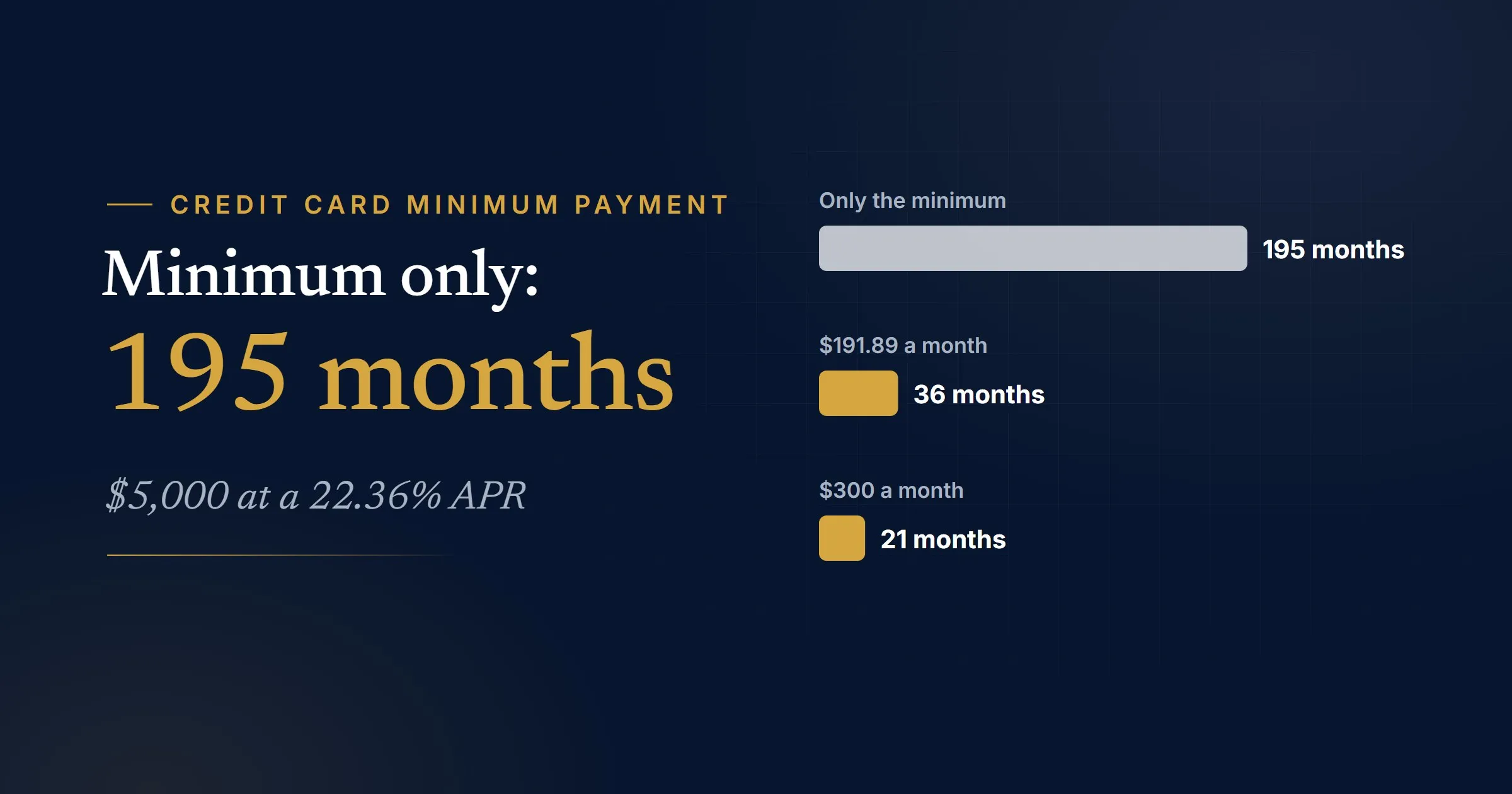
- If you’d carry a card balance, an interest-free pay-in-4 plan paid on time is cheaper. Credit card accounts that were charged interest averaged 22.36% in the third quarter of 2026.Source 10 Our guide to credit card minimum payments shows what a balance costs over time.
- If you might pay late, neither is cheap. A late plan brings fees and possibly overdrafts, and a late card payment brings fees and interest.
How to use buy now, pay later safely
- Only buy what you could pay for today. The plan should be about convenience, not about stretching to afford something.
- Check the terms first: whether there’s interest, the late fee, when payments are due and how returns work.Source 4
- Keep one plan at a time, or write every plan in one place with its dates.
- Keep a cushion in checking so automatic payments don’t overdraw it.Source 4
- Pay a plan off early if you can, since a finished plan can’t run late.
- Don’t treat an approval as permission. As the CFPB puts it, qualifying for a loan doesn’t mean you should use it.Source 5
Common questions
Is buy now, pay later a loan?
Yes. BNPL is an installment loan: you buy now and repay the balance in payments over time, usually four or fewer for the most common plans.Source 1
Does buy now, pay later hurt your credit score?
Not usually, if you pay on time. Most pay-in-4 lenders don’t report payments to the major credit bureaus or run a hard credit check, but an unpaid loan sent to collections can be reported and lower your scores.Source 3
What happens if you miss a buy now, pay later payment?
You’ll probably owe a late fee, the lender may freeze your account so you can’t make more purchases, and if you don’t catch up, the debt could go to a collector.Source 5 If the payment was automatic and your account was short, your bank may charge an overdraft or insufficient-funds fee as well.Source 4
Is buy now, pay later a good idea?
It can be, for a purchase you could already afford and a plan you’ll pay on time, since the most common plans charge no interest. It’s a poor idea when it’s the only way to afford something, or when you already have other plans running.
Can you pay off buy now, pay later early?
Lenders set their own policies,Source 4 so check your loan’s terms. On an interest-free plan, paying early doesn’t save money, but it removes the risk of a late payment or an overdraft later.
Run your own numbers
See where your take-home pay goes each month.
Open the calculator
Sources
Numbers in the text link to these sources. We check them whenever we update this page.
- 1
What is a Buy Now, Pay Later (BNPL) loan?(external site)
Consumer Financial Protection Bureau · Last reviewed May 21, 2024 · Accessed November 25, 2026 · Back to text for source 1
- 2
Credit, Report on the Economic Well-Being of U.S. Households in 2025 - May 2026(external site)
Board of Governors of the Federal Reserve System · Accessed November 25, 2026 · Back to text for source 2
- 3
Will a Buy Now, Pay Later (BNPL) loan impact my credit scores?(external site)
Consumer Financial Protection Bureau · Last reviewed August 30, 2024 · Accessed November 25, 2026 · Back to text for source 3
- 4
Do Buy Now, Pay Later (BNPL) loans have fees?(external site)
Consumer Financial Protection Bureau · Last reviewed August 30, 2024 · Accessed November 25, 2026 · Back to text for source 4
- 5
What happens if I can't pay back a Buy Now, Pay Later (BNPL) loan?(external site)
Consumer Financial Protection Bureau · Last reviewed August 30, 2024 · Accessed November 25, 2026 · Back to text for source 5
- 6
FICO Unveils Groundbreaking Credit Scores That Incorporate Buy Now, Pay Later Data(external site)
FICO · Published June 23, 2025 · Accessed November 25, 2026 · Back to text for source 6
- 7
12 CFR 1026.13, Billing error resolution (Regulation Z)(external site)
Electronic Code of Federal Regulations · Accessed November 25, 2026 · Back to text for source 7
- 8
Consumer Financial Protection Bureau, Federal Register · Published May 31, 2024 · Accessed November 25, 2026 · Back to text for source 8
- 9
Consumer Financial Protection Bureau, Federal Register · Published May 12, 2025 · Accessed November 25, 2026 · Back to text for source 9
- 10
Consumer Credit, G.19 statistical release(external site)
Board of Governors of the Federal Reserve System · Published November 6, 2026 · Accessed November 25, 2026 · Back to text for source 10
About the author
Wealthistry Editorial Team
Research, writing and editing
The team that researches, writes, fact-checks and updates Wealthistry's guides and calculators, following our published editorial standards.
Author profileEditorial policyHow we researchReport an error