Electricity has been getting more expensive. U.S. homes paid an average of 16.5 cents per kilowatt-hour in 2024, and the Energy Information Administration expects 18.2 cents in 2026 and 18.7 cents in 2027.Source 1 That’s a 10% rise in two years. In September 2026, the average was 18.17 cents, and prices were higher than a year earlier in 41 states and the District of Columbia.Source 2
You can’t control the price, but you can control how much you use and, in some places, which plan you’re on. This guide shows where the money goes, what common appliances cost to run and the changes that cut the bill the most.
How your electric bill is figured
Most of your bill is the electricity you used, measured in kilowatt-hours, times the price of each one. A kilowatt is 1,000 watts, and a kilowatt-hour is one kilowatt used for one hour.Source 3 To estimate what any appliance costs, check its wattage, usually printed on a label, and use this:
Cost equals watts times hours used, divided by 1,000, times the price per kilowatt-hour.
- watts ÷ 1,000 turns watts into kilowatts, and multiplying by hours gives kilowatt-hours
- price per kWh is on your bill, usually shown in cents
The average U.S. residential customer used about 899 kilowatt-hours a month in 2022, the latest year in EIA’s estimate.Source 4 At September 2026’s average price, that much electricity would cost about $163 a month. Where you live matters as much as how much you use: in September 2026, home prices ranged from 13.25 cents per kilowatt-hour in Nevada to 48.31 cents in Hawaii.Source 2
What uses the most electricity
Air conditioning was the biggest electric use in U.S. homes in 2020, at 19% of residential electricity, followed by space heating and water heating at 12% each. Lighting and refrigerators came next.Source 5 ENERGY STAR estimates that heating and cooling take almost half of the average household’s yearly energy bill, more than $900 a year.Source 6
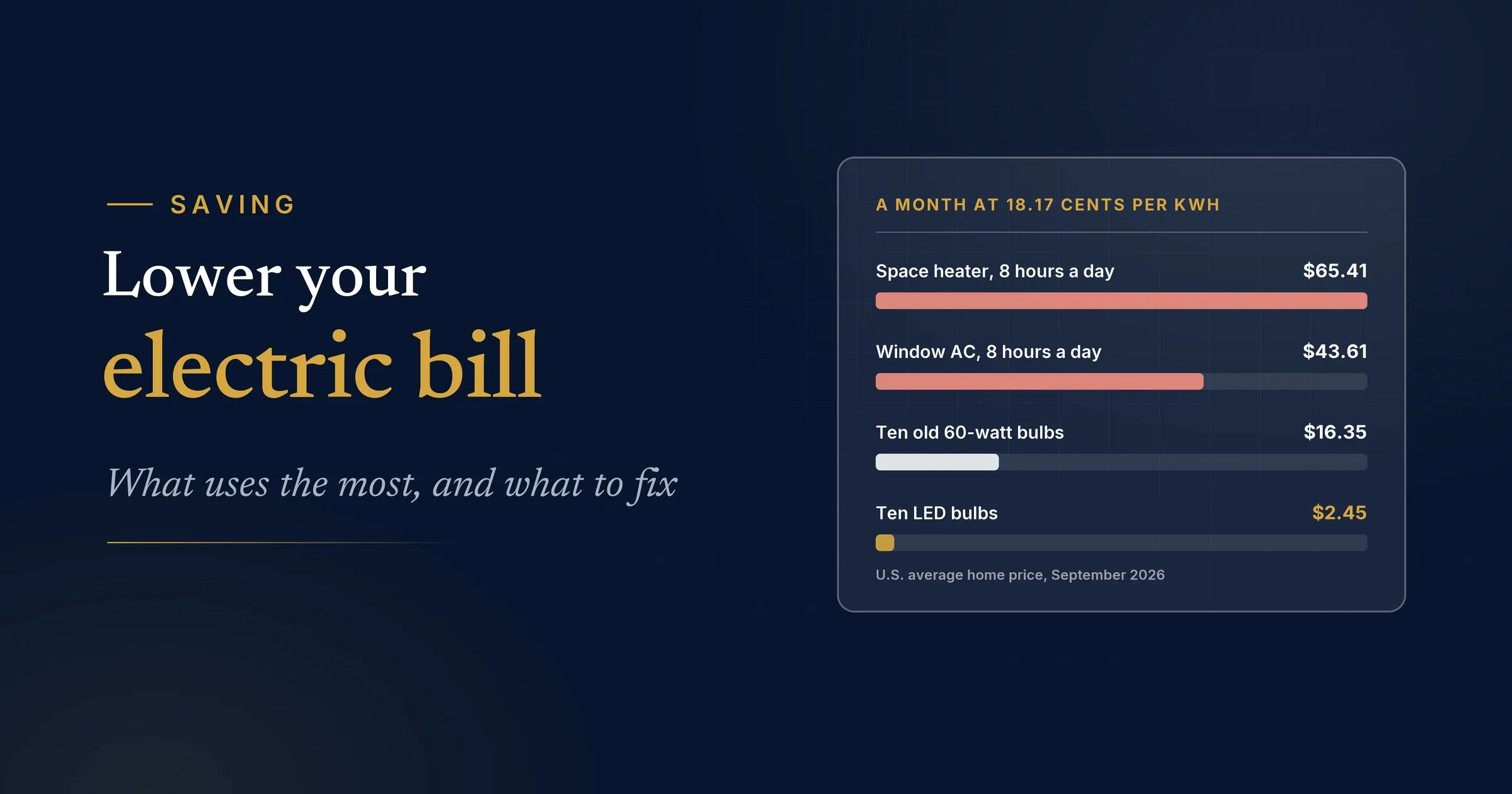
Here’s what some common uses cost at September 2026’s average price:
| Use | kWh a month | Cost a month |
|---|---|---|
| Space heater, 1,500 watts, 8 hours a day | 360 | $65.41 |
| Window air conditioner, 1,000 watts, 8 hours a day | 240 | $43.61 |
| Ten 60-watt incandescent bulbs, 5 hours a day | 90 | $16.35 |
| Ten 9-watt LED bulbs, 5 hours a day | 13.5 | $2.45 |
Example wattages and hours, with a 30-day month. Your appliance's label shows its wattage, and your bill shows your price.
Anything that heats or cools uses a lot. Lighting costs little once you’ve switched to LEDs.
Heating and cooling: the biggest savings
- Set the temperature back when you’re asleep or away. A smart thermostat does it automatically. ENERGY STAR says a certified smart thermostat cuts heating and cooling bills by more than 8%, about $50 a year on average, and about $100 a year in homes that sit empty much of the day.Source 6
- Seal air leaks and add insulation. The EPA estimates that air sealing and insulating attics, crawl spaces and basements saves an average of 15% on heating and cooling, or 11% of total energy costs.Source 7
- Cover a window air conditioner for winter with a tight-fitting cover, so cold air doesn’t leak in around it.Source 6
- Use a space heater for one room, not the whole house. At the prices above, a 1,500-watt heater run 8 hours a day costs about $65.41 a month, so it only saves money if you turn the main heat down while you use it.
- When the system needs replacing, consider a heat pump. Replacing an air conditioner or heating system more than 10 years old with a heat pump could save up to $500 a year.Source 7
Hot water: the next biggest
- Turn the water heater down to 120°F. Most are set at 140°F, which wastes energy through standby heat loss and can scald.Source 7
- Wash clothes in cold water. Switching from hot to warm can cut a wash’s energy use in half, and cold cuts it more.Source 7
- Swap in an efficient showerhead, which can save up to $145 a year on electricity.Source 6
- When the water heater wears out, a heat pump water heater can save a family of four up to $425 a year.Source 7
Lights, electronics and appliances
- Switch to LEDs. ENERGY STAR certified LED bulbs use up to 90% less energy and last 15 times longer than standard bulbs. Replacing the bulbs in your five most-used fixtures can save about $40 a year.Source 6
- Plug electronics into a power strip and switch it off when you’re done, which cuts the standby power they draw when they’re off.Source 6
- Don’t overdry clothes. Running a dryer an extra 15 minutes per load can cost up to $34 a year, and cleaning the lint trap before every load can save up to $34 a year.Source 6
- Run the dishwasher full, scrape dishes instead of rinsing them, and use the air-dry setting if you have one.Source 6
One household's winter month
- The household uses 1,100 kilowatt-hours in a winter month, including a space heater run 8 hours a day and ten 60-watt bulbs used 5 hours a day. At 18.17 cents, the bill is $199.87.
- Switching the ten bulbs to 9-watt LEDs saves 76.5 kilowatt-hours, or $13.90.
- Running the heater 4 hours a day instead of 8 saves 180 kilowatt-hours, or $32.71.
- The month’s use drops to 843.5 kilowatt-hours and the bill to $153.26, $46.61 less, a cut of about 23%.
Check your plan and your supplier
The price you pay also depends on your plan, so ask your utility which rate plans it offers. Electricity costs more to provide in peak hours, usually the afternoon and early evening, and some utilities offer time-of-day pricing that charges less outside them.Source 8 That pays off if you can run the dishwasher and laundry at off-peak times. Many utilities also have a budget billing program to smooth out seasonal swings; Indiana’s Office of Utility Consumer Counselor, for one, recommends it for managing high winter bills.Source 9 You still pay for all the electricity you use. Setting money aside in a sinking fund for the expensive months does the same job on your own terms.
In states that have restructured their electricity markets, some customers can buy electricity from a different supplier, while the local utility still delivers it and charges for delivery. Choice is usually limited to customers of investor-owned utilities, and in Texas, customers of utilities on the grid run by ERCOT are required to choose a provider. Your utility or your state’s utility commission can tell you whether you have a choice.Source 10 Before switching, compare the price per kilowatt-hour, how long it’s fixed for and any fee for leaving early.
Help paying the bill
- LIHEAP, the Low Income Home Energy Assistance Program, is federally funded help with home energy bills, energy crises, weatherization and minor energy-related repairs. For how to apply, the program’s page points to its Energyhelp site.Source 11
- The Weatherization Assistance Program pays for efficiency upgrades for low-income households. The Department of Energy says it serves about 32,000 homes a year with its funds, and that weatherized households save an average of $372 or more a year.Source 12
- Call your utility before you fall behind. Ask about payment plans and any hardship programs. If money is tight across the board, our guide to breaking the paycheck-to-paycheck cycle covers which bills to pay first.
The federal tax credits have ended
Until recently, two federal tax credits paid back part of the cost of efficiency upgrades and home solar. Both ended after 2025. The Energy Efficient Home Improvement Credit covers improvements made through December 31, 2025,Source 13 and the Residential Clean Energy Credit isn’t available for property placed in service after December 31, 2025.Source 14 If you’re planning an upgrade now, ask your utility and your state energy office about rebates instead, and don’t count on a federal credit.
Common questions
Why is my electric bill so high all of a sudden?
Start by comparing the kilowatt-hours on your bill with the same month last year. If your use is about the same, the price rose: the U.S. average was 18.17 cents in September 2026, and it was up from a year earlier in most states.Source 2 If your use jumped, look for something new that heats or cools, such as a space heater, or a cold or hot spell that kept the system running.
What uses the most electricity in a house?
Air conditioning, space heating and water heating, followed by lighting and refrigerators.Source 5 Anything that makes heat or cold uses far more than electronics.
Does unplugging things save money?
A little. Devices draw standby power even when they’re off, and a power strip lets you cut it off with one switch.Source 6 The bigger savings are in heating, cooling and hot water.
How can I cut my electric bill by 75%?
For most homes, that isn’t realistic, because the biggest uses are heating, cooling and hot water, which you can trim but not eliminate. Single categories can drop that much, though: LED bulbs use up to 90% less energy than standard bulbs.Source 6 Our guide to saving money has more ways to free up room in the budget, and our guide to fixed vs. variable expenses explains why utilities are easier to trim than rent.
Run your own numbers
See where your take-home pay goes each month.
Open the calculator
Sources
Numbers in the text link to these sources. We check them whenever we update this page.
- 1
Short-Term Energy Outlook: Electricity, coal, and renewables(external site)
U.S. Energy Information Administration · Published November 10, 2026 · Accessed November 25, 2026 · Back to text for source 1
- 2
U.S. Energy Information Administration · Accessed November 25, 2026 · Back to text for source 2
- 3
Measuring electricity(external site)
U.S. Energy Information Administration · Accessed November 25, 2026 · Back to text for source 3
- 4
How much electricity does an American home use?(external site)
U.S. Energy Information Administration · Updated January 8, 2024 · Accessed November 25, 2026 · Back to text for source 4
- 5
Electricity use in homes(external site)
U.S. Energy Information Administration · Updated December 18, 2023 · Accessed November 25, 2026 · Back to text for source 5
- 6
Low- to No-Cost Tips for Saving Energy at Home(external site)
ENERGY STAR, U.S. Environmental Protection Agency · Accessed November 25, 2026 · Back to text for source 6
- 7
How to Save Energy at Home(external site)
ENERGY STAR, U.S. Environmental Protection Agency · Accessed November 25, 2026 · Back to text for source 7
- 8
Electricity explained: Prices and factors affecting prices(external site)
U.S. Energy Information Administration · Accessed November 25, 2026 · Back to text for source 8
- 9
Reduce Your Winter Energy Bills(external site)
Indiana Office of Utility Consumer Counselor · Published August 25, 2026 · Accessed November 25, 2026 · Back to text for source 9
- 10
Can customers choose their electricity supplier?(external site)
U.S. Energy Information Administration · Accessed November 25, 2026 · Back to text for source 10
- 11
Low Income Home Energy Assistance Program (LIHEAP)(external site)
Office of Community Services, Administration for Children and Families, U.S. Department of Health and Human Services · Accessed November 25, 2026 · Back to text for source 11
- 12
Weatherization Assistance Program(external site)
U.S. Department of Energy · Accessed November 25, 2026 · Back to text for source 12
- 13
Energy Efficient Home Improvement Credit(external site)
Internal Revenue Service · Last reviewed April 28, 2026 · Accessed November 25, 2026 · Back to text for source 13
- 14
Residential Clean Energy Credit(external site)
Internal Revenue Service · Last reviewed November 23, 2026 · Accessed November 25, 2026 · Back to text for source 14
About the author
Wealthistry Editorial Team
Research, writing and editing
The team that researches, writes, fact-checks and updates Wealthistry's guides and calculators, following our published editorial standards.
Author profileEditorial policyHow we researchReport an error